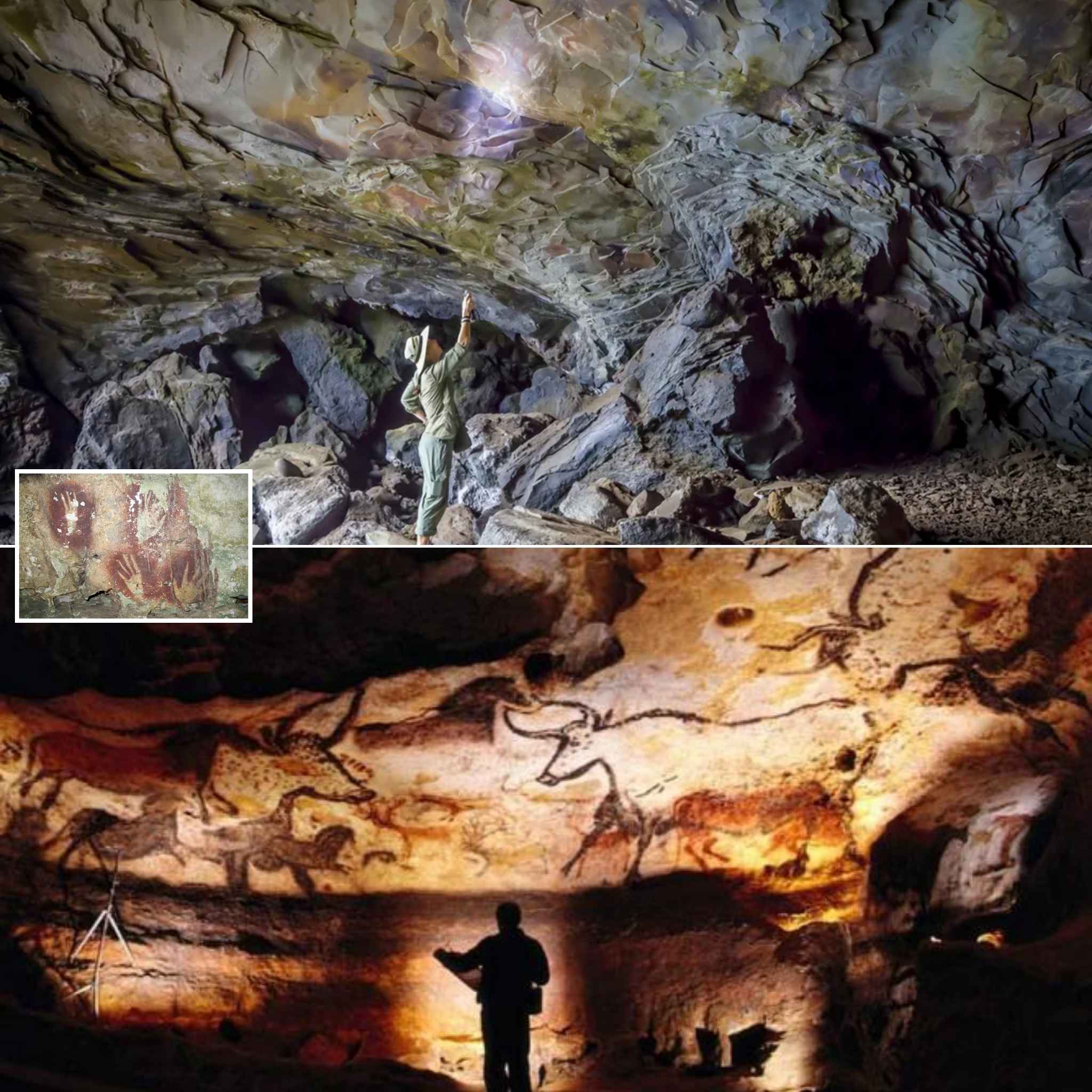
For years, the discovery of ancient cave paintings has transformed humanity’s understanding of prehistoric intelligence, creativity, and symbolic thinking. Stunning depictions of animals, mysterious hand stencils, and abstract symbols found deep inside caves across Europe and Southeast Asia have suggested that early humans — and perhaps even Neanderthals — possessed artistic abilities far earlier than once believed.

But now, a growing scientific debate is raising a difficult question:
What if some of those famous dates are wrong?
At the center of the controversy is a widely used scientific technique known as uranium-thorium dating, or U-Th dating — a method that has helped researchers assign astonishingly ancient ages to cave art around the world. Some paintings dated with the method are now claimed to be more than 50,000 years old, while one Indonesian hand stencil was estimated to be an incredible 67,800 years old.
Those numbers dramatically pushed back the timeline of human artistic development. Yet some archaeologists and dating specialists now warn that the method may systematically overestimate the true ages of prehistoric paintings.
If correct, the implications could reshape one of the most important stories in human history.
The Discovery That Changed Human History
For decades, archaeologists believed Europe contained the earliest examples of symbolic art. Famous Ice Age cave paintings in France and Spain — including the iconic images at Lascaux and Altamira — were long considered among humanity’s oldest masterpieces.
That view changed dramatically in recent years when researchers began discovering extraordinarily old cave paintings in Indonesia.
Among the most famous examples was a life-sized painting of a Sulawesi warty pig that researchers announced was at least 51,000 years old. Another nearby cave contained a red hand stencil reportedly dating back 67,800 years — potentially making it the oldest known example of figurative or symbolic art ever discovered.
The findings stunned the scientific world.
If accurate, they suggested that humans were creating sophisticated symbolic imagery tens of thousands of years earlier than many experts once believed. They also implied that artistic traditions may have emerged independently in multiple regions of the world rather than originating solely in Europe.
Even more controversial, some ancient cave markings in Spain had previously been dated to over 64,000 years old — a period before modern humans are believed to have arrived in Western Europe. That raised the explosive possibility that Neanderthals themselves may have created symbolic art.
The discoveries fundamentally altered discussions about human intelligence and cognitive evolution.
But not everyone was convinced.


A Growing Scientific Dispute
One of the leading critics questioning some of these ancient dates is Georges Sauvet, a researcher at the Center for Research and Studies of Prehistoric Art in France.
In a communication published in the journal AOJ of Histoarchaeology and Anthropological Exploration, Sauvet argued that researchers may be relying too heavily on uranium-thorium dating without sufficiently verifying the results using additional methods.
According to Sauvet, the scientific excitement surrounding ancient cave art has created what he describes as a “race towards the earliest rock art.”
That race, he warns, may be encouraging some researchers to accept uncertain dates too quickly.
Sauvet’s main concern is not necessarily that uranium-thorium dating is useless — far from it. Instead, he believes the method may produce ages that are older than the actual paintings under certain conditions.
If the dates are inflated, the consequences extend far beyond archaeology.
“Our understanding of the intelligence and symbolic capacities of early humans and Neanderthals depends heavily on these chronologies,” Sauvet argued.
In other words, if the dates are wrong, entire theories about when humans developed advanced cognition and artistic thinking may also need revision.
How Uranium-Thorium Dating Works
To understand the debate, it helps to understand the science behind the dating method itself.
Uranium-thorium dating does not directly measure the age of the paint used in cave art. Instead, it measures calcite deposits — thin mineral layers that form naturally over cave surfaces through dripping water.
Over thousands of years, water slowly dissolves limestone and carries dissolved minerals through cave systems. When that mineral-rich water drips onto cave walls, it deposits microscopic layers of calcite.
These calcite layers contain tiny amounts of uranium isotopes.
One isotope in particular — uranium-234 — slowly decays over time into thorium-230 through radioactive decay.
{}^{234}U \rightarrow {}^{230}Th + \alpha
Because scientists know the precise rate at which uranium-234 decays into thorium-230, they can calculate how long the process has been occurring by measuring the ratio between the two isotopes.
The method is powerful because thorium is generally absent when calcite first forms. As uranium decays, thorium gradually accumulates like a natural clock.
The decay process occurs extremely slowly.
t_{1/2}({}^{234}U)=245,629\ \text{years}
That long half-life allows researchers to date materials ranging from a few thousand years old to several hundred thousand years old.
When calcite forms on top of cave paintings, scientists can date the mineral layer to determine the minimum age of the art underneath. If a calcite layer covering a painting formed 50,000 years ago, then the painting itself must be at least that old.
At least in theory.
The Problem With “Closed Systems”
The reliability of uranium-thorium dating depends on one critical assumption:
The system must remain chemically closed.
That means no uranium or thorium can enter or leave the calcite layer after it forms. If additional uranium is later introduced through groundwater, or if thorium is removed by environmental changes, the calculated age can become distorted.
Critics argue that cave environments are far more chemically complicated than many dating studies acknowledge.
Water continues moving through cave systems long after paintings are created. Minerals can dissolve, recrystallize, or shift over time. Microscopic contamination may alter isotope ratios in ways that produce artificially old dates.
Sauvet argues that this risk has not always been adequately addressed.
According to him, uranium-thorium dating alone should not be treated as definitive proof of a painting’s age without independent confirmation from other dating techniques.
“This on its own is not acceptable,” Sauvet reportedly stated regarding relying solely on U-Th dates.
Why the Debate Matters So Much
At first glance, the disagreement might sound like a narrow technical dispute among archaeologists.
In reality, the stakes are enormous.
The emergence of symbolic behavior is one of the defining moments in human evolution. Art reflects abstract thought, memory, communication, spirituality, and imagination — traits closely linked to modern human cognition.
For decades, scientists debated exactly when humans first developed these abilities.
Older archaeological models suggested symbolic art emerged relatively late, perhaps around 40,000 years ago during the Upper Paleolithic period in Europe.
But the increasingly ancient cave dates overturned that timeline.
If humans were producing complex symbolic imagery 60,000 or even 70,000 years ago, then advanced cognition may have evolved much earlier than previously believed.
Even more dramatically, the dating of some Spanish cave markings implied that Neanderthals — long stereotyped as primitive — may also have created symbolic art before modern humans arrived in Europe.
That possibility deeply challenged older assumptions about Neanderthal intelligence.
If some of those dates are later revised downward, however, many of these revolutionary interpretations could weaken considerably.


Supporters Defend the Method
Not all researchers agree with Sauvet’s criticism.
Many scientists continue to defend uranium-thorium dating as one of the most important breakthroughs in archaeological science.
Before the method became widely available, researchers often relied on radiocarbon dating. But radiocarbon dating only works on organic materials, such as charcoal, wood, or bone.
Many cave paintings contain mineral pigments rather than organic carbon, making radiocarbon analysis impossible.
U-Th dating therefore opened entirely new possibilities for studying prehistoric art.
Supporters also note that many research teams carefully screen calcite samples for contamination and use sophisticated laboratory procedures to minimize errors.
In some cases, multiple samples from the same painting produce consistent results, strengthening confidence in the estimated ages.
Researchers further argue that even if individual dates contain uncertainties, the broader pattern still points toward extremely ancient artistic traditions outside Europe.
The debate, therefore, is not necessarily about whether prehistoric art is old — but exactly how old.
The Race for the “Oldest Art”
Sauvet’s criticism also highlights another issue increasingly affecting archaeology: scientific competition.
Discovering the “oldest” example of something often attracts enormous media attention, academic prestige, and research funding.
World’s oldest cave painting.
World’s oldest hand stencil.
World’s oldest symbolic art.
Such headlines capture global attention instantly.
But some experts worry that the pressure to produce groundbreaking discoveries may unintentionally encourage researchers to publish bold claims before all uncertainties are fully resolved.
Sauvet specifically warned against what he described as a growing “race towards the earliest rock art.”
The concern reflects a broader tension within modern science, where sensational discoveries often generate public excitement long before scientific consensus fully develops.
What Happens Next?
The controversy surrounding uranium-thorium dating is unlikely to disappear anytime soon.
Instead, many researchers expect future studies to increasingly combine multiple dating methods to verify prehistoric timelines more carefully.
Scientists may pair U-Th analysis with radiocarbon dating, stratigraphic analysis, microscopic pigment studies, or other geochemical techniques to cross-check results.
Improved sampling technologies may also help researchers better detect contamination or chemical alterations inside calcite deposits.
In science, debate is not necessarily a weakness — it is part of the process.
Extraordinary claims require extraordinary evidence, especially when those claims reshape humanity’s understanding of its own origins.
A Window Into Humanity’s Deep Past
Regardless of the final outcome, the debate itself reveals how rapidly prehistoric archaeology is evolving.
Only a few decades ago, scientists knew remarkably little about the true age of cave art outside Europe. Today, sophisticated isotopic techniques allow researchers to investigate human creativity stretching back tens of thousands of years.
Whether the oldest paintings are 40,000 years old, 50,000 years old, or nearly 70,000 years old, one fact remains undeniable:
Early humans possessed far more complex symbolic abilities than earlier generations of researchers ever imagined.
The caves of Indonesia, Spain, France, and countless other regions continue to preserve fragments of humanity’s earliest attempts to communicate ideas through images.
And as scientists refine their methods and challenge one another’s conclusions, the story of when art truly began is still being written.