 Part 1
Evan Whitmore had built his reputation on precision.
As CEO of Whitmore Capital Group, he measured everything in outcomes: profit margins, acquisition timelines, risk exposure, human efficiency. Even empathy, in his world, was something that could be optimized if applied correctly.
Which was why he almost didn’t notice the woman collapsing in his lobby.
The marble floors of the Whitmore tower in Chicago reflected everything — light, movement, status. People here rarely fell apart in public. If they did, they usually did it quietly and somewhere else.
But she didn’t.
She simply stopped.
A young woman in a dark coat staggered near the reception desk, fingers tightening around a worn envelope before her knees gave out completely.
The security team moved instantly.
“Sir, should we—”
“Wait,” Evan said sharply.
He didn’t know why.
He just saw the envelope slip from her hand before she hit the floor.
White paper. No markings except a faint hospital stamp.
That detail alone made something in his chest tighten.
Evan stepped forward before anyone could stop him.
The woman was conscious, barely. Her breathing shallow, eyes unfocused.
“Don’t—” she whispered.
“I’m not here to hurt you,” Evan said quietly.
That wasn’t something he usually had to say.
Security hovered closer.
Evan ignored them.
He picked up the envelope.
And then everything in his world shifted slightly out of place.
Inside: a hospital discharge notice.
And a name he recognized instantly.
Juliet Whitmore
His wife.
The document listed complications. Emergency procedure. Confidential maternal records.
And a second page.
A consent form signed… in her handwriting.
Evan’s fingers tightened.
“She’s pregnant?” he said quietly.
The woman on the floor shook her head faintly.
“No,” she whispered. “Not anymore.”
Something in the lobby temperature dropped.
Evan looked up sharply.
“What did you just say?”
But she was already slipping again.
Security finally stepped in.
“Call an ambulance,” Evan ordered immediately.
Then he looked down at the envelope again.
And for the first time in years—
he didn’t understand what he was reading.
 Part 2
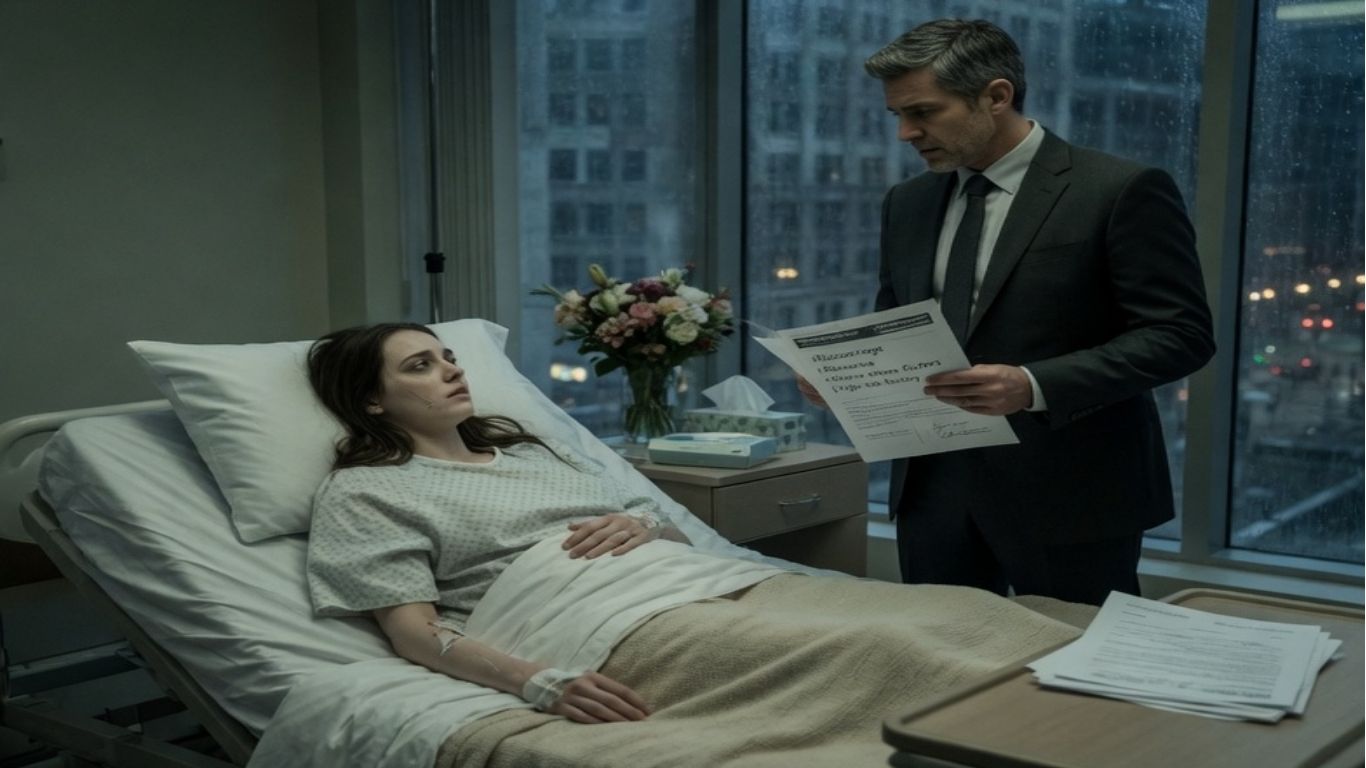
The hospital room smelled like antiseptic and rain.
Evan stood completely still, as if movement might make reality shift again.
Juliet lay in the bed, pale against white sheets, eyes half-open but distant.
She looked like someone who had already left the conversation before it began.
“Why didn’t you tell me?” Evan asked.
His voice was controlled.
Too controlled.
Juliet didn’t answer immediately.
When she finally spoke, it was almost a whisper.
“I tried.”
That was the problem.
Evan had built an entire life on the assumption that important things would always be loud enough to notice.
“This wasn’t supposed to happen like this,” she said weakly.
He looked down at the medical chart again.
Miscarriage.
Severe stress factors.
High-risk history.
Three words that didn’t belong in the same sentence as the woman he married.
“You were alone,” he said.
Not a question.
A realization.
Juliet closed her eyes.
“I didn’t want you to fix it,” she whispered.
That hit harder than anything else.
Because fixing was what Evan did.
Fixing was who he was.
If something broke, he repaired it.
If someone failed, he replaced them.
If systems collapsed, he rebuilt them.
But none of that applied here.
“I didn’t know,” he said again.
Juliet gave a faint, broken smile.
“That’s the point.”
Silence stretched between them.
Outside the room, rain hit the glass in slow rhythm.
Evan finally spoke again.
“The envelope—who gave it to you?”
Juliet hesitated.
Then:
“My sister.”
A pause.
“She said if anything went wrong… I should make sure you saw it.”
Evan frowned slightly.
“Why would she give it to me?”
Juliet turned her head slowly toward him.
“Because she doesn’t trust you not to bury things when they hurt.”
That landed cleanly.
Too cleanly.
Evan felt something unfamiliar rise in his chest.
Not anger.
Not control.
Uncertainty.
For the first time in years, he realized something terrifying:
He had been making decisions for a life he might not actually understand.
Part 3
Two weeks later, Juliet left the hospital.
Not because she was healed.
But because staying felt harder than leaving.
Evan didn’t argue.
That surprised both of them.
Instead, he did something he had never done before.
He followed her—not with security reports or legal teams—but personally.
The truth unfolded slowly.
Not in dramatic confessions.
In fragments.
Juliet had been managing the pregnancy alone for months.
Appointments she never mentioned.
Calls she deleted.
Fear she swallowed before it became visible.
Because every time she tried to speak, Evan was already somewhere else—meetings, negotiations, numbers that mattered more than timing.
And then there was the final truth:
The miscarriage hadn’t been an accident.
It had been a collapse of everything she was holding alone.
That night, Evan stood in his office long after everyone left.
The city of Chicago stretched beneath him like a system he no longer trusted.
On his desk lay the envelope.
He had read it twenty-seven times.
Each time it said the same thing.
Each time it hurt more.
His assistant spoke softly from the doorway.
“Sir… do you want us to prepare a statement?”
Evan didn’t turn around.
“No,” he said.
A pause.
Then, quieter:
“Cancel tomorrow’s meetings.”
That was new.
She hesitated.
“All of them?”
“Yes.”
“For how long?”
Evan finally looked up.
And for the first time in his life, he didn’t have an answer that fit inside a schedule.
“I don’t know yet,” he said.
Down in the city, lights kept moving like nothing had changed.
But something inside Evan Whitmore had already begun to break open.
Not dramatically.
Not loudly.
Just enough to finally let the truth in.
He had spent years believing control was strength.
Now he was beginning to understand something else:
Sometimes, the most important things in life only arrive when you stop controlling the outcome.
And by then—
it might already be too late to undo what silence has taken.