Bead-Net Funerary Shroud: The 2,500-Year-Old Egyptian Veil That Transformed the Dead Into Osiris
More than 2,500 years ago, ancient Egyptian artisans created extraordinary funerary veils from thousands of brightly colored beads, weaving them into symbolic coverings designed to guide the dead into eternal life. Among the most striking surviving examples is a bead-net funerary shroud now housed at the Art Institute of Chicago — a masterpiece of ancient craftsmanship that reveals how Egyptians imagined death, rebirth, and divine transformation.
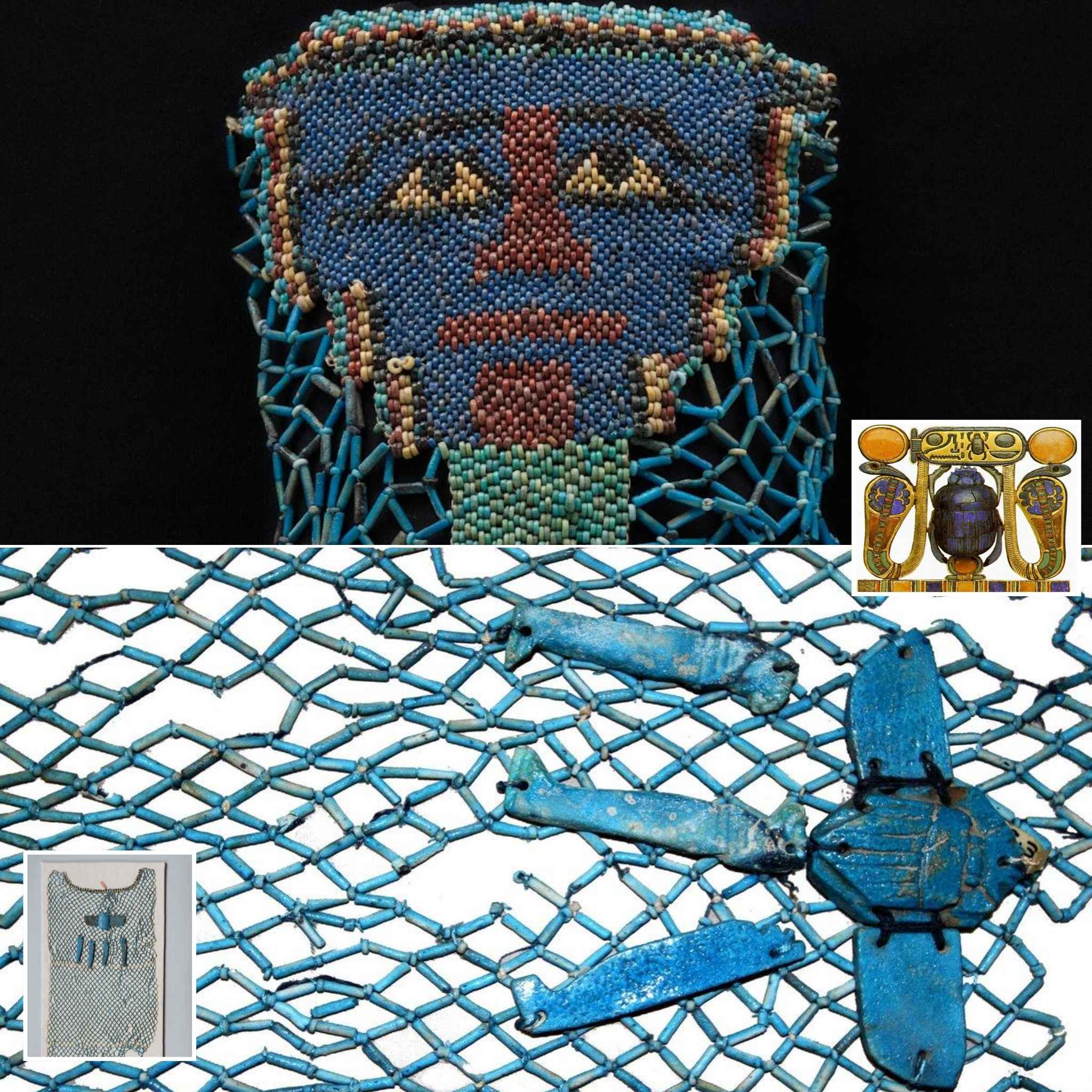
The delicate shroud, dating to around the Late Period of ancient Egypt, was carefully constructed from multicolored faience beads arranged into symbolic images including a human face, a winged scarab beetle, and a ceremonial collar. Far more than decoration, every detail carried religious meaning tied to the afterlife and the deceased’s transformation into Osiris, ruler of the underworld and symbol of resurrection.


A Funeral Veil Made From Thousands of Tiny Beads
The funerary shroud measures approximately 18 inches long by 15.8 inches wide (45.7 by 40 centimeters), making it large enough to cover the head and upper chest of a mummy wrapped in linen.
At first glance, the piece resembles a stylized mask or decorative textile. But closer examination reveals astonishing technical complexity.
Ancient Egyptian craftsmen individually threaded thousands of tiny beads together into a flexible net that could drape over the contours of the body. The resulting design combines portraiture, divine symbolism, and protective imagery into a single funerary object.
The shroud entered the collection of the Art Institute of Chicago in the late 19th century after being acquired from Rev. Chauncey Murch, an American missionary based in Luxor who collected Egyptian antiquities during his time in Egypt.
The Face of the Deceased
The upper section of the bead net depicts a stylized human face.
Most of the face is composed of deep blue beads, while the eyes, eyebrows, and cosmetic markings are highlighted with black, yellow, and red beads. Though abstract by modern standards, the facial features remain remarkably expressive.
A long false beard rendered in teal-colored beads extends downward from the chin. This ceremonial beard is one of the clearest signs that the deceased was being associated with divine status in the afterlife.
In ancient Egyptian religion, the false beard was strongly linked with gods and pharaohs. Perhaps the most famous surviving example appears on the golden funerary mask of Tutankhamun.
According to Egyptologist Emily Teeter, the dominance of blue beads may also connect the shroud to Nut, whose celestial body was often depicted as blue and covered in stars.
Blue in Egyptian symbolism frequently represented:
- The heavens
- Creation
- Fertility
- Divine protection
- Rebirth
The color choice therefore reinforced the spiritual transformation occurring after death.
The Sacred Scarab of Rebirth
Directly beneath the face appears one of the most important symbols in Egyptian religion: the winged scarab beetle.
The scarab is rendered in multiple colors with carefully extended wings spreading outward across the shroud.
This image likely represents Khepri, the scarab-headed deity associated with the rising sun, creation, renewal, and rebirth.
Ancient Egyptians observed dung beetles rolling balls across the ground and associated this behavior with the movement of the sun across the sky. As a result, scarabs became powerful symbols of cyclical rebirth and regeneration.
Scarab amulets were commonly placed inside mummy wrappings, especially over the heart. But in this funerary net, the scarab is not hidden within the wrappings—it becomes a central visual declaration of resurrection itself.
The winged form further emphasizes divine movement and protection, symbolically carrying the deceased into the afterlife.


A Collar of Lotus Flowers and Sacred Ornamentation
The lower portion of the shroud contains a broad ceremonial collar woven from dark-blue, red, yellow, black, and light-blue beads.
Within the collar pattern are yellow lotus flowers and red floral pendants.
The lotus flower carried deep spiritual meaning in ancient Egypt because it closes at night and opens again in daylight. This natural cycle made it a symbol of:
- Rebirth
- Creation
- Resurrection
- Solar renewal
Lotus imagery frequently appeared in tomb art, temple decoration, and funerary objects connected to the afterlife journey.
The collar itself also imitates the broad jeweled collars worn by Egyptian elites and deities. By placing this ornament directly on the funerary shroud, the deceased was visually transformed into a glorified being worthy of eternal life.
The Shroud as a Transformation Into Osiris
According to Emily Teeter, bead-net funerary shrouds were deeply tied to the mythology of Osiris.
In Egyptian belief, Osiris had been murdered, dismembered, and resurrected, becoming ruler of the underworld and eternal judge of the dead. Every deceased person hoped to symbolically unite with Osiris in death and achieve rebirth through him.
The bead net helped accomplish this transformation.
Placed over red linen wrappings surrounding the mummy, the net imitated the wrapped body of Osiris himself.
Teeter explained:
“Together, the shroud and net imitated the wrappings of Osiris, hence symbolizing the assimilation of the deceased to the god.”
In effect, the deceased was not merely buried—they were ritually reconstructed as a divine being.
The Protective Embrace of Nut
The shroud may also reference Nut, who frequently appeared on coffins and mummy cases.
Nut was believed to stretch her body across the heavens, swallowing the sun each evening and giving birth to it again every dawn.
She also acted as a protective mother figure for the dead.
Egyptian coffins often depict Nut with outstretched wings or arms embracing the deceased. The bead net likely echoed this same symbolism.
As Teeter noted:
“Just as the arms of Nut encircled the deceased, the bead net enveloped the mummy.”
Thus, the shroud simultaneously represented:
- The wrappings of Osiris
- The protection of Nut
- The rebirth of Khepri
- The eternal cycle of the cosmos
The Rise of Bead-Net Burial Traditions
Bead-net funerary coverings became especially popular during Egypt’s Late Period, roughly between the 7th and 4th centuries B.C.
This era saw a renewed emphasis on elaborate burial rituals and increasingly detailed funerary equipment.
Many bead nets were made using faience beads—a glazed ceramic-like material prized for its vivid colors and reflective qualities.
Creating these objects required enormous labor:
- Beads had to be individually produced
- Dyed or glazed in different colors
- Strung in precise geometric patterns
- Fitted to the dimensions of the mummy
The result was both artistic and spiritual: a shimmering protective layer connecting the dead to divine forces.


Why These Shrouds Matter Today
Funerary bead nets are more than beautiful museum artifacts. They preserve evidence of how ancient Egyptians understood identity, death, and immortality.
Unlike many ancient cultures that viewed death primarily as an ending, Egyptian religion focused intensely on transformation.
Every symbol on the shroud reflects this idea:
- The scarab represents rebirth
- The lotus symbolizes renewal
- The false beard signals divinity
- The blue beads invoke the heavens
- The net itself becomes sacred protection
Together, they formed a ritual technology designed to help the deceased survive eternity.
A Delicate Survivor Across Millennia
That this fragile object survived at all is remarkable.
Organic textiles from antiquity often decay completely, but Egypt’s dry climate preserved many funerary materials in extraordinary condition. The bead net’s intricate patterns remain visible more than two millennia after it was placed over a mummy.
Today, the shroud stands as both a masterpiece of ancient craftsmanship and a powerful expression of Egyptian beliefs about life after death.
Its tiny beads still tell a cosmic story woven thousands of years ago—a story in which death was not an ending, but the beginning of transformation into something eternal.