The Gold That Remembered the Abbasids: A Lost Treasury of Dariyah
There are moments in archaeology when the ground does not merely yield objects—it releases a frozen economy of beauty, belief, and power. At ancient Dariyah in Saudi Arabia’s Al-Qassim region, that moment arrived when excavators uncovered a hoard of 100 gold jewelry pieces dating back more than 1,100 years to the Abbasid era.
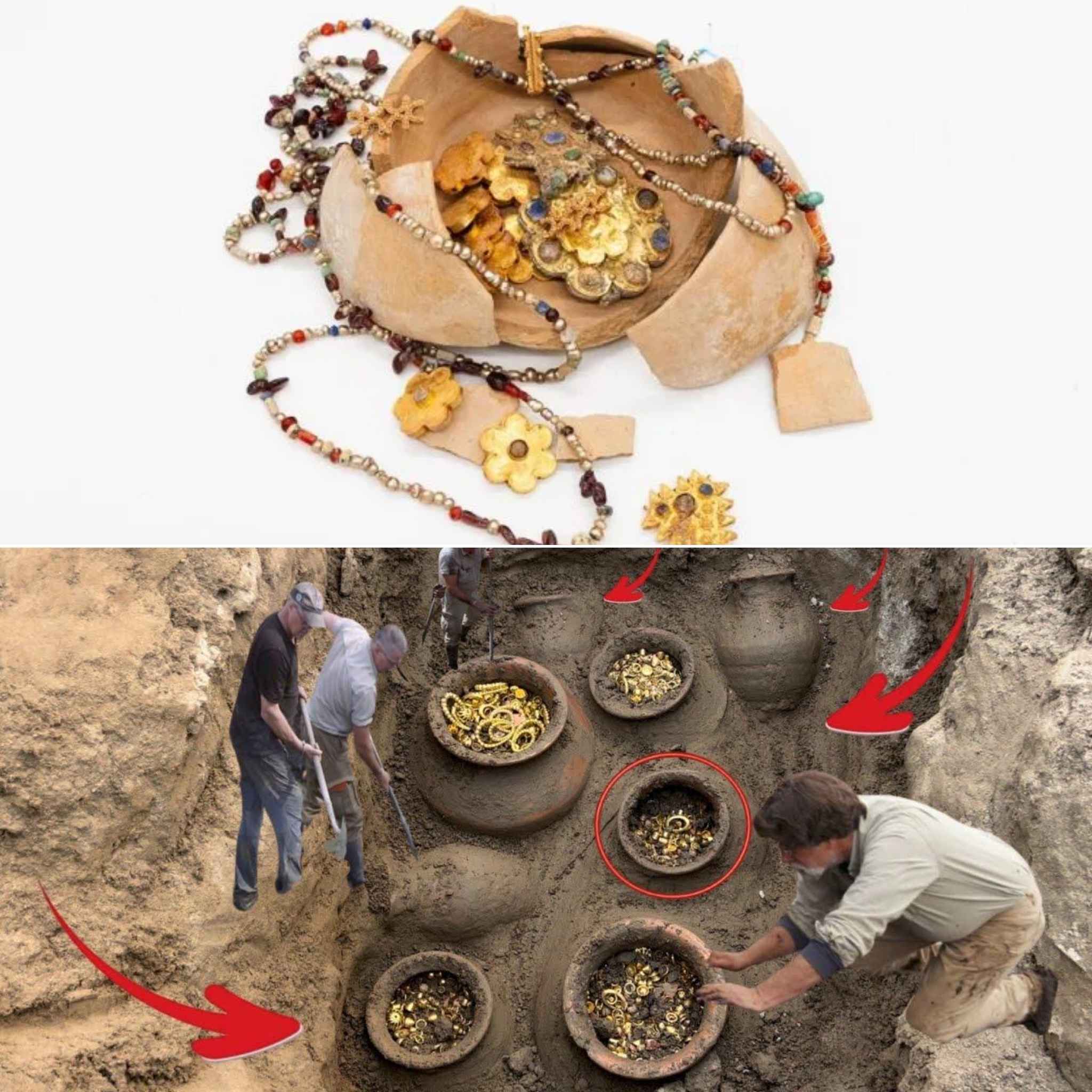
But this was not a random scatter of valuables.
It was something closer to a sealed system—an intact design language of an empire that once stretched across continents, now reappearing in fragments of gold.
I. A CITY AT THE EDGE OF MOVEMENT
Dariyah was never just a settlement. It was a node—one of those rare places where geography turns into acceleration.
Positioned along routes that carried pilgrims, merchants, and political messengers between Iraq and the holy cities, the site sat on what could be described as an ancient logistical bloodstream: the Basran Hajj route.
Caravans passed through carrying textiles from Baghdad, spices from the Indian Ocean, and ideas that traveled faster than any horse could run.
And somewhere within that circulation, gold changed hands, changed meaning, and eventually—was buried.


Dariyah was not isolated.
It was embedded in motion.
And motion, in archaeology, often means preservation through interruption.
II. THE HOARD THAT NEVER DISPERSED
When archaeologists uncovered the collection, what struck them was not only the quantity—100 pieces of gold jewelry—but the coherence.
This was not a marketplace loss.
It was not debris.
It was a set.
Pendants. Gold discs. Beads. Spacers. Ornamental elements designed to be assembled, worn, and seen as a unified composition.
A system of adornment that once moved with a body.
And then stopped.
The pieces suggest a complete matching ensemble, as if someone had paused mid-preparation and never returned.
III. GOLD AS LANGUAGE, NOT LUXURY
In the Abbasid world, gold was never just decoration.
It was communication.
A disc-shaped ornament with symmetrical inlays could signal status, affiliation, or access to long-distance trade networks. Floral and geometric patterns were not merely aesthetic—they were part of a visual grammar shared across the Islamic Golden Age.
These designs spoke a language understood from Córdoba to Baghdad, from Cairo to the caravan routes of Arabia.


Goldsmiths of the period were not simply artisans.
They were engineers of symbolism.
Techniques such as hammering ultra-thin gold sheets, embossing intricate relief patterns, and embedding colored stones required precision that bordered on scientific control. Each object balanced fragility and permanence—designed to survive both time and status transitions.
IV. THE HAND THAT STOPPED WORKING
The arrangement of the Dariyah hoard raises a quieter question:
Why was it left unfinished?
Archaeology rarely receives answers in narrative form. Instead, it receives conditions.
Here, the condition is interruption.
A jewelry set that appears ready for assembly, yet never completed. No final fastening. No documented owner. No accompanying burial context that would clearly explain its placement.
This suggests several possibilities:
- A workshop inventory hidden during unrest
- A merchant’s stock concealed during travel disruption
- A ritual deposit marking transition or loss
- Or simply a personal cache never retrieved
Each hypothesis points to the same underlying truth: this was a moment when human intention was cut short by external forces.
And the gold remained.
V. THE ENGINEERING BEHIND BEAUTY
The Abbasid Caliphate is often remembered for philosophy, astronomy, and architecture.
But its material culture was equally sophisticated—and jewelry reveals a hidden layer of technological continuity.
The Dariyah pieces demonstrate:
- Controlled gold sheet production
- High-precision decorative embossing
- Stone inlay alignment with near-symmetrical calibration
- Modular assembly systems (beads and spacers designed to function structurally, not just visually)
This was not ornamental excess.
It was modular design thinking applied to personal adornment.
In modern terms, it resembles early systems engineering—where each component has both aesthetic and structural role within a larger wearable configuration.
VI. A CROSSROADS THAT BECAME A TIME CAPSULE
Dariyah’s location ensured constant interaction between communities.
Pilgrims moving toward Mecca passed traders heading toward Basra. Goods from the Mediterranean intersected with materials from the Indian Ocean trade network.
This convergence created what historians now recognize as a “stacked economy”—layers of exchange systems operating simultaneously across the same geography.
And sometimes, when such systems collapse or pause, they leave behind compressed snapshots of their complexity.
Dariyah is one such snapshot.


Alongside the gold, archaeologists recovered pottery, glass fragments, stone tools, and architectural remains—fire hearths and mudbrick walls that once formed a functioning settlement.
This was not a single deposit site.
It was a living system.
VII. THE POLITICS OF PRECIOUS METAL
Gold in the Abbasid era was not evenly distributed. It flowed along controlled routes tied to taxation, pilgrimage infrastructure, and elite networks of patronage.
Dariyah’s assemblage suggests access to those networks.
Whether through trade, governance, or religious economy, whoever controlled or owned this jewelry set existed within a structured hierarchy of mobility and privilege.
In that sense, the hoard is not just decorative history.
It is economic evidence.
A record of who could move wealth—and who could transform it into identity.
VIII. WHEN OBJECTS OUTLIVE THEIR OWNERS
What makes the Dariyah discovery compelling is not just its craftsmanship, but its completeness.
Most archaeological gold finds arrive fragmented—melted, dispersed, or recycled across centuries of reuse.
Here, however, the pieces survived as a group.
That means they were likely removed from circulation deliberately, not lost gradually.
And when objects are removed deliberately, they usually mark one of three thresholds:
- Death
- Transition
- Crisis
Gold, in this sense, becomes archival material for human disruption.
IX. THE ABBASID IMPRINT IN MODERN TIME
The Abbasid Caliphate (8th–13th centuries) is often described as a golden age of knowledge and cultural synthesis. But discoveries like Dariyah shift that abstraction into material clarity.
It was not just an age of ideas.
It was an age of systems:
- Trade routes engineered across deserts
- Artistic standards shared across continents
- Material technologies refined through repetition
- Urban and rural nodes connected by pilgrimage infrastructure
The jewelry from Dariyah is one of those systems made visible.
Not in text.
But in metal.
X. WHAT THE DESERT KEPT
Today, the Al-Qassim region is again part of large-scale archaeological documentation efforts aligned with national heritage initiatives. Each excavation layer adds another coordinate to a map that is still being reconstructed.
But the Dariyah hoard stands out because it does not behave like a typical archaeological find.
It behaves like a paused narrative.
A moment in which craftsmanship, movement, and intention were briefly aligned—and then stopped.
And the desert did what deserts do best:
It preserved the interruption.
XI. FINAL OBSERVATION: GOLD AS MEMORY SYSTEM
The 100 pieces of Abbasid-era jewelry are not simply artifacts.
They are components of a lost wearable system—an architecture of identity once designed to move through space, light, and human interaction.
Now separated from the body they once adorned, they function differently:
As memory objects.
Not memories of individuals alone, but of networks—pilgrimage routes, workshops, trade corridors, and cultural grammars that once defined a civilization at scale.
And perhaps that is the quiet conclusion of Dariyah:
Civilizations do not vanish.
They fragment into systems.
And sometimes, those systems reassemble themselves briefly in the ground—waiting, not to be worn again, but to be understood.