Mysterious Ancient Tunnel Found Beneath Jerusalem Baffles Archaeologists
Beneath the crowded streets, apartment blocks, and traffic of modern Jerusalem, archaeologists have uncovered a mysterious underground tunnel carved deep into bedrock — a hidden passage that may have lain untouched for thousands of years.
The discovery has stunned researchers.
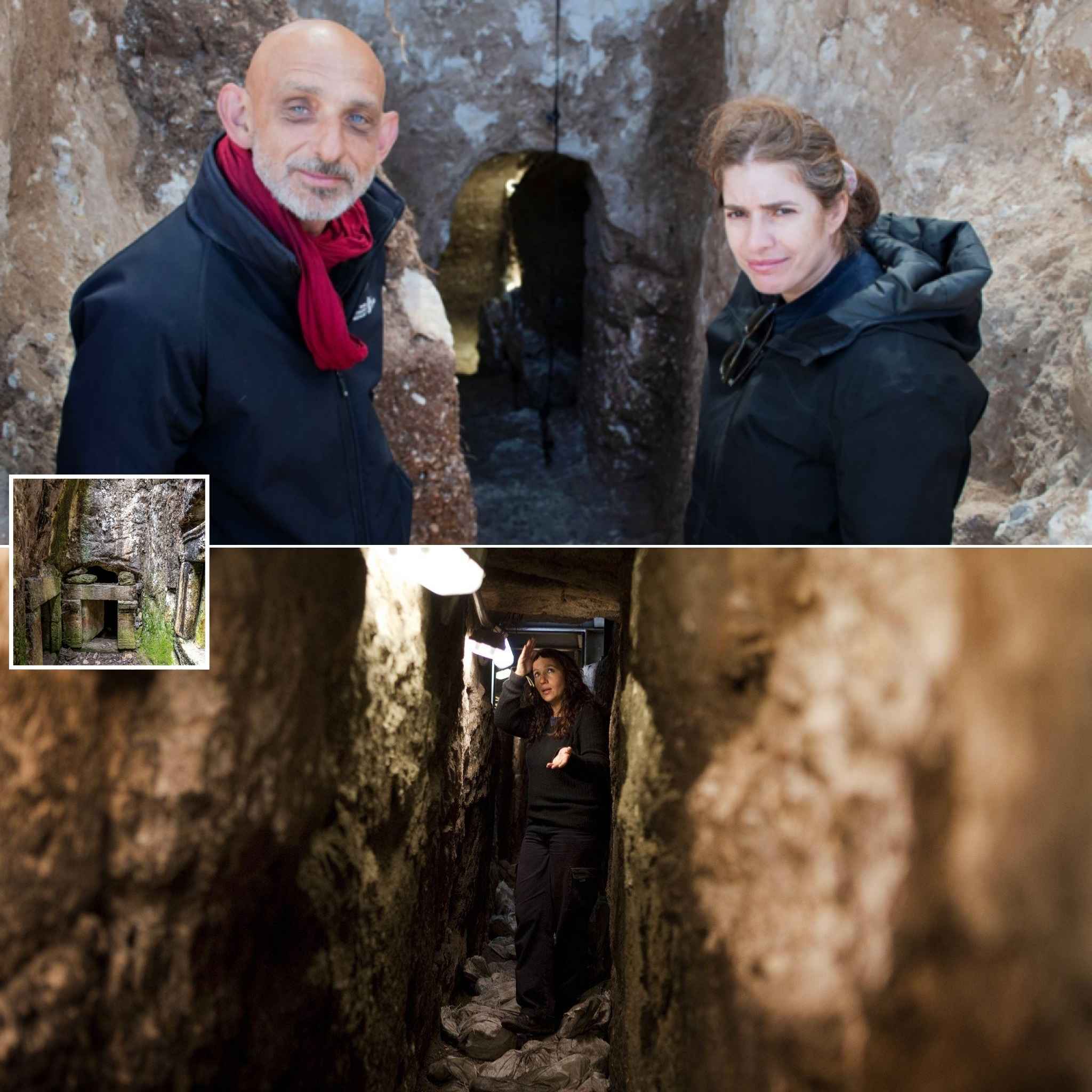
Stretching through solid stone beneath the hills near Kibbutz Ramat Rachel, the tunnel appears to have been created with remarkable engineering skill. Yet despite its impressive scale and craftsmanship, archaeologists still do not know exactly why it was built.
Was it part of a forgotten water system?
An unfinished industrial project?
A hidden quarry?
Or something even more ambitious that ancient builders abandoned before completion?
The underground structure has now become one of Jerusalem’s newest archaeological mysteries, adding another layer to the city’s already astonishing underground history.
For a city built atop thousands of years of civilizations, religions, wars, and empires, Jerusalem still continues to surprise archaeologists.
And this latest discovery may eventually rewrite what historians understand about ancient engineering in the region.
A Discovery Beneath a Growing City
The tunnel was uncovered during archaeological excavations conducted before construction of a new residential neighborhood north of Kibbutz Ramat Rachel, located within Jerusalem’s municipal boundaries.
Modern development projects in Jerusalem almost always involve archaeology.
Every layer of earth beneath the city potentially contains remains from ancient kingdoms, Roman occupations, Byzantine monasteries, Islamic dynasties, Crusader fortresses, or Ottoman settlements.
This time, surveyors initially believed they had found nothing more than a natural cavity in the rock.
But as excavation continued, the opening widened into something far more remarkable.
A carefully carved underground passage emerged beneath the earth.
Archaeologists soon realized they were standing inside a massive ancient tunnel cut directly into the bedrock.
An Underground Passage Carved From Stone


The tunnel extends roughly 50 meters beneath the surface.
Researchers estimate that its original dimensions may have reached nearly 5 meters in height and approximately 3 meters in width — enormous proportions for an underground passage carved entirely by hand.
Even after centuries underground, the workmanship remains striking.
The walls preserve smooth surfaces and consistent shapes, revealing the expertise of ancient stone cutters who planned the tunnel with precision.
Whoever built the passage clearly understood advanced techniques of excavation and structural stability.
The builders carved directly into solid bedrock, creating a surprisingly regular and carefully engineered interior.
Archaeologists noted that the craftsmanship itself is one of the most impressive aspects of the discovery.
“This was not random digging,” one researcher explained. “This required planning, manpower, and considerable technical skill.”
A Staircase Into Darkness
The original entrance to the tunnel once included a staircase descending into the underground chamber.
Inside, archaeologists discovered multiple layers of compacted soil that had slowly accumulated over centuries, gradually filling portions of the passage.
Some areas remain inaccessible because ceilings or walls collapsed long ago.
Until engineers can assess the structural safety of the site, archaeologists cannot fully excavate the entire tunnel.
That limitation has only deepened the mystery.
Researchers know the passage continues farther into the bedrock, but exactly where it leads — or what lies beyond the blocked sections — remains unknown.
The First Theory: Water
At first, archaeologists suspected the tunnel may have formed part of an ancient water system.
Jerusalem’s history has always been deeply connected to water engineering.
For thousands of years, the city’s inhabitants built tunnels, cisterns, channels, and reservoirs to survive in the region’s difficult climate.
Some of Jerusalem’s most famous archaeological sites — including Hezekiah’s Tunnel and Warren’s Shaft — are underground water systems.
Naturally, researchers initially assumed the newly discovered passage served a similar function.
But several crucial details contradicted that theory.
Why Archaeologists Rejected the Water Theory


Ancient water systems were typically lined with thick waterproof plaster designed to prevent leakage.
This tunnel contained none.
The walls were entirely bare stone.
Additionally, geological surveys revealed no underground spring or water source nearby.
Researchers also found no sediment patterns indicating flowing or standing water.
If the tunnel once carried water, it left behind almost no evidence.
That absence eventually forced archaeologists to abandon the water-system explanation.
The tunnel appeared to serve some entirely different purpose.
An Industrial Complex Underground?
Researchers next considered whether the structure had an industrial or agricultural function.
Could the tunnel have been used for storage?
Wine production?
Olive oil processing?
Underground workshops?
Again, problems emerged.
The sheer scale of the passage seemed excessive for ordinary industrial activity.
Moreover, archaeologists found no evidence of installations, basins, presses, or storage features normally associated with agricultural production.
The site also lacks nearby parallel systems.
If it was industrial, it was unlike anything previously documented in the region.
The Quarrying Hypothesis
At present, the leading theory connects the tunnel to quarrying activity.
Archaeologists believe ancient workers may have been searching for high-quality chalk layers suitable for producing lime or extracting construction stone.
Several details support this interpretation.
Researchers discovered quarry debris scattered across portions of the floor.
They also identified a vertical shaft carved upward through the ceiling — a feature that may have functioned as ventilation for workers operating underground.
Ventilation shafts are commonly associated with ancient quarry systems and mining operations.
The dimensions of the tunnel itself may also reflect large-scale excavation efforts rather than transportation or habitation.
Still, even the quarrying theory leaves unanswered questions.
Why create such an enormous underground passage?
Why abandon it?
And why are there no associated tools, pottery fragments, or construction debris that might clearly identify its purpose?
The Tunnel That Leads Nowhere
Perhaps the strangest aspect of the discovery is that the tunnel currently appears unfinished.
Sections abruptly terminate.
Other portions collapse before revealing where the passage ultimately leads.
Researchers increasingly suspect the project may never have been completed.
If ancient builders abandoned the excavation midway through construction, the original goal of the tunnel may never be fully understood.
That possibility frustrates archaeologists because unfinished projects often leave behind fewer clues.
No inscriptions.
No decorative elements.
No evidence of final usage.
Only stone.
A Mystery Without a Date
One of the biggest challenges facing archaeologists is determining when the tunnel was built.
Normally, ancient structures are dated using associated artifacts such as pottery, coins, tools, charcoal, or organic remains.
This tunnel has produced almost nothing.
No pottery shards.
No metal objects.
No human remains.
No inscriptions.
No carbon samples.
The tunnel is archaeologically silent.
That silence has made dating nearly impossible.
Surrounded by Ancient History


Yet the surrounding landscape complicates the mystery even further.
The tunnel lies only a short distance from two highly significant archaeological sites.
One is an important Iron Age public building discovered in the Arnona neighborhood.
The other is Tel Ramat Rachel, a major settlement occupied from the Iron Age through the Islamic period.
For centuries, the area served as a strategic and administrative center overlooking Jerusalem.
Different empires, kingdoms, and cultures occupied the region across thousands of years.
Any one of them may have built the tunnel.
Dr. Zenovi Matskevich, one of the archaeologists involved in the excavation, acknowledged the extraordinary uncertainty surrounding the site.
“The date of the tunnel is a mystery to us,” he explained, “since not even the smallest find was uncovered that could indicate when it was created.”
That lack of evidence is unusual in Jerusalem archaeology, where even tiny excavations often uncover large quantities of material.
Jerusalem’s Hidden Underground World
The discovery also highlights something extraordinary about Jerusalem itself:
Much of the city still remains buried.
Over thousands of years, new cities repeatedly rose atop older ones.
Buildings collapsed.
Wars destroyed neighborhoods.
Earthquakes reshaped landscapes.
Each civilization constructed directly over previous generations.
As a result, Jerusalem contains an astonishing underground network of hidden chambers, tunnels, cisterns, and passages.
Some are famous tourist attractions.
Others remain sealed beneath modern streets and buildings.
The newly discovered tunnel now joins that hidden subterranean world.
Urban Development Meets Archaeology
The find has also created challenges for city planners.
Construction of the new residential neighborhood cannot proceed normally while archaeologists continue investigating the site.
Israeli authorities must now incorporate tunnel preservation into future development plans.
Officials from the Israel Antiquities Authority hope the area may eventually become part of an archaeological park integrated into the new neighborhood.
That balancing act between preservation and modernization is a constant reality in Jerusalem.
Every new road, apartment complex, or infrastructure project risks uncovering another ancient secret.
Engineering Across the Ages
Regardless of the tunnel’s purpose, one fact is already clear:
Its builders possessed impressive engineering abilities.
Carving a passage of this scale directly into bedrock required organization, labor coordination, technical knowledge, and careful planning.
Workers needed to remove enormous amounts of stone while maintaining structural stability underground.
Ventilation, lighting, debris removal, and excavation sequencing would all have required logistical planning.
Even without knowing exactly who built the tunnel, archaeologists can already recognize the sophistication involved.
The Problem With Ancient Mysteries
One reason discoveries like this fascinate both archaeologists and the public is because they resist easy explanation.
Modern people often assume archaeology always provides clear answers.
But many ancient sites remain deeply ambiguous.
Sometimes the evidence simply disappears.
Organic materials decay.
Metal corrodes.
Stone survives while human stories vanish.
The Jerusalem tunnel represents precisely that kind of mystery:
A massive human achievement whose purpose may have been forgotten almost immediately after it was abandoned.
Waiting for the Missing Clue
For now, archaeologists continue carefully documenting the structure while engineers evaluate unstable sections.
Researchers hope future excavation may finally uncover the clue that changes everything:
A single pottery fragment.
A coin.
A tool.
An inscription.
Any datable artifact could suddenly place the tunnel within a known historical period.
That one discovery might reveal whether the builders were Iron Age Judeans, Roman engineers, Byzantine workers, Islamic laborers, or another civilization entirely.
Until then, the tunnel remains suspended between theories.
The Endless Archaeology of Jerusalem
Jerusalem has always been a city layered with memory.
Beneath synagogues lie Roman streets.
Below churches rest ancient Jewish structures.
Under mosques survive Byzantine foundations.
And now, beneath a future residential neighborhood, archaeologists have uncovered another hidden monument whose story has not yet been told.
The ancient tunnel beneath Jerusalem may eventually prove to be part of a quarry, an unfinished engineering project, or something entirely unexpected.
But even in uncertainty, the discovery carries enormous significance.
It reminds us that after thousands of years of excavation, Jerusalem still conceals mysteries beneath its streets.
And somewhere beyond the collapsed walls of that underground passage, deeper answers may still be waiting in the darkness.