Melting Mountain Ice Is Bringing Ancient Secrets to the Surface
Archaeologists Are Racing Against Time Before Climate Change Erases Thousands of Years of Human History
High in Norway’s frozen mountains, where icy winds sweep across jagged peaks and ancient snowfields cling stubbornly to the stone, a single object appeared from the melting ice on an unusually warm autumn day.
It was a shoe.
Not a modern hiking boot or a lost mountaineering slipper, but a perfectly preserved leather loafer crafted by human hands more than 3,400 years ago.
When local hiker Reidar Marstein spotted the brown leather shoe emerging from an ice patch in September 2006, he immediately sensed its importance. Carefully wrapping it in paper and plastic, he carried the artifact down the mountain and contacted archaeologist Espen Finstad.
Neither man could have imagined what that discovery would ignite.
The ancient shoe became the beginning of one of the world’s most extraordinary archaeological movements — a race against time unfolding across melting mountains worldwide.
As Earth’s glaciers and ancient ice patches disappear under rising global temperatures, they are releasing objects hidden for thousands of years: Viking equipment, prehistoric hunting weapons, textiles, tools, trade goods, animal remains, and even traces of ancient human DNA.
For archaeologists, the melting ice has opened a frozen archive of human history unlike anything ever seen before.
But there is a terrifying catch.
The moment these objects emerge from the ice, they begin to decay.
And once they are gone, the knowledge they carry disappears forever.
A Frozen Time Capsule Opens


The 3,400-year-old shoe discovered in Norway transformed the field of glacial archaeology.
After the discovery, Finstad and Marstein helped establish Secrets of the Ice, a joint research initiative involving Norway’s Innlandet County Council and Oslo’s Museum of Cultural History.
Today, the project is considered the largest glacial archaeology program in the world.
Each August and September, when mountain ice reaches its seasonal minimum, small teams of archaeologists climb into Norway’s highest mountain ranges searching for newly exposed artifacts.
What they have found is astonishing.
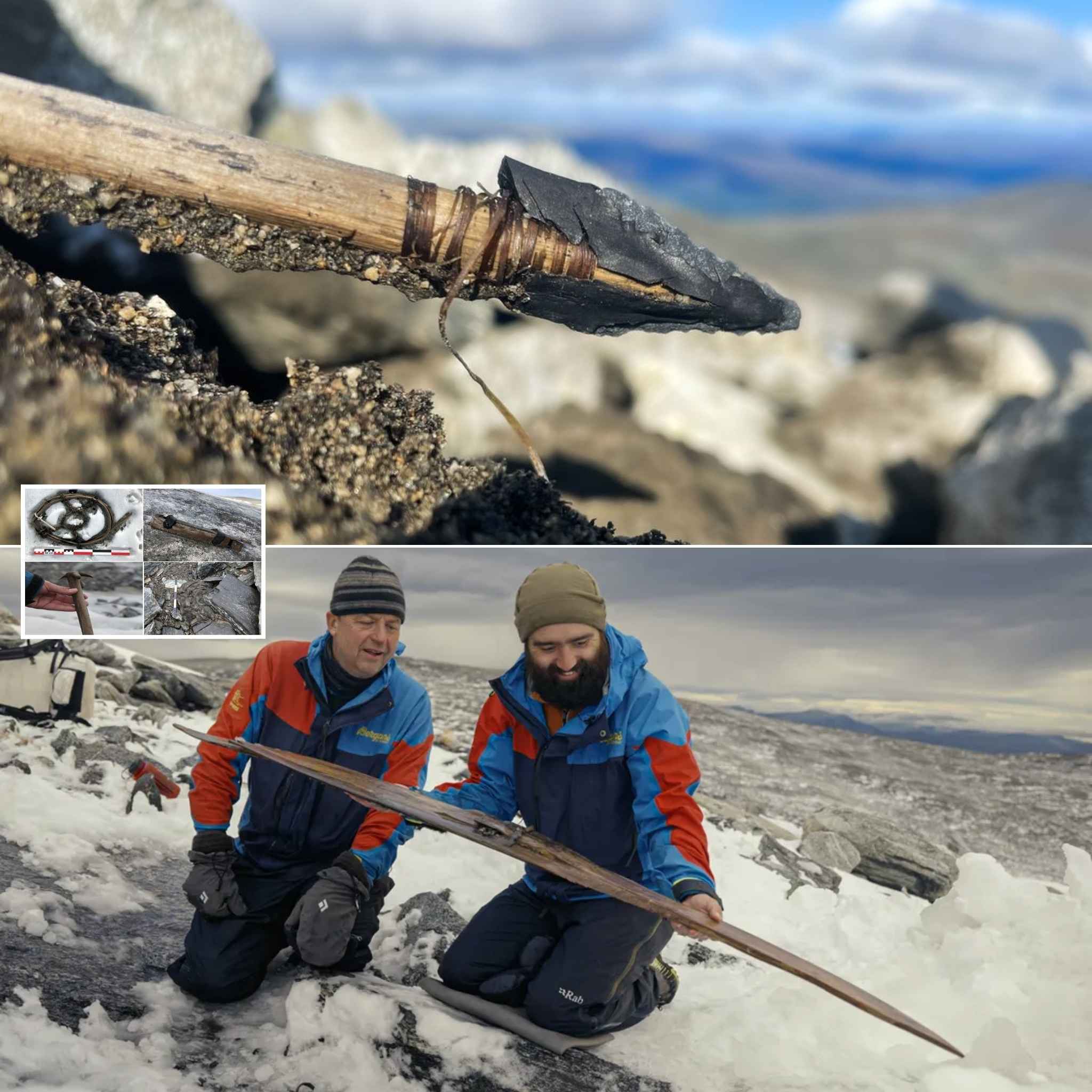
Since its founding, Secrets of the Ice has recovered approximately 4,500 ancient objects from melting ice patches.
Among them are:
- The world’s oldest intact pair of wooden skis
- Bronze Age arrowheads used by reindeer hunters
- Viking textiles and clothing
- Leather tunics and shoes
- Hunting traps and sled fragments
- Ancient horse equipment
- Trade goods lost along mountain routes
Some objects are over 6,000 years old.
Many appear almost untouched by time.
Why Ice Preserves the Past So Perfectly
The reason these artifacts survive for millennia lies in the unique preservation power of ice.
Unlike ordinary archaeological sites, frozen ice patches act like natural deep freezers.
Cold temperatures dramatically slow microbial activity, preventing decomposition of fragile organic materials such as leather, wood, fur, textiles, and sinew.
The absence of oxygen further protects the objects.
Stationary ice patches — unlike moving glaciers — are especially valuable because they preserve artifacts in place instead of crushing them.
For thousands of years, mountain ice silently protected traces of ancient human activity.
Now climate change is exposing them at an unprecedented speed.
The Moment Artifacts Begin to Die
The tragedy is that the same melting process that reveals these treasures also destroys them.
As soon as organic materials emerge into sunlight, oxygen, moisture, and fluctuating temperatures, decomposition begins almost immediately.
Leather dries and cracks.
Textiles crumble.
Wood splinters.
Animal sinew disintegrates.
Archaeologists describe the process as a race against irreversible loss.
Julian Post-Melbye, one of Secrets of the Ice’s leading archaeologists, explained the urgency bluntly:
“If we don’t do it now, we will never get the chance again.”
Walking Through Dangerous Terrain
Glacial archaeology is among the most physically dangerous forms of archaeology on Earth.
Researchers must navigate unstable mountain terrain, melting ice fields, hidden crevasses, rockfalls, and collapsing permafrost.
Post-Melbye himself once fell into a crevasse without safety equipment.
Another colleague survived a rockfall.
As ice disappears, the landscape becomes even more hazardous.
Frozen ground that remained stable for thousands of years is now collapsing.
Entire slopes are destabilizing.
The mountains themselves are changing.
Climate Change Is Accelerating the Crisis
Scientists warn that the world’s mountain ice is vanishing at alarming speed.
In Norway alone, researchers estimate that up to 80 percent of mountain ice could disappear by the end of the century — even if greenhouse gas emissions stopped immediately.
Some ice patches may vanish within just 20 years.
For archaeologists, this creates overwhelming pressure.
There are simply too many melting sites and too few researchers.
The Archaeological Gold Rush of the Ice Age


The discoveries pouring from the ice are rewriting history.
One of the most famous finds was a pair of prehistoric skis recovered from the Digervarden ice patch in Norway.
The skis, preserved for over 1,300 years, are the best-preserved prehistoric ski pair ever found.
Elsewhere, archaeologists uncovered Roman-era sandals high in mountain terrain previously believed impassable during antiquity.
That discovery completely changed historians’ understanding of ancient trade routes.
It revealed that humans and pack animals crossed extreme mountain environments far more frequently than previously thought.
Ancient Highways Through the Mountains
The artifacts emerging from the ice reveal a forgotten world of movement.
Long before modern roads, mountain travelers crossed frozen passes carrying goods, hunting reindeer, guiding livestock, and connecting distant communities.
Every object tells a story:
A broken arrow suggests a failed hunt.
A lost mitten hints at freezing weather.
A horse shoe reveals ancient transportation routes.
A woven basket fragment points to everyday survival in extreme conditions.
Together, the artifacts reconstruct entire human landscapes now lost to time.
A Field Born From a Frozen Body
Modern glacial archaeology truly began in 1991 with one of archaeology’s most famous discoveries:
Ötzi the Iceman.
When hikers discovered a frozen human body in the Alps between Austria and Italy, they initially believed they had found a recently deceased mountaineer.
Instead, the corpse belonged to a man who had died over 5,300 years earlier.
Ötzi’s astonishing preservation shocked the scientific world.
His clothing, tools, weapons, tattoos, and even stomach contents survived.
The discovery demonstrated the extraordinary preservation power of ice and triggered worldwide interest in melting glacier archaeology.
Frozen Mummies at the Roof of the World
Other discoveries soon followed.
In 1999, archaeologists working high in the Andes uncovered the mummified remains of the “Children of Llullaillaco.”
The children, sacrificed during the Incan Empire around 1500 C.E., were discovered near the summit of a volcano over 22,000 feet above sea level.
Their bodies were so perfectly preserved by freezing temperatures that scientists could analyze their hair, diets, health, and even drug consumption before death.
The discovery remains one of the most extraordinary archaeological finds ever made.
Ancient DNA Unlocks New Histories
Modern technology is transforming what archaeologists can learn from ice-preserved remains.
Advances in DNA sequencing now allow researchers to analyze tiny biological traces from artifacts and organic material.
From animal dung, archaeologists identify ancient parasites and grazing patterns.
From preserved pollen, they reconstruct ancient vegetation and climates.
From chewed birch bark pitch once softened in human mouths, researchers extract human DNA dating back thousands of years.
These discoveries allow scientists to reconstruct entire ecosystems and migration patterns.
Mongolia’s Melting Heritage
The crisis extends far beyond Norway.
In Mongolia’s Altai Mountains, archaeologist William Taylor has spent years documenting ice-patch archaeology.
There, rapidly melting ice has already destroyed many organic artifacts before researchers could recover them.
Taylor warns that entire chapters of human history may disappear within years.
“There are so many chapters of the human story preserved in rapidly melting mountain ice,” he explains, “and so few of these areas have been properly investigated.”
Archaeology Under Impossible Conditions


The work itself is exhausting and highly specialized.
Glacial archaeologists must combine skills from multiple disciplines:
- Archaeology
- Mountaineering
- Preservation science
- Mapping
- Climate science
- Ice dynamics
Field seasons are extremely short.
Weather conditions can shift violently.
Many sites are accessible only on foot after long mountain hikes.
And archaeologists often discover far more artifacts than they can process.
Norway’s Ice Tunnel Into the Past
One of the most remarkable sites connected to Secrets of the Ice is Klimapark 2469, an ice tunnel carved into a 7,600-year-old ice patch in Norway’s Jotunheimen National Park.
Visitors walking through the tunnel encounter replicas of artifacts and sculptures inspired by Norse mythology.
The tunnel itself symbolizes the region’s deep connection to glacial archaeology.
Local communities increasingly view the disappearing ice as both a scientific emergency and a cultural loss.
The Emotional Weight of Vanishing Ice
For many archaeologists, the work carries profound emotional complexity.
The melting ice is simultaneously revealing priceless knowledge and destroying the very environment that preserved it.
Every new discovery is also evidence of environmental collapse.
Post-Melbye describes watching entire ice patches disappear during his career.
“For the last 15 years,” he says, “I can see that half the ice has disappeared.”
The landscape changes visibly year after year.
Some sites archaeologists once studied no longer exist.
The Deep Freezers of Human History
Researchers often describe ice patches as archaeological “deep freezers.”
Unlike traditional archaeological sites buried underground, frozen environments preserve delicate materials almost impossible to recover elsewhere.
Without the ice, entire aspects of prehistoric life would remain invisible.
Wooden tools.
Textiles.
Leather clothing.
Animal harnesses.
Plant fibers.
These materials usually decay rapidly in ordinary soil.
Ice alone preserved them.
The Puzzle of Ancient Mountain Life
As discoveries accumulate, archaeologists are reconstructing forgotten mountain societies.
The artifacts show that high-altitude regions once bustled with activity.
Hunters tracked reindeer across snowfields.
Merchants crossed dangerous passes.
Families moved livestock between seasonal grazing grounds.
Entire trade networks operated through mountains once thought nearly impassable.
The ice is slowly revealing that ancient humans were far more adaptable and mobile than historians once believed.
A Scientific Field That May Disappear
Ironically, glacial archaeology itself may exist for only a brief historical moment.
The field emerged because of melting ice.
But once the ice is gone, so too is the source of new discoveries.
Researchers may have only a few decades left.
That reality creates immense urgency.
Entire mountain regions around the world remain barely explored.
And every year, more artifacts decay before scientists can reach them.
A Race Humanity Cannot Win
The central tragedy of glacial archaeology is unavoidable:
Scientists are losing the race.
Even with growing international attention, funding and manpower remain limited.
The number of archaeologists working in glacial environments is tiny compared to the scale of the crisis.
And climate change continues accelerating.
The Final Window Into Frozen History
Yet despite the urgency, discoveries continue astonishing researchers.
Every melting season uncovers new objects.
New stories.
New evidence of forgotten lives.
The mountains are opening archives sealed since the Stone Age.
But they are opening only briefly.
Soon, many of the ice patches preserving humanity’s frozen history may disappear forever.
And with them will vanish countless untold stories — of hunters, travelers, traders, families, and entire cultures that once crossed the icy heights of the world.
For glacial archaeologists, the mission has become painfully clear:
Recover what can still be saved.
Because once the ice is gone, history itself melts with it.