Inside the Thrilling Chariot Races of Ancient Rome’s Circus Maximus
For centuries, nothing in Rome captured the imagination of the masses quite like chariot racing. Long before modern stadiums, professional sports leagues, or celebrity athletes, the Roman world had the Circus Maximus — a colossal arena where speed, danger, wealth, and spectacle collided before crowds that sometimes exceeded a quarter of a million people.
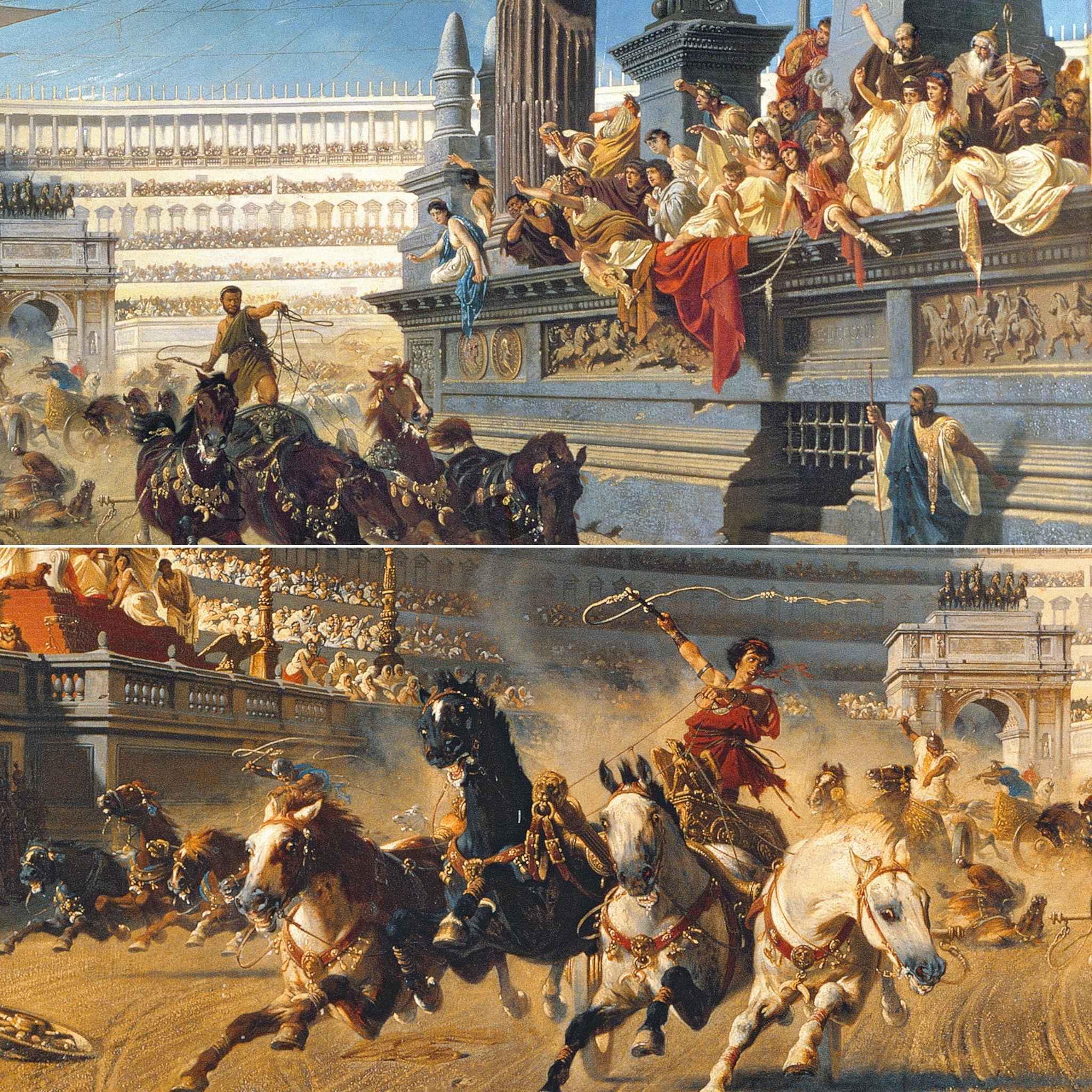
The roar of the audience could be heard across the city. Dust rose into the sky as teams of horses thundered around the track. Charioteers risked horrific injury and death for glory and fortune. Fans placed bets, cheered passionately for their favorite teams, and occasionally even turned to magic and curses in hopes of influencing the outcome.
At the center of it all stood the Circus Maximus, the largest sporting venue of the ancient world and the beating heart of Roman entertainment.
The origins of the Circus Maximus stretch deep into Roman legend. According to the historian Livy, the site played a role in one of the most famous stories of Rome’s founding — the abduction of the Sabine women. While historians regard the tale as myth rather than fact, it illustrates how closely public spectacles and political power were linked from Rome’s earliest days.
By the sixth century B.C., King Tarquin the Elder began transforming the valley between the Palatine and Aventine hills into a formal racing venue. Over the centuries, successive rulers expanded the structure until it became the largest entertainment complex in the Roman Empire.
Unlike modern sports arenas designed for a single activity, the Circus Maximus hosted a wide range of spectacles. Gladiatorial contests, athletic competitions, military reenactments, exotic animal hunts, and religious festivals all took place there. Yet no event generated more excitement than the chariot races.
The Greatest Stadium of the Ancient World
At its peak, ancient writers claimed the Circus Maximus could accommodate as many as 250,000 spectators. Whether that figure is entirely accurate remains debated, but there is no doubt that the venue was enormous.
The racetrack stretched approximately 1,900 feet (580 meters) in length and about 250 feet (76 meters) wide. Running down its center was the famous spina, a long divider decorated with shrines, fountains, statues, and Egyptian obelisks.
At either end stood the metae — turning posts that represented the most dangerous points on the circuit. Success or disaster often depended on how closely a driver could maneuver around these markers.
The races themselves usually consisted of seven laps. While each contest lasted only eight or nine minutes, the intensity was extraordinary. A single mistake could send horses and drivers crashing into one another in spectacular pileups.
Roman spectators loved every second of it.
The Teams That Ruled Roman Sport
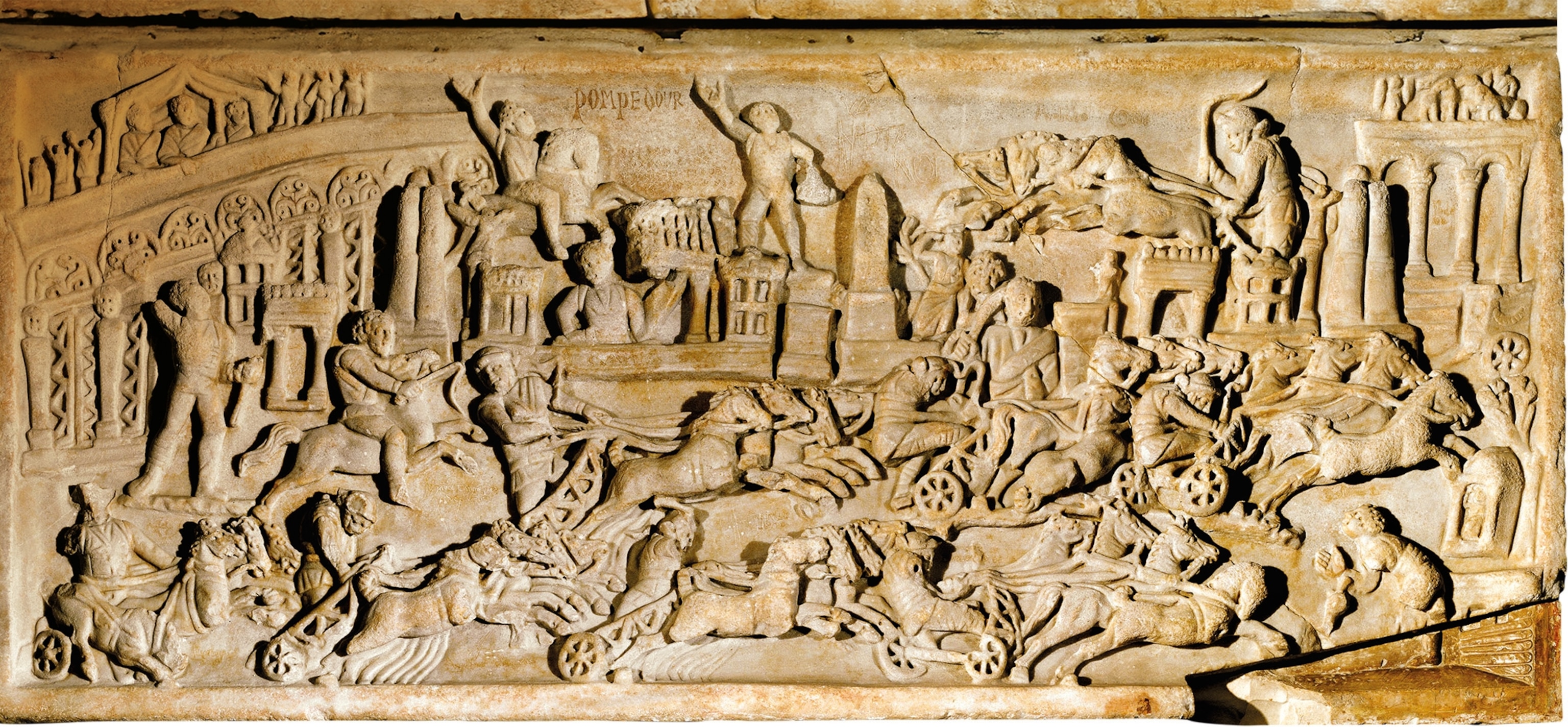
Roman chariot racing operated much like a professional sports league.
Drivers and horses belonged to powerful organizations known as factiones, or factions. Originally there were only two teams — the Reds and the Whites. Later, the Blues and Greens were added, creating fierce rivalries that divided the city.
Supporters were intensely loyal. Many inherited their allegiance from their families. Some fans followed their teams with a passion rivaling that seen in modern football stadiums.
Each faction employed trainers, veterinarians, craftsmen, horse breeders, and support staff. They invested enormous sums into developing faster horses and better equipment.
Success brought immense wealth. Victorious drivers earned prize money, gifts, and celebrity status throughout the empire.
Rome’s Superstar Athletes
Although most charioteers began life as slaves or freedmen, the most successful became among the richest and most famous individuals in Roman society.
One of the greatest stars was Gaius Appuleius Diocles.
Born in Roman Spain around A.D. 104, Diocles raced professionally for twenty-four years. During his career he competed in 4,257 races and achieved 1,462 victories.
His earnings were astonishing. Historians estimate that his prize money would be worth hundreds of millions of dollars today, making him arguably one of the highest-paid athletes in human history.
Crowds idolized drivers like Diocles. Their names appeared in inscriptions, graffiti, and public monuments. They enjoyed fame comparable to modern sports superstars.
Even certain horses became celebrities.
Successful racing horses were remembered long after their deaths, with fans recording their victories and breeding records for future generations.
The Quadriga: Rome’s Favorite Racing Machine

Several different types of racing chariots existed.
The biga was pulled by two horses. The triga used three. Occasionally races featured even larger teams.
But the undisputed favorite was the quadriga, a lightweight chariot drawn by four horses.
The design prioritized speed above all else. Chariots weighed as little as 55 to 65 pounds and rode on a single axle. Their narrow construction allowed them to accelerate quickly but also made them highly unstable.
Positioning the horses correctly was essential.
The horse nearest the spina needed exceptional strength and intelligence because it guided the entire team through dangerous turns. A poorly positioned horse could spell disaster for everyone involved.
The Grand Procession
Before racing began, spectators witnessed an elaborate ceremonial parade known as the pompa circensis.
The procession wound through Rome’s streets before entering the Circus Maximus.
Nobles, magistrates, priests, musicians, and charioteers all participated. Statues of gods were carried through the crowd while incense filled the air.
The event reinforced the religious significance of the games. For Romans, sport, politics, and religion were inseparable.
Every race honored divine powers as much as it entertained the public.
A Thunderous Beginning
As anticipation reached its peak, the competing chariots lined up inside the carceres, the starting gates.
Positions were determined by lottery. Some gates offered slight advantages, making luck an important factor before the race even began.
The sponsor of the games signaled the start by dropping a white cloth known as a mappa.
At that exact moment, trumpets sounded.
The gates burst open.
Four teams of horses exploded onto the track.
Ancient writers describe crowds instantly erupting into deafening cheers. Thousands of spectators leaned forward, shouting encouragement to their favorite drivers as the race began.
The thunder of hooves shook the arena.
Dust filled the air.
The contest had started.
Danger at Every Turn
Chariot racing was one of the most dangerous sports ever invented.
Drivers wrapped the reins around their waists to maintain better control of the horses. While effective, this practice created a deadly risk.
If a chariot crashed, the driver could become tangled in the reins and dragged across the track.
To counter this danger, charioteers carried knives attached to their belts. In an emergency, they could cut themselves free.
Unfortunately, many were not quick enough.
The Romans referred to catastrophic crashes as naufragia — literally “shipwrecks.”
The comparison was appropriate.
When a chariot clipped a turning post or collided with a rival, the resulting wreck could send horses, vehicles, and drivers tumbling together in a chaotic mass of splintered wood and flying bodies.
The crowd loved these dramatic accidents.
For spectators, danger was part of the attraction.
Strategy and Skill
Victory required far more than courage.
Successful charioteers needed exceptional tactical awareness.
Some drivers attempted to seize the lead immediately and maintain it throughout the race.
Others conserved energy and waited for rivals to tire before launching a late attack.
Positioning around the turns was critical. Hugging the spina shortened the distance traveled, but it also increased the risk of crashing into the metae.
Many races were won or lost by inches.
A perfectly executed turn could transform a trailing driver into the leader within seconds.
Gambling, Rivalries, and Magic
Betting was everywhere.
Spectators wagered money on individual races, drivers, and teams.
Large fortunes changed hands every racing day.
Yet some fans sought advantages beyond simple prediction.
Archaeologists have discovered numerous curse tablets buried around Roman racing venues. These thin sheets of lead contain inscriptions invoking supernatural forces against rival teams.
Some specifically name horses and drivers.
Others ask spirits to cripple opponents or cause catastrophic crashes.
Roman authorities occasionally prosecuted individuals accused of using magic to influence races.
Whether anyone genuinely believed such practices worked remains unclear.
What is certain is that fans were willing to try almost anything to secure victory.
More Than Entertainment
The Circus Maximus was not merely a sporting venue.
It was a political tool.
Roman leaders sponsored games to win public support. Successful events enhanced reputations and demonstrated generosity toward the population.
Emperors frequently attended races, using the occasion to appear before the people.
Crowds sometimes used the games to express political opinions. Cheers could quickly transform into protests if public dissatisfaction grew.
The arena therefore functioned as both entertainment center and political stage.
The Victorious Finish
As the final lap approached, excitement reached its peak.
Spectators stood and shouted.
Drivers pushed their horses to the limit.
Then, after seven exhausting circuits, one chariot crossed the finish line first.
Trumpets sounded again.
The winner received a palm branch and a laurel wreath, symbols of triumph recognized throughout the Roman world.
Prize money followed.
So did glory.
Victorious charioteers completed celebratory laps around the track while thousands of spectators cheered their achievement.
For a brief moment, a former slave or commoner could become the most celebrated individual in Rome.
The Legacy of the Circus Maximus
Today, only fragments remain of the structure that once dominated Roman entertainment.
Visitors can still walk through the valley where generations of Romans gathered to witness races that combined athletic skill, deadly risk, political ambition, and religious ceremony.
Yet the influence of the Circus Maximus extends far beyond archaeology.
Modern stadiums, professional sports teams, fan rivalries, celebrity athletes, sports betting, and even organized leagues all echo traditions that flourished nearly two thousand years ago in Rome.
The crowds may be gone, the horses long vanished, and the track silent.
But the spirit of competition that filled the Circus Maximus still survives in every stadium around the world.
For centuries, Romans came to this immense arena seeking excitement, glory, and escape from daily life. What they witnessed was far more than a race. It was one of the greatest spectacles ever created by human civilization — a roaring celebration of speed, skill, danger, and ambition that defined the Roman world.