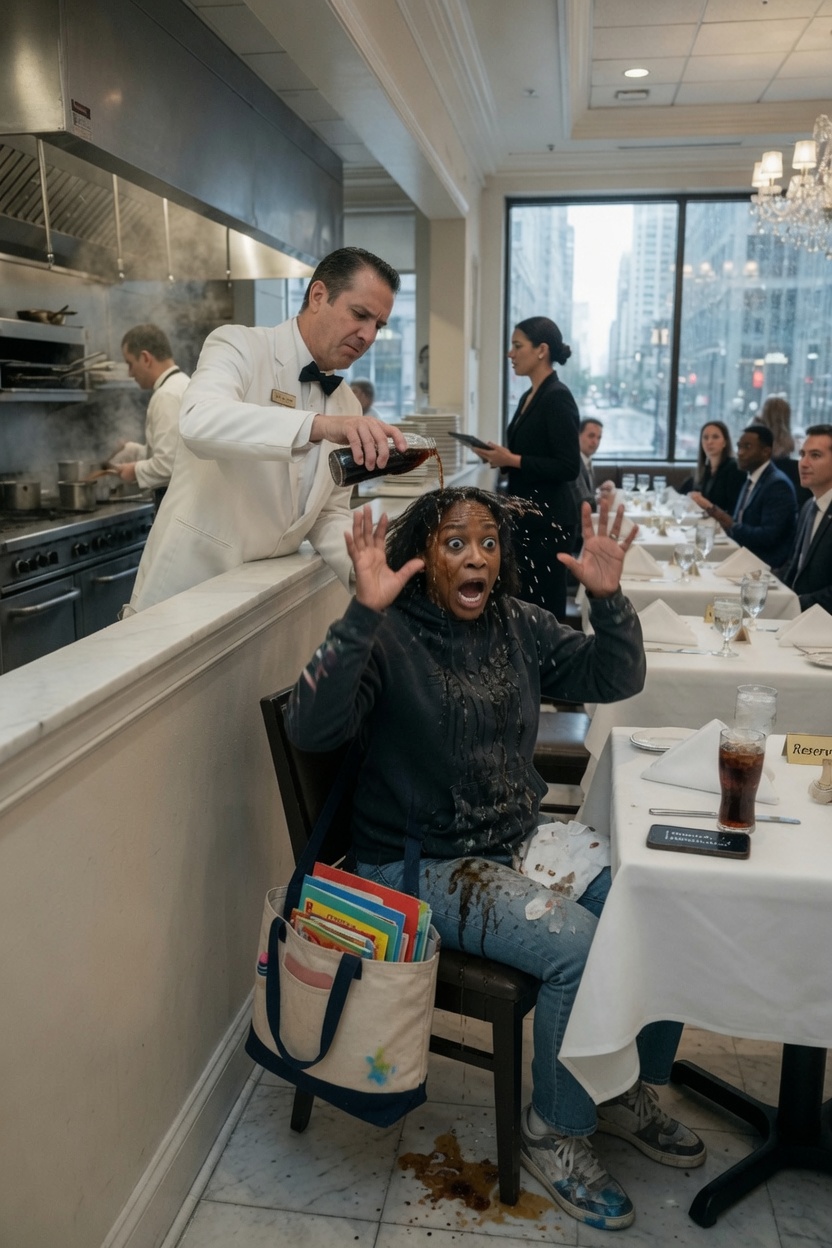
Alex Mercer had worked at Harlow’s for seven years, long enough to believe he could measure a guest’s value before they unfolded a napkin.
He was not the owner. He was not the chef. Until that week, he had not even been management.
But on Tuesday morning, Paul Okafor had promoted him to floor manager, and by Friday lunch Alex was already wearing the title like armor. He moved through the dining room with a narrow smile, correcting forks by a quarter inch, lowering his voice around important tables, and ignoring everyone who did not look like they could affect his tip or his future.
Diane saw that before he said a word.
“Are you waiting for someone?” Alex asked.
“Yes,” Diane said. “My husband.”
He looked at the second place setting, then at her tote bag on the chair beside her.
“You’ll need to keep that off the furniture.”
Diane moved the tote to the floor without argument. A corner of a children’s book slid out, bright yellow against the dark carpet.
Alex glanced at it.
His expression did not change, but something in his face settled. A conclusion had been reached.
“Would you like water while you wait?”
“There’s already water,” Diane said gently.
Alex looked at the glass, as if it had appeared there by accident. “Of course.”
She waited one beat. “Also, my husband reserved a window table. Would you mind checking?”
Alex’s eyes shifted toward the front of the restaurant. The window tables were still empty. One had a small card with Carter printed on it in black ink.
He picked up her menu and tapped it lightly against his palm.
“Those tables are being held.”
“For Carter?” Diane asked.
His smile thinned. “For confirmed parties.”
Diane looked at him for a moment. Not angrily. Not loudly. Just long enough for him to know she had heard every word underneath the words.
“My husband is on his way.”
“I’m sure he is.”
At the next table, a woman in pearls stopped cutting into her salad. Her lunch companion, a man with a silver watch, looked down at his plate with the discomfort of someone witnessing something wrong and deciding not to spend social capital on it.
Diane took out her phone and typed one sentence.
He says the window tables are for confirmed parties.
Marcus replied almost instantly.
I’m walking in.
Diane placed the phone face down.
Alex was still standing there.
“Would you like to order something inexpensive while you wait?” he asked.
The word landed softly.
That was how people like Alex did it. They rarely shouted. They rarely insulted directly. They used words wrapped in manners, small enough to deny, sharp enough to leave a mark.
Diane’s hand rested near the rim of her water glass.
“No, thank you.”
Alex nodded. “Of course.”
He turned away, but not before exchanging a look with the hostess. It was quick, practiced, almost invisible. A private little confirmation that they had both understood the same story about the woman in the hoodie by the kitchen.
Then Marcus Carter walked in.
The room recognized him before anyone introduced him.
Not because he demanded attention. Marcus never did. He entered quietly, tall and composed, in a charcoal suit that looked custom without trying too hard. But people who read business pages knew his face. People who served power for a living knew his name. The hostess straightened so fast she nearly knocked over the reservation tablet.
“Mr. Carter,” she said, suddenly warm. “Welcome back.”
Marcus’s eyes moved past her.
He found Diane near the kitchen.
For the first time, the hostess looked afraid of a table assignment.
Marcus did not raise his voice. He did not ask for a manager. He simply walked through the dining room toward his wife, passing the window table with his own name on it.
Diane looked up as he approached.
“You found it,” she said.
“I did.” He kissed her cheek and sat across from her at the bad table, as if it were the best seat in Chicago.
That small act changed the air.
The woman in pearls looked at Diane again, but differently now. The man with the silver watch suddenly became fascinated by his water glass. The hostess whispered something to Alex, and Alex turned.
For half a second, his face emptied.
Then he recovered.
“Mr. Carter,” he said, arriving at the table with a new voice. Softer. Lower. Full of respect he had not wasted earlier. “I apologize. There seems to have been a misunderstanding with your table. We can move you to the front immediately.”
Marcus looked at Diane.
Diane looked at the window table.
Then she looked back at Alex. “We’re fine here.”
Alex blinked.
Marcus leaned back slightly, watching his wife with the kind of calm that comes from years of knowing when not to interrupt.
“You’re sure?” he asked her.
Diane smiled faintly. “I already adjusted.”
Marcus nodded once. “Then we’re fine here.”
Alex stood there with two menus in his hand, unsure what to do with the respect he had prepared too late.
“Very good,” he said.
But it was not very good.
Not for him.
Because Diane had not caused a scene. She had not threatened him. She had not announced who she was, what she funded, whose name was on which building, or why Marcus Carter’s reservation mattered.
She simply ordered tea.
Marcus ordered coffee.
And for the next forty minutes, they had lunch beside the kitchen doors while the most expensive room in the restaurant slowly learned that the woman Alex had tried to hide was the one person at that table who had never needed the room’s approval.
Near the end of the meal, Alex returned with the check.
He placed it beside Marcus.
Diane reached for it first.
Alex’s fingers tightened slightly on the leather folder. “I can leave that with Mr. Carter.”
Diane looked up.
The dining room noise seemed to dip, just a little.
Marcus said nothing.
Diane kept her voice even. “You can leave it with me.”
Alex hesitated.
It was a tiny hesitation. Less than a second.
But everyone close enough to see it understood.
He did not believe the woman in the paint-stained hoodie belonged to the reservation, the table, the check, or the man sitting across from her.
Then Diane opened the folder, looked at the total, and placed a black card inside.
Alex saw the name.
Diane E. Carter.
His smile moved, but did not fully form.
And before he could speak, Diane’s phone lit up on the table.
A message preview appeared from someone named Paul Okafor.
Mrs. Carter, thank you again for meeting next week. We’re honored that the Carter Family Foundation is considering Harlow’s for the literacy luncheon.
Alex read just enough.
His hand stopped in midair.
Diane turned the phone over calmly.
“Whenever you’re ready,” she said.
For the first time since she walked in, Alex had no polished answer.