Underwater Military Ship and Ancient Burials Found at Egypt’s Sunken City of Thonis-Heracleion
New discoveries beneath Abu Qir Bay reveal a military vessel, Greek funerary remains, and traces of the multicultural world that once flourished at one of Egypt’s most important ancient ports.
Beneath the waters of Abu Qir Bay, just north of Alexandria, lies one of the most remarkable archaeological sites in the Mediterranean.
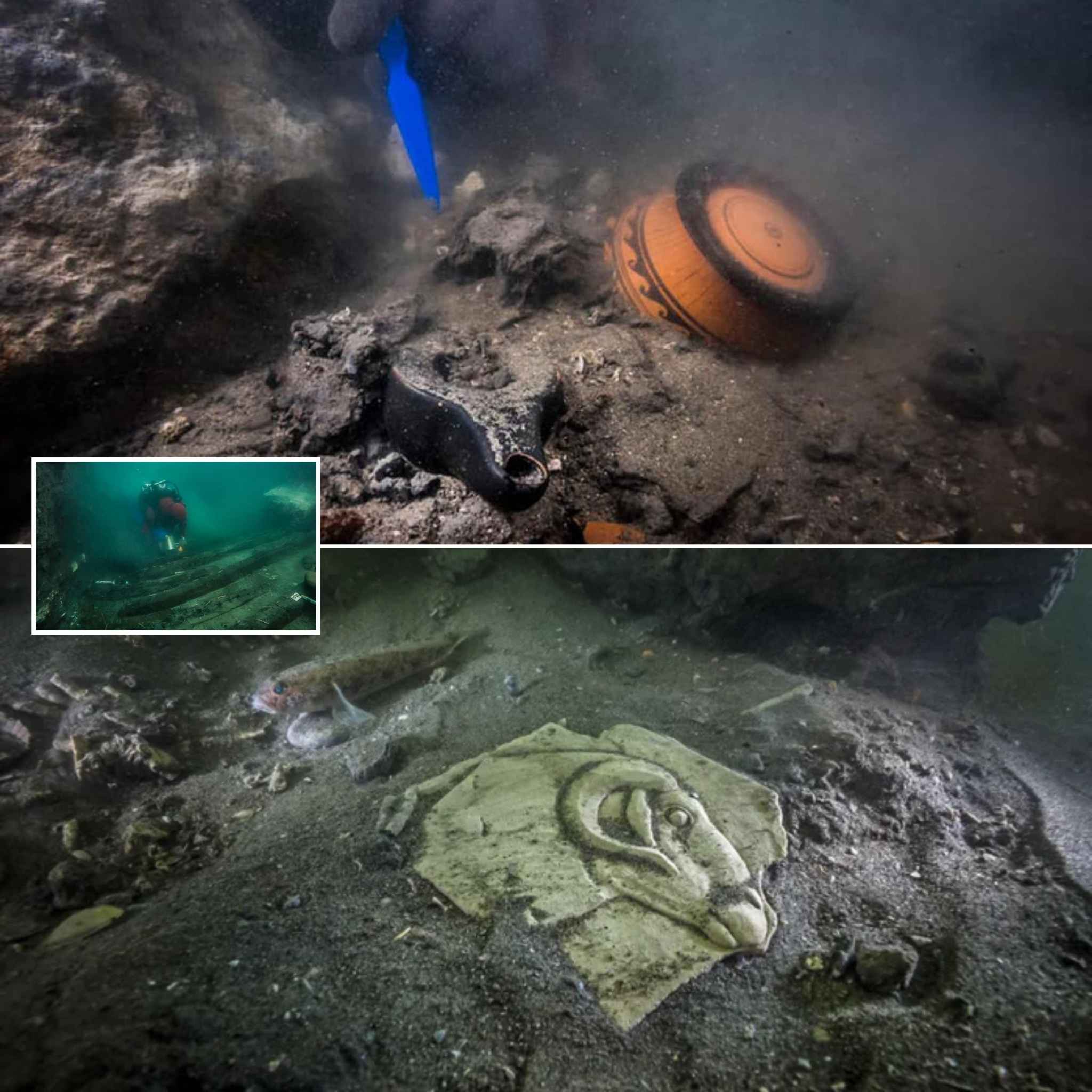
For centuries, the ancient city of Thonis-Heracleion was known mainly through scattered references in classical texts. It was described as a wealthy port, a gateway into Egypt, and a religious center where Egyptian and Greek cultures met. Yet for generations, many scholars were uncertain exactly where it had stood.
Then underwater archaeology changed the story.
In the late 1990s and early 2000s, researchers rediscovered the remains of Thonis-Heracleion and nearby Canopus beneath the sea. Since then, the submerged city has become a treasure house of ancient history, revealing temples, statues, inscriptions, ships, ritual objects, and traces of a lost urban world.
Now, new excavations have uncovered more remarkable evidence from the site: the remains of an ancient military ship, along with a Greek burial tumulus and a richly decorated funerary complex.
Together, the discoveries offer fresh insight into the final centuries of pharaonic Egypt, when native Egyptian traditions existed side by side with Greek settlement, trade, and religious life.
A City Lost Beneath the Sea
Thonis-Heracleion once stood near the mouth of the Canopic branch of the Nile, in what is now Abu Qir Bay.
Before Alexandria rose to prominence, the city served as one of Egypt’s key maritime gateways. Ships arriving from the Greek world passed through its harbor before entering the Nile Delta and traveling deeper into Egypt.
The city was also home to the famous Temple of Amun, an important religious sanctuary that drew worshippers, officials, merchants, and travelers.
Later, as Greeks settled in the region during Egypt’s late pharaonic dynasties, they built their own sanctuaries beside and around the older Egyptian temple complex.
The result was a vibrant island-city where Egyptian and Greek traditions overlapped.
But the landscape beneath the city was unstable.
At the end of the second century B.C., a series of natural disasters devastated the region. Earthquakes, tidal waves, and soil liquefaction affected a large section of the Nile Delta. As the ground collapsed and shifted, parts of Thonis-Heracleion and Canopus sank into the sea.
Temples, houses, ships, statues, and burial areas disappeared beneath the water.
For nearly two thousand years, the city remained hidden.
Rediscovery by Underwater Archaeologists
The modern rediscovery of Thonis-Heracleion was led by French underwater archaeologist Franck Goddio and the European Institute for Underwater Archaeology, working with Egypt’s Ministry of Tourism and Antiquities.
Canopus was rediscovered in 1999, followed by Thonis-Heracleion in 2001.
Since then, underwater excavations have revealed a sprawling ancient landscape located about 4.3 miles off Egypt’s modern coastline.
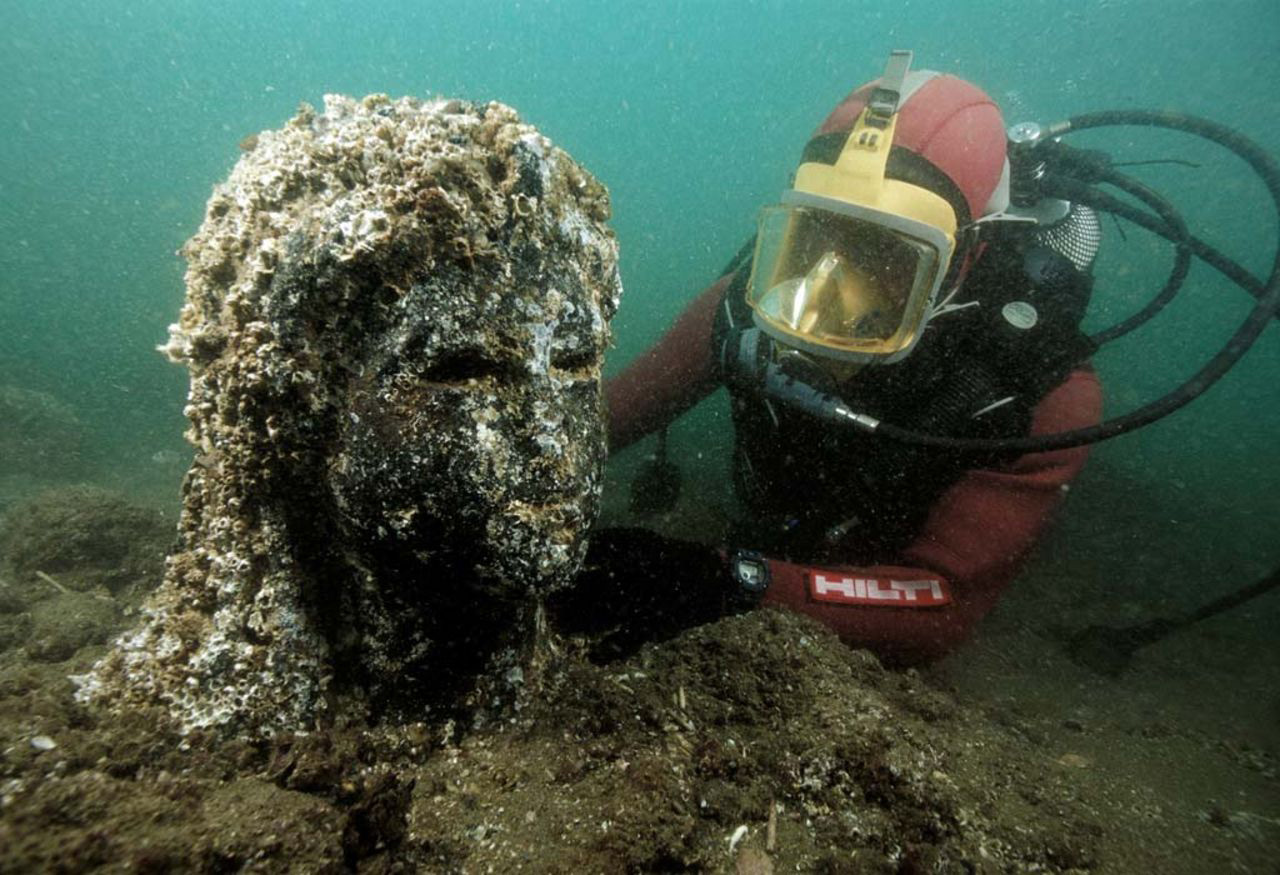
The site has produced an extraordinary range of finds, including colossal statues, temple remains, coins, jewelry, inscriptions, anchors, ceramics, and numerous ancient shipwrecks.
The latest discoveries add another important chapter to this underwater city’s story.
A Military Ship Beneath the Temple Ruins
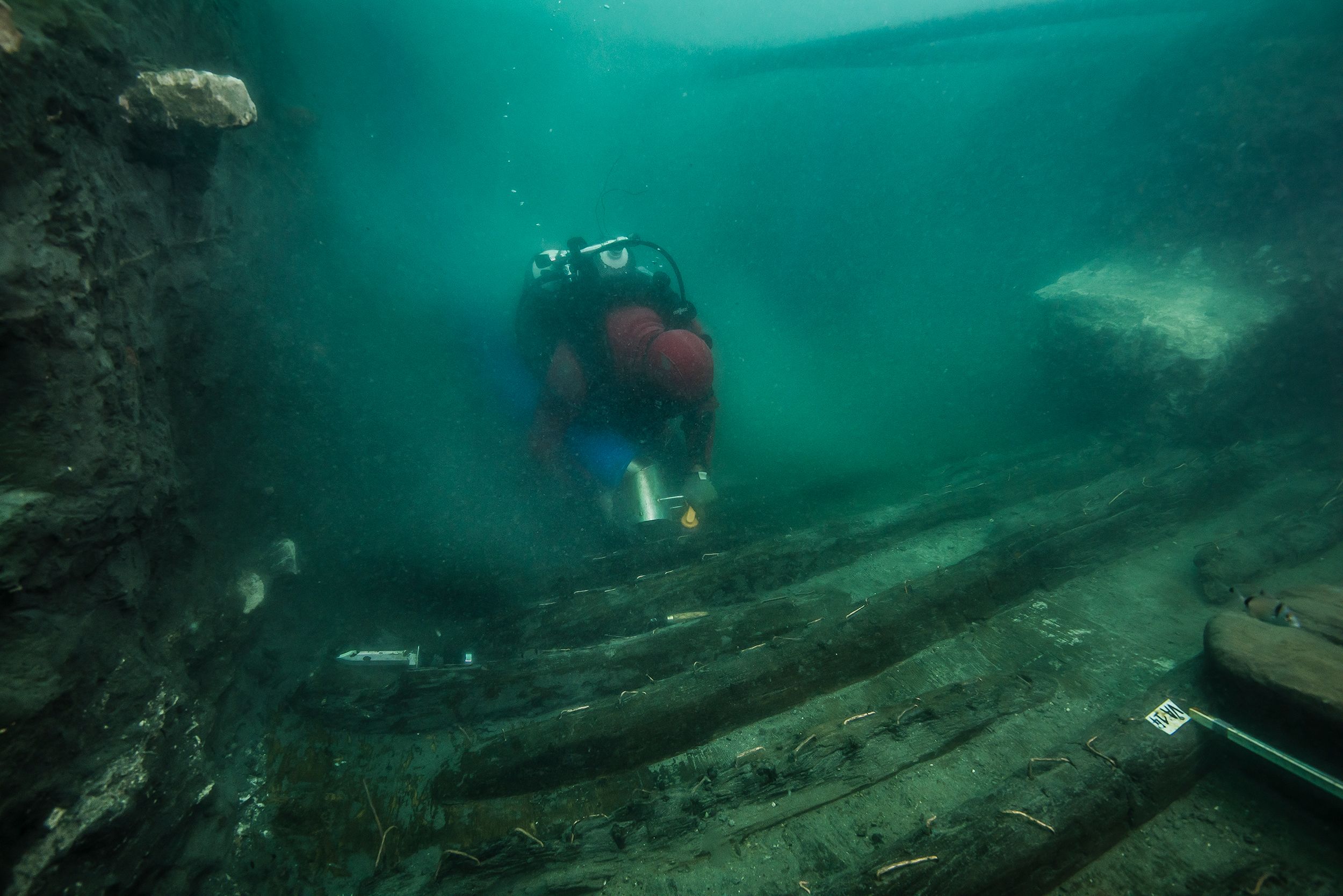
One of the most important discoveries is an ancient military vessel found in the main canal that once ran along the southern side of the Temple of Amun.
The ship measures approximately 82 feet long, or about 25 meters.
According to researchers, the vessel was found beneath nearly 16 feet of hard clay mixed with fallen temple debris.
This buried position helped preserve the ship for centuries.
Archaeologists believe the vessel may have been loading large stone blocks from the Temple of Amun when disaster struck. During the catastrophic collapse of the city, heavy blocks from the temple fell onto the ship, driving it down into the canal.
Those same blocks may have helped protect the wreck.
By pinning it to the bottom and sealing it beneath sediment, they preserved parts of the vessel that might otherwise have been destroyed by currents, marine organisms, or later disturbance.
Built for the Nile Delta
The ship’s design reveals much about the environment in which it operated.
Researchers describe it as a military vessel equipped with both a large sail and oars.
It also had a flat-bottomed hull, a practical feature for navigating the shallow and sometimes windless waterways of the Nile Delta.
Unlike deep-sea ships designed for open-water voyages, this vessel appears to have been built for river channels, coastal waters, and delta navigation.
Its construction combines classical Mediterranean shipbuilding traditions with distinctly Egyptian techniques.
The hull used long mortise-and-tenon joints, a method common in ancient shipbuilding. At the same time, the internal structure and evidence of reused timber suggest that the ship was built locally in Egypt.
This mixture of influences reflects the character of Thonis-Heracleion itself: a city where Egyptian and Greek worlds met, traded, worshipped, and worked side by side.
Technology Reveals the Hidden Wreck
The ship was not easy to find.
It was buried beneath thick layers of clay and temple debris, making it invisible to ordinary underwater survey methods.
Researchers detected it using advanced sub-bottom profiling equipment, technology designed to look beneath the seabed.
This tool sends signals into the sediment and records buried structures below the surface.
Without such equipment, the ship might have remained hidden indefinitely.
The discovery shows how modern technology is transforming underwater archaeology. Sites that were once unreachable or unreadable can now be mapped, scanned, and studied in remarkable detail.
In a place like Thonis-Heracleion, where entire city districts lie buried beneath sediment, such tools are essential.
A Greek Burial Tumulus
While the military vessel captured much of the attention, it was not the only important find.
In another part of the submerged city, archaeologists uncovered a Greek burial tumulus near the northeastern entrance to the canal.
A tumulus is a mound or raised burial structure, often associated with elite or ceremonial funerary practices.
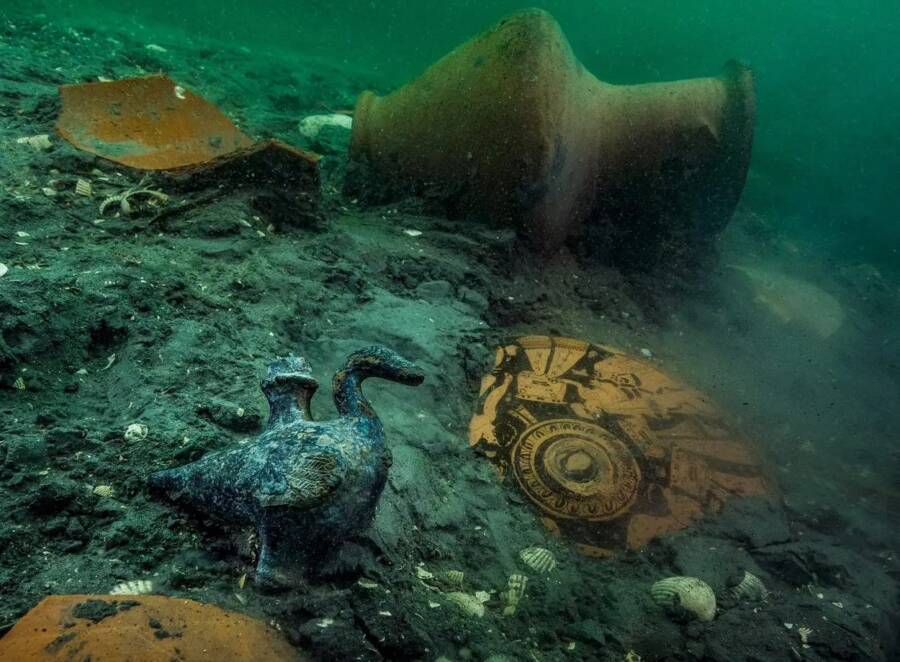
This funerary area contained rich offerings dating back to the early fourth century B.C.
The finds illustrate the wealth and influence of Greek merchants who lived and worked in Thonis-Heracleion during Egypt’s late pharaonic period.
At that time, Greek communities played an increasingly important role in Egyptian trade, especially in coastal and delta cities.
The burial complex shows that these communities were not temporary visitors. They had established a lasting presence, complete with sanctuaries, burial grounds, and social institutions.
A City of Two Traditions
The discoveries at Thonis-Heracleion reveal a city shaped by cultural exchange.
The older Egyptian Temple of Amun stood at the heart of the city’s sacred landscape.
Around it, Greek settlers built their own religious sanctuaries.
The newly discovered burials show that Greek communities maintained their own funerary customs while living within an Egyptian religious and commercial center.
This coexistence was not unusual in Egypt’s late dynastic period.
Greek traders, soldiers, and settlers had been present in Egypt for centuries before the arrival of Alexander the Great.
Their communities helped connect Egypt with the wider Mediterranean world.
Thonis-Heracleion, positioned at the entrance to the Nile, was one of the places where that connection was most visible.
The End of Thonis-Heracleion
The city’s destruction was not caused by war or abandonment, but by geology.
The Nile Delta is a dynamic and fragile environment.
Its soft sediments are vulnerable to shifting water levels, earthquakes, erosion, and liquefaction.
When earthquakes and tidal waves struck near the end of the second century B.C., large portions of the land lost stability.
Buildings collapsed.
Canals shifted.
Stone temples fell into waterways.
Eventually, sections of Thonis-Heracleion and Canopus sank below the sea.
For the people who lived there, the disaster must have been devastating.
For archaeologists today, the submerged environment has preserved a rare ancient landscape.
The same forces that destroyed the city also sealed parts of it beneath layers of mud and sediment.
Why the Discovery Matters
The military ship and burial complex provide important new evidence about daily life, trade, religion, and warfare in late ancient Egypt.
The ship shows that Thonis-Heracleion was not only a commercial port but also a place where military vessels operated.
Its construction reveals how local shipbuilders combined Egyptian and Mediterranean techniques.
The Greek burial tumulus highlights the role of foreign communities in the city’s social and economic life.
Together, the finds deepen our understanding of Egypt during a period of cultural transition.
They show a world in which Egyptians and Greeks shared space, exchanged ideas, and built institutions beside one another.
A Sunken City Still Revealing Its Story
More than two decades after its rediscovery, Thonis-Heracleion continues to transform our understanding of ancient Egypt’s Mediterranean connections.
Every excavation season reveals new pieces of the city’s lost world.
Its temples show the endurance of Egyptian religion.
Its Greek sanctuaries reveal foreign settlement and cultural exchange.
Its shipwrecks illuminate trade, transportation, and military life.
Its burials preserve the identities of communities that once lived at the edge of the Nile and the sea.
The newly discovered military ship and burial tumulus are not isolated finds. They are part of a larger story about a city that stood at the meeting point of cultures, economies, and sacred traditions.
For centuries, Thonis-Heracleion slept beneath the waters of Abu Qir Bay.
Now, piece by piece, it is returning to history.