 ## Part 1 — The Laugh
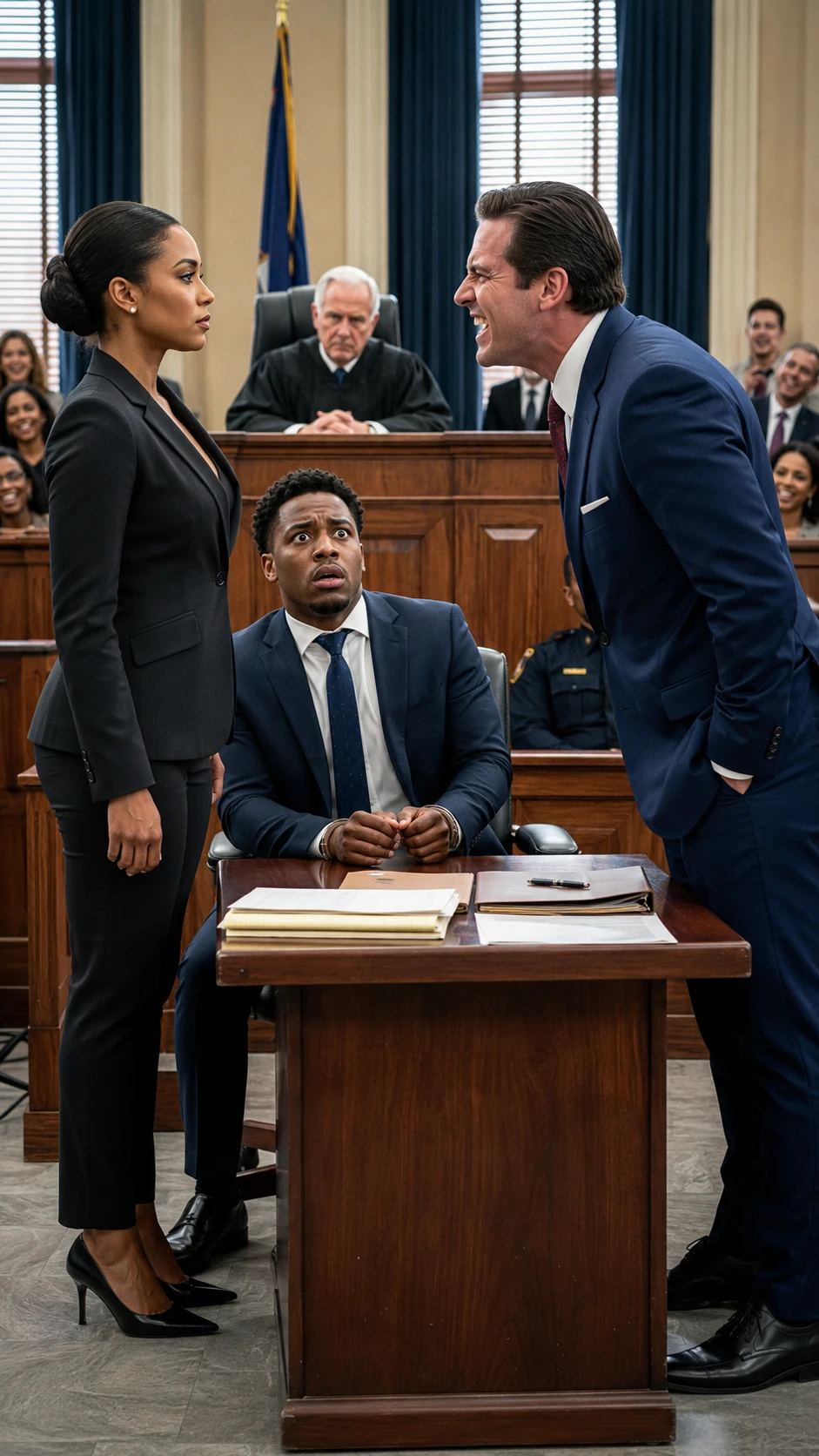
**“You can cry outside,”** the prosecutor said, and the laughter that followed was small, ugly, and perfectly legal. Naomi Bell did not cry. She did not even lower her eyes.
Her brother Marcus sat beside her at the defense table with his wrists chained in front of him, his shoulders rounded as if the whole courthouse had been built to press him smaller. The metal cuffs made him look guilty before anyone had proven a thing. That was how county arraignment court worked, Naomi had decided. It dressed fear in procedure and called it justice.
The courtroom smelled of old polish, damp wool coats, burnt coffee, and other people’s bad luck. A row of spectators sat behind the rail, some waiting for their own names to be called, others just enjoying the public theater of someone else’s ruin. The judge sat high above them with his hands folded, his face unreadable beneath the lights. The American flag in the corner stood stiff and silent.
Across the aisle, Prosecutor Raymond Voss smiled at Naomi as if she were an interruption. He was a handsome man in a way that made people forgive him too quickly. Gray at the temples, bright white shirt, red tie, perfect posture. His voice had the velvet cruelty of someone who had spent years learning how to humiliate people without raising it.
Naomi wore a soft black blazer, pearl studs, and low heels sensible enough for courthouse marble. Her hair was pinned cleanly back from her face. She had chosen everything carefully that morning because she knew men like Voss studied women before they spoke to them. They looked for trembling hands, bitten lips, soft places to press.
He would find none. Marcus leaned toward her and whispered, “Naomi, don’t.” His voice broke on her name.
She did not look at him right away. If she did, she would see the boy who used to wait outside her middle school classroom with a scraped knee and a grape soda, pretending he had come to protect her from bullies when he was the one who needed protection. She would see the man their mother had asked her to look after when the cancer spread to her bones. She would see the brother who had made mistakes, yes, but not this one.
Not the assault outside the Route 17 gas station. Not the blood on another man’s face. Not the version of events the state was selling.
The one thing that could prove it was a security video from the gas station. Three days earlier, it had existed. That morning, it was “corrupted.”
The public defender, Mr. Alan Price, looked as tired as the wooden benches. His jacket hung loosely from his shoulders, and his briefcase was scuffed pale at the corners. He had met Marcus only twice and Naomi once, in a hallway where he’d explained the plea offer in a voice that sounded like apology had become his second language.
“Three years if he pleads today,” Price had said. “Maybe less with good behavior.” “And if he doesn’t?” Naomi asked.
Price glanced away. “The prosecutor is threatening ten.” Marcus had laughed then, but not because anything was funny. “Ten years for standing there?”
“For being near the wrong man,” Naomi said softly. Now Voss tapped the plea folder on the table. “Your Honor, the state has been more than generous. Mr. Bell was identified near the scene.
The victim suffered significant injury. The defendant has prior disorderly conduct history.” “One college bar fight,” Naomi said quietly. Voss turned his head slowly.
“Excuse me?” The judge’s eyes moved to her. “Ms. Bell, you are not counsel of record.” “No, Your Honor,” she said.
“I understand.” Voss smiled wider. “Apparently not. Family members often confuse loyalty with evidence.”
Somebody behind Naomi laughed again. Marcus stared at the table. Naomi kept breathing. **Inhale. Hold. Release.**
Voss stepped closer to the defense table. “Your brother can take responsibility today, or he can gamble with a jury that will not be moved by your little silent performance.” That was the moment Naomi finally turned fully toward him.
“Mr. Voss,” she said, “you told defense counsel the original surveillance file was corrupted.” The courtroom changed temperature. It was slight. Almost invisible.
But Naomi felt it. The public defender stopped shuffling papers. The judge sat a fraction straighter. Voss’s smile held, but the corners stiffened.
“This is not a community meeting,” he said. “No,” Naomi replied. “It is an arraignment in a courtroom with a working record.” Marcus looked up.
Voss laughed once. “Your Honor, I don’t know what this woman thinks she is doing, but—” Naomi opened the slim leather folder on her lap.
Just one page sat inside. But Voss saw the seal at the top. And for the first time that morning, **his face forgot how to smile.**
## Part 2 — The Missing Eight Minutes
Naomi had not wanted power. Most people who had never held any believed power felt like triumph. Naomi knew better. Real power felt like weight.
It felt like waking at 3:17 in the morning, reading regulations by lamplight while your husband slept alone on his side of the bed. It felt like refusing to attend birthday dinners because the office had another emergency file. It felt like learning the exact difference between a mistake, negligence, and a cover-up.
For twenty-two years, Naomi Bell had worked inside the machinery of federal accountability. Not as a prosecutor. Not as a judge. Nothing so theatrical.
She was a regional evidence-preservation compliance officer attached to a federal oversight program that reviewed failures in state and local digital evidence systems when federal grant funds were involved. It was unglamorous work. Most people’s eyes glazed over when she explained it. But because the county had purchased its evidence portal with federal criminal justice money, certain rules applied.
Rules about chain of custody. Rules about deletion logs. Rules about original files. Rules about what happened when video evidence disappeared after a defendant requested it.
Naomi had spent her life studying the places where truth went to be misplaced. Marcus knew none of this in detail. To him, she was simply his older sister—the one who remembered appointments, fixed tax forms, brought soup, corrected grammar, and never let people talk over her twice. He knew she worked for “the government,” but not the part that mattered now.
Naomi had not told him because she had hoped it would not matter. Then the gas station video vanished. The night Marcus was arrested, Naomi had gone to the station herself. A clerk named Devon, no older than twenty, had whispered that the cameras worked and that the police had already copied the footage.
“What did it show?” Naomi asked. Devon looked toward the door. “Your brother didn’t hit anybody.”
“Then who did?” Devon’s face closed. “I can’t lose this job.”
The next day, Mr. Price requested the video. The day after that, Voss’s office replied that the file was corrupted during transfer. The day after that, Marcus was offered three years if he pled before noon.
Naomi knew timing. Timing was the fingerprint of corruption. So she made one phone call she had hoped never to make regarding her own family. She called her office.
By dawn, a preservation inquiry had been opened—not a trial, not an accusation, not a cavalry charge. Just a lawful hold on evidence systems connected to the case. Quiet. Official.
Unforgiving. The signed notice in Naomi’s folder was not a weapon. It was worse. It was a door Voss had not known was open behind him.
Back in the courtroom, he stared at the paper and regained his voice with effort. “Whatever she thinks she has,” he said, “it has no bearing on this proceeding.” Naomi lifted the page just enough for the judge to see the letterhead. “It has bearing on evidence preservation connected to this proceeding.”
The judge leaned forward. “Ms. Bell, approach.” Voss’s jaw tightened. “Your Honor, the state objects to this circus.”
The judge looked at him. “To what, precisely?” “To a family member attempting to intimidate the state.” Naomi stepped toward the bench.
Her low heels made soft, controlled sounds on the floor. She handed the page to the bailiff, who carried it up. The judge read. The courtroom waited.
Marcus watched Naomi as though she had become a stranger in the shape of his sister. She could feel his confusion and fear and hope reaching for her from across the room. Hope was dangerous in court. It made people stand too soon.
The judge looked down. “Ms. Bell, are you acting in any official capacity here today?” “No, Your Honor,” she said. “I am present as Marcus Bell’s sister.
But my agency issued that preservation notice independently this morning, after receiving information that digital evidence in this case may have been altered, withheld, or improperly described.” Voss exhaled loudly. “May have been. That is doing a lot of work.”
Naomi turned toward him. “So is corrupted.” A murmur moved through the gallery.
The judge tapped the page once. “Mr. Voss, was your office served with this notice?” Voss’s face tightened. “I received an email shortly before the docket began.”
“And you proceeded to pressure the defendant into a plea without disclosing that?” “Your Honor, an inquiry is not evidence.” “No,” Naomi said. “But missing evidence is.”
The judge raised a hand. “Ms. Bell.” She stopped immediately.
Voss seized the opening. “This is exactly what I mean. She is emotional. She is family. She is trying to rescue her brother from consequences.”
Naomi looked at him. There it was again. The old trick. Put a woman in a room, call her emotional, and hope no one noticed who was sweating.
“Your Honor,” Voss continued, “the state will not be intimidated by some grieving sister with a printed letter and an attitude.” Naomi turned slightly toward the court reporter. Her face remained calm.
But everyone close enough saw the shift. **The stillness became a blade.** “Your Honor,” she said, “before Mr. Voss continues, I respectfully ask that the courtroom recorder preserve the prosecutor’s last statement in full.”
No one laughed this time.
## Part 3 — The Man Who Thought He Owned The Room
Judge Ellery had served on the county bench for thirty-one years. He had seen fake tears, real collapse, bad lawyers, worse police reports, mothers fainting, fathers cursing, defendants lying, victims shaking, and prosecutors confusing punishment with virtue. He had also seen Raymond Voss rise.
Voss had come to the district attorney’s office fifteen years earlier with ambition polished brighter than his shoes. He won hard cases. He gave good press conferences. He spoke at Rotary breakfasts about community safety and shook hands with widows after sentencing hearings.
To the public, he was order wearing a navy suit. But inside the courthouse, people knew his appetite. He liked pleas fast. He liked defendants frightened.
He liked families silent. Naomi had read enough of his cases over the weekend to see the pattern. Missing body camera clips. Incomplete jail hallway footage.
Surveillance files “not retained.” Witness statements summarized instead of recorded. Always small enough to explain. Always happening to people with overworked attorneys and empty wallets.
Marcus was not special to Voss. That made Naomi angrier than if he had been.
The judge removed his glasses and rubbed the bridge of his nose. “Mr. Voss, I am going to ask you a direct question. Does the state possess any version of the gas station surveillance footage?”
Voss looked wounded. “Your Honor, as stated, the file received was corrupted.” “That was not my question.”
Price, the public defender, seemed to come alive beside Marcus. He leaned forward, his voice rough but steady. “Your Honor, we have requested the original file, transfer logs, upload logs, and any communication between law enforcement and the prosecutor’s office regarding the file.” “And?” the judge asked.
“We received a two-sentence email and a plea deadline.” Voss snapped, “The defense is exaggerating.” Naomi said nothing.
She did not need to. The judge looked at Voss. “Did you view the footage before it became corrupted?” Voss paused.
It was less than a second. But in court, a pause could scream. “I reviewed a summary,” he said.
“Prepared by whom?” “Detective Harlan.” Naomi watched the uniformed officer near the rear wall shift his weight. Detective Harlan.
There he was. Broad shoulders, silver watch, expression controlled badly. Marcus followed Naomi’s gaze and froze.
“That’s him,” Marcus whispered. Price heard him. “That is the arresting detective?” Marcus nodded.
“He told me nobody would believe me.” The judge’s eyes sharpened. “Mr. Bell, speak only through your counsel.” Marcus swallowed.
“Yes, sir.” Voss turned toward Marcus. “The defendant is now making accusations because his sister has coached him.” Naomi’s hands remained folded.
But inside her, something old stirred. When Marcus was fourteen, a store owner had accused him of stealing batteries because he had walked too slowly down the hardware aisle. Naomi, twenty-five then and already tired of asking politely, made the man review his own security tape. Marcus had not stolen anything.
He had been counting coins in his pocket to see if he could afford a flashlight. Afterward, Marcus had cried in her car, furious at himself for crying. “Don’t let them teach you shame that belongs to them,” Naomi had told him. Now, nearly fifteen years later, she wondered if he remembered.
The judge said, “We are going to take a brief recess.” Voss moved quickly. “Your Honor, before we do, the state asks that the plea offer remain open only until noon. We cannot allow proceedings to be derailed by insinuation.”
Naomi finally spoke again. “Marcus should not be forced to plead guilty while the status of exculpatory evidence is under federal preservation review.” Voss turned on her. “You do not get to decide what is exculpatory.”
“No,” Naomi said. “The evidence does.” Price stood. “Your Honor, defense moves to suspend the plea deadline, compel production of all digital evidence records, and release Mr. Bell on his own recognizance pending review.”
Marcus looked stunned. Release was a word he had stopped letting himself imagine. Voss laughed sharply. “Absolutely not. He is a danger.”
“To whom?” Naomi asked. “To public order,” Voss said.
Naomi looked at the gallery, then at the judge. “Public order was laughing at him five minutes ago.” Silence.
Judge Ellery studied her for a long moment. “Ms. Bell, you understand you are walking a narrow line.” “Yes, Your Honor.”
“And you understand this court does not take kindly to surprises.” Naomi’s eyes went to Voss. “Neither does my office.”
Voss flushed. The judge called recess. The gavel struck once. The courtroom erupted.
Reporters who had wandered in for routine arraignments suddenly started typing. The spectators whispered. Detective Harlan slipped toward the side door. Naomi saw him move.
So did Marcus. “He’s leaving,” Marcus said. Naomi turned her head only slightly.
At the back of the courtroom, Detective Harlan looked over his shoulder. Their eyes met. For one moment, his face showed not guilt, not fear, but recognition.
And Naomi understood with a coldness that reached her bones. **He knew her.** Not from today. From somewhere else.
## Part 4 — The Video That Was Never Gone
The hallway outside the courtroom was chaos dressed as marble. Voss stormed past Naomi without looking at her, phone already pressed to his ear. Detective Harlan had disappeared. Price hurried after Marcus, who was being led through a side door by the bailiff for the recess hold.
“Naomi!” Marcus called. She turned.
His eyes were wet. He hated that. She walked to him before the bailiff could stop her. “Listen to me.”
“I didn’t do it.” “I know.” “No, I mean—” His voice dropped. “I saw who did.”
Naomi went still. Marcus looked past her, terrified. “It was Harlan’s son.” For the first time that day, Naomi’s composure nearly broke.
“What?” Marcus swallowed hard. “The victim was arguing with some young guy outside the gas station. White kid, baseball jacket, drunk or high. He hit him with something.
I ran over after the man fell. Then Detective Harlan showed up later and kept asking why I touched him. I told him I checked if he was breathing.” Naomi felt the hallway tilt.
“Why didn’t you tell Price?” “I did. He said we needed proof.” Marcus’s mouth twisted. “Then the video disappeared.”
The bailiff shifted impatiently. “Ma’am, we have to move him.” Naomi touched two fingers to Marcus’s cuffed hands. It was the only contact allowed.
“Do not say another word without Mr. Price.” Marcus nodded. As they took him away, he called back, “Naomi?”
“Yes?” “Don’t let them make me disappear too.” That sentence entered her like a wound.
She stood in the hallway while people moved around her. Her phone buzzed once in her pocket. A secure message from her deputy director.
Preliminary system review complete. Original upload not corrupted. File was accessed, copied, and manually reclassified. Remote backup located. Hold escalated.
Naomi closed her eyes. Not in relief. In grief. Because every uncovered truth brought with it the question of how many had been buried before.
Price found her near the vending machines ten minutes later. “Ms. Bell.” “Naomi.” “Naomi.”
He looked different now. Less defeated. “What exactly is happening?” “The original footage may still exist.”
He gripped his briefcase. “May?” “It exists,” she said. “But I cannot hand it to you. There are protocols.”
He let out a breath. “Of course there are.” “File an emergency motion during recess. Ask for an evidentiary hearing.
Ask the judge to order all parties to remain available.” Price stared at her. “You do this every day, don’t you?” “No,” Naomi said.
“Usually the people being crushed are strangers.” He looked down, ashamed. “I should have pushed harder.” “Yes,” Naomi said.
He flinched. Then she added, “Push harder now.” When court resumed, the room had changed. Word had spread through the building.
Two reporters sat in the back row. Detective Harlan had returned, but he no longer leaned against the wall. He stood near the aisle with his arms crossed too tightly. Voss entered last.
His face was composed, but Naomi saw the strain around his eyes. Judge Ellery took the bench. “Mr. Price, I understand defense has a motion.”
Price rose. His voice shook once, then steadied. “Your Honor, defense moves for immediate production and review of the Route 17 gas station surveillance footage, all metadata, all access logs, and all communications regarding alteration, corruption, removal, or reclassification of that evidence. We further move that the plea deadline be vacated and that Mr. Bell be released pending this review.”
Voss stood before Price finished. “The state objects. This is fishing.” Naomi almost smiled.
Men like Voss always called it fishing when they knew there was blood in the water. The judge said, “Mr. Voss, sit down until counsel finishes.” Voss sat.
Price continued. “Additionally, Your Honor, my client has identified a potential alternate suspect connected to the investigating detective.” The courtroom inhaled.
Detective Harlan stepped forward. “Your Honor, this is outrageous.” The judge’s voice cracked like a door slamming. “Detective, you will sit down or leave.”
Harlan sat. Voss was on his feet again. “Your Honor, the state has no knowledge of any such connection.”
Naomi watched him carefully. No knowledge. Not “no connection.” Not “untrue.”
Just enough words to survive the moment. The judge looked at Naomi. “Ms. Bell, can your agency confirm whether the file exists?”
Voss objected before she spoke. “She should not be testifying.” “I am not asking for testimony on guilt,” the judge said. “I am asking about evidence preservation.”
Naomi stood. “Your Honor, I can state that a federal preservation hold has identified a recoverable version of the original uploaded surveillance file and associated access records. I cannot discuss contents without proper release.”
Marcus made a sound like air returning to his lungs. The judge turned to Voss. “You told this court the file was corrupted.”
Voss’s mouth opened. Then a woman in the back row stood. She was small, silver-haired, wearing a blue cardigan and holding her purse with both hands. Naomi recognized her from the gas station.
She was the clerk’s grandmother, the one who sometimes sat near the register in the afternoons. “My grandson gave them a copy,” the woman said. The judge stared. “Ma’am, sit down.”
But she did not. Her voice trembled. “He gave the detective a copy, and he kept another because he was scared. They came to our house last night.
They told Devon if he talked, he’d be charged with obstruction.” Voss went pale. Detective Harlan stood so fast his chair scraped backward.
The judge thundered, “Bailiff.” But the old woman kept speaking. “And that video doesn’t show Marcus Bell hitting anybody.” Naomi’s hands curled at her sides.
The woman looked straight at Voss. “It shows your son.” The courtroom exploded.
## Part 5 — She Did Not Lower Her Eyes
For three seconds, no authority in the room functioned. People shouted. Reporters surged upright. Marcus began crying openly now, not with shame but with the terrible relief of a drowning man breaking surface.
Price grabbed his shoulder and whispered, “Stay seated, stay seated.” Detective Harlan moved toward the old woman. The bailiff intercepted him.
“Sit down,” the bailiff ordered. “That woman is lying,” Harlan snapped. Naomi watched Voss.
That was where the answer would be. Raymond Voss did not look surprised. He looked ruined. The judge ordered silence twice before the room obeyed.
Then he said the words slowly, as if placing stones on a grave. “Mr. Voss, does this allegation involve your son?” Voss’s throat moved. “Your Honor, I—”
“Does it?” Voss looked toward the reporters. Then toward Harlan. Then, finally, toward Naomi.
And in his eyes she saw it all. Not the whole story, but enough. A son in trouble. A detective friend.
A defendant close enough to blame. A video inconvenient enough to vanish. A prosecutor arrogant enough to believe he could force a plea before anyone with power looked closely. Naomi had imagined many endings.
She had not imagined this much ugliness packed into one room. “My son was present,” Voss said. Marcus made a broken sound.
The judge’s face hardened. “Was your son identified in the surveillance footage?” Voss said nothing.
The silence answered. Price rose, fury giving his voice new life. “Your Honor, defense moves for immediate dismissal and sanctions, and requests that Mr. Bell be released from custody now.” Voss turned, suddenly desperate.
“The state can assign another prosecutor. This case is not—” “This case?” Price shouted. “You tried to bury my client alive to protect your son.”
Naomi looked at Price. He looked ashamed again, but this time he wore it properly, like a debt he intended to pay. Judge Ellery ordered Marcus uncuffed.
The bailiff hesitated only a second before unlocking the restraints. The sound of those cuffs opening was small. To Naomi, it was thunder.
Marcus stared at his free hands as if they belonged to someone else. Then he stood and turned toward Naomi. She stepped forward.
He folded into her arms like the boy with the scraped knee. “I was so scared,” he whispered. “I know.” “I thought nobody would believe me.”
Naomi held him tighter. “I believed you.” Across the room, Voss was speaking rapidly to the judge, to Harlan, to anyone who might still treat him as important.
But the room had shifted. Power had moved, quietly and completely, the way a tide moves around a stranded boat. Then the second twist came.
The old woman in the blue cardigan walked slowly toward Naomi. “Ms. Bell,” she said. Naomi released Marcus gently. “Yes?”
The woman opened her purse and removed a small flash drive attached to a plastic keychain shaped like a sunflower. “Devon told me to give this to the person who didn’t blink.” Naomi stared at it.
Price said, “Is that the video?” The old woman nodded. “Not just that one.”
Voss stopped talking. Naomi felt every eye turn. The woman’s hand shook as she held out the drive. “My grandson copies lots of things.
Not to be nosy. Because people come into that station after bad things happen, and sometimes the official stories don’t match what he saw.” Naomi took the drive with both hands.
The woman leaned closer. “There are folders on there. Dates. Names.
Detective Harlan. Mr. Voss. Other cases.” The courtroom seemed to recede.
Naomi heard her heartbeat. Other cases. Not one brother. Not one missing video.
A system. Voss whispered, “That material is stolen.” Naomi turned toward him. For the first time, she allowed herself the smallest expression.
Not a smile. Something colder. “No,” she said. “It sounds preserved.”
Judge Ellery ordered the drive placed under seal, federal authorities contacted, Detective Harlan detained for questioning, and Raymond Voss removed from the case pending investigation. His voice trembled with anger by the end. Perhaps at Voss.
Perhaps at himself. Perhaps at all the years he had mistaken neat paperwork for truth. Marcus was released that afternoon.
Outside the courthouse, the sky was painfully bright. Cameras waited on the steps. Reporters shouted Naomi’s name though she had never given it to them. Marcus stood beside her in the same wrinkled suit he had worn in chains, blinking at daylight like freedom was too large to understand.
“Are you going to make a statement?” Price asked. Naomi looked at Marcus. He looked back at her, and for once, she saw no boyhood shame in his face. Only exhaustion.
Only survival. “Just one,” she said. The reporters quieted when she stepped forward.
Naomi Bell stood on the courthouse steps in her soft black blazer, pearl studs bright against her skin, her hair still perfectly pinned though the day had tried to tear everything loose. She looked into the cameras, not angry, not triumphant, not broken.
“My brother was told to plead guilty because evidence disappeared,” she said. “Today, we learned the evidence was not gone. It was hidden.” A murmur moved through the crowd.
Naomi continued, each word steady. “So now the question is not only what happened to Marcus Bell. The question is how many people stood in rooms like that one, heard the state call them guilty, and never had anyone come looking for the missing truth.”
Behind her, Marcus lowered his head. Naomi did not.
Weeks later, the investigation widened beyond anything the county had ever seen. Cases reopened. Convictions questioned. Families who had stopped hoping received phone calls that made them sit down before they could speak.
Detective Harlan’s son was charged in the Route 17 assault. Harlan himself faced charges for evidence tampering and intimidation. Raymond Voss resigned before he was indicted, but resignation did not save him.
The flash drive became known in the press as **the Sunflower Archive**. But the final secret inside it was not about Voss. That was what no one saw coming.
At the bottom of the oldest folder was a video from twelve years earlier, outside a different store on a different night. The footage showed a young man being shoved against a police car by Detective Harlan while another man stood nearby, watching, saying nothing.
That silent watcher was Raymond Voss, younger then, not yet powerful. The young man in handcuffs was not Marcus. It was Naomi’s husband, Daniel.
Naomi sat alone in her kitchen when the federal investigator showed her the clip. Daniel had died six months after that arrest, officially from a heart condition no one in his family knew he had. Naomi had spent years believing grief was a locked room whose furniture she knew by touch.
But on the video, Daniel was alive. Afraid. Trying to speak.
Then Harlan leaned close to him and said something the camera did not catch. Daniel looked directly into the lens. Not at Harlan.
Not at Voss. At the camera. As if he knew someday Naomi would be watching.
In his hand, barely visible, was a folded receipt from the same gas station chain. On the back, enhanced later by technicians, Daniel had written six words before they took him away.
**If I vanish, follow the evidence.**
Naomi covered her mouth, but she did not cry. Not then. The investigator asked if she wanted to stop.
Naomi looked again at her husband’s face, at the man who had left her not with answers, but with a trail. She thought of Marcus’s cuffs opening. She thought of the old woman’s shaking hand. She thought of every person who had lowered their eyes because the room had taught them to.
Then Naomi Bell sat straighter. “No,” she said. “Play the next file.”


