Secret Graves at Pedralbes Monastery Reveal New Insights Into Medieval Catalonia
Archaeologists investigating the tombs of Barcelona’s Royal Monastery of Santa Maria de Pedralbes have uncovered the remains of Queen Elisenda de Montcada and a series of unexpected burials that are reshaping historians’ understanding of medieval life, death, and memory in Catalonia.
For seven centuries, the Royal Monastery of Santa Maria de Pedralbes has stood quietly on the outskirts of Barcelona, its Gothic cloisters and stone walls preserving the memory of one of medieval Spain’s most influential royal women.
Founded in the early fourteenth century by Queen Elisenda de Montcada, the monastery served as a spiritual center, a residence for noblewomen, and a symbol of royal authority. Generations of nuns, aristocrats, and religious leaders passed through its halls, leaving behind a rich historical legacy recorded in manuscripts, architecture, and tradition.
Yet some of the monastery’s most important stories remained hidden beneath its floors.
A recent archaeological investigation, launched as part of commemorations marking the monastery’s 700th anniversary, has opened a series of medieval tombs and revealed a far more complex picture of life and death at Pedralbes than historians had previously imagined.
Researchers recovered the remains of Queen Elisenda herself, confirming details about her final years. But they also encountered unexpected discoveries: skeletons bearing signs of violent injuries, a partially mummified pregnant woman, misidentified burials, and evidence of burial practices that had remained unknown for centuries.
Together, the findings are providing a rare glimpse into the realities of medieval Catalan society and challenging long-held assumptions about some of the monastery’s most famous occupants.
A Royal Foundation
The story of Pedralbes begins with Queen Elisenda de Montcada.
Born into one of Catalonia’s most powerful noble families, Elisenda married King James II of Aragon in 1322.
At the time, she was around thirty years old, while the king was in his mid-fifties.
Although the marriage was relatively brief, Elisenda quickly established herself as an influential figure within the royal court.
When James II’s health began to decline, Elisenda secured permission to establish a monastery for the Order of Saint Clare, commonly known as the Poor Clares.
The monastery was founded in 1326.
Only a year later, King James II died.
Rather than retreating completely from public life, Elisenda chose a unique path.
She moved into a small palace built adjacent to the monastery, where she remained closely connected to the religious community while continuing to exercise considerable influence over its affairs.
For nearly four decades, she oversaw the institution she had founded.
When she died in 1364, she was buried within the monastery that had become her life’s greatest legacy.
The Mystery of the Double Tomb
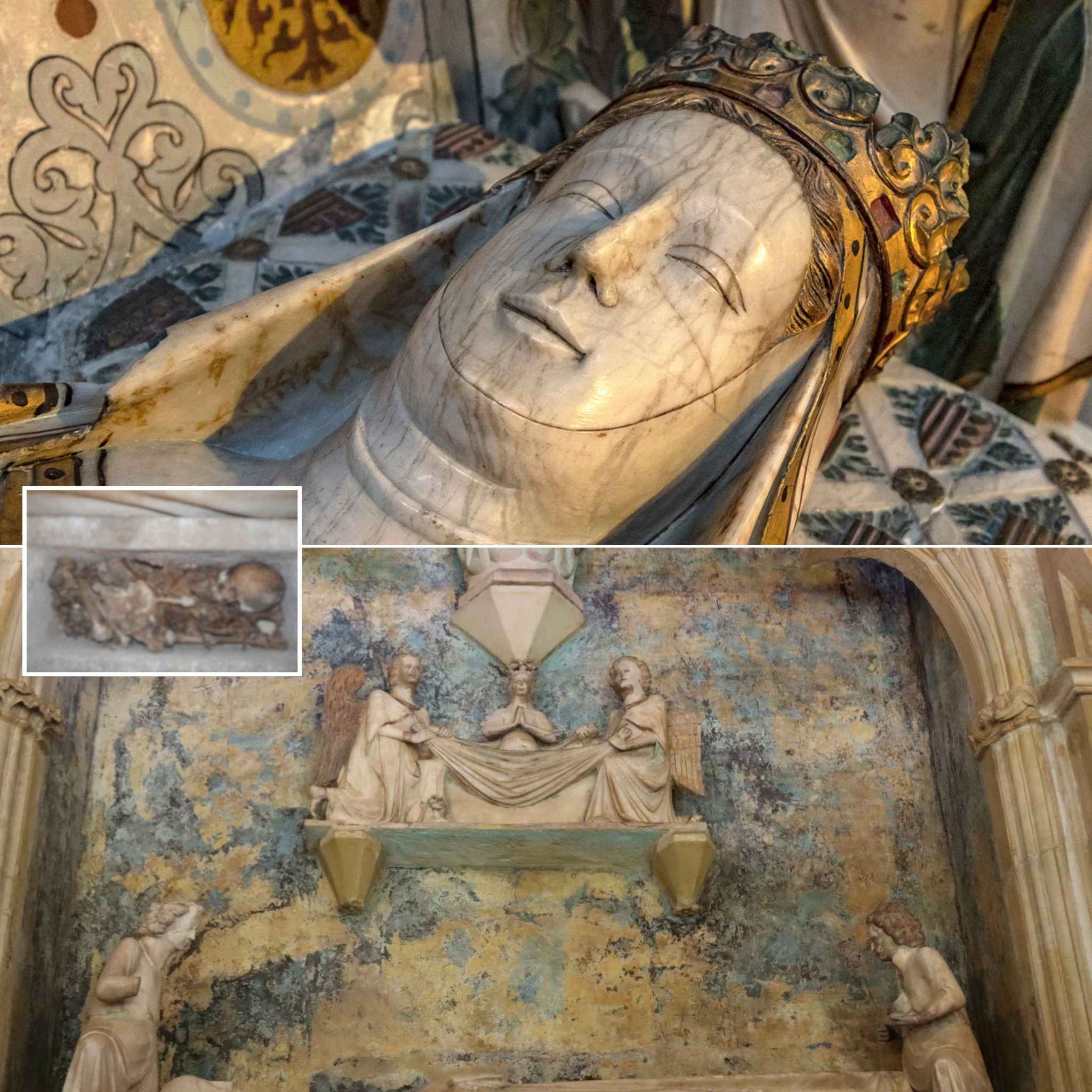
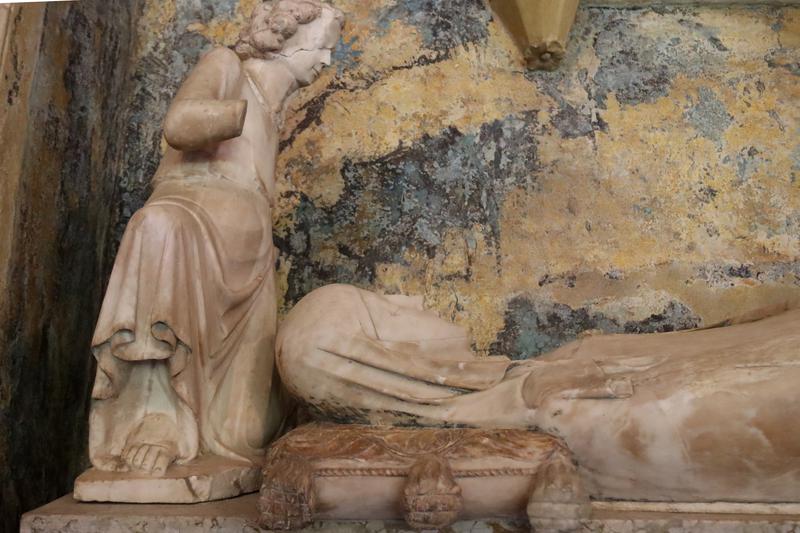
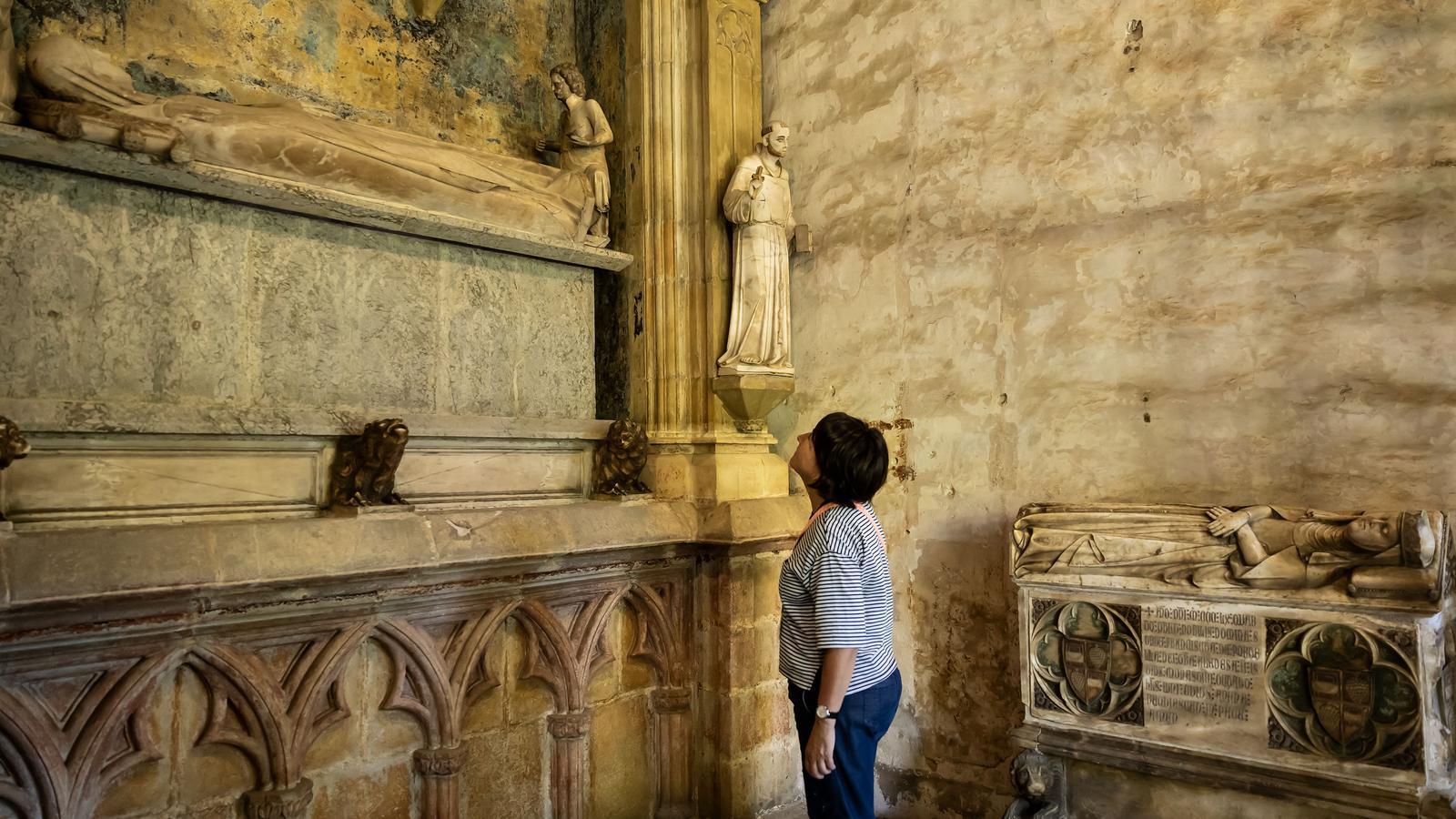
One of the monastery’s most famous features is Queen Elisenda’s monumental Gothic tomb.
For centuries, visitors admired its unusual design.
The tomb appears to span the wall separating the church from the cloister, creating the impression of a single burial monument visible from two different spaces.
Historians traditionally interpreted the structure as one elaborate sarcophagus viewed from opposite sides.
The recent excavation revealed something far more sophisticated.
Archaeologists discovered that the monument actually consists of two separate burial chambers, divided internally by a partition wall.
This arrangement was not accidental.
Instead, it reflected a carefully crafted symbolic message.
On the church side, Elisenda appears as a queen.
She is represented wearing royal attire and crowned as a sovereign ruler.
On the cloister side, however, she appears as a humble widow dressed in monastic clothing.
The design allowed her to embody two identities simultaneously.
To the public, she remained a queen.
To the religious community she supported, she appeared as a pious woman devoted to spiritual life.
The tomb thus served as both a political statement and a religious expression.
Recovering the Queen
When researchers finally examined the burial chamber, they found skeletal remains consistent with historical descriptions of Queen Elisenda.
Analysis revealed a woman who had lived to approximately seventy years of age, an impressive lifespan for the medieval period.
The skeleton showed evidence of several age-related conditions.
Among them were:
- Osteoarthritis
- Degenerative joint disease
- Metabolic health issues
These findings provide insight into the physical challenges Elisenda likely experienced during her later years.
Despite these ailments, historical records indicate that she remained active in monastery affairs until the end of her life.
The remains offer a rare opportunity to compare documentary evidence with physical reality.
In many respects, the archaeology confirmed what historians already suspected.
Elsewhere in the monastery, however, the excavations produced far more surprising results.
An Abbess’s Tomb Full of Secrets
One of the most unexpected discoveries came from the tomb traditionally associated with Francesca Saportella, the monastery’s second abbess and Queen Elisenda’s niece.
Researchers expected to find the remains of a single prominent religious leader.
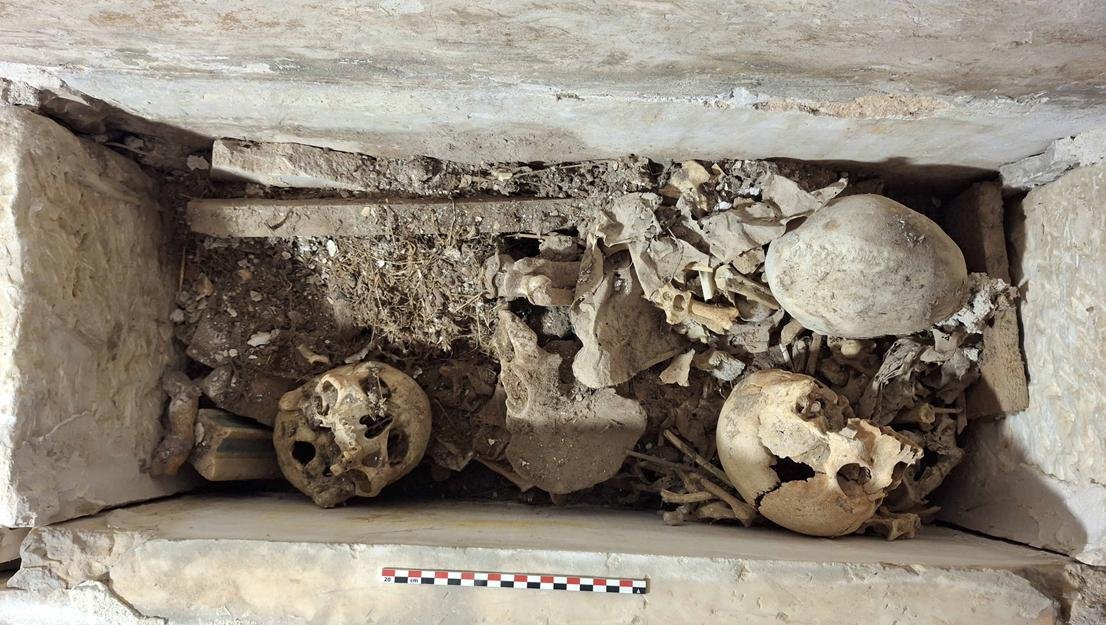
Instead, they encountered a complex and crowded burial containing at least nine individuals.
The tomb included:
- Multiple adult skeletons
- Several children
- Four adult male skulls
- A partially mummified woman
The male skulls attracted immediate attention.
Each showed evidence of fatal injuries inflicted by bladed weapons.
The wounds suggest violent deaths, although the exact circumstances remain unknown.
Such injuries are unusual within a monastic burial setting and have prompted significant debate among researchers.
Who were these men?
Why were they buried inside the tomb of an abbess?
And what events led to their deaths?
At present, no definitive answers exist.
Researchers hope that ongoing DNA analysis and historical investigation may provide additional clues.
The Mummified Woman
Perhaps the most poignant discovery within Francesca Saportella’s tomb was the remains of a pregnant woman.
Part of her torso had naturally mummified, preserving soft tissue alongside skeletal remains.
Even more remarkable was the presence of a fetus approximately twenty-two weeks into gestation.
The discovery offers a rare glimpse into medieval maternal mortality.
Pregnancy and childbirth carried significant risks throughout the Middle Ages.
Many women died from complications that modern medicine can now prevent or treat.
Although researchers cannot yet determine the precise cause of death, the burial provides an intimate reminder of those dangers.
The tomb appears to have been reopened and reused repeatedly over several centuries.
This practice may explain why so many individuals ended up interred together.
Historical evidence suggests that some of the later burials could date as recently as the early nineteenth century, during the Peninsular War.
If so, the violent injuries observed on the male skulls may relate to conflicts from that period rather than the medieval era.
Another Abbess, Another Mystery
The tomb of Sobirana Olzet, the monastery’s first abbess, also produced unexpected evidence.
Researchers discovered that her skull bore signs of a serious facial injury inflicted by a sharp object.
Whether the injury resulted from violence, an accident, or a medical procedure remains unclear.
The finding nevertheless highlights how physical evidence can reveal details absent from written records.
Medieval documents often emphasize religious achievements and institutional history.
They rarely describe personal injuries, illnesses, or daily hardships.
Archaeology helps fill those gaps.
In doing so, it humanizes historical figures who might otherwise remain little more than names in manuscripts.
A Knight Who Wasn’t There
Perhaps the most surprising challenge to traditional historical interpretations came from another tomb.
For generations, one burial had been identified as the resting place of Artau de Foces, a notable medieval knight associated with the Crown of Aragon.
Excavation overturned that assumption entirely.
Researchers found no male remains in the tomb.
Instead, they uncovered:
- Two young women
- Three children
One of the women retained an extraordinary feature: a long ponytail of preserved hair that had survived nearly seven hundred years.
The discovery raises important questions about historical memory and burial identification.
If this tomb was incorrectly attributed for centuries, how many other medieval burials across Europe might also be misidentified?
Archaeological evidence increasingly demonstrates that assumptions based solely on tradition can sometimes be misleading.
Medieval Burial Practices Revealed
The project has also shed light on medieval funerary customs.
Researchers collected more than two hundred soil samples from the graves.
Analysis of plant remains revealed that different individuals were buried with carefully selected botanical materials.
Queen Elisenda’s coffin contained:
- Dill
- Rosemary
- Myrtle
Other noblewomen were associated with:
- Wormwood
- Broom flowers
These plants likely served multiple purposes.
Some possessed symbolic religious meanings.
Others may have helped mask odors during funeral preparations.
Certain species also contain natural compounds that can slow decomposition.
Together, they illustrate the care invested in medieval burial rituals.
Death was not simply a biological event.
It was a deeply spiritual and social process shaped by tradition, status, and belief.
DNA and the Future of the Investigation
The most advanced phase of the project is still underway.
Researchers are conducting extensive paleogenomic analysis on the recovered remains.
The goal is to reconstruct biological relationships among individuals buried within the monastery.
DNA evidence may reveal:
- Family connections
- Geographic origins
- Genetic health conditions
- Evidence of infectious diseases
Scientists hope to establish whether some of the individuals buried together were related by blood or merely connected through the monastery community.
The results may also clarify the identities of several individuals whose historical records remain incomplete.
This work is expected to continue through 2027.
Rewriting the Human Story of Pedralbes
The archaeological investigation has done far more than confirm the location of Queen Elisenda’s remains.
It has transformed understanding of the people who lived, worshipped, and died at Pedralbes.
The findings reveal a community shaped not only by spirituality and royal patronage but also by violence, illness, childbirth, family relationships, and social change.
The monastery’s history is no longer limited to documents and architecture.
It now includes the voices of individuals whose stories survived only in their bones.
For centuries, those stories remained hidden beneath stone floors and sealed tombs.
Today, archaeology is bringing them back into the light.
A Window Into Medieval Catalonia
The discoveries at Pedralbes remind us that history is rarely as simple as it appears.
Beneath familiar monuments often lie unexpected realities.
A queen’s tomb becomes a symbol of dual identity.
An abbess’s grave contains evidence of violence and tragedy.
A celebrated knight turns out not to be there at all.
Each revelation deepens understanding of medieval Catalonia and the people who shaped it.
As scientific analysis continues, the monastery will likely yield even more insights.
For now, the excavations have already achieved something remarkable: they have transformed a collection of ancient graves into a vivid portrait of life, death, faith, and memory in one of medieval Spain’s most important religious communities.
Seven hundred years after their burial, the residents of Pedralbes are finally telling their stories.