 Part 2: The House With Too Many Locked Doors
Harper did not sleep.
She tried. She took off her diner uniform, washed the alley grime from her hands, and sat on the edge of her mattress in the tiny room she rented above a closed laundromat on East Mercer. The radiator clanked like it was arguing with the building. Somewhere downstairs, water dripped steadily into a bucket the landlord had promised to fix three months ago.
The black card sat on her windowsill.
No name.
No company.
Only a phone number printed in silver.
By 3:17 a.m., Harper had convinced herself it was a bad idea. By 4:05, she had decided desperate people did not always get the luxury of good ideas. By 6:30, after checking her bank balance and seeing twenty-eight dollars and forty cents, she picked up her phone.
Her thumb hovered over the number.
Then she pressed call.
One ring.
A woman answered. “Yes.”
Harper sat up straighter. “My name is Harper Reeves. Mr. Blackstone gave me this number last night.”
There was a pause, brief but deliberate, as if the woman had already known and was simply confirming the shape of Harper’s voice.
“Be outside your residence in forty minutes,” the woman said. “Wear something clean and bring identification.”
“I have class at ten.”
“Your appointment will not interfere with your class.”
“I didn’t say I was accepting anything.”
“No,” the woman replied. “You called.”
Then the line went dead.
Harper stared at the screen.
At 7:10, a black sedan pulled up outside the laundromat.
Not a rideshare. Not a taxi. A car so clean the morning looked dirty around it.
The driver stepped out, opened the rear door, and said, “Miss Reeves.”
Harper looked up and down the street. No one else was awake except a man salting the sidewalk outside the pawnshop.
She got in.
The car smelled like leather, cedar, and money. The kind of money that did not need to announce itself. It simply existed and expected the world to move around it.
As the sedan crossed the city, Harper watched familiar streets change into streets she had only seen from bus windows. Cracked sidewalks became clean stone. Dollar stores became private galleries. Apartment blocks became townhouses with polished brass numbers and winter planters arranged by someone who had probably never carried groceries home in the snow.
Then they reached the hill.
Everyone knew about the Blackstone house.
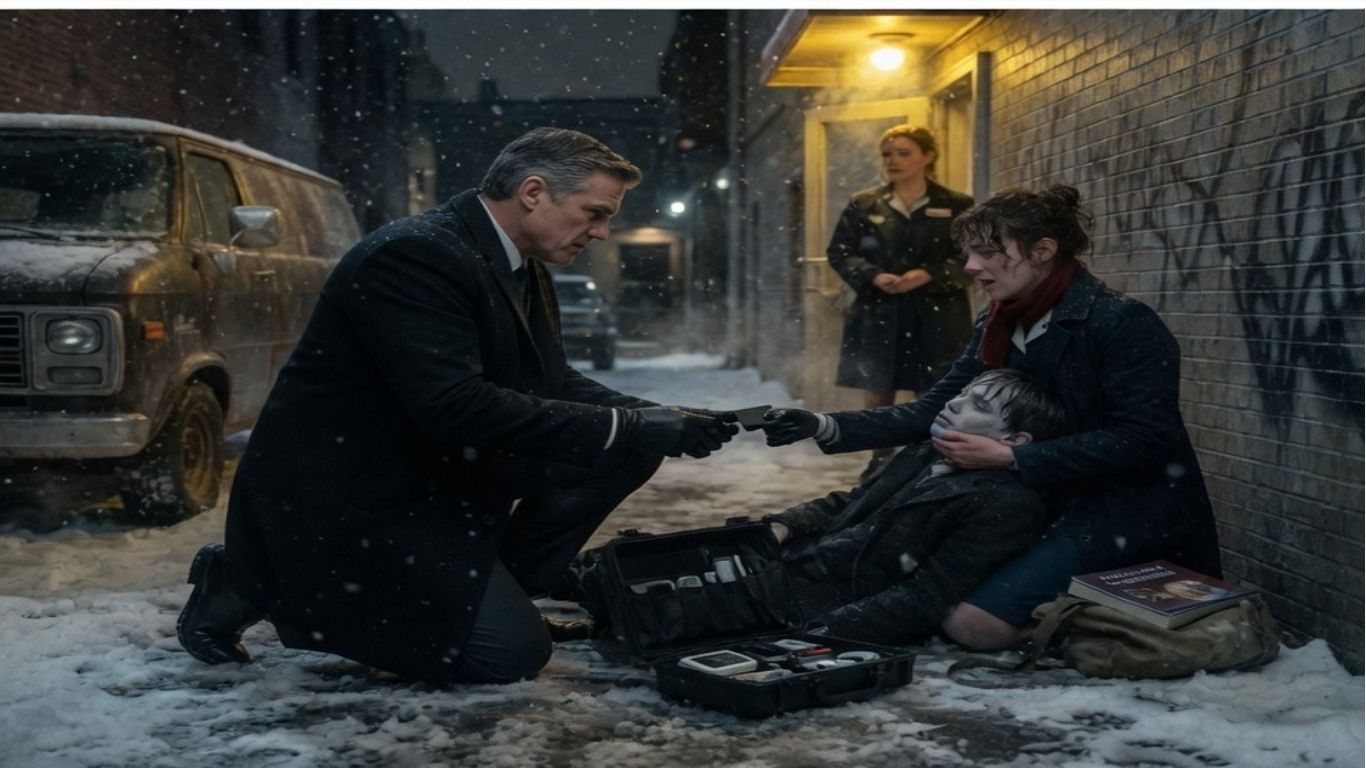 People called it a mansion, but that word felt too cheerful. It sat behind iron gates at the top of Briar Hill, surrounded by old trees and security cameras that turned almost invisibly as the car approached. The gate opened before the driver touched anything.
Harper’s stomach tightened.
The driveway curved through a quiet stretch of white lawn, then stopped before a stone house the size of a courthouse. Tall windows. Black doors. No holiday decorations. No warmth from the outside.
Just order.
A woman in her sixties waited at the entrance, hair pinned neatly, expression calm enough to make Harper feel unprepared.
“I am Mrs. Chen,” she said. “You may leave your coat here.”
Harper hesitated before handing it over. It was the only coat she owned.
Mrs. Chen noticed, but did not comment.
The foyer was larger than Joe’s Diner. Marble floors. Dark wood staircase. Paintings in heavy frames. Fresh flowers in a vase taller than Harper’s kitchen table. Nothing was out of place. Nothing looked touched by accident.
Mrs. Chen led her down a hall where two men stood near a doorway pretending not to be guards.
They were very bad at pretending.
At the end of the hall, James Blackstone stood beside a window with his back to the room. Morning light cut across his black suit, sharp and pale. He did not turn immediately.
“You came,” he said.
“You sent a car.”
“That does not answer the question.”
Harper lifted her chin. “I came to hear the offer.”
Only then did he turn.
In daylight, he looked less like the man from the alley and more like the version people whispered about. Controlled. Expensive. Unreadable. The bruise of sleeplessness beneath his eyes was the only human thing on his face.
“Nicholas is stable,” he said.
Harper released a breath she had not realized she was holding. “Good.”
“He asked whether you were paid.”
“For what?”
“For saving him.”
Harper frowned. “No.”
“He seemed offended.”
“That I wasn’t paid?”
“That I had not thought of it first.”
For a moment, something almost soft touched Blackstone’s expression. It was gone quickly.
He gestured toward the chair across from his desk. Harper sat, balancing her bag on her knees. The office was lined with shelves, but very few books looked decorative. There were framed photographs too, though not many. One of Nicholas at about seven, holding a soccer trophy. One of James Blackstone younger, standing beside a woman with dark hair and a smile that made the whole room seem less severe.
Harper looked away before he caught her studying it.
He caught her anyway.
“My son has Type 1 diabetes,” Blackstone said. “Diagnosed at six. He is intelligent, stubborn, and convinced that needing help makes him weak.”
“That’s not uncommon.”
“No. It is dangerous.”
Harper waited.
“I need someone with medical training to monitor him closely. Someone who can recognize symptoms early, respond without panic, and keep private matters private.”
“You need a nurse.”
“I need someone he will not immediately reject.”
Harper gave him a look. “You met me for twelve minutes in an alley.”
“And in those twelve minutes, you assessed a medical emergency, contradicted me when necessary, protected my son from exposure, and did not ask for anything afterward.”
“I didn’t protect him from exposure. I just didn’t livestream a kid almost dying.”
“Again,” Blackstone said, “rare.”
Harper tightened her hands around the strap of her bag. “I’m still in school.”
“I know.”
Of course he did.
He opened a folder and slid one page across the desk.
Harper looked down.
Her name. Her college. Her work schedule. Her overdue tuition balance. Her clinical placement application. Even her address.
Her throat went cold.
“You had me investigated.”
“I had you verified.”
“That sounds cleaner.”
“It is not.”
She stood. “I think we’re done.”
Blackstone did not move. “Sit down, Miss Reeves.”
“No.”
The word came out before fear could stop it.
For the first time since she entered the room, James Blackstone looked fully at her. Not past her. Not through her. At her.
The silence stretched.
Then he closed the folder.
“You are right,” he said.
Harper blinked.
“I crossed a line before asking permission. In my world, waiting politely can get people killed. That does not make it acceptable in yours.”
That answer disarmed her more than an argument would have.
She did not sit, but she also did not leave.
Blackstone continued. “The position pays eight thousand dollars a month. Housing provided. Tuition covered. Schedule coordinated with your nursing program. You will accompany Nicholas to school events, appointments, and public engagements where necessary. You will not discuss this household with anyone. You will not enter locked rooms. You will not ask about business that does not concern Nicholas. You will report medical issues to me directly.”
Harper stared at him.
Eight thousand dollars a month.
For a second, the number made no sense. Her mind tried to translate it into rent, textbooks, groceries, bus passes, lab fees, nights without panic.
“That’s too much,” she said quietly.
“No,” Blackstone said. “It is enough to make refusal honest.”
Before Harper could answer, the office door opened.
Nicholas stood there in a school sweater, face pale but sharper than the night before. He looked from his father to Harper, then to the paper on the desk.
“Oh, you’ve got to be kidding me.”
“Nicholas,” Blackstone said.
“You hired the alley girl?”
Harper raised an eyebrow. “Nice to see you conscious too.”
Nicholas flushed, but covered it with irritation. “I don’t need a babysitter.”
“You collapsed behind a diner,” his father said.
“I forgot my kit one time.”
“You nearly died one time.”
The room went still.
Nicholas looked away first.
Harper saw it then, beneath the expensive clothes and the anger. Shame. Not drama. Not teenage moodiness. A deep, exhausted shame that had probably been following him for years. The kind that made a kid hide symptoms until hiding became more dangerous than the disease.
“I’m not here to embarrass you,” Harper said.
Nicholas gave a bitter laugh. “That’s literally the job.”
“No. The job is to make sure you don’t end up unconscious in an alley because you’d rather pretend you’re fine.”
His eyes snapped to hers.
Blackstone said nothing.
Nicholas opened his mouth, but no words came. He looked younger when he was angry. Younger still when he was scared.
“I said I don’t need her,” he muttered.
“And I said you do,” Blackstone replied.
The finality in his voice landed like a locked door.
Nicholas’s jaw tightened. “Mom wouldn’t have done this.”
The words changed the air.
Mrs. Chen, standing near the doorway, lowered her eyes.
Blackstone’s face did not move, but Harper saw his right hand curl once against the desk.
“Nicholas,” he said, very softly.
“No, it’s fine.” Nicholas backed toward the hall. “Let’s just hire strangers to follow me around because everybody in this house is afraid of everything.”
He left before anyone could stop him.
For several seconds, no one spoke.
Then Blackstone turned toward the window.
“My wife was killed three years ago,” he said.
Harper’s pulse slowed.
Not died.
Killed.
“She was leaving a charity event at St. Agnes Hospital. A car struck hers two blocks away. The police report called it an accident. It was not.”
Harper remembered the photograph on the shelf. The woman with the warm smile.
“Nicholas was in the car?” she asked before she could stop herself.
“No. He was waiting for her at home.”
Somehow that sounded worse.
Blackstone’s voice stayed controlled, but the room around him seemed to darken. “After that, his blood sugar became harder to manage. Stress, grief, sleep disruption, anger. He refuses to acknowledge any connection. His physicians disagree.”
Harper knew enough to understand. Trauma did not stay politely in the mind. It entered the body. It changed appetite, sleep, hormones, control. It made numbers misbehave and then punished the person for not controlling them.
“He needs consistency,” she said.
“He needs to live.”
There it was.
Not a business offer.
A father standing in the ruins of one loss, trying to prevent another with money, gates, guards, and rules.
Harper should have felt sympathy.
She did.
But she also felt the trap forming around her.
By noon, she had signed a provisional agreement.
By evening, Mrs. Chen showed her the east wing room prepared for her.
It was not a room. It was a suite.
A bed with white linens. A desk facing the garden. A private bathroom with heated floors. A closet larger than her rented room above the laundromat. On the desk sat a new laptop, a class schedule printed neatly, and a small silver medical pouch labeled NICHOLAS — EMERGENCY.
Harper stood in the doorway, unable to step inside.
Mrs. Chen watched her quietly.
“The first nights are difficult,” she said.
“How many people have had first nights here?”
“Enough.”
Harper looked at her.
Mrs. Chen’s face revealed nothing.
Then she began explaining the rules.
Breakfast at seven unless Nicholas refused, which he often did. School transport at seven forty. Medical readings logged discreetly, never in front of his classmates unless necessary. West corridor off-limits after nine. Basement level restricted. Third-floor archive locked. No guests. No photographs inside the house. No questions during business meetings. If alarms sounded, Harper was to remain with Nicholas and follow security instructions without hesitation.
Harper listened.
With every rule, the salary made more sense.
That night, she saw her first meeting.
She had gone downstairs for water and stopped at the top of the hall when she heard voices behind a half-closed door.
“Donovan is testing the port schedule,” a man said.
Another replied, “Then let him test it and lose money.”
Blackstone’s voice cut through both of them. “No. He does not care about the shipment. He cares about response time.”
Harper stepped back.
The floor creaked.
The voices stopped.
A guard appeared at the end of the hall so quickly she almost dropped the glass.
“Miss Reeves,” he said. “Your room is the other direction.”
It was not a suggestion.
She went back upstairs.
For the next two weeks, Harper learned the rhythm of the house.
Nicholas hated oatmeal but tolerated eggs. He lied about headaches. He checked his glucose when asked, but only after rolling his eyes hard enough to injure himself. He preferred sarcasm to conversation and silence to gratitude.
Yet he listened.
Not always visibly. Not when anyone else could see. But he listened.
The first time Harper noticed his hand shaking before breakfast, she did not announce it. She simply placed orange juice beside his plate and kept talking to Mrs. Chen about laundry schedules.
Nicholas stared at the glass.
Then at Harper.
Then he drank it.
Across the table, James Blackstone saw everything.
He did not praise her.
He did not praise Nicholas.
He simply continued reading the file in front of him as if nothing had happened.
That was when Harper understood something important about power in that house.
The loudest moments were never the most dangerous ones.
One morning, as she passed Blackstone in the corridor, she saw bruises across his knuckles.
Fresh.
Purple at the edges.
He adjusted his cuff, but not before she noticed the split skin near his thumb.
Their eyes met.
Harper said nothing.
Blackstone’s gaze held hers for one measured second.
Then he continued walking.
No explanation.
No apology.
No lie.
That silence stayed with her all day.
Because the longer Harper lived inside the Blackstone house, the more she understood that danger was not an interruption there.
It was the architecture.
And by the time Nicholas began saving her a seat at breakfast without being asked, Harper realized the worst part.
She was no longer just observing the rules of that world.
She was becoming part of them.