Unique Močići Mithras Sanctuary Reveals Open-Air Worship in Roman Croatia
A remarkable archaeological study on Croatia’s Dalmatian coast is reshaping historians’ understanding of one of the Roman Empire’s most mysterious religions. The sanctuary of Močići, carved into a natural rocky landscape above the Adriatic Sea, suggests that followers of Mithras adapted their rituals to local environments far more creatively than previously believed.
For generations, scholars viewed the cult of Mithras as one of the most standardized religious traditions in the Roman world.
From Britain to Syria, archaeologists uncovered remarkably similar sanctuaries dedicated to the enigmatic god. These underground or enclosed spaces shared nearly identical layouts, leading researchers to conclude that Mithraic worship followed a rigid formula wherever it appeared.
A new study from southern Croatia is challenging that assumption.
The sanctuary of Močići, located in the hills above the ancient Roman city of Epidaurum (modern Cavtat), reveals a very different approach to worship.
Instead of gathering inside a carefully constructed temple, devotees appear to have performed rituals in an open-air setting shaped by caves, springs, and natural rock formations.
The findings suggest that Mithraic communities were not simply reproducing the same sacred architecture across the empire. They were also adapting their beliefs and rituals to the unique landscapes around them.
The Mystery of Mithras
Few religions of the Roman world remain as mysterious as the cult of Mithras.
Worshipped throughout the empire between the second and fourth centuries A.D., Mithras was particularly popular among soldiers, merchants, and imperial officials.
Unlike public Roman religions, Mithraism was a mystery cult.
Membership was restricted to initiates, and many aspects of its rituals remain unknown today.
Because followers left few written records, most modern knowledge comes from archaeology.
Across Europe, North Africa, and the Near East, archaeologists have discovered roughly one hundred Mithraic sanctuaries.
These sites reveal a striking consistency in design.
Most were narrow, elongated halls featuring raised benches along the sides where participants gathered for communal meals.
At the far end stood the cult’s most recognizable image: the tauroctony, a depiction of Mithras slaying a sacred bull.
This scene appeared in virtually every sanctuary.
Its symbolism remains debated, but it clearly occupied the center of Mithraic belief.
A Cult Built Around Caves
One of the defining features of Mithraic worship was its association with caves.
Many sanctuaries were built underground or designed to imitate cavern-like environments.
This pattern influenced scholarly interpretations for more than a century.
Ancient philosopher Porphyry, writing in the third century A.D., described Mithraic caves as symbolic representations of the universe.
His writings encouraged historians to view Mithraic sanctuaries as carefully controlled cosmic environments.
Under this model, the physical location mattered little.
Whether in Rome, Germany, Britain, or the Balkans, worshippers supposedly recreated the same sacred universe through architecture.
The sanctuary at Močići tells a different story.
Rediscovering Močići
The site was first documented in 1883 by renowned archaeologist Arthur Evans, who later became famous for excavating the Minoan palace of Knossos on Crete.
Although the sanctuary was known for more than a century, modern technology has now provided a far more detailed understanding of its layout.
Researchers Ian S. Wilson of Harvard University and Matthew McCarty of the University of British Columbia recently conducted an extensive study using advanced 3D photogrammetry.
Their work was published in the Journal of Roman Archaeology.
The results revealed a sanctuary unlike almost any other known Mithraic site.

A Sanctuary Carved Into Nature
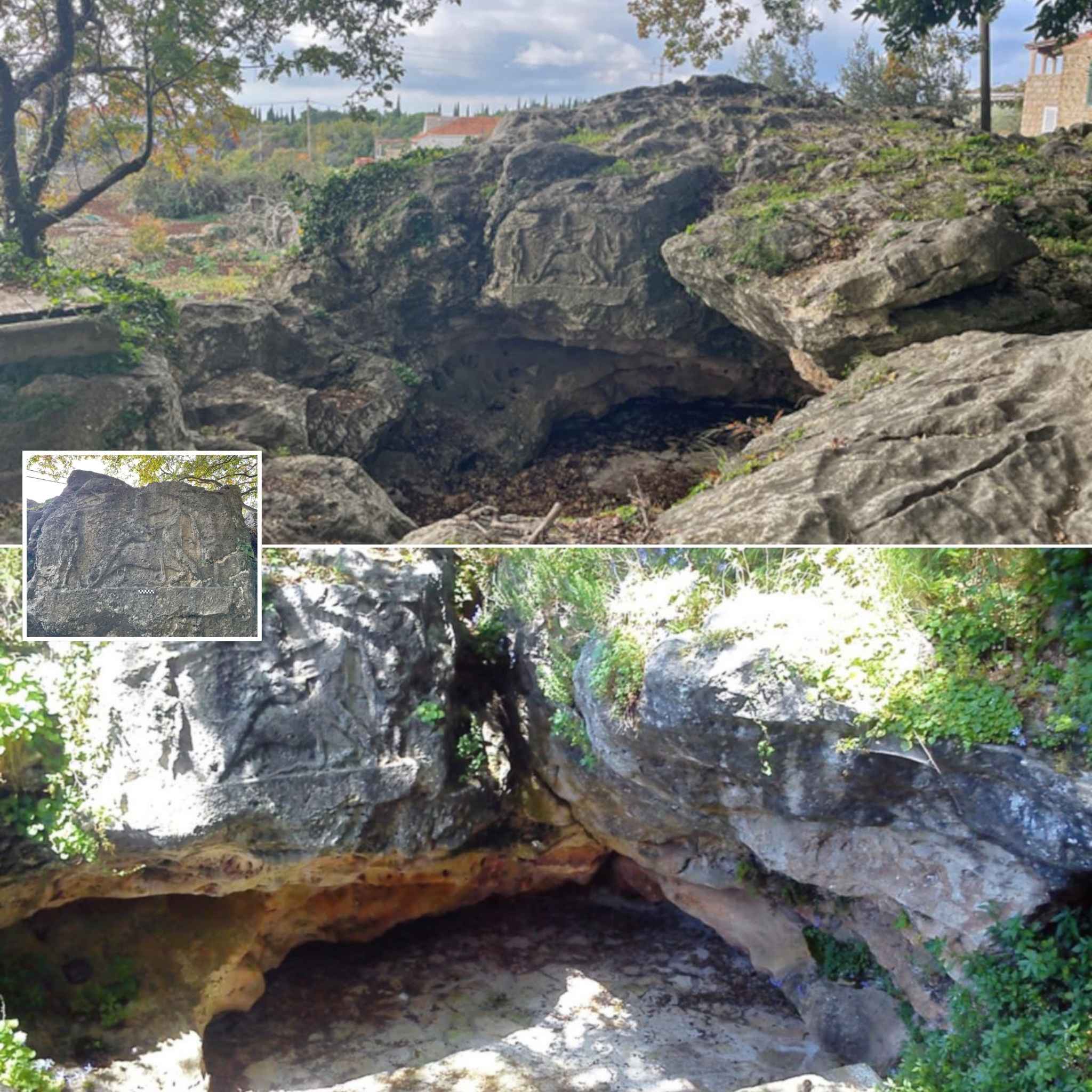
At the heart of the site lies a relief of Mithras carved directly into living limestone.
The sculpture measures approximately 75 by 110 centimeters and depicts the familiar tauroctony scene.
Mithras appears alongside:
- The sacrificial bull
- A dog
- A snake
- A scorpion
- Torchbearers
- Celestial symbols
The iconography follows traditional Mithraic conventions.
The setting does not.
The relief sits above the entrance to a small natural cave.
Unlike standard mithraea, the site contains:
- No roof
- No constructed walls
- No benches
- No enclosed ritual hall
Everything is integrated into the natural landscape.
The cave itself measures only about 17.7 square meters.
This is far smaller than the average Mithraic sanctuary, which often exceeded 68 square meters.
The limited interior space would have made it impossible to host the communal banquets typically associated with Mithraic worship.
Researchers therefore concluded that rituals likely occurred outside.
Worship Beneath the Open Sky
Detailed mapping revealed a natural clearing surrounding the cave.
The area forms a shallow amphitheater-like space measuring approximately 120 square meters.
This open area could comfortably accommodate groups of worshippers.
Rather than reclining on stone benches inside an enclosed sanctuary, participants may have gathered on the ground itself.
The relief of Mithras served as the focal point for ceremonies conducted outdoors.
Interestingly, the sculpture is difficult to see from inside the cave.
This further supports the idea that the primary ritual space was external.
Such an arrangement represents a significant departure from the standard model of Mithraic worship.
Instead of recreating a symbolic cave through architecture, the worshippers of Močići utilized an actual cave and the surrounding landscape.
The Importance of Water and Stone
The location may have held special significance because of its natural features.
Mithras possessed strong symbolic connections to both rock and water.
In ancient mythology, he was often described as being born from stone.
Some traditions also portrayed him striking rocks to create life-giving springs.
The Močići sanctuary naturally incorporated both elements.
A permanent spring emerges from the cave and flows throughout the year.
For worshippers, this feature may have reinforced sacred associations already connected to Mithras.
Elsewhere in the Roman Empire, communities often built artificial features to evoke such symbolism.
At Močići, nature provided them directly.
The sanctuary demonstrates how local landscapes could become integral components of religious practice.
A Meeting Place for Pilgrims
Researchers believe Močići functioned as a destination sanctuary.
Located above Epidaurum, it required intentional travel rather than serving as a neighborhood shrine.
Pilgrims may have journeyed into the hills specifically to participate in ceremonies.
The experience would have differed significantly from visiting an urban temple.
Participants encountered:
- Natural caves
- Flowing water
- Limestone cliffs
- Expansive views of the Adriatic landscape
The environment itself likely became part of the ritual experience.
Such a setting may have enhanced feelings of isolation, sacredness, and connection to divine forces.
The Presence of Silvanus
Another discovery highlights the sanctuary’s unique local character.
Inside the cave, archaeologists identified a second weathered relief.
The figure is believed to represent Silvanus, the Roman god of forests, pastures, and nature.
Silvanus held particular importance in Dalmatia.
Throughout the region, he was closely associated with caves, rural landscapes, and pastoral life.
The coexistence of Mithras and Silvanus at Močići suggests a blending of religious traditions.
Rather than replacing local beliefs, Mithraic worship may have incorporated elements already familiar to nearby communities.
The spring likely served as a watering source for livestock.
This connection linked sacred rituals directly to everyday agricultural activities.
Religion and daily life became intertwined within the same physical landscape.
Challenging the Standard Model
For decades, scholars emphasized the uniformity of Mithraism.
The similarities among sanctuaries across the empire appeared to support this interpretation.
Močići reveals a more flexible reality.
The cult maintained shared symbols and imagery while adapting to local circumstances.
The worshippers did not abandon Mithraic traditions.
The tauroctony remained central.
The cave remained important.
The symbolism of stone and water persisted.
What changed was the way those elements were expressed.
Instead of constructing an artificial environment, they embraced the natural one.
This suggests that Mithraism was not simply imposed upon landscapes.
It evolved in dialogue with them.
Religion and Local Identity
The findings contribute to a broader trend in archaeology.
Researchers increasingly recognize that ancient religions were deeply connected to specific places.
Even within large empires, local communities shaped religious practice according to regional traditions, geography, and cultural identity.
The Roman Empire was extraordinarily diverse.
Its inhabitants spoke different languages, followed different customs, and lived in dramatically different environments.
Religious worship often reflected that diversity.
Močići provides a vivid example of how a global Roman cult could acquire distinctly local characteristics.
A New Perspective on Mithraic Worship
The sanctuary of Močići offers more than an unusual archaeological site.
It provides a fresh perspective on how ancient people experienced religion.
For the worshippers who gathered there nearly two thousand years ago, sacred space was not limited to buildings.
The cave, the spring, the surrounding hills, and the open sky all formed part of a living ritual landscape.
The discovery challenges the assumption that Mithraism functioned identically across the Roman world.
Instead, it reveals a religion capable of adapting to local conditions while preserving its core beliefs.
As archaeologists continue investigating the site, Močići may help answer larger questions about how ancient religions spread, transformed, and interacted with the environments in which they flourished.
Far from being an isolated anomaly, the sanctuary suggests that nature itself played a more significant role in Mithraic worship than scholars once believed.
And in the hills above the Adriatic coast, that ancient relationship between landscape and belief remains carved into stone.