
 The knocking started just after lunch.
At first, Eleanor Hayes thought it was the wind.
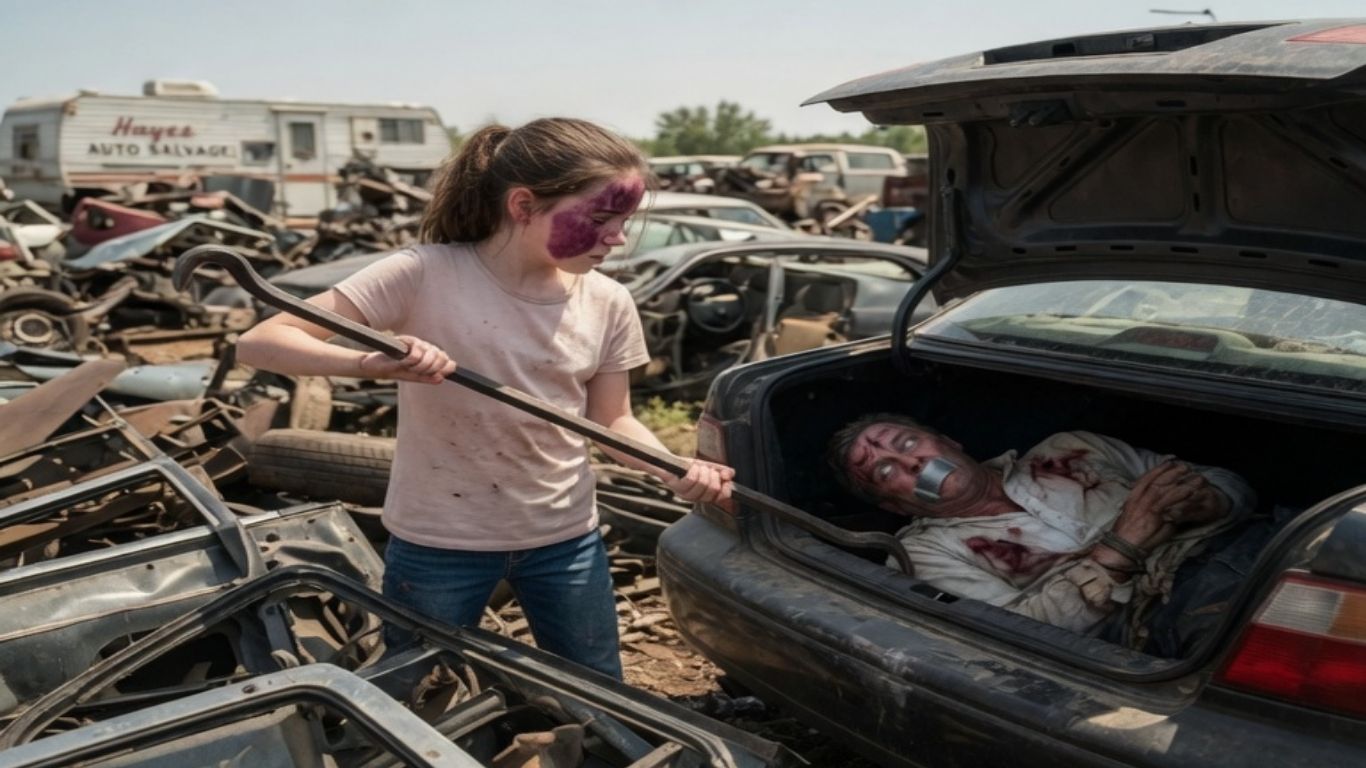
The ten-year-old girl stood on top of a pile of rusted car doors, looking out across the junkyard that surrounded the old trailer she shared with her grandmother. The summer sun bounced off twisted metal and shattered windshields. Most people saw garbage.
Eleanor saw kingdoms.
She spent hours wandering among forgotten things, imagining stories for abandoned cars and broken machines. It was easier than dealing with people.
People stared.
They always stared.
Some looked away quickly.
Others didn’t.
The large wine-colored birthmark covering the left side of her face had taught her that lesson long ago.
So when she heard the sound again—three sharp thuds coming from somewhere nearby—she froze.
Knock.
Knock.
Knock.
It wasn’t the wind.
It was coming from a black sedan parked near the far edge of the yard.
The car didn’t belong there.
Unlike the crushed wrecks surrounding it, this one looked almost intact.
Eleanor climbed down and walked toward it.
The closer she got, the louder the sound became.
Then she heard something else.
A voice.
Muffled.
Desperate.
Someone was inside.
She spun around.
No one.
Her grandmother Ruth was in the office trailer finishing paperwork.
Old Mr. Donovan, who hauled scrap for the yard, had already left.
There wasn’t another adult in sight.
The knocking came again.
Faster this time.
Panicked.
Eleanor’s heart hammered.
She should run for help.
She knew that.
But something about the sound made her stay.
The trunk.
The noise was coming from the trunk.
She grabbed the handle and pulled.
Locked.
Inside, whoever was trapped started kicking harder.
Eleanor backed away.
Then she spotted a crowbar leaning against a stack of tires.
It was nearly as long as she was tall.
Dragging it across the dirt took everything she had.
Her hands burned.
Her arms shook.
Twice she almost gave up.
But the pounding inside the trunk never stopped.
Finally, she wedged the metal bar into the seam.
Pulled.
Nothing.
Pulled again.
The metal groaned.
One more time.
The lock snapped.
The trunk flew open.
Eleanor stumbled backward.
Inside was a man.
Bound hand and foot.
Duct tape across his mouth.
Bruises covering his face.
Blood staining his shirt.
For a moment they simply stared at each other.
Then the man began desperately nodding.
Eleanor rushed forward and peeled away the tape.
The man gasped for air.
“Thank God,” he whispered.
His wrists were raw from fighting the ropes.
Eleanor used a rusted utility knife she carried for opening boxes and carefully cut him free.
The man slowly climbed out and leaned against the car.
He looked exhausted.
Relieved.
Disbelieving.
Then his eyes settled on her face.
And everything changed.
He stopped breathing.
Not literally.
But close.
His gaze locked onto the birthmark.
His expression shifted from confusion to shock.
Then to something Eleanor couldn’t understand.
Pain.
Hope.
Fear.
All at once.
“What is your name?” he asked.
“Eleanor.”
“How old are you?”
“Ten.”
His voice trembled.
“Who do you live with?”
“My grandma.”
“What is her name?”
“Ruth Hayes.”
The man’s face turned pale.
“And your mother?”
Eleanor hesitated.
“Caroline Hayes.”
The man closed his eyes.
When he opened them again, tears filled them.
“What about your father?”
“He died before I could remember him.”
The stranger looked away.
For several seconds he said nothing.
Then he reached into his jacket pocket with shaking fingers.
He pulled out an old photograph.
The edges were worn from years of handling.
He handed it to Eleanor.
The moment she saw it, her stomach dropped.
The woman in the picture looked like her.
Not similar.
Not a little.
Almost identical.
The same eyes.
The same smile.
And on the left side of her face—
The same birthmark.
Exactly the same.
Eleanor stared.
“Who is this?”
The man swallowed.
“My daughter.”
Silence settled between them.
Then he whispered the words that changed everything.
“Her name was Caroline Hartley.”
Eleanor looked up.
“No.”
The man nodded.
“Yes.”
For a long moment neither spoke.
Finally he took a shaky breath.
“My name is William Hartley.”
The name meant nothing to Eleanor.
But what he said next did.
“I believe I’m your grandfather.”
 The world suddenly felt too small.
William sat on an old tire while Eleanor sat across from him on an overturned crate.
The junkyard disappeared.
The noise disappeared.
All she could hear was his voice.
He told her about Caroline.
About how she had left home at nineteen after a terrible fight.
About how he had tried to control every part of her future.
She wanted to become an artist.
He wanted her to run the family business.
The argument lasted years.
The final one ended with her walking out.
Neither spoke again.
William expected her to come back.
She expected him to apologize.
Neither happened.
Years passed.
Pride became distance.
Distance became silence.
Then silence became regret.
When he finally hired investigators to find her, it was too late.
Caroline had died in a car accident.
William’s voice cracked when he said it.
“I found out she had a child.”
His eyes met Eleanor’s.
“You.”
He looked away.
“But nobody could tell me where you were.”
For ten years he searched.
Ten years.
Private investigators.
Databases.
Lawyers.
Nothing.
Then Eleanor asked the question.
“What about my grandmother?”
William nodded slowly.
“The woman you call Ruth Hayes isn’t actually Ruth Hayes.”
Eleanor frowned.
“What?”
“She’s Ruth Novak.”
The name sounded unfamiliar.
William explained.
James Novak—Eleanor’s father—had married Caroline six months before the accident.
After both parents died, James’s mother took Eleanor away.
To protect her.
To raise her.
And perhaps to hide her.
She changed back to an old family surname.
Hayes.
The trail disappeared.
So did Eleanor.
William had been searching for a ghost.
Until today.
Until a little girl with a crowbar opened a trunk.
Eleanor sat quietly.
Then another question came.
“How do you know I’m really your granddaughter?”
William smiled sadly.
“The birthmark.”
Eleanor touched her cheek automatically.
“I hate it.”
William’s eyes softened.
“My daughter used to say the same thing.”
He reached into his wallet and pulled out another photograph.
Then another.
And another.
Every woman carried the same mark.
Different shades.
Different sizes.
The same place.
Generation after generation.
“It runs through our family.”
Eleanor stared at the photos.
For the first time in her life, the thing that made her different didn’t look strange.
It looked familiar.
It looked like belonging.
Then William told her why he had been trapped in the trunk.
And suddenly the story became even stranger.
William Hartley wasn’t just a grandfather.
He was the CEO of Hartley Pharmaceuticals.
A billion-dollar company.
A powerful company.
The kind that made enemies.
A rival group had tried to force him into selling.
When he refused, they kidnapped him.
Beat him.
Bound him.
And hid him inside a vehicle destined for a remote disposal site.
The junkyard.
By nightfall, he probably would have disappeared forever.
No witnesses.
No evidence.
No body.
He looked directly at Eleanor.
“You didn’t just save my life.”
His voice broke.
“You gave me back my family.”
The walk back to the office trailer felt unreal.
William moved slowly because of his injuries.
Eleanor stayed beside him.
When Ruth saw them, she nearly dropped her coffee.
Her eyes widened.
Then narrowed.
Then widened again.
“Eleanor!”
She rushed forward.
“What happened?”
Her gaze landed on William.
Instant fear crossed her face.
She stepped in front of Eleanor protectively.
“Stay away from him.”
William opened his mouth.
Ruth already knew.
The recognition hit both of them at once.
Neither needed introductions.
The years vanished from their faces.
William Hartley.
Ruth Novak.
Two people connected by grief.
Two people separated by fear.
Eleanor explained everything.
The trunk.
The kidnapping.
The photographs.
The conversation.
The possibility.
When she finished, Ruth sank into a chair.
Suddenly she looked much older.
“I knew this day might come.”
William remained silent.
Ruth stared at her hands.
“Caroline talked about you before she died.”
William’s eyes filled.
“She did?”
Ruth nodded.
“She wanted to contact you.”
The words hit like a punch.
“She said enough time had passed.”
William closed his eyes.
A tear slipped down his cheek.
“But the accident happened first.”
Neither spoke for several seconds.
Then Ruth finally confessed.
After losing her son and daughter-in-law, Eleanor became everything she had left.
The idea of losing her too was unbearable.
So she hid.
Changed names.
Moved.
Disappeared.
William listened.
Then surprised everyone.
“I don’t want to take her away.”
Ruth looked up.
“I never did.”
He glanced toward Eleanor.
“You raised her.”
His voice trembled.
“You stayed when I couldn’t.”
The tension slowly dissolved.
Not because the past vanished.
But because both finally admitted the same truth.
Everything they had done had come from love.
Fearful love.
Imperfect love.
But love.
The police arrived shortly afterward.
Ambulances followed.
William was taken to the hospital.
The kidnappers were eventually arrested.
The executives behind the crime were exposed.
DNA tests were arranged.
Though by then, nobody really needed them.
The results only confirmed what everyone already knew.
William Hartley was Eleanor’s grandfather.
But the most important part of the story happened afterward.
Not in courtrooms.
Not in hospitals.
Not in police reports.
In ordinary days.
William never tried to buy Eleanor’s affection.
He never arrived with flashy gifts.
Instead, he showed up.
Again.
And again.
And again.
He attended school plays.
Parent-teacher meetings.
Art shows.
Science fairs.
He created an education fund.
Helped Ruth repair the trailer.
Made sure neither of them worried about money.
Yet the thing Eleanor remembered most wasn’t any of that.
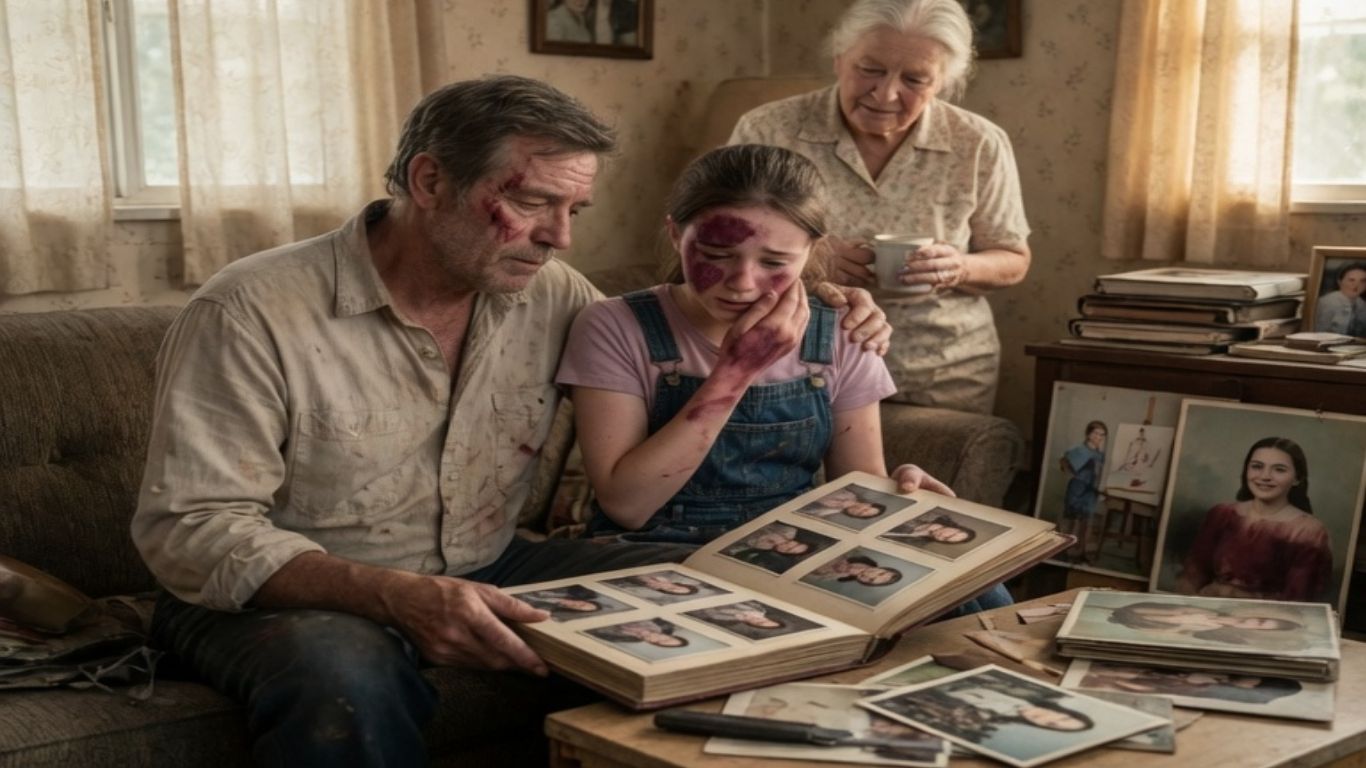
It was a Sunday afternoon.
William arrived carrying three large photo albums.
Inside were hundreds of photographs of Caroline.
As a baby.
As a child.
As a teenager.
As a young woman.
Eleanor spent hours turning pages.
Sometimes laughing.
Sometimes crying.
Sometimes staring silently.
The resemblance was impossible to ignore.
Not just the birthmark.
The smile.
The eyes.
The way she tilted her head.
It felt like meeting her mother for the first time.
William told stories she had never heard.
Caroline loved painting.
Loved sketching.
Loved creating worlds on paper.
Eleanor stared at him.
“So did I.”
William blinked.
Then laughed through tears.
“Of course you do.”
That day, he made a promise.
One he wished he had made years earlier.
“No dream is too impractical.”
Years passed.
Eleanor became a teenager.
The birthmark returned as a source of insecurity.
Cruel comments.
Whispers.
Judgment.
The same wounds Caroline once carried.
But this time something was different.
She wasn’t alone.
William sat beside her one evening and told the truth.
“I failed your mother.”
The words came without excuses.
“I spent too much time trying to change her.”
He looked directly at Eleanor.
“I won’t make that mistake with you.”
Slowly, Eleanor began seeing herself differently.
The birthmark stopped being a flaw.
It became history.
Connection.
Identity.
Eventually she launched an art program for students with visible differences.
A place where they could create without apology.
William funded it.
But everyone knew whose vision it was.
Eleanor’s.
On her eighteenth birthday, William gave her a large portfolio case.
Inside were dozens of paintings.
Caroline’s paintings.
Lost for years.
Forgotten in storage.
Rediscovered by accident.
Self-portraits filled the collection.
And in every one of them, the birthmark remained visible.
Not hidden.
Not softened.
Celebrated.
Transformed into art.
Eleanor sat for hours studying them.
For the first time, she understood something important.
Her mother hadn’t died ashamed.
She had learned to love herself.
Several years later, Eleanor stood on a graduation stage at one of the country’s top art schools.
Ruth sat in the audience.
William sat beside her.
Older now.
Slower.
But smiling.
When Eleanor stepped to the microphone, the room quieted.
She spoke about difference.
About belonging.
About the strange things people spend years trying to hide.
Then she touched the mark on her face.
The same one she once wished away.
And smiled.
“Sometimes,” she said, “the thing you fear most about yourself becomes the thing that leads you home.”
In the audience, William lowered his head.
Ruth wiped away tears.
And for a moment, three generations seemed present.
The grandmother who protected.
The daughter who dreamed.
The granddaughter who healed what was broken.
After the ceremony, Eleanor hugged William.
“Thank you for staying.”
William’s eyes glistened.
“No.”
He shook his head.
“Thank you for giving me a second chance.”
Eleanor looked at Ruth.
Then at William.
And finally understood something many people spend their entire lives learning.
Family isn’t built by perfection.
It’s built by the people who keep showing up.
And sometimes the scar you spend years trying to hide is the very thing that proves where you truly belong.


