The Petralona Skull: A Controversial Fossil and the Debate Over Early Human Evolution in Europe
A Discovery Hidden Beneath the Snow
In the winter of 1959, an unexpected discovery in northern Greece would ignite one of the most enduring debates in paleoanthropology.
Near the village of Petralona in the Chalkidiki Peninsula, a local shepherd noticed a small opening in a hillside after heavy snow began to melt. Curious about what lay beyond, he gathered several villagers to clear the entrance and explore the newly revealed cave.
What they found was remarkable.
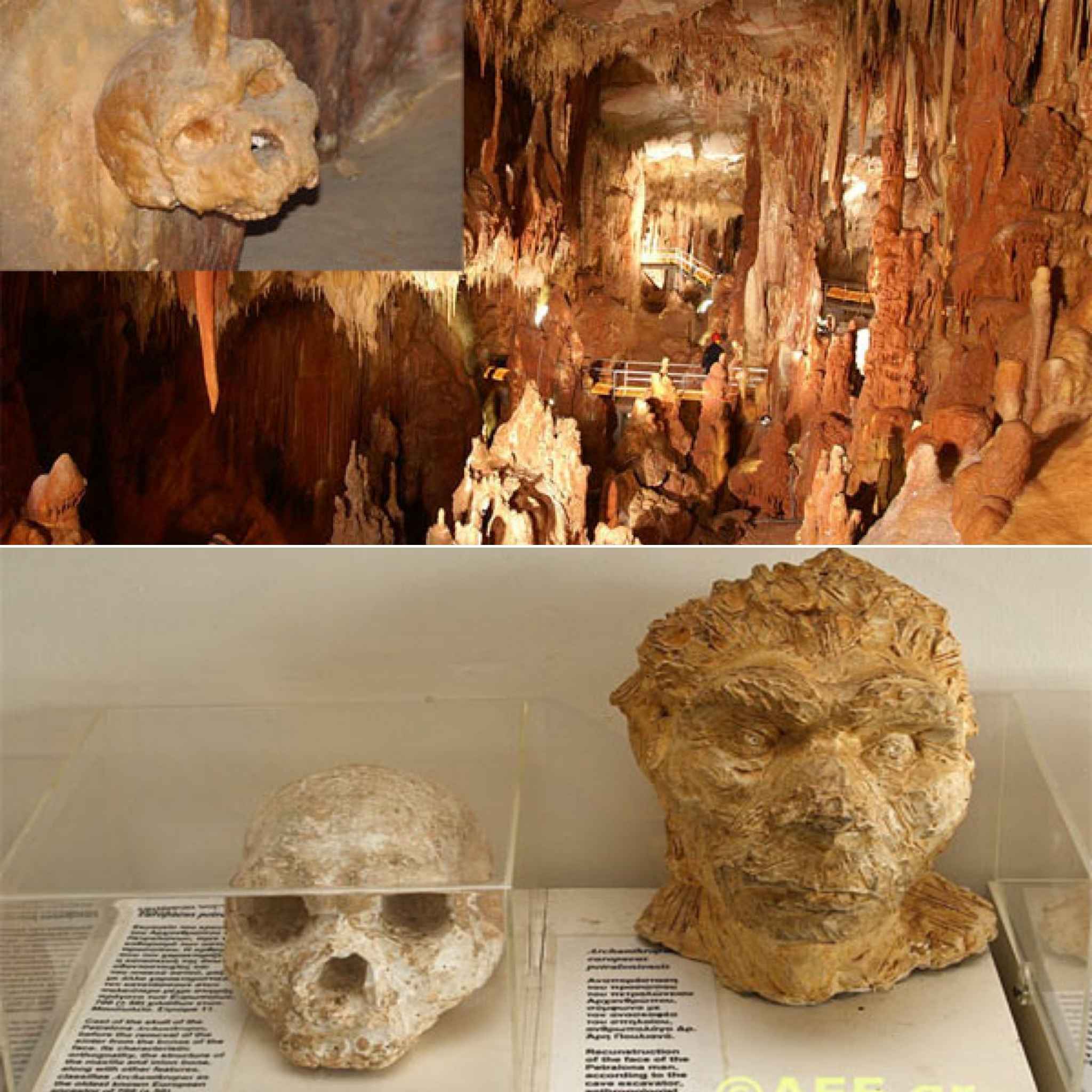
Inside stretched a vast underground chamber decorated with stalactites and stalagmites that had formed over hundreds of thousands of years. Yet the most astonishing discovery was not geological.
Embedded within a wall of cave deposits was a fossilized human skull.
The find immediately attracted the attention of Greek scientists and would eventually become known as the Petralona Skull—one of the most important and controversial human fossils ever discovered in Europe.
More than six decades later, the skull remains at the center of scientific debates concerning human evolution, fossil dating, and the origins of ancient populations in Europe.
The Cave of Petralona
The Petralona Cave lies approximately 35 kilometers southeast of Thessaloniki in northern Greece.
Although relatively unknown before the discovery, the cave would soon become one of Europe’s most significant paleoanthropological sites.
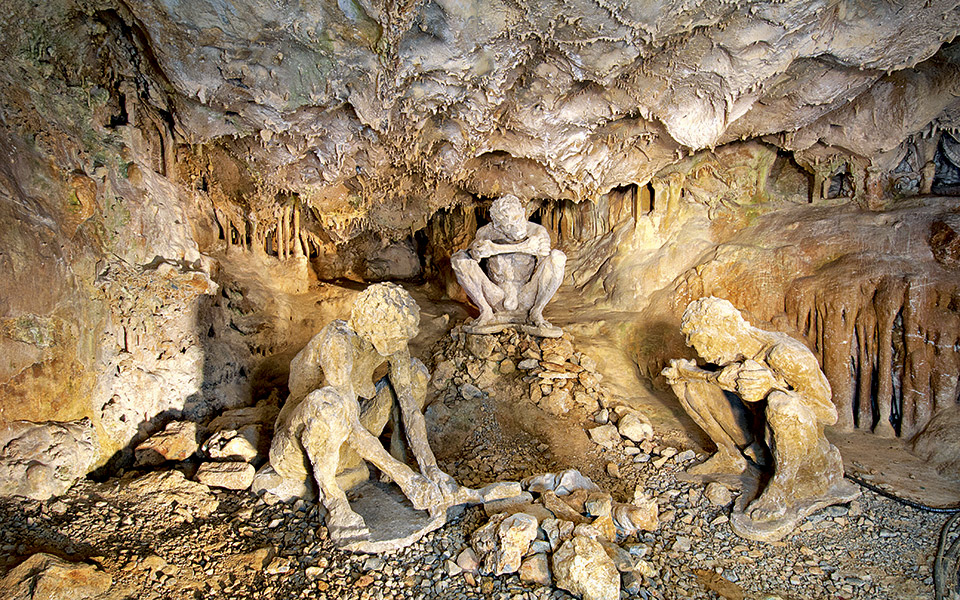
Researchers investigating the cave found that it contained far more than a single fossil skull.
Over the following decades, excavations uncovered:
- Animal fossils from numerous extinct species
- Fossilized wood
- Preserved plant remains
- Animal hair
- Coprolites (fossilized dung)
- Stone tools
- Bone tools
- Evidence of repeated human occupation
The exceptional preservation of these materials transformed the cave into a valuable archive of environmental and human history.
Scientists quickly realized that Petralona offered a rare opportunity to study life in southeastern Europe during the Middle Pleistocene, a period spanning hundreds of thousands of years.
The skull, however, would become the focus of most attention.
The Skull That Started a Debate
After its discovery, the fossil was transferred to the University of Thessaloniki for study.
Researchers immediately recognized that the skull possessed an unusual combination of characteristics.
It appeared neither fully modern nor entirely primitive.
The cranium exhibited features associated with several different stages of human evolution.
Among its notable characteristics were:
- A large cranial capacity
- Robust brow ridges
- Thick cranial bones
- A relatively broad face
- Traits associated with archaic European populations
This mixture of features made classification difficult.
Was the individual an early representative of Homo heidelbergensis?
An archaic Homo sapiens?
A late Homo erectus?
Or a member of an evolutionary lineage unique to Europe?
These questions remain debated today.
The Arrival of Aris Poulianos
One of the most influential figures in the Petralona story was Dr. Aris Poulianos, a Greek anthropologist who had studied in the Soviet Union.
After returning to Greece in the 1960s, Poulianos became deeply involved in researching the Petralona fossil and the cave itself.
Poulianos argued that the skull represented a distinct European evolutionary form that had developed independently within Europe rather than arriving from elsewhere.
His interpretation challenged several prevailing assumptions about human evolution.
More controversially, he proposed that the skull was approximately 700,000 years old.
If correct, such an age would place the fossil among the oldest human remains ever discovered in Europe.
Poulianos referred to the specimen as the “Archanthropus of Petralona” and believed it represented evidence for a long, continuous human presence in Europe.
His conclusions would spark decades of disagreement.
The Dating Controversy
Perhaps no aspect of the Petralona Skull has generated more debate than its age.
Determining the age of ancient fossils is rarely straightforward.
Researchers use multiple techniques, including:
- Stratigraphic analysis
- Paleomagnetic dating
- Uranium-series dating
- Electron spin resonance
- Faunal comparisons
Different methods applied to the Petralona Cave deposits have produced varying results.
Poulianos and his supporters argued that the cave sediments demonstrated an age approaching 700,000 years.
Other researchers produced considerably younger estimates.
Over the years, published age estimates have ranged from approximately:
- 160,000 years
- 200,000 years
- 250,000 years
- 300,000 years
- More than 700,000 years
Most contemporary paleoanthropologists favor an age between roughly 200,000 and 350,000 years.
Even at the lower end of these estimates, the fossil remains extremely important because it represents a key stage in European human evolution.
The disagreement illustrates a broader challenge in paleoanthropology: fossil interpretation often evolves as new techniques become available.
What Species Was the Petralona Individual?
The classification of the skull remains equally controversial.
Unlike modern humans, whose skeletal features are generally consistent, Middle Pleistocene hominins often exhibit combinations of traits that blur the boundaries between species.
The Petralona Skull has been classified at various times as:
- Homo erectus
- Homo heidelbergensis
- Archaic Homo sapiens
- A transitional European hominin
Many specialists now view it as belonging to a population ancestral to later Neanderthals while also retaining features seen in earlier human species.
Rather than fitting neatly into a single category, the fossil may represent an evolutionary transition.
This complexity reflects the reality of human evolution.
The process was not linear.
Instead, multiple populations existed simultaneously, often exchanging genes and developing unique regional characteristics.
Human Evolution in Europe During the Middle Pleistocene
To understand the importance of Petralona, it is necessary to place the fossil within its broader evolutionary context.
Between 800,000 and 100,000 years ago, Europe was inhabited by several populations of archaic humans.
These groups experienced repeated cycles of:
- Climate change
- Glaciations
- Population expansions
- Regional extinctions
Over time, some populations developed traits that would eventually characterize Neanderthals.
Others may have contributed to different evolutionary branches.
Petralona provides a valuable snapshot of this transitional period.
The fossil helps researchers understand how European populations evolved long before the arrival of anatomically modern humans.
Does the Petralona Skull Challenge the Out of Africa Model?
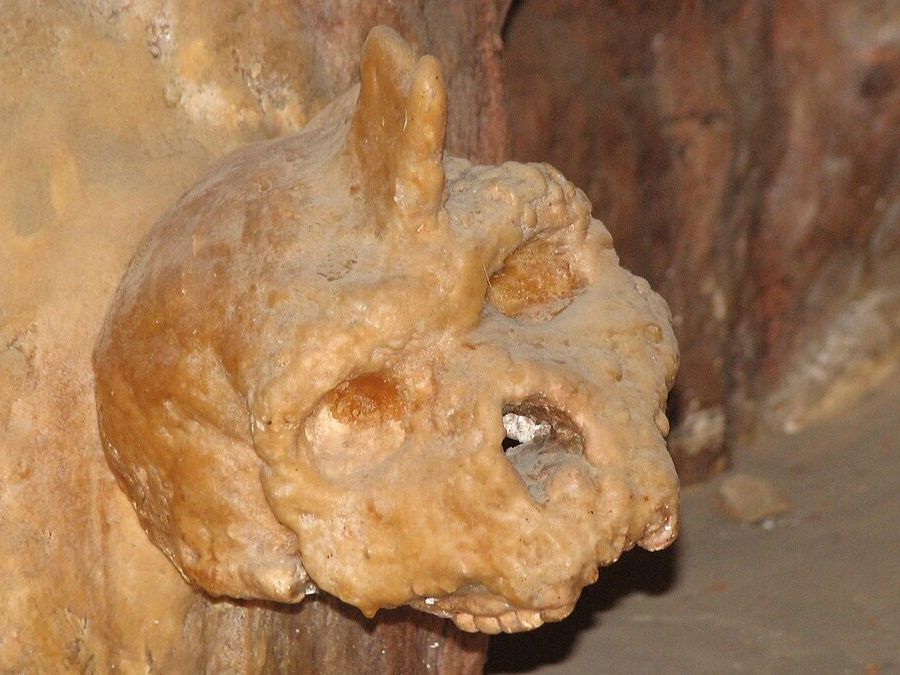
The Petralona Skull is often cited in alternative interpretations of human evolution.
Some writers argue that the fossil disproves the Out of Africa model.
However, most paleoanthropologists disagree.
The Out of Africa theory refers specifically to the origin of anatomically modern humans (Homo sapiens), not to the existence of earlier human species outside Africa.
Current evidence indicates that:
- Homo sapiens evolved in Africa approximately 300,000 years ago.
- Earlier human species occupied Europe and Asia long before modern humans appeared.
- These populations included Homo erectus, Homo heidelbergensis, Neanderthals, and Denisovans.
The existence of ancient European fossils does not contradict an African origin for modern humans.
Instead, fossils such as Petralona help document the diverse human populations that existed before Homo sapiens spread across the globe.
In fact, modern genetic evidence strongly supports an African origin for our species while also revealing interbreeding with archaic populations after migration into Eurasia.
Excavations and Further Discoveries
Excavations at Petralona continued for decades and involved specialists from numerous countries.
Researchers uncovered a remarkable range of materials that provided insight into ancient environments.
These included:
- Fossilized oak leaves
- Preserved wood fragments
- Animal remains
- Stone artifacts
- Bone implements
The discoveries suggested repeated occupation of the cave over long periods.
The site’s rich fossil record also enabled scientists to reconstruct changing climates and ecosystems.
Large mammals, carnivores, and other species found within the cave helped establish environmental conditions during different phases of occupation.
Petralona became far more than the location of a single fossil.
It evolved into one of Europe’s most important Middle Pleistocene archaeological sites.
Scientific Disagreements and Administrative Disputes
The history of Petralona has not been limited to scientific debates.
It has also involved disagreements concerning excavation rights, administration, and access to materials.
Beginning in the 1980s, disputes emerged between researchers, government agencies, and various scientific organizations.
These conflicts led to legal challenges and restrictions affecting research activities at the site.
Supporters of Poulianos argued that his work received insufficient recognition.
Others maintained that disagreements reflected normal scientific and administrative processes rather than deliberate suppression.
The resulting controversy became intertwined with debates over the skull’s age and interpretation.
As a result, discussions surrounding Petralona frequently extend beyond science into questions of heritage management and academic authority.
Why the Petralona Skull Still Matters
Regardless of where one stands on the debates, the significance of the Petralona Skull is undeniable.
The fossil remains one of the most complete Middle Pleistocene human crania ever discovered in Europe.
Its importance stems from several factors:
- Exceptional preservation
- Complex mixture of anatomical traits
- Association with rich archaeological deposits
- Potential insights into European human evolution
The skull continues to appear in scientific studies examining the origins of Neanderthals and other archaic populations.
Advances in imaging technology and analytical methods may eventually provide new answers regarding its age and evolutionary relationships.
As techniques improve, previously inaccessible details may emerge from the fossil itself.
A Fossil That Continues to Inspire Debate
More than sixty years after its discovery, the Petralona Skull remains one of the most discussed human fossils in Europe.
For some researchers, it represents evidence of a long and complex evolutionary history within Europe.
For others, it serves as a valuable example of how scientific interpretations change as new evidence becomes available.
The fossil’s true significance may not lie in overturning established theories but in reminding us that human evolution was far more intricate than once believed.
Rather than a simple story of linear progress, it involved numerous populations, migrations, adaptations, and interactions spread across continents over hundreds of thousands of years.
The Petralona Skull occupies an important place within that story.
Whether future research confirms older or younger dates, whether it is ultimately classified as Homo heidelbergensis, archaic Homo sapiens, or another category altogether, the fossil remains a remarkable window into humanity’s distant past.
Its discovery in a cave hidden beneath the snow of northern Greece continues to challenge researchers to refine their understanding of where we came from—and how much there is still left to learn.