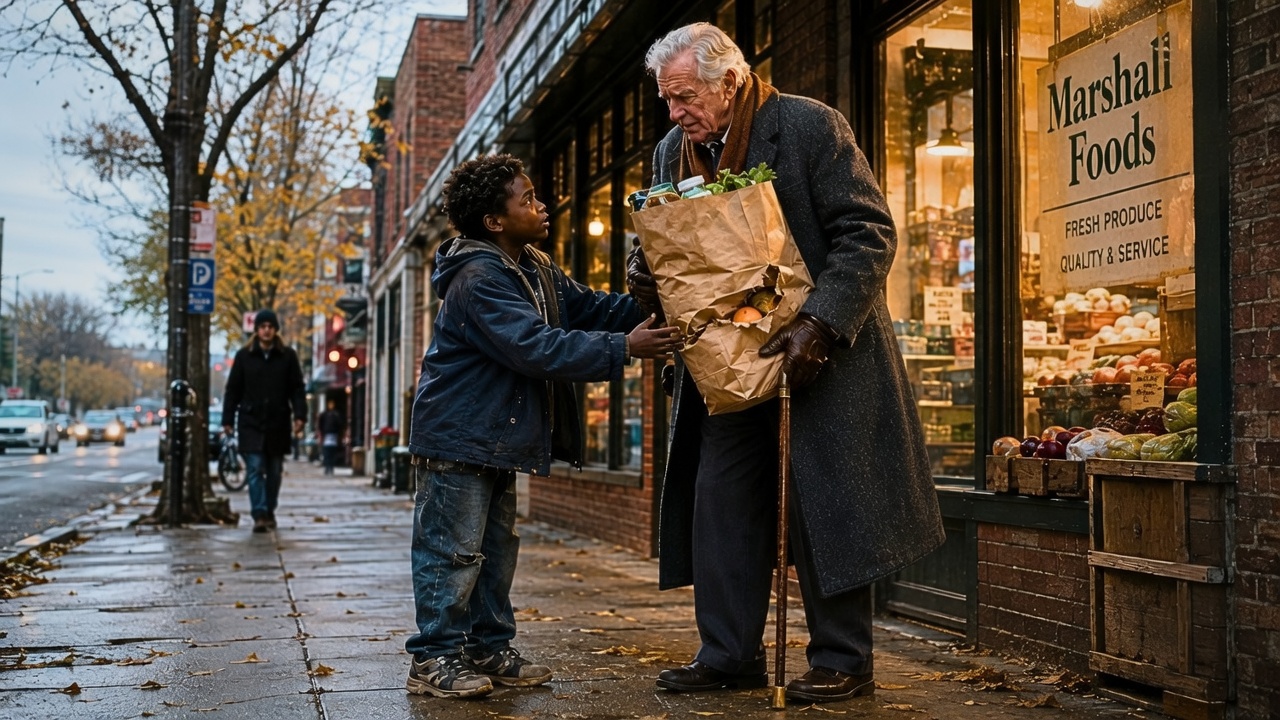
A ten-year-old boy who had not eaten in almost two days crossed a freezing Cleveland street to help an old man carry groceries.
He did not ask for food.
He did not ask for money.
He only pointed at the torn paper bag in the man’s hand and said, “Sir, your oranges are about to fall.”
That small sentence changed both of their lives.
It was late November in East Cleveland, the kind of cold that came off Lake Erie like a warning. The sky was gray, the sidewalks cracked, and the bus stop outside Marshall Foods was filled with people standing too still in coats too thin.
Elijah Monroe stood near the iron fence across the street, watching the grocery store doors.
He was ten.
Too skinny.
Wearing shoes two sizes too big.
His blue jacket had a broken zipper, so he kept one arm wrapped across his chest to hold it closed.
He had been living almost alone for three weeks.
His grandmother was in the hospital. His mother had died the year before. The adults who promised to check on him had stopped coming. The food at home had run out two days ago.
But Elijah was not waiting to steal.
His mother had taught him better.
“If you’re hungry, baby, you still keep your hands clean,” she used to say. “And if you can help somebody, you help.”
So Elijah waited near Marshall Foods, hoping someone might drop an apple, leave a loaf behind, forget a bag.
Then Harold Whittaker came out.
He was seventy-eight, tall but bent slightly at the shoulders, wearing an old gray wool coat that still looked expensive. One hand held a cane. The other struggled with two heavy grocery bags.
Elijah saw it before anyone else did.
The bottom of one bag was tearing.
An orange rolled toward the edge.
For one second, Elijah looked at the food.
His stomach cramped so sharply he almost bent over.
Then he crossed the street.
“Sir,” he said carefully, keeping distance. “Your bag is ripping.”
The old man stopped.
Elijah reached out and caught the orange just before it fell.
Harold looked at the boy’s face, then at his hands.
“You saved my groceries.”
Elijah shrugged. “I didn’t want them to hit the ground.”
Harold studied him for a moment.
“What’s your name?”
“Elijah.”
“A strong name.”
“My mom picked it.”
“Then your mother had good taste.”
Elijah looked down.
“She died.”
Most adults filled silence with useless words.
Harold did not.
He only nodded and said, “Then I’m glad I know her choice.”
That sentence hit Elijah harder than pity would have.
Harold shifted the bag again, but his hand shook.
Elijah noticed.
“I can carry that one for you,” he said. “Just to wherever you’re going.”
Harold glanced at him. “You’re sure?”
“Yes, sir.”
So they walked.
Through the cold streets of East Cleveland.
Past old apartment buildings with rusted fire escapes.
Past chain-link fences and empty lots.
Past people who looked at Elijah like he was invisible.
Harold did not ask too many questions. That made Elijah trust him a little.
After a few blocks, Harold said, “Is someone waiting for you at home for dinner?”
Elijah tightened his grip on the grocery bag.
“No, sir.”
“Anyone waiting at all?”
Elijah did not answer.
That was answer enough.
At the corner, a black town car waited by the curb. A driver in a dark coat stood beside it.
Elijah stopped walking.
His whole body changed.
Harold noticed immediately.
“That’s Marcus,” Harold said. “He works with me.”
Marcus smiled gently. “Evening, Mr. Whittaker.”
Then he looked at Elijah.
“And thank you, Mr. Monroe. Those oranges would’ve been gone without you.”
Mr. Monroe.
No one had called Elijah that before.
Not like he mattered.
Harold reached into his coat.
Elijah stepped back.
“I don’t need money,” he said quickly. “I didn’t help you for money.”
Harold’s face softened.
“I know.”
He held out a card instead.
“My name and number. If you ever need help, you call. No explanation required.”
Elijah took the card like it was something fragile.
Then Harold said, “Have you eaten today?”
Elijah tried to lie.
His stomach answered first.
Harold heard it.
“There’s a place nearby,” he said. “Anna’s. Warm soup. Good bread. No questions unless you want to answer them.”
Elijah looked at the car.
Then the street.
Then the card in his hand.
His mother’s voice came back to him.
If you can help somebody, you help.
Maybe, he thought, sometimes you also let somebody help you.
So he nodded.
Anna’s sat on Larchmere Boulevard, small and warm, with fogged windows and the smell of bread coming through the door.
The woman behind the counter looked up when Harold entered.
“Harold,” she said, like family.
Then she saw Elijah.
Not his shoes.
Not his thin coat.
Not the hunger he was trying to hide.
She saw him.
“Welcome, sweetheart,” Anna said. “Come sit.”
Elijah sat across from Harold, stiff and careful.
Anna brought bread first.
Then soup.
Then chicken, potatoes, green beans, and a glass of milk.
Elijah stared at the food.
“It’s yours,” Anna said softly.
He ate slowly at first.
Then faster.
Then slower again, embarrassed by how badly he needed it.
Harold did not stare.
He looked out the window and gave the boy his dignity.
After several minutes, Elijah whispered, “Why are you doing this?”
Harold folded his hands.
“When I was your age, I was hungry too.”
Elijah looked up.
“I lived in a steel town that had already started dying. My father was gone. My mother worked until her hands cracked. Some nights we had nothing but hot water and salt.”
He paused.
“One winter, I saw an old woman drop a bag of apples. I was so hungry I could have run with one. But I picked them up and gave them back.”
“What happened?”
“She fed me dinner that night. And the next week. And many times after that.”
“What was her name?”
“Mrs. Kowalski.”
Harold smiled faintly.
“She never made me feel poor. She made me feel expected.”
Elijah swallowed.
Harold leaned forward.
“Today, you did for me what I once did for her. So I’m not doing charity, Elijah. I’m returning something that was given to me.”
That was the first time Elijah understood kindness could travel.
From one hand to another.
Across years.
Across pain.
Across strangers.
After dinner, Harold did not rush him.
But when the plates were cleared, he spoke carefully.
“Elijah, I have a guest room. Clean bed. Private bathroom. Door that locks from the inside. You don’t owe me anything. You don’t have to stay forever. But tonight, you should not be cold.”
Elijah stared at him.
A door that locks from the inside.
A bed.
Warmth.
No one yelling.
No pretending not to be hungry.
He thought of his grandmother in the hospital. His mother’s picture in his pocket. The empty kitchen at home.
Then he nodded.
At Harold’s stone farmhouse outside the city, a woman named Dorothy opened the door.
She did not gasp at Elijah’s clothes.
She did not ask what happened.
She only said, “I made up the room. Towels are on the chair.”
That night, Elijah slept under a thick blanket with Harold’s card under his pillow.
For the first time in weeks, he did not wake up afraid.
Over the next months, Harold moved quietly.
He found Elijah’s grandmother proper medical care.
He worked with the courts until Elijah had legal protection.
He made sure the boy returned to school.
He never turned Elijah’s story into a headline.
He never called a reporter.
He never posted a photo.
He simply stayed.
Winter became spring.
Elijah gained weight.
He laughed sometimes.
He kept three things in his coat pocket: Harold’s card, his mother’s photo, and a peppermint Anna had given him on that first night.
Harold lived longer than his doctors expected.
Dorothy said it was because he finally had someone to wait for at dinner.
He watched Elijah graduate high school.
Then college.
The scholarship, Elijah later learned, had come from Harold, quietly arranged years before.
When Harold died, Elijah was sitting beside his bed, reading aloud from an old book.
In his will, Harold left one letter.
“Elijah,
Remember three things.
Your mother gave you a name with strength in it.
You helped me when no one else noticed.
And the world becomes better every time someone chooses the good part of themselves.
Pass it on.
— Harold.”
Years later, people in Cleveland would know Dr. Elijah Monroe as the man who opened Kowalski House.
A safe home for children with nowhere safe to sleep.
Every room had a clean bed.
Every bathroom had fresh towels.
Every child had a door that locked from the inside.
On the wall near the entrance were three framed photos.
Mrs. Kowalski.
Harold Whittaker.
And a small picture of Elijah’s mother.
When people asked why he built it, Elijah never gave a long speech.
He simply said, “Because once, when I was starving, I helped an old man carry groceries.”
And that was the truth.
Sometimes a life is not saved by a miracle.
Sometimes it is saved by one torn paper bag, one hungry child who still chooses kindness, and one person wise enough to recognize the beginning of a legacy.