Ancient DNA Reveals the Hidden Story of Post-Roman Pannonia: How “Barbarians” and Romans Built a New Europe
When the Western Roman Empire began to collapse during the 5th century AD, chroniclers described a world descending into chaos.
Ancient writers spoke of barbarian invasions, crumbling cities, collapsing institutions, and migrating tribes sweeping across Europe. For centuries, historians often imagined the post-Roman world as a period in which Germanic peoples simply replaced the Roman populations that had dominated the continent for hundreds of years.
But new scientific evidence is challenging that narrative.
Using advanced ancient DNA analysis, an international team of researchers has uncovered a far more nuanced picture of life in one of Europe’s most important frontier regions. Rather than a story of conquest and replacement, the evidence reveals one of integration, adaptation, and social transformation.
The findings suggest that the societies that emerged after Rome’s decline were neither purely Roman nor purely barbarian. Instead, they were complex communities forged from multiple peoples, cultures, and ancestries.
At the heart of this discovery lies the ancient province of Pannonia.
Pannonia: Rome’s Frontier Province
For centuries, Pannonia occupied a critical position within the Roman world.
Located in what is now Hungary and neighboring regions, the province stretched along the Danube River, one of the empire’s most important frontiers.
This border zone served as both shield and gateway.
Roman soldiers guarded the frontier against tribes living north of the Danube, while merchants, travelers, diplomats, and migrants constantly crossed between worlds.
Pannonia became one of the most culturally diverse regions of the empire.
People from across the Roman world settled there:
- Italians
- Greeks
- Celts
- Thracians
- Syrians
- North Africans
- Local populations of Central Europe
Military camps evolved into thriving towns.
Trade routes connected the province to distant corners of the Mediterranean.
By the 4th century AD, Pannonia had become a melting pot of cultures, languages, and ancestries.
Yet this stability would not last forever.
The End of Roman Rule
Beginning in the late 4th century, pressure on Rome’s frontiers intensified.
Political instability, economic decline, and external invasions weakened imperial authority.
Groups traditionally labeled as “barbarian” peoples—including Goths, Huns, Gepids, and Lombards—moved through the region.
As Roman administration retreated, Pannonia became one of the primary stages upon which post-Roman Europe emerged.
Written records from this period are sparse and often biased.
Most surviving accounts were written by Roman observers who viewed incoming groups as outsiders.
As a result, historians long debated what actually happened to local populations.
Did migrants replace the inhabitants?
Were local communities displaced?
Or did newcomers integrate with existing populations?
Ancient DNA is now providing answers.
Unlocking the Past Through Ancient Genomes
The new study, published in Science, represents one of the largest ancient DNA investigations ever conducted for this period.
Researchers analyzed 314 genomes recovered from human remains buried in seven cemeteries across northwestern Hungary.
These burial grounds spanned both the late Roman and early medieval eras.
The project brought together specialists in:
- Genetics
- Archaeology
- Anthropology
- History
- Isotope analysis
By combining biological evidence with archaeological data, scientists reconstructed not only ancestry but also social relationships, migration patterns, diet, and status.
The results transformed understanding of post-Roman society.
A Cosmopolitan Roman Population
The late Roman cemeteries revealed a remarkably diverse population.
Genetic analysis showed that many individuals possessed ancestry associated with southern Europe.
However, this was only part of the picture.
Researchers also identified genetic contributions linked to:
- North Africa
- Western Asia
- Eastern Mediterranean regions
- Central Europe
This diversity reflects the highly interconnected nature of the Roman Empire.
Pannonia was not a remote frontier.
It was a crossroads where people from multiple continents interacted.
Military service played a major role in shaping this diversity.
Roman legions recruited soldiers from across the empire.
Many veterans settled permanently after completing their service.
Merchants, administrators, and craftspeople followed similar patterns.
The Roman communities of Pannonia were therefore multicultural long before the empire’s collapse.
A Dramatic Genetic Shift
The post-Roman cemeteries told a different story.
Researchers observed a substantial increase in northern European ancestry.
This genetic shift corresponds broadly with historical accounts describing the expansion of groups such as the Lombards during the 6th century AD.
The Lombards originated north of the Danube before eventually establishing a kingdom in Italy.
For generations, historians imagined such movements as massive tribal migrations that displaced local populations.
The DNA evidence paints a more complicated picture.
Rather than a single wave of invaders, researchers identified repeated patterns of mobility involving people moving across both short and long distances.
Some individuals possessed ancestry connecting them to northern Europe.
Others exhibited mixed ancestry that combined northern and southern European backgrounds.
This suggests ongoing interaction rather than simple replacement.
The newcomers did not arrive in an empty landscape.
They became part of existing communities.
Building New Communities
One of the study’s most significant discoveries concerns social organization.
Researchers found that post-Roman societies varied dramatically in structure.
Some communities displayed strong kinship networks.
Others appeared far more integrated and diverse.
At the cemetery of Hegykő, northern European migrants formed large family groups connected through multiple generations.
These individuals occupied prominent positions within the community.
Evidence indicates they enjoyed:
- Better nutrition
- Richer burial goods
- Higher social status
- Greater political influence
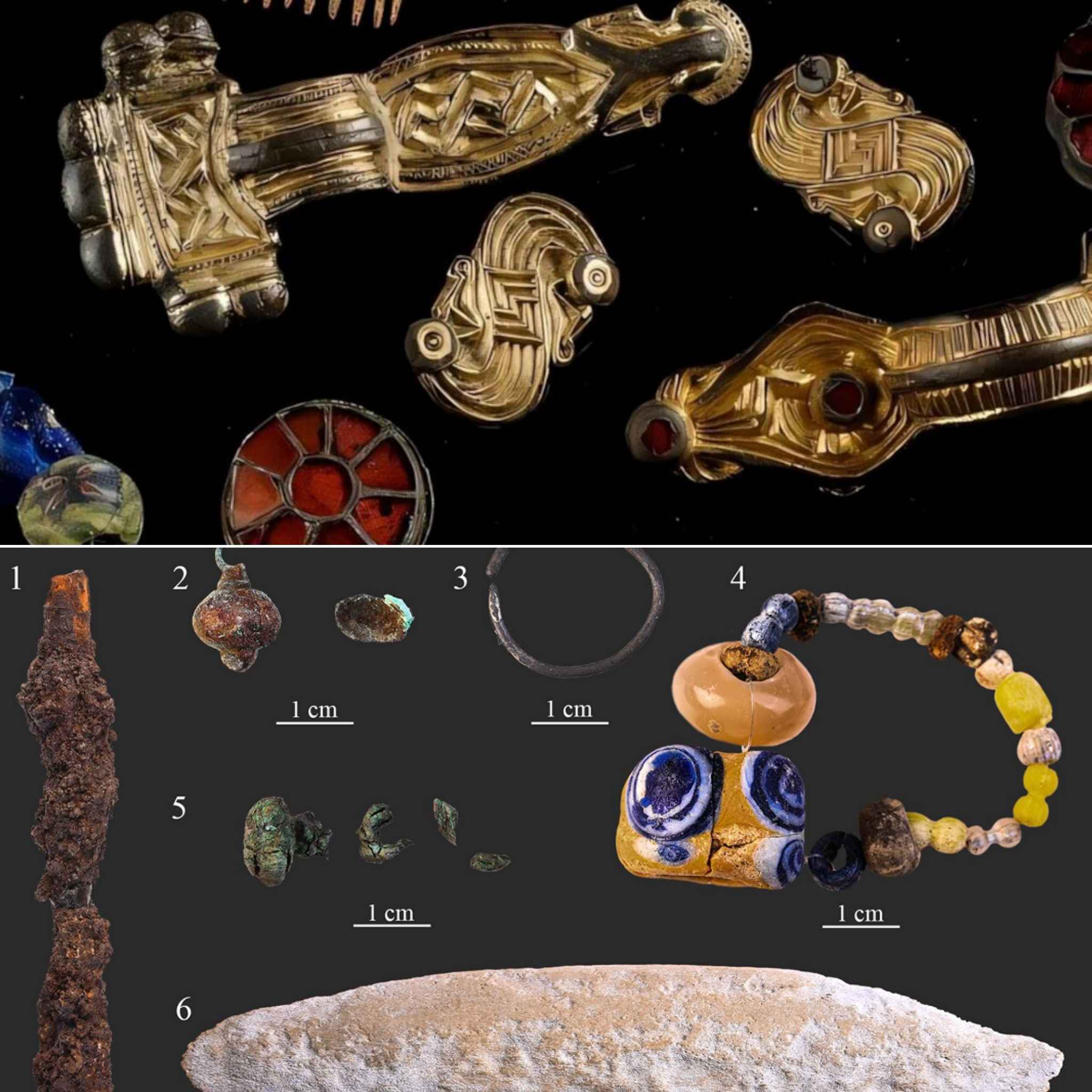
Their graves contained valuable objects such as weapons, jewelry, and ornate brooches.
These findings suggest the existence of a ruling elite.
The newcomers did not merely settle in the region.
They established positions of authority.
Yet their power operated within a society that also included people of local Roman ancestry.
The result was a complex hierarchical system rather than a segregated population.
A Different Model at Szeleste
Just a short distance away, the cemetery at Szeleste revealed a contrasting pattern.
Here, kinship connections were less pronounced.
Families displayed mixed ancestry, combining local and migrant backgrounds.
Burial customs showed fewer distinctions based on ancestry.
The community appeared more integrated.
Rather than preserving rigid divisions between newcomers and locals, residents formed new social identities that blended multiple traditions.
This diversity demonstrates that there was no single model for post-Roman society.
Different communities developed distinct strategies for adaptation.

The Meaning of Grave Goods
Archaeologists have long used grave goods to interpret social status.
The new study allowed researchers to compare burial objects with genetic ancestry for the first time on a large scale.
The results challenge several traditional assumptions.
Some individuals with northern European ancestry possessed elaborate grave goods.
Others did not.
Likewise, people of local ancestry sometimes received prestigious burials.
This demonstrates that material culture and biological ancestry were not always directly linked.
Identity in the post-Roman world was flexible.
A person’s status depended on more than genetics.
Political alliances, family connections, cultural affiliation, and economic resources all influenced social standing.
The findings undermine simplistic narratives that equate ethnicity with power.
Instead, they reveal societies negotiating new identities amid profound political change.
The Lombards Reconsidered
The Lombards occupy a central place in early medieval history.
Traditional accounts portray them as a Germanic people who migrated southward and established dominance over former Roman territories.
The DNA evidence confirms that substantial movement occurred.
Yet it also shows that Lombard communities were far more diverse than once believed.
They incorporated people from multiple backgrounds.
Communities associated with Lombard culture included individuals whose ancestry linked them to:
- Northern Europe
- Southern Europe
- Local Roman populations
- Other migrant groups
The Lombards were therefore not a homogeneous tribe.
They were part of a broader process of social formation that blended diverse peoples into new political structures.
Migration Across Europe
The study also sheds light on broader migration patterns during Late Antiquity.
Researchers identified evidence of mobility spanning vast distances.
Some genetic links connected individuals in Hungary with populations hundreds or even thousands of kilometers away.
These findings reinforce a growing understanding that early medieval Europe was highly mobile.
People traveled for many reasons:
- Warfare
- Trade
- Marriage
- Political alliances
- Religious activity
- Economic opportunities
Migration was not an exceptional event.
It was a normal feature of life.
The collapse of Roman authority accelerated these movements but did not create them.
Instead, existing networks adapted to new political realities.
Ancient DNA and the Rewriting of History
The ability to recover ancient DNA has revolutionized historical research.
For generations, scholars relied primarily on written records.
Yet written sources often reflect the perspectives of elites.
They can exaggerate conflicts, ignore ordinary people, and oversimplify complex realities.
Ancient DNA provides an independent source of evidence.
It allows researchers to reconstruct:
- Family relationships
- Population movements
- Biological ancestry
- Community structures
In Pannonia, this evidence reveals a world far richer than the old narrative of Roman collapse and barbarian conquest.
Beyond the Myth of Barbarian Invasions
For centuries, the term “barbarian invasion” dominated explanations of Rome’s fall.
The phrase suggests sudden destruction caused by external forces.
The reality appears far more complex.
The people who entered former Roman territories did not simply destroy civilization.
They inherited, adapted, and transformed it.
Roman institutions continued to influence law, administration, religion, and culture.
Migrants adopted many Roman practices even as they introduced their own traditions.
The resulting societies were hybrid creations.
They combined elements of both worlds.
In many ways, modern Europe emerged from these interactions.
The Foundations of Medieval Europe
The post-Roman communities of Pannonia represent a crucial chapter in European history.
Within these cemeteries, researchers can see the early formation of societies that would eventually evolve into medieval kingdoms.
The process was not straightforward.
It involved:
- Migration
- Integration
- Social competition
- Cultural exchange
- Political innovation
New elites emerged.
Communities reorganized.
Identities shifted.
Yet beneath these changes lay a remarkable continuity.
People continued to build families, maintain communities, and adapt to changing circumstances.
A New Understanding of Europe’s Past
The ancient DNA recovered from the cemeteries of Pannonia tells a story that written sources alone could never fully reveal.
It shows that the fall of Rome was not simply an ending.
It was also a beginning.
The people who inherited the Roman frontier created new societies that blended diverse ancestries, cultures, and traditions.
Some communities became hierarchical and dominated by powerful kin groups.
Others integrated newcomers and locals more evenly.
Together, they demonstrate the extraordinary flexibility of human societies during periods of upheaval.
Far from representing an age of darkness, the post-Roman centuries were a period of experimentation and transformation.
The ruins of the Roman Empire did not give rise to chaos alone.
They gave rise to the foundations of medieval Europe.
And thanks to ancient DNA, we can finally begin to see that world as it truly was—not as a simple tale of conquest, but as a complex human story of migration, adaptation, and renewal.