EGYPT: The 150-Ton Megalith Hidden in Plain Sight — A Monument Older Than the Pharaohs?
In the quiet expanse of Egypt’s Nile Delta, far from the iconic pyramids of Giza, a colossal red granite structure stands alone in a farmer’s field.
To most passersby, it looks like an abandoned temple shrine—weathered, silent, and partially buried in agricultural land that has been cultivated for generations. But to archaeologists and researchers who have studied it, this monument raises uncomfortable questions.
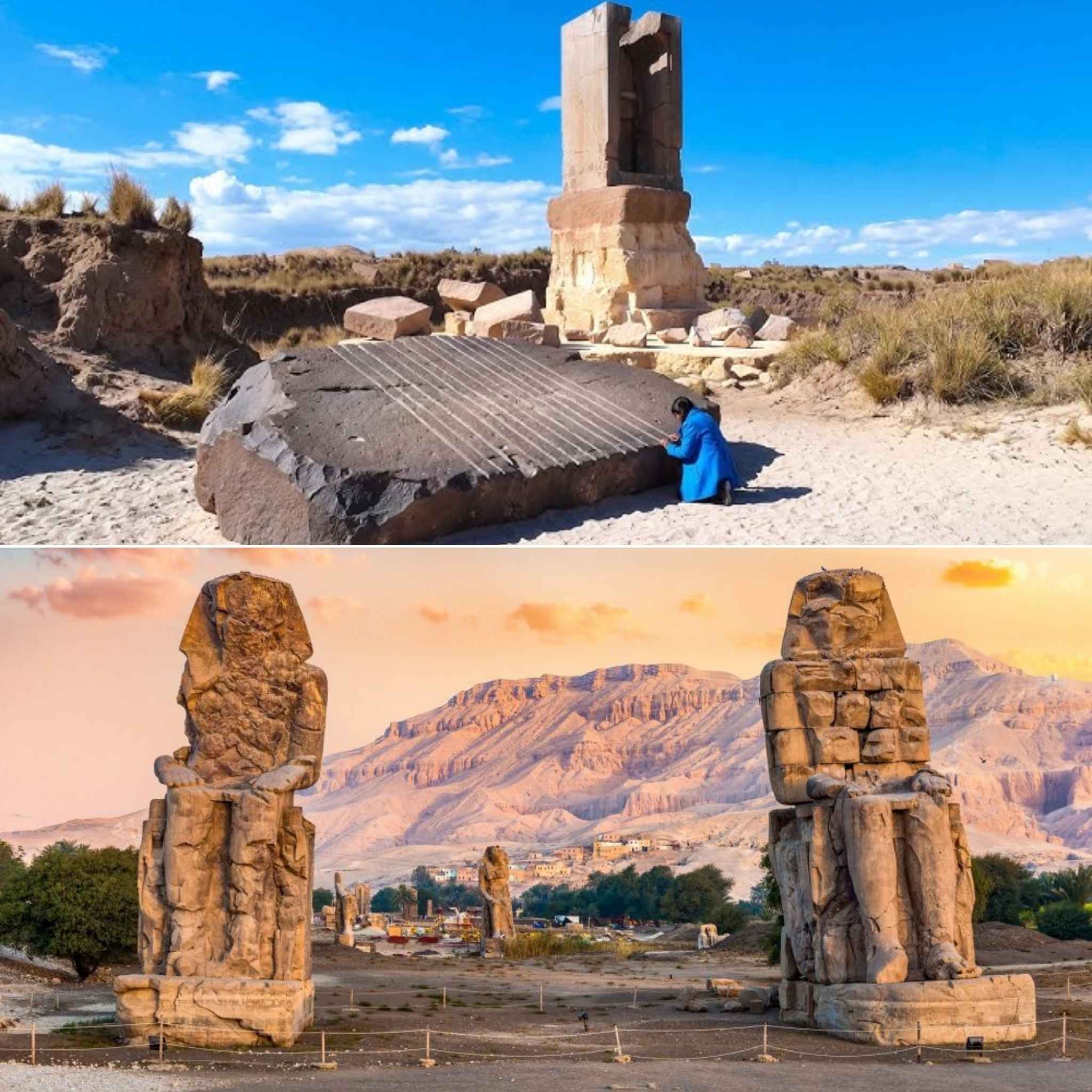
It is estimated to weigh around 150 tons, carved from solid granite, and assembled with a precision that rivals Egypt’s most famous monuments.
Yet its true age—and even its construction history—remains deeply contested.
Some researchers attribute it to King Amasis (26th Dynasty, 6th century BC). Others argue the structure sits atop a far older platform built using materials that may predate it by centuries. And a small number of alternative interpretations suggest something even more controversial: that the monument may preserve engineering traditions inherited from an unknown earlier phase of Egyptian civilization.
What is certain is this: the structure does not fit neatly into the timeline we think we understand.
A Monument of Impossible Weight and Precision
The shrine itself rises from the ground like a fragment of an unfinished world.
Carved from deep red Aswan granite, it is composed of massive blocks fitted together with tight joints and polished surfaces. Its scale alone is staggering—individual components weighing many tons each, requiring coordinated labor, engineering knowledge, and lifting systems that remain partially unexplained even today.
The structure sits on a stone platform, which is where the mystery deepens.
This base layer contains reused blocks bearing inscriptions of earlier pharaohs, including names associated with Ramesses II and Merneptah, rulers from the 13th century BC—hundreds of years earlier than Amasis.
This raises an immediate question:
Was the shrine built on top of an older monument? Or was it assembled using repurposed stones from multiple eras?
The answer is not yet settled.
Layered History or Lost Continuity?
Egypt is well known for recycling building materials across dynasties. Temples were dismantled, stones reused, inscriptions overwritten. Political change often meant architectural reuse rather than complete reconstruction.
However, the case of this Delta shrine is unusual.
Unlike typical reused structures, the megalithic base appears to show architectural coherence, not random assembly. Some researchers suggest that what we are seeing may not be simple reuse—but a layered construction sequence spanning multiple historical phases.
In other words, the monument may represent a physical record of Egypt’s architectural evolution, built directly atop earlier sacred foundations.
Others disagree, arguing that erosion, relocation, or later modification could explain the mixture of inscriptions.
Still, one detail continues to fuel debate: the precision of the stonework.

The Strange Marks Beneath the Surface
Close examination of the granite surfaces has revealed markings that some researchers compare to fine saw-like striations. These markings are not universally accepted as tool traces, but they have sparked discussion because of their similarity—at least in appearance—to high-precision stone cutting techniques found at other ancient Egyptian sites.
At Giza and Saqqara, similar microscopic patterns have been documented on hard stone surfaces, often interpreted as evidence of advanced abrasive drilling and cutting techniques using quartz sand and copper tools.
The question here is not whether ancient Egyptians could cut stone—they clearly could.
The question is whether the consistency and scale of these marks across multiple sites indicate a standardized technological tradition far more advanced and widespread than previously understood.
Architectural Echoes Across Dynasties
Another striking feature of the shrine is its architectural molding.
The structure preserves traces of what Egyptologists call torus-and-cavetto cornice design, a curved architectural style found on temple entrances from multiple periods of Egyptian history.
This design is often associated with monumental sacred architecture and appears across temples built over nearly a thousand years.
Its presence here raises two competing interpretations:
- A conventional one: the shrine was built or modified during the Late Period using established architectural styles.
- A broader one: these design principles may originate from a much older architectural tradition that persisted across dynasties.
In either case, the monument acts as a bridge between eras.
The Problem of Transportation
Perhaps the most debated question is not how it was carved—but how it was moved.
A 150-ton monolith cannot be transported casually, even with modern machinery. In ancient Egypt, such feats required coordinated systems of sledges, ramps, waterways, and thousands of workers.
The Nile Delta, however, presents a challenge.
Unlike quarry sites near the riverbanks of Upper Egypt, this monument sits in a region where transport logistics would have been significantly more complex. Some researchers suggest canal systems may have been used, while others propose that large stones were moved during seasonal flooding when waterways expanded.
Still, no direct evidence explains the full logistics of the shrine’s placement.
And so the question remains open:
Was this monument transported using known ancient methods—or does it reflect engineering solutions we have yet to fully reconstruct?
A Missing Excavation Layer Beneath the Platform

One of the most intriguing details about the site is what has not been done.
The base of the monument remains largely unexcavated.
This is significant because layered temple complexes in Egypt often contain older construction phases buried beneath later additions. At sites like Karnak and Abydos, deeper excavation has revealed entire architectural worlds hidden below visible structures.
In this case, however, the ground beneath the shrine has not been systematically explored.
Until that happens, the earliest phase of the monument’s history remains speculative.
And that uncertainty continues to fuel debate.
Comparing Egypt’s Megalithic Tradition
To understand the significance of the structure, it helps to place it in context.
Egypt is home to some of the largest stone constructions in the ancient world:
- The pyramids of Giza, built with limestone and granite blocks exceeding tens of tons each
- The unfinished obelisk of Aswan, estimated at over 1,000 tons
- The granite temples of Karnak and Luxor, constructed with enormous transported blocks
Within this broader tradition, the Delta shrine is not unique in scale—but it is unusual in location and composition.
Unlike the carefully planned pyramid fields of Giza, this structure feels isolated, almost displaced from its architectural ecosystem.
That isolation is part of what makes it so compelling.
Competing Interpretations
Scholars generally fall into three broad interpretive camps:
1. Conventional Egyptological View
The shrine is a Late Period structure built under Amasis, using recycled materials from earlier dynasties.
2. Hybrid Construction Model
The monument was built in phases over centuries, incorporating earlier stones and inscriptions into a later unified structure.
3. Alternative Chronology Hypotheses
The site preserves remnants of a much older construction tradition that predates established dynastic history, later reused and modified by successive rulers.
While the first explanation remains the academic consensus, the second is widely considered plausible, and the third remains speculative but popular in alternative archaeology circles.
What unites all interpretations is agreement on one point:
The structure is not simple.
The Role of Memory in Stone
Ancient Egyptian architecture was never just functional. It was symbolic, political, and deeply religious.
Reusing older monuments was not uncommon—it was often intentional. By incorporating the names and stones of earlier kings, later rulers asserted continuity, legitimacy, and divine approval.
In this sense, the shrine may represent something more than engineering:
It may represent political memory embedded in stone.
Each layer of inscription could reflect not confusion, but deliberate historical layering—an attempt by successive rulers to connect themselves to a longer lineage of divine kingship.
Why the Mystery Persists
Despite decades of study, no single interpretation fully resolves the contradictions at the site.
The monument remains under-studied compared to Egypt’s more famous archaeological locations, and its remote position in agricultural land limits large-scale excavation.
Until more comprehensive research is conducted—particularly beneath its foundation—the structure will continue to generate debate.
It stands, quite literally, at the intersection of certainty and speculation.
Conclusion: A Stone That Refuses to Speak Clearly
The 150-ton granite shrine of Egypt’s Nile Delta is not unknown.
It is documented, measured, and physically present.
What is unknown is its full story.
Is it a Late Period construction built on recycled stones from older temples? A layered monument spanning centuries of Egyptian engineering tradition? Or a fragment of a deeper, more complex architectural history than we currently understand?
For now, the stone remains silent.
And silence, in archaeology, is often where the most important questions begin.
Because beneath its massive weight lies something even heavier:
The possibility that we have not yet fully understood the depth of Egypt’s earliest engineering traditions.
And somewhere beneath that platform—still unexcavated—the next chapter may already be waiting.