A 2,500-YEAR-OLD LEATHER CAP FROM UKRAINE REWRITES THE STORY OF SCYTHIAN-ERA ELITE WOMEN
In the forest-steppe zone of ancient Scythia, where nomadic traditions met settled cultures and trade routes stretched across continents, archaeologists have uncovered an extraordinary burial that is forcing scholars to rethink how identity, status, and cultural exchange worked in the Early Iron Age.
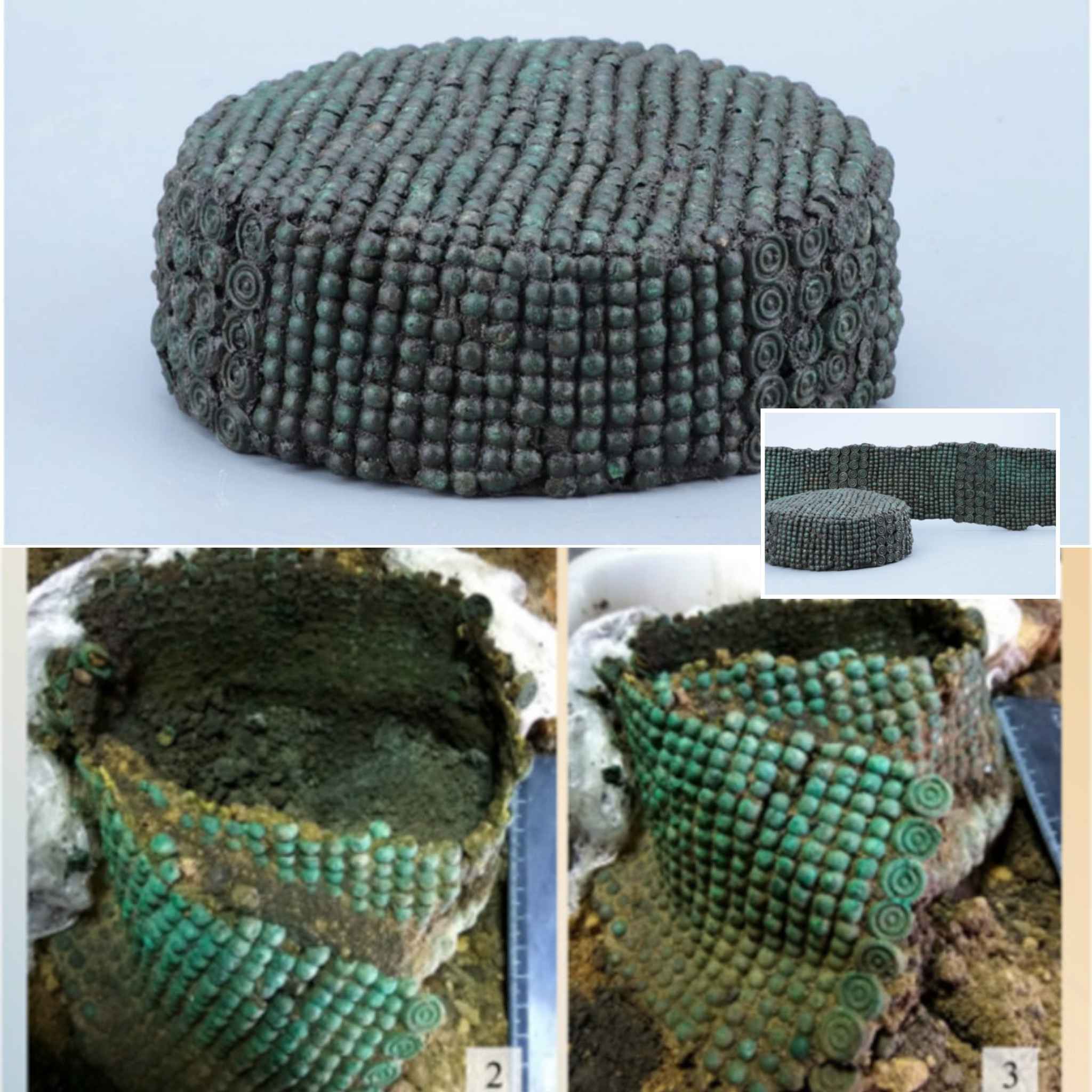
At the Skorobir necropolis near the Bilsk Hillfort in modern Ukraine, a rare set of organic artifacts—a 2,500-year-old leather cap and matching belt decorated with bronze plaques—was discovered in the burial of a young elite woman.
What makes this find exceptional is not only its preservation, but its cultural ambiguity. The objects do not fit neatly within Scythian traditions, instead pointing toward unexpected connections with Central European Hallstatt cultural practices, suggesting that ancient Eastern Europe was far more interconnected than previously believed.
A BURIAL DISCOVERED IN 2017, BUT ONLY NOW FULLY UNDERSTOOD
The burial was originally excavated in 2017, but the artifacts only recently entered broader scholarly discussion after years of careful conservation and analysis.
The grave belonged to a paired burial, containing:
- A man aged approximately 30–40
- A young woman aged approximately 18–22
Although the burial had been disturbed by ancient grave robbers, who removed many valuable items, several key objects remained beside the woman’s body.
These included:
- A leather cap with bronze decoration
- A matching belt with bronze fittings
- A bronze mirror
- Gaming pieces (likely astragali or knucklebones)
- A black-polished bowl
- A horn vessel
- Fragments of wooden container fittings
Together, these items suggest a person of high social status, possibly connected to ritual practice or elite household traditions rather than ordinary domestic life.
Image 1: Reconstruction of Scythian Burial Context
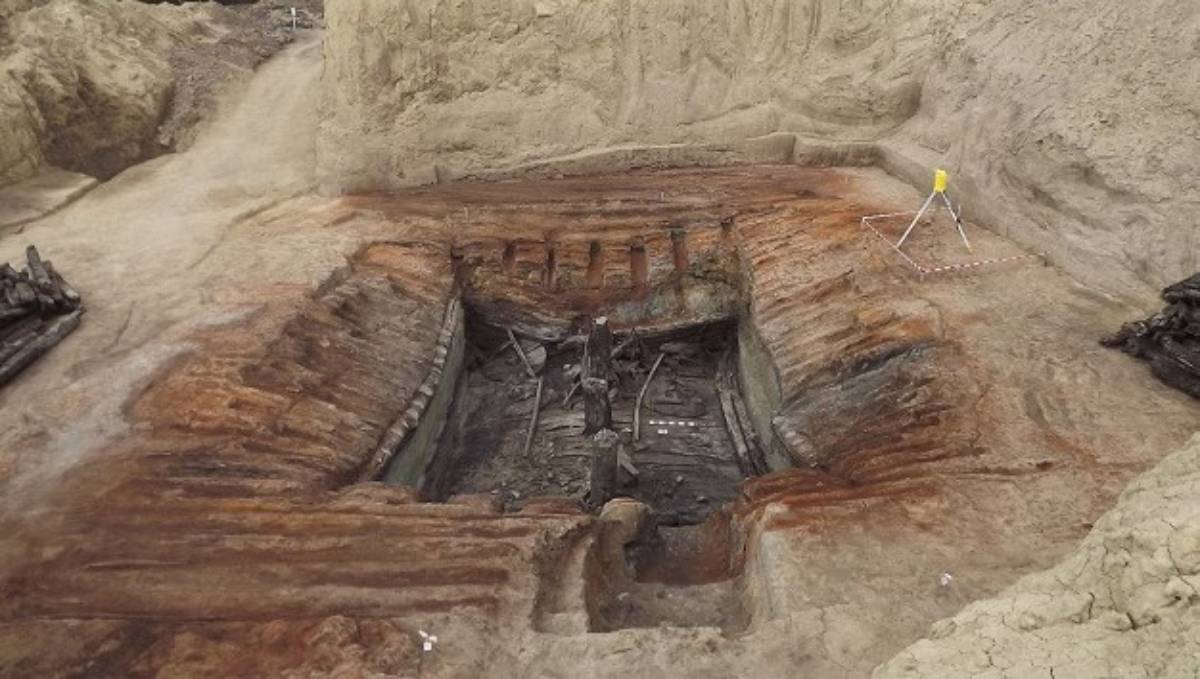
A RARE SURVIVAL: ORGANIC MATERIAL IN THE ARCHAEOLOGICAL RECORD
One of the most remarkable aspects of the Skorobir discovery is the survival of organic leather materials, which rarely endure in archaeological contexts.
Leather typically decomposes rapidly unless preserved under exceptional conditions such as:
- Waterlogging
- Freezing
- Extremely dry soil
- Mineral-rich burial environments
At Skorobir, the objects were recovered as part of an earth block, requiring delicate extraction in the field. Once exposed to air, the leather began to deteriorate rapidly, forcing conservators to stabilize it immediately on-site.
Researchers describe the process as technically demanding, as the leather:
- Shrinked rapidly upon exposure
- Became fragile and unstable
- Required continuous humidity control
- Needed careful reinforcement before transport
Without rapid intervention, much of the object would likely have been lost forever.
THE LEATHER CAP: A STRIKING PIECE OF IRON AGE DESIGN
The most visually distinctive object from the burial is a leather cap shaped like a low cylinder with a flat top.
Its surface was decorated with small bronze plaques, carefully attached in a patterned arrangement. Inside, traces of a thin inner lining were preserved, likely intended to:
- Improve comfort
- Protect the head from metal fasteners
- Stabilize the structure during wear
This combination of leather craftsmanship and bronze decoration indicates a highly developed production technique, suggesting specialized artisanship rather than simple domestic manufacture.
The cap’s form is unusual within known Scythian material culture, making it a key piece in debates about cultural interaction across Iron Age Europe.
THE BELT: A FRAGMENT OF LOST IDENTITY
Alongside the cap, archaeologists recovered fragments of a matching leather belt, also decorated with bronze fittings.
Although incomplete, the surviving sections indicate:
- A shared decorative system with the cap
- A consistent manufacturing tradition
- A structured pattern of bronze attachment
- High-quality craftsmanship
The belt and cap likely formed part of a coordinated costume, possibly worn during ceremonial, social, or ritual occasions.
Because leather rarely survives, this set provides a rare glimpse into how elite individuals in the Scythian forest-steppe may have presented themselves in life.
NOT TYPICAL SCYTHIAN FASHION: A CULTURAL ANOMALY
Elite women in Scythian burials are often associated with elaborate headgear, sometimes decorated with precious metals such as gold. These objects are frequently interpreted as markers of status or ritual authority.
However, the Skorobir cap differs in several key ways:
- It uses bronze instead of gold
- It features small staple-shaped plaques rather than large ornamental plates
- It follows a construction technique not typical of Scythian steppe traditions
- It resembles Central European decorative systems more closely than local ones
This has led researchers to suggest that the object reflects a different cultural tradition embedded within a Scythian burial context.
Image 2: Bronze-Age Style Decorative Metalwork
CONNECTIONS TO CENTRAL EUROPE AND THE HALLSTATT WORLD
One of the most intriguing aspects of the research is the similarity between the Skorobir artifacts and material culture from the Hallstatt cultural sphere of Central Europe (modern Austria, southern Germany, and surrounding regions).
Parallels include:
- Small bronze plaques used in textile and leather decoration
- Belt construction techniques
- Headgear forms associated with elite identity
- Ornament systems emphasizing repetition and geometric attachment patterns
These similarities suggest either:
1. Cultural exchange across long-distance networks
or
2. Movement of people and traditions into the forest-steppe region
or
3. Shared technological traditions across interconnected Iron Age societies
While no single explanation is definitive, the evidence strongly supports the idea of active cultural interaction between Central and Eastern Europe during the Early Iron Age.
A WOMAN OF STATUS — BUT NOT A SIMPLE LOCAL BURIAL
The burial context indicates that the young woman was not an ordinary member of society.
Several factors support this interpretation:
- Presence of a bronze mirror (a prestige item)
- Inclusion of gaming pieces (elite leisure activity markers)
- Carefully placed vessels and containers
- Specialized clothing accessories
- Association with a male burial in a structured grave context
Together, these suggest a socially elevated identity, possibly connected to ritual authority, elite lineage, or interregional cultural networks.
GENETIC CLUES AND POSSIBLE CENTRAL EUROPEAN LINKS
Preliminary genetic analysis has revealed affinities with populations linked to Central Europe, particularly groups associated with the region of the ancient Iapodes, near modern-day Croatia.
While such genetic signals cannot determine identity or culture on their own, they add an important dimension to the archaeological evidence.
Combined with the stylistic parallels in clothing, researchers have proposed several interpretations:
- The woman may have belonged to a migrant group
- Her community may have maintained inherited dress traditions
- The burial may reflect intermarriage between cultural zones
- Or the objects may symbolize identity rather than origin
None of these explanations exclude the others, highlighting the complexity of Iron Age social structure.
BILSK HILLFORT: A MULTICULTURAL CROSSROADS
The Skorobir necropolis is located near the Bilsk Hillfort, often identified with the ancient settlement of Gelonus, described by the Greek historian Herodotus.
If this identification is correct, the region would have been one of the largest fortified settlements of the Scythian world, positioned at the intersection of multiple cultural spheres.
Archaeological evidence suggests that this area was not culturally uniform. Instead, it functioned as a multi-layered frontier zone, where:
- Nomadic Scythian groups
- Settled forest-steppe populations
- Greek trading networks
- Central European influences
all interacted and overlapped.
The Skorobir burial fits neatly into this picture of cultural complexity.
Image 3: Reconstruction of Bilsk Hillfort Landscape

A COSTUME THAT SPEAKS OF IDENTITY, NOT JUST WEALTH
One of the key conclusions of the study is that the cap and belt should not be interpreted purely as luxury objects.
Instead, they likely carried deeper meaning:
- Social identity
- Clan or group affiliation
- Ritual function
- Ancestral tradition
- Cultural memory
The use of bronze rather than gold may be especially significant. Rather than signaling pure wealth, the objects may have emphasized belonging, lineage, or ceremonial role.
In this sense, clothing becomes a language—communicating identity across cultural boundaries.
A GLIMPSE INTO A CONNECTED IRON AGE WORLD
The Skorobir discovery challenges older assumptions that Iron Age Europe was divided into clearly separated cultural zones.
Instead, it supports a growing view that:
- Cultural traditions were mobile
- Artistic techniques spread across vast distances
- Clothing styles could reflect shared or transmitted identities
- Burial practices were influenced by multiple overlapping traditions
What emerges is not a fragmented world, but a deeply interconnected Iron Age landscape, where people, ideas, and technologies moved more freely than once assumed.
CONCLUSION: A BURIAL THAT OPENS NEW QUESTIONS
The 2,500-year-old leather cap and belt from Skorobir are more than rare artifacts—they are evidence of a complex cultural meeting point in ancient Europe.
They show that:
- Elite identity in the Scythian world was diverse
- Central European traditions reached deep into the steppe
- Clothing could carry symbolic and cultural meaning beyond status
- And ancient societies were far more interconnected than once believed
Much remains uncertain about the young woman buried at Bilsk Hillfort. But her grave has already achieved something important: it has expanded the boundaries of what we thought we knew about the Early Iron Age.
And in doing so, it has reminded us that even the smallest fragments of leather and bronze can carry the weight of entire lost worlds.


