Pete first noticed it in the hallway between third and fourth period, the place where lockers echoed like they were designed to humiliate you.
It wasn’t even anything new.
Just a glance.
But in high school, a glance can feel like a verdict.
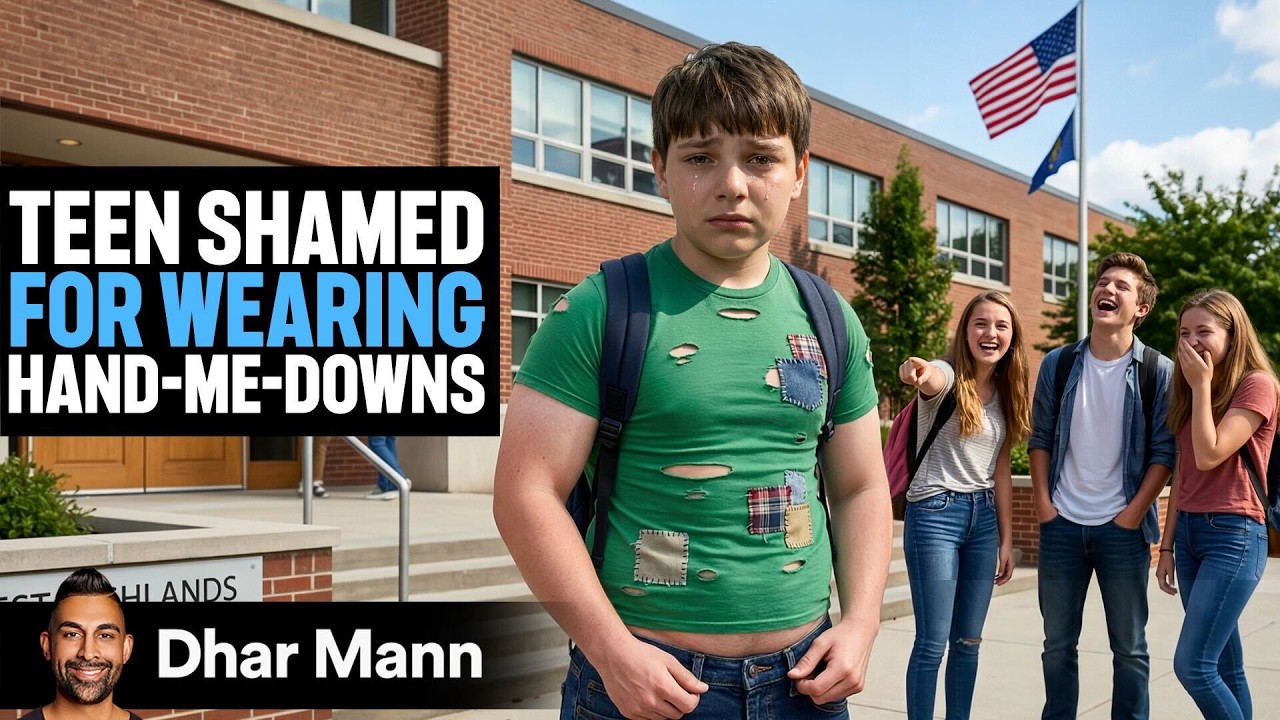
“Yo… is that your brother’s shirt again?” someone called out behind him.
A few laughs followed. Not loud enough for teachers to notice, but sharp enough for Pete to feel them land right between his shoulder blades.
He kept walking.
Didn’t turn around. Didn’t react.
That was his rule: if you don’t feed it, it dies.
But it never really died.
The shirt was faded navy, slightly too big at the sleeves, the collar softened from years of washing. It had once belonged to Rob—his older brother, the kind of guy teachers remembered even after graduation. The kind of guy people said was “going places.”
Now it belonged to Pete because that’s how things worked in their house. Clothes didn’t get thrown away. They got passed down. Fixed. Reused. Made to last longer than pride.
And pride was exactly what Pete was running out of.
By lunch, the teasing had grown legs.
“Bro, does your wardrobe come from a museum?”
“Bet his fashion icon is his laundry basket.”
Pete sat with his tray untouched, picking at the plastic edge until it bent. His friends—if he could still call them that—laughed like it was harmless fun. Like it didn’t matter.
But it mattered.
Because every laugh sounded like someone saying: you don’t belong here.
And Pete was starting to believe them.
The store was only three blocks from school.
He’d walked past it a hundred times.
Bright windows. Mannequins dressed like they had better lives than most people in town. Hoodies that cost more than a week of groceries. Shoes displayed like trophies.
Pete told himself he wasn’t going to do anything.
Not at first.
He just stood near the entrance, hands in his pockets, watching people come and go like they belonged to a different version of the world.
Inside, everything felt clean in a way his life wasn’t.
No faded shirts. No hand-me-downs. No laughter behind your back.
Just price tags that decided who mattered.
He saw a hoodie on a rack near the back. Black, simple, nothing special—but it didn’t look tired. It didn’t look like something someone else had already lived in.
It looked like starting over.
His heart hammered before he even realized what he was doing.
A quick glance around.
A step closer.
Another.
He told himself it was just to try it on. Just to see.
But his fingers were already moving.
The fabric slipped under his jacket faster than he expected.
Too fast.
Like the world had already decided he was going to do it.
And for one suspended second, everything felt quiet.
Then a voice cut through it.
“Sir.”
Not loud.
Not angry.
Just certain.
Pete froze.
The store security guard stood near the exit, holding a radio, eyes locked on him with the kind of calm that didn’t need to shout.
Pete’s mouth went dry.
He tried to speak. Nothing came out.
The walk to the back room felt longer than the entire school day.
They called his mother.
She arrived in fifteen minutes, breathing hard like she’d run the whole way. Her face changed the moment she saw him sitting there under the fluorescent light, hoodie on the table between them like evidence in a trial.
She didn’t shout.
That somehow made it worse.
“I’m sorry,” Pete said quickly, too quickly. “I wasn’t thinking—I just—”
But she wasn’t looking at him.
She was looking at the hoodie.
Then at the guard.
Then back at him.
Something in her expression didn’t match anger.
It matched exhaustion.
“I’ll handle it,” she said softly.
On the drive home, she didn’t turn on the radio.
Pete stared out the window, waiting for the lecture. The punishment. The disappointment.
It came, but not the way he expected.
“You know what hurts most?” she asked finally.
He braced himself.
She didn’t wait for an answer.
“Not the hoodie. Not the store. It’s that you thought you needed it so badly you’d risk everything for it.”
Her voice cracked slightly on the last word.
Everything.
Pete sank deeper into his seat.
He wanted to say something that would fix it. Something smart. Something that would make him less of a mistake.
But all he could think about was laughter in the hallway.
And how easy it would’ve been if he’d just been born different.
That night, Rob came home late.
Pete heard him before he saw him—the familiar rhythm of his steps, slower than usual.
Rob used to move like someone sure of where he was going.
Now he moved like someone conserving energy.
Pete noticed it but didn’t know what to make of it.
Rob dropped his bag near the door and gave him a look.
Not judgment.
Something else.
Concern.
“I heard what happened,” Rob said.
Pete stiffened. “Of course you did.”
Silence stretched between them.
Then Rob sat down across from him.
“You stole a hoodie.”
Pete’s jaw tightened. “Yeah. Congratulations, I’m a criminal now.”
Rob didn’t react to the sarcasm. Just studied him.
“Why?”
That question hit harder than the guard’s voice.
Pete looked away. “Because everyone at school thinks I’m… invisible. Because I wear your old clothes like I don’t matter.”
Rob leaned back slightly, as if absorbing the answer.
“You think clothes decide that?”
Pete laughed bitterly. “You don’t get it. You’ve never been the one getting laughed at every day.”
Something flickered across Rob’s face. Something unreadable.
Then he said quietly, “You’re right. I don’t get it.”
And that was the end of the conversation.
Or so Pete thought.
The next morning, Rob was still home.
That was unusual.
He was usually gone early—work, appointments, something always pulling him out the door.
But today he sat at the kitchen table, staring at a cup of tea he hadn’t touched.
Pete noticed how thin his brother looked in the morning light.
Too thin.
But he pushed the thought away.
At school, nothing changed.
The hoodie story spread faster than anything important ever did.
By second period, Pete had a nickname again. Something he didn’t bother remembering.
By lunch, even the friends who used to sit with him had migrated elsewhere, like association itself was contagious.
He kept his head down.
That’s when it happened again.
“Hey, hoodie thief!”
Laughter.
Someone tossed a crumpled paper ball that hit his tray.
Pete stood up so fast his chair scraped loudly.
The cafeteria went quiet for half a second—the kind of silence that always feels like a decision point.
He could walk away.
Or he could finally snap.
He didn’t get the chance to choose.
Because the intercom crackled overhead.
“Pete Thompson, please come to the front office.”
His stomach dropped.
He didn’t expect Rob to be there.
But he was.
Sitting in a chair outside the office, elbows on knees, head slightly bowed like he was holding himself together through sheer concentration.
Their mother stood beside him.
Red-eyed.
That was the first thing Pete noticed.
Not anger.
Not disappointment.
Fear.
“What’s going on?” Pete asked, voice suddenly smaller than he meant it to be.
No one answered immediately.
The principal stepped out, then paused when he saw the three of them.
“Pete,” he said gently, “your mother asked to speak with you here.”
Something about the tone made Pete’s chest tighten.
This wasn’t about the hoodie anymore.
His mother finally looked at him.
And when she spoke, her voice didn’t sound like it belonged to the car ride home anymore.
“It’s about Rob.”
Pete turned slowly toward his brother.
Rob still wasn’t looking at him.
“Pete…” Rob said quietly, like the word itself weighed something down.
“I didn’t want you to find out like this.”
The room felt too small suddenly.
Pete’s thoughts scrambled for something logical.
Something normal.
But nothing normal followed.
His mother took a breath.
“Rob has been sick.”
The words didn’t land immediately.
They floated.
Waited.
Then sank.
Cancer.
Not dramatic in the way movies make it. No sudden music. No collapse.
Just a sentence that rearranged everything without permission.
Pete felt his legs go slightly numb.
“That’s why I’ve been taking his old clothes,” his mother continued softly. “That’s why things have been… tight.”
Rob finally looked at him.
And in his eyes, Pete saw something he had never seen before in his brother.
Not strength.
Not confidence.
Weariness that had been carefully hidden for a long time.
“I didn’t want you to carry it,” Rob said. “You’ve been carrying enough already.”
Pete’s mouth opened, but nothing came out.
The hoodie. The laughter. The shame.
All of it suddenly felt like it belonged to a different world.
A smaller one.
One that didn’t matter.
“I thought…” Pete started.
He stopped.
Because everything he thought suddenly sounded childish.
Rob gave a faint, tired smile.
“Clothes don’t define you,” he said. “But I guess I forgot how easy it is to believe they do when you’re seventeen.”
That was the moment something inside Pete cracked—not loudly, but completely.
Not shame anymore.
Understanding.
The days after didn’t erase what happened.
But they changed its shape.
Pete went back to school expecting the worst.
It came.
The whispers. The looks.
But something was different now.
He didn’t shrink from them in the same way.
When someone mocked him in the hallway, he stopped walking for a second.
Looked at them.
Not angry.
Just present.
Then kept walking.
The reaction confused them more than silence ever had.
At lunch, he sat alone at first.
Then someone—someone who had never sat with him before—moved closer.
“Is it true about your brother?” they asked quietly.
Pete hesitated.
Then nodded.
That was all.
No drama.
No explanation.
But something shifted after that.
Not everyone changed.
Not overnight.
But enough did.
Enough to matter.
At home, Rob got weaker before he got better.
But on the nights he was strong enough, he’d sit with Pete and talk about normal things.
School. Music. Nothing heavy.
Like they were both trying to remember what life felt like before everything became important.
One evening, Pete sat across from him and said, “I was so stupid.”
Rob shook his head slowly.
“No,” he said. “You were trying to survive a place that makes people feel small. That’s not stupidity. That’s pressure.”
Pete looked down at his hands.
“I thought I needed different clothes to matter.”
Rob leaned back slightly, eyes tired but steady.
“And now?”
Pete thought about it.
The hallway. The laughter. The hoodie.
Then something simpler.
“I think I just needed to stop listening to the wrong people.”
Rob nodded once.
Like that was enough.
The last time Pete heard anyone bring up the hoodie story was weeks later.
It came up in the cafeteria again, but this time someone else shut it down.
“Leave it,” a student said. “You don’t know what happened.”
That was new.
Not sympathy.
Respect.
Pete didn’t notice it immediately.
He was too busy finishing his homework, sitting with people who didn’t laugh at him anymore.
Or maybe had never needed to.
On a quiet afternoon, he walked home with Rob slowly beside him.
Rob was stronger that day.
Not healed.
But present.
They didn’t talk much.
They didn’t need to.
At one point, Rob adjusted his sleeve—one of Pete’s old hand-me-down shirts.
Pete glanced at it.
Then smiled slightly.
“Still wearing my stuff?” he asked.
Rob smirked faintly.
“Guess it runs in the family.”
They walked a little further.
The sun was low, turning everything soft around the edges.
Pete realized something then—not as a lesson, not as a thought, but as a feeling sitting quietly in his chest.
He didn’t need to be new to be enough.
He just needed to be real.
And for the first time, that felt like something solid enough to stand on.
Because in the end, it was never about the hoodie.
It was about who he chose to become when no one was laughing anymore—and what kind of person still stood there when they were.
And that was the moment everyone who had ever judged him finally understood something they couldn’t take back.