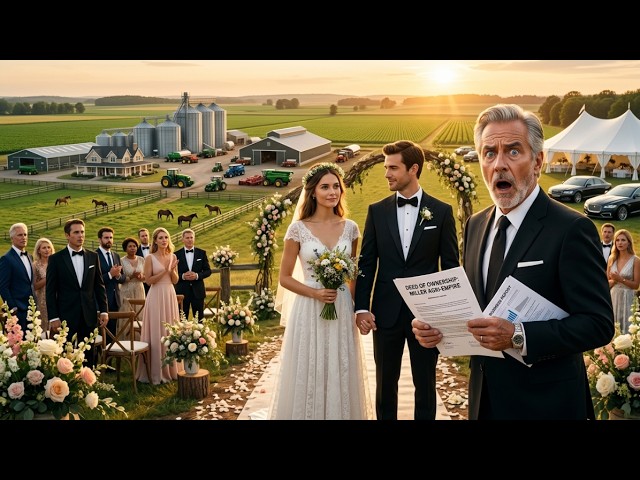
Millionaire Forces His Son to Marry a Humble Farmer—Then Discovers He Was Wrong All Along
The first time Richard Hale met the woman his father had chosen for him to marry, she was standing in a muddy field with a shovel in her hand, boots covered in dirt, and rain dripping from the brim of her old canvas hat.
Richard stepped out of the black Mercedes, stared at her, and laughed.
“You can’t be serious,” he said.
His father, Henry Hale, didn’t laugh back.
Henry was one of the wealthiest men in the county. He owned shopping centers, warehouses, luxury apartments, and half the downtown skyline. People lowered their voices when he entered a room. Bank managers returned his calls immediately. Mayors shook his hand with both hands.
Richard was his only son.
And Richard had spent twenty-eight years making sure everybody knew it.
He crashed sports cars, insulted waiters, skipped board meetings, dated women he barely remembered, and treated money like air—something that simply existed around him because he deserved it.
For years, Henry covered it up.
The speeding tickets disappeared. The nightclub fights never reached the papers. The broken contracts were repaired quietly by lawyers. The embarrassing videos were bought before they spread.
But the final straw came on a Monday morning.
Richard walked into a Hale Holdings investor meeting forty minutes late, wearing sunglasses indoors, smelling faintly of champagne, and interrupted a senior partner by saying, “Relax, Morris. You’re paid to worry. I’m paid to inherit.”
The room went silent.
Henry didn’t speak.
He just looked at his son across the polished conference table and saw, maybe for the first time, not a young man who needed guidance—but a grown man who had never been forced to carry the weight of anything.
That evening, Henry summoned Richard to his private study.
No whiskey.
No cigar.
No lecture.
Just one folder on the desk.
Richard dropped into the leather chair opposite him. “Are we doing the disappointed father speech again? Because I have dinner plans.”
Henry pushed the folder forward.
Inside were photographs of a small farm about forty miles outside the city. A red barn with peeling paint. Fenced pasture. A white farmhouse with a sagging porch. Rows of vegetables. A dirt road lined with tired-looking trees.
Richard flipped through the photos with a smirk.
“What is this? Your new charity case?”
“Her name is Emma Brooks,” Henry said. “She owns that farm.”
“Congratulations to Emma.”
“You’re going to marry her.”
Richard stopped smiling.
For a few seconds, the only sound in the room was the old grandfather clock ticking against the wall.
Then Richard laughed so hard he leaned back in the chair.
Henry didn’t move.
Richard’s laughter died slowly.
“You’re serious.”
“Completely.”
Richard tossed the folder onto the desk. “No.”
“You have two choices,” Henry said calmly. “Marry Emma Brooks and live on that farm for one year, or lose access to every account, every trust distribution, every company role, every property, every car, and every Hale family connection you have mistaken for your own achievement.”
Richard stood so fast the chair scraped the floor.
“You can’t do that.”
“I already have.”
“You’re punishing me with a wife?”
“I’m giving you a life you can’t buy your way out of.”
Richard’s face turned red. “And what does she get? A millionaire’s son as a husband? Lucky her.”
Henry’s expression hardened.
“She gets help keeping her farm alive.”
Richard narrowed his eyes. “So you paid her.”
“I made an arrangement.”
“That’s disgusting.”
“For once,” Henry said, “we agree.”
The wedding happened three weeks later.
It was not the kind of wedding Richard imagined for himself.
No champagne tower. No celebrity DJ. No magazine photographer. No rooftop venue with city lights.
It took place in a small courthouse with flickering fluorescent lights and a clerk who looked like she had already seen every kind of bad decision two people could make.
Emma wore a simple cream dress and held a small bouquet of wildflowers tied with twine. Her brown hair was pinned back neatly, but a few loose strands framed her face. She looked calm, almost too calm.
Richard wore an expensive navy suit and the expression of a man attending his own sentencing.
Henry stood in the back, hands folded over his cane.
Emma’s older neighbor, Mrs. Whitaker, came as her witness. She kept glancing at Richard with the same suspicion people reserve for loose dogs and unpaid bills.
When the clerk asked Richard if he took Emma as his wife, he looked at his father first.
Henry did not blink.
Richard turned back.
“I do,” he said, like the words tasted bitter.
Emma’s voice was steady when it was her turn.
“I do.”
There was no kiss.
Richard walked out ahead of her.
By sunset, he was standing in the farmhouse kitchen, staring at a room smaller than his walk-in closet.
The floorboards creaked. The sink dripped. A chipped yellow kettle sat on the stove. There was no marble island, no espresso machine, no private chef, no city view.
Emma set a paper bag of groceries on the table.
“Your room is upstairs,” she said. “Second door on the left.”
“My room?”
She looked at him. “You didn’t think we were sharing one, did you?”
Richard scoffed. “Trust me, that was not my concern.”
She nodded once, as if confirming something she already knew.
“Breakfast is at five.”
Richard stared at her.
“In the morning?”
Emma hung her coat on the hook by the door. “That’s usually when five happens.”
He gave a cold smile. “I don’t get up at five.”
“You do now.”
The first morning, Emma knocked on his door at 4:55.
Richard opened it at 6:30.
By then, she had already fed the chickens, checked the irrigation pump, loaded crates into the truck, and repaired a broken latch on the goat pen.
She was standing in the yard when he finally came outside wearing designer sneakers that sank instantly into the mud.
Emma looked down at his shoes.
“You’ll want boots.”
“I’ll want a divorce.”
“You’ll want gloves too.”
She handed him a pair.
Richard didn’t take them.
Emma simply placed them on the fence post and walked toward the barn.
For the first week, Richard was useless.
He complained about everything.
The smell.
The bugs.
The cold mornings.
The heavy feed bags.
The lack of cell service.
The fact that the nearest decent restaurant was thirty minutes away and closed on Mondays.
He called the chickens “aggressive feathered idiots.” He called the tractor “a medieval torture device with wheels.” He called the rooster “a tiny terrorist.”
Emma rarely reacted.
That annoyed him more than if she had yelled.
Every morning, she gave him tasks. Every morning, he acted insulted. Every evening, he collapsed into bed with aching shoulders and blistered palms, furious that the world had not adjusted itself to his comfort.
One afternoon, Emma asked him to help mend a fence after a storm.
Richard spent twenty minutes trying to untangle wire, sliced his thumb, cursed loudly, and kicked a fence post.
Emma looked over from where she was kneeling in the grass.
“Does the post owe you money?”
Richard glared at her.
“You think you’re very clever.”
“No,” she said, twisting wire with pliers. “I think the cows will get out if we don’t fix this.”
He stood there, breathing hard, blood running down his thumb.
Emma noticed.
She walked over, took his hand without asking, and wrapped a clean cloth around the cut.
Her hands were rough. Callused. Steady.
Richard looked at them.
“You always this calm?”
“No.”
“What scares you?”
Emma tightened the cloth.
“Losing something I worked for.”
For some reason, Richard didn’t have a response.
The days became longer.
Or maybe Richard simply began noticing how much lived inside them.
At five in the morning, the fields were blue and silver, quiet except for birds and the distant creak of the barn door. At noon, the sun beat down until sweat soaked his shirt. In the evenings, the sky turned orange over the pasture, and Emma would sit on the porch steps with a mug of tea, saying very little.
Richard had always hated silence.
Silence forced thoughts to speak.
At first, he filled it with phone calls to old friends.
Most of them laughed when he told them where he was.
“Bro, your dad put you in farm jail?”
“Is your wife hot at least?”
“Send a picture of the cows.”
After a while, he stopped calling.
Their jokes sounded thinner from the farmhouse porch.
Emma never asked about his old life.
That bothered him too.
One night, after a long day loading hay bales, he found her at the kitchen table surrounded by invoices. Her hair was loose around her shoulders. Her fingers pressed against her temple.
Richard poured water from the tap.
“You always do that?”
“Do what?”
“Stare at bills like they might apologize.”
A tired smile crossed her face.
“Sometimes they do. Not often.”
He leaned against the counter.
“How bad is it?”
Emma gathered the papers too quickly.
“It’s handled.”
“That means bad.”
She looked up.
“You don’t need to worry about it.”
Richard almost laughed. For the first time in his life, someone had told him not to worry because he was irrelevant, not because he was protected.
He walked over and picked up one invoice before she could stop him.
Feed supplier. Two months overdue.
Another one.
Equipment repair.
Another.
Property tax notice.
He looked at her.
“This place is drowning.”
Emma took the papers from him.
“This place has survived droughts, floods, bad banks, worse weather, and my father’s heart attack. It will survive numbers on paper.”
But her voice was softer than before.
Richard saw the tiny tremor in her hand as she stacked the bills.
He didn’t mock her.
He didn’t say his father could solve it.
He didn’t offer money.
Something told him that would only make her close the door between them even tighter.
The next morning, he got up at five.
Emma was already in the barn.
She looked surprised when Richard walked in wearing work boots.
Not new designer boots ordered overnight.
Old boots.
A pair she had left by the back door.
They were too tight and smelled like damp leather, but he wore them anyway.
“What needs doing?” he asked.
Emma studied him for a second.
Then she pointed toward the feed bags.
“Start there.”
He did.
Badly.
But he started.
Something changed after that.
Not all at once.
Richard still complained. Emma still corrected him. The rooster still hated him with spiritual intensity.
But he began remembering things.
Which gate needed the extra chain. Which hen always hid eggs behind the broken crate. Which tractor sound meant trouble. Which customers at the Saturday market wanted basil, which wanted tomatoes, and which older man tried to haggle every week but always paid full price when Emma smiled.
The first time Richard sold produce at the market, he showed up in a pressed shirt.
By noon, it was stained with dirt, tomato juice, and one mysterious green smear he chose not to investigate.
A woman picked up a bunch of carrots and asked, “Were these grown here?”
Richard opened his mouth to give some lazy answer.
Then he remembered Emma kneeling in that row before sunrise, thinning seedlings by hand.
“Yes,” he said. “South field. Pulled yesterday afternoon.”
Emma, arranging jars of honey beside him, paused.
The woman bought three bunches.
On the drive home, Emma said, “You did well today.”
Richard looked out the window.
“Don’t sound so shocked.”
“I’m not shocked.”
“You paused when I answered her.”
“I was listening.”
“To what?”
Emma kept her eyes on the road.
“To whether you cared.”
Richard said nothing.
Because the uncomfortable truth was that he had.
Weeks became months.
Richard learned pain that came from effort instead of consequences.
He learned hunger that made a simple dinner taste better than any private club tasting menu.
He learned that money could buy speed, comfort, access, and applause—but it could not buy the feeling of standing in a field at dusk, looking at straight rows you had planted yourself.
One evening, a storm rolled in faster than expected.
The wind came first, bending the trees and rattling the windows. Then rain hit the farmhouse sideways.
Emma ran from the porch toward the barn.
Richard followed.
“The lower field!” she shouted over the wind. “If the drainage ditch backs up, we lose the seedlings.”
They worked in the rain for nearly an hour, digging mud from the blocked trench with shovels and bare hands. Water soaked Richard to the skin. Mud splattered his face. His arms burned.
At one point, he slipped and fell hard onto one knee.
Emma turned. “Richard!”
“I’m fine,” he snapped, but he wasn’t angry at her.
He was angry because the water was still rising.
He got back up.
Together, they cleared the ditch.
The water broke through all at once, rushing away from the field in a dark, muddy stream.
Emma stood beside him, breathing hard, rain running down her face.
Then she laughed.
Not politely.
Not quietly.
A real laugh, startled and relieved.
Richard looked at her.
He had seen women laugh in rooftop bars, on yachts, in hotel lobbies, at jokes they didn’t find funny.
He had never seen anything like this.
He started laughing too.
By the time they made it back inside, they were soaked and shivering. Emma handed him a towel. He took it, then noticed her hands trembling from cold.
Without thinking, he stepped closer and wrapped the towel around her shoulders instead.
Emma looked up at him.
Neither of them moved.
For the first time, the silence between them did not feel like punishment.
It felt like something waiting.
A month later, Henry Hale arrived at the farm.
He did not call first.
A black SUV rolled up the dirt driveway just after lunch, followed by another car carrying his assistant and lawyer.
Richard was in the yard, helping Emma repair the old produce stand sign. He had paint on his sleeve and dirt across one cheek.
Henry stepped out in a tailored gray coat, polished shoes somehow untouched by mud.
He looked at his son for a long moment.
Richard wiped his hands on a rag.
“Father.”
Henry’s eyes moved from Richard’s work shirt to the paintbrush in his hand.
“You look different.”
“I’m busy.”
Emma appeared from the barn, carrying a crate of squash. She stopped when she saw Henry.
“Mr. Hale.”
“Mrs. Hale,” Henry said.
Richard noticed the way Emma’s shoulders tightened.
Henry’s assistant opened a folder on the hood of the SUV.
“I came with an offer,” Henry said.
Richard’s face hardened.
“I’m not interested.”
“You haven’t heard it.”
“I know you.”
Henry stepped closer.
“The year is not over, but I have seen enough. You have met the terms better than I expected.”
Richard glanced at Emma.
She was looking at the ground.
Henry continued, “Come back to the company. I’ll restore your accounts, your position, your apartment, your car. You will start as director of acquisitions under Morris. Real responsibilities this time. Real authority.”
Richard stared at him.
Six months earlier, those words would have felt like oxygen.
His apartment.
His car.
His suits.
His old table at restaurants where the manager knew his name.
The life he had been furious to lose.
Henry looked toward the farmhouse, then back at him.
“You don’t belong here, Richard.”
Emma’s eyes lifted.
Richard saw it.
Not fear exactly.
Something worse.
Readiness.
Like she had always known the day would come when someone would offer him a door back to the world that made sense, and she had already trained herself not to stand in front of it.
Henry’s lawyer cleared his throat and placed documents on the SUV hood.
“We can handle the annulment discreetly.”
Richard turned slowly.
“Annulment?”
Henry’s voice remained calm.
“This marriage served its purpose.”
The yard went still.
Mrs. Whitaker, who had been walking up the lane with a basket of eggs, stopped near the fence.
A farmhand from the neighboring property paused beside his truck.
Emma’s face did not change, but her hand tightened around the crate until her knuckles went white.
Richard looked at the documents.
Then at his father.
Then at Emma.
Six months ago, he would have signed.
Maybe not happily.
But quickly.
Now he saw the farmhouse porch he had sanded with Emma one Sunday afternoon. The lower field they had saved in the storm. The kitchen table where they had eaten soup after midnight because a calf had been sick. The Saturday market customers who now greeted him by name.
He saw Emma standing in the rain, laughing because they had saved something together.
Richard picked up the papers.
Henry relaxed slightly.
Then Richard tore them in half.
Once.
Twice.
The sound was sharp in the open air.
Henry’s assistant froze.
The lawyer’s mouth fell open.
Richard dropped the pieces into the mud.
“I’m staying.”
Henry stared at him.
“You’re making an emotional decision.”
“For once,” Richard said, “I’m making my own.”
Emma looked at him like she had forgotten how to breathe.
Henry’s jaw tightened.
“You would choose this farm over Hale Holdings?”
Richard glanced around.
The crooked sign. The old barn. The muddy driveway. The woman holding a crate of squash like it weighed more than it did.
“No,” he said. “I’m choosing who I became here over who I was there.”
For a moment, nobody spoke.
Then Henry did something Richard did not expect.
He looked at Emma.
Not angrily.
Not kindly.
Carefully.
“Then perhaps it’s time you knew everything.”
Emma’s face went pale.
Richard noticed immediately.
“What does that mean?” he asked.
Henry reached into his coat and removed another envelope.
Emma set the crate down slowly.
“Henry,” she said quietly.
Richard turned to her.
“You knew he was coming?”
“No.”
“But you know what’s in that envelope.”
She swallowed.
Henry held it out to Richard.
Inside were copies of emails.
Not many.
Just enough.
The first was from Emma Brooks to Henry Hale, dated two months before the courthouse wedding.
Subject: About the proposal.
Richard read the first line.
Mr. Hale, I am willing to consider your arrangement if it means the foreclosure is stopped and my workers can keep their jobs.
The words blurred for half a second.
He looked up.
Emma was standing perfectly still.
Henry’s voice cut through the silence.
“Emma came to me after the bank refused to extend her loan. Her father had borrowed against the land before he died. The farm was ninety days from foreclosure.”
Richard read another email.
I do not want your son’s money. I want time.
Another.
If he refuses, I will not pressure him. But if this arrangement goes forward, I need assurance the farm will remain in my name.
Richard looked at Emma.
“You asked for this?”
Emma’s eyes shone, but she did not cry.
“Yes.”
The word landed harder than any insult.
Mrs. Whitaker covered her mouth near the fence.
The neighboring farmhand looked away.
Richard felt heat rise in his chest.
All the moments replayed themselves with new edges.
Her calm at the wedding.
Her separate bedrooms.
Her refusal to discuss money.
Her tense shoulders when Henry arrived.
The whole marriage—the punishment he thought his father invented—had also been a lifeline she had reached for.
“You let me think you were forced too,” Richard said.
Emma’s voice was low.
“I was forced. Just not by your father.”
Richard looked at her.
“By debt?”
“By weather. By a bank. By my father’s medical bills. By every person who told me to sell the land and move on as if this place was just dirt.”
She stepped closer, then stopped.
“I should have told you.”
“Yes,” Richard said.
The word came out cold.
Emma flinched.
Henry watched them, expression unreadable.
Richard turned on him.
“And you? You thought this was the right moment?”
Henry’s eyes narrowed slightly.
“I thought you should know before you made a permanent choice.”
“No,” Richard said. “You thought you could break it.”
Henry said nothing.
And there it was—the moment.
The moment Richard saw his father clearly.
Henry Hale had built an empire by knowing where to apply pressure. He had assumed love worked the same way as business. Find the weak point. Push. Watch the structure reveal itself.
But this time, he had miscalculated.
Because Richard did not look broken.
He looked awake.
Henry’s face changed.
Only slightly.
The certainty in his eyes flickered. His mouth opened as if to speak, then closed. His fingers tightened around the silver handle of his cane.
For the first time that Richard could remember, Henry Hale looked like a man who had won the argument and lost something larger.
Richard turned back to Emma.
“Were any of those days real?”
Emma looked at him directly.
“The arrangement was real.”
Her voice shook on the next words.
“But so was every morning after.”
Richard’s face tightened.
“The storm?”
“Real.”
“The market?”
“Real.”
“When you taught me to fix the irrigation pump?”
“You were terrible at it,” she said, almost smiling, but the smile vanished. “But real.”
“When you laughed in the rain?”
Emma’s eyes finally spilled over.
“Richard, I didn’t plan for you to become someone I trusted.”
The yard was silent enough to hear the wind moving through the corn.
Richard looked down at the torn annulment papers in the mud, then at the emails in his hand.
He could feel the old Richard rising in him.
The one who would punish embarrassment with cruelty.
The one who would walk away first so nobody could say he had been left.
The one who believed being wronged gave him permission to become worse.
He looked at Emma’s hands.
Rough. Callused. Trembling now.
Those hands had bandaged his cut thumb. Pulled him up in the rain. Passed him coffee before dawn without asking if he deserved it.
He folded the emails and placed them back in the envelope.
Then he walked past Henry, past the lawyer, past the SUV.
Emma turned slightly, as if preparing to watch him leave.
Instead, Richard picked up the crate of squash she had set down.
He carried it to the produce stand and placed it on the table.
Then he came back.
“I’m angry,” he said.
Emma nodded.
“You should be.”
“I don’t know how long it takes to rebuild trust.”
“I don’t either.”
Richard looked at the fields.
“But I know what foreclosure notices look like now. I know what it costs to keep this place alive. I know you made a desperate choice before you knew me.”
Emma pressed her lips together.
Richard stepped closer.
“And I know I made cruel choices for years when I wasn’t desperate at all.”
Henry’s face darkened, but he stayed silent.
Richard looked at Emma.
“I’m not forgiving the lie today because it doesn’t matter. I’m forgiving you because it does.”
Emma covered her mouth with both hands.
Mrs. Whitaker began to cry openly at the fence.
Richard turned to his father.
“And you,” he said, “will never use her farm, her debt, or my life as a lesson again.”
Henry’s assistant stared at the ground.
The lawyer slowly closed his folder.
Henry looked at his son.
“You would speak to me that way?”
Richard held his gaze.
“I learned from you that a man’s word matters. I’m giving you mine.”
The old Henry would have answered with a threat.
A month earlier, Richard might have expected one.
But Henry looked at the torn papers in the mud, then at Emma, then at Richard standing beside her in work boots.
Something in his expression shifted again.
Less pride.
More pain.
“I thought hardship would teach you discipline,” Henry said quietly.
Richard waited.
“I did not expect it to teach you dignity.”
No one moved.
Then Henry turned to Emma.
“I was wrong to treat your desperation as a tool.”
Emma wiped her face, but her voice was steady.
“Yes, you were.”
The lawyer looked horrified that anyone had spoken to Henry Hale like that.
Henry only nodded.
“Yes.”
It was the closest thing to humility Richard had ever seen from his father.
But humility without consequence is just another performance.
Richard understood that now.
So did Emma.
The next week, Hale Holdings made a public donation to a county agricultural preservation fund, structured so no single farm could be controlled by the company. Henry also paid off the predatory portion of several small-farm loans—not as ownership, not as leverage, but through an independent trust overseen by the county.
Emma accepted only one thing directly: the removal of the foreclosure penalty that Henry’s original arrangement had quietly covered.
The rest, she insisted, had to help other families too.
When a reporter asked Henry why Hale Holdings had suddenly become interested in small farms, he paused longer than usual.
Then he said, “Because I confused land value with value.”
The clip spread online.
But the people who had been in the farmyard that afternoon knew the real story was not about a billionaire’s generosity.
It was about a son who had been forced into humility and somehow found honor there.
It was about a farmer who had made one desperate choice and then spent every day afterward proving she was more than that choice.
It was about a father who believed he could engineer character like a business deal, only to discover that character grows in places power cannot reach.
Richard did not return to the city.
He sold the sports car he had left in his father’s garage and used the money to buy a secondhand refrigerated truck for market deliveries.
He learned bookkeeping.
Slowly.
Painfully.
With Emma laughing at him whenever he confused cash flow with profit.
He fixed the porch properly. He repainted the barn red. He built a small farm store by the road with Emma’s name on the sign, not his.
BROOKS FARM.
Under it, in smaller letters, someone had painted:
EST. 1978. STILL STANDING.
At first, Richard thought Emma had added that.
Then one morning, he found Henry standing by the sign with a paintbrush in his hand and a look on his face like he was hoping not to be noticed.
Richard leaned against the fence.
“You misspelled ‘standing’ the first time, didn’t you?”
Henry looked at the sign.
“There may have been an incident.”
Richard laughed.
Henry did not laugh immediately.
Then he did.
It was awkward. Rusty. Almost uncomfortable.
But real.
Months later, on their first anniversary, Richard and Emma returned to the courthouse.
Not for an annulment.
For a second ceremony.
This time, there were flowers from their own field. Mrs. Whitaker brought a cake. The neighboring farmers came in clean shirts and muddy boots. Henry stood in the front row, not as a man supervising a deal, but as a father watching the result of a mistake he could never fully undo.
When the clerk asked Richard if he took Emma as his wife, he did not look at his father.
He looked only at her.
“I do,” he said.
And this time, when Emma said it back, Richard believed every word had roots.
After the ceremony, Henry approached Emma while the others gathered outside.
He held out a small envelope.
Richard stiffened.
Emma noticed.
Henry did too.
“It’s not money,” Henry said.
Emma opened it.
Inside was the original deed history of Brooks Farm, carefully restored and framed in archival paper. Her grandfather’s signature appeared near the bottom. Her father’s name beneath it. Hers at the end.
Emma stared at it for a long time.
Henry’s voice was quiet.
“I thought I was giving my son a punishment. I didn’t understand I was walking him into a home.”
Emma looked up at him.
Neither of them said more.
They didn’t need to.
Some apologies are not repaired by speeches. They are repaired by never repeating the harm.
That evening, Richard and Emma stood on the porch as the last guests left. The fields were dark except for the low gold line of sunset beyond the trees.
Emma leaned against his shoulder.
“Do you ever miss it?” she asked.
“The city?”
“The life you had.”
Richard thought about glass towers, private elevators, expensive watches, loud rooms, empty mornings.
Then he looked at the farmhouse window glowing behind them.
“I miss sleeping past five.”
Emma smiled.
“That can be arranged.”
“Really?”
“No.”
He laughed and pulled her closer.
Out by the barn, the rooster crowed at absolutely nothing, as if personally offended by peace.
Richard shook his head.
“I still hate that bird.”
“He knows.”
They stood there until the sky went black.
A year before, Richard Hale had believed losing luxury was the worst thing that could happen to him.
He was wrong.
The worst thing would have been keeping everything and never becoming the kind of man who deserved any of it.
Because sometimes the life that feels like punishment is actually the first honest gift we have ever been given.