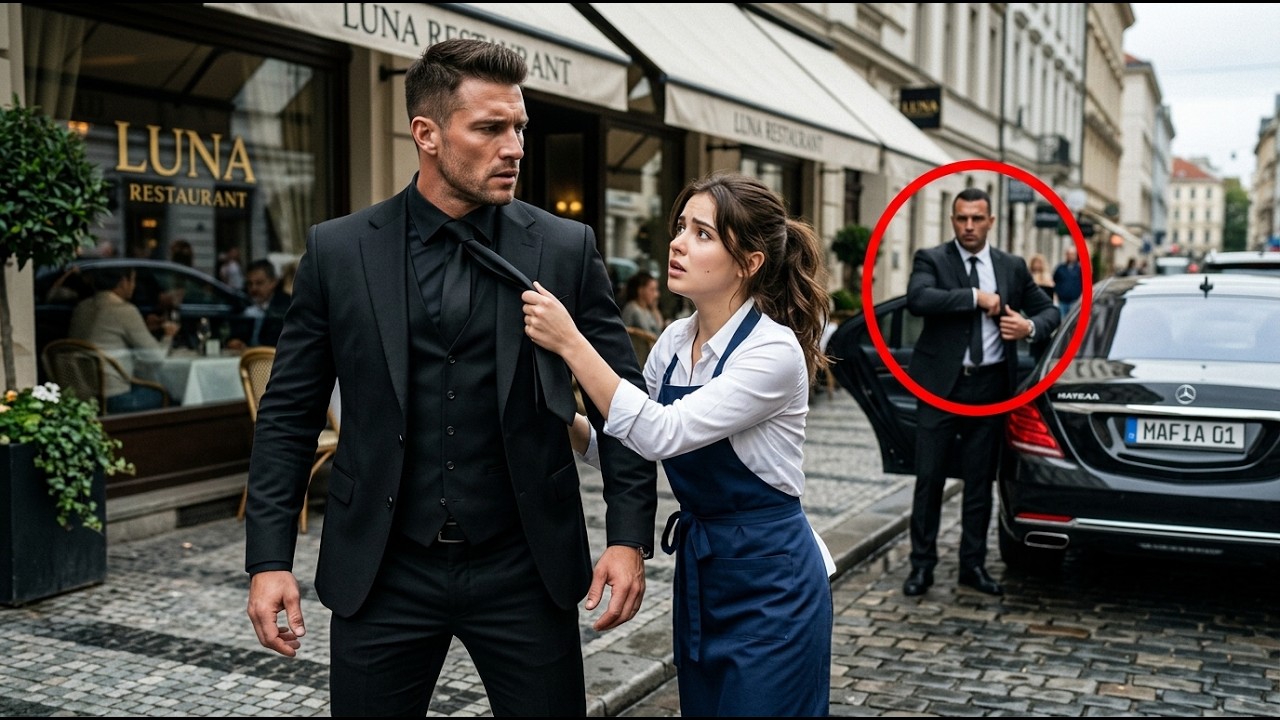
The ballroom in Geneva didn’t feel like a place where violence was possible.
That was the illusion.
Crystal chandeliers. Soft violin quartet. Waiters moving like practiced ghosts between tables of diplomats, bankers, and men who never introduced themselves twice.
And at the center of it all stood Glenn Slover.
He wore wealth the way other men wore armor—tailored, polished, unquestioned. People called him a businessman. The city called him a problem that somehow kept winning.
But tonight, something was wrong.
Not loudly wrong.
Subtly wrong.
The kind of wrong only noticed by someone trained to see what people tried to hide with perfect posture.
Michelle Vole noticed everything.
She wasn’t supposed to be seen at all.
Blue apron. Hair tied back. Disposable identity. One of the “event staff” hired through a subcontracting agency that changed names every six months.
To the room, she was invisible.
To herself, she was something else entirely.
Former surveillance analyst. Blackwatch Federal Intelligence Division. Until she stopped existing on paper and started existing in the only place that mattered for survival: under radar.
She carried a tray of empty glasses through the edge of the ballroom, eyes never stopping.
That was when she saw him.
The driver.
Standing near the marble pillar by the east exit, too still for someone who belonged to service staff. His suit didn’t match the uniform code. His badge hung slightly too high, like it had been placed by someone who didn’t care about details but wanted authority visible.
But it wasn’t the uniform that gave him away.
It was the sweat.
Cold. Controlled. The kind that appears when a decision has already been made and the body is just catching up.
Michelle slowed her steps.
Then she saw the second detail.
His right hand hovered near his jacket.
Not resting.
Not adjusting.
Hovering.
A hesitation that wasn’t hesitation.
It was timing.
She shifted her tray slightly, as if balancing weight.
And she saw it.
The outline beneath the fabric.
Wrong angle.
Wrong placement.
Not security standard.
Not ceremonial carry.
Operational.
A weapon positioned for a short draw at close range.
Her mind clicked into place automatically.
Threat vector: ballroom interior. Primary target: Glenn Slover. Execution window: within 90 seconds.
Her heartbeat didn’t change.
That was the difference between training and panic.
She continued walking.
Slow.
Natural.
Invisible.
Until she was directly behind Glenn Slover.
He was speaking to a foreign delegate, smiling like a man who had never been afraid of consequences.
Michelle stepped in close.
Too close for staff.
She reached up and adjusted his tie.
The gesture looked accidental.
Intimate.
Harmless.
But her fingers brushed his collar and she leaned in just enough for only him to hear.
“Don’t move,” she whispered.
Glenn’s eyes flicked slightly—confused, irritated, but still composed.
She didn’t look at him.
She kept her gaze on the reflection in the mirrored pillar across the room.
The driver had shifted.
Just slightly.
The weight distribution changed.
The hand moved closer.
Michelle exhaled once.
Then spoke again, quieter.
“The man by the east pillar,” she said, voice almost lost in music. “He’s not security.”
Glenn didn’t respond.
She added one more line.
“The gun is already aimed at you.”
That was when everything paused.
Not physically.
Not visibly.
But inside the architecture of intent.
Glenn finally looked at her properly.
Not as staff.
Not as decoration.
As signal.
And in that single second of recognition, Michelle saw what most people missed about men like him.
He believed in control.
Which meant he hated uncertainty more than he feared death.
He didn’t move.
But he listened.
That was enough.
Because across the room, the driver adjusted again.
The wrong kind of adjustment.
Final preparation.
Michelle’s hand dropped from the tie slowly.
She stepped back into invisibility.
And waited.
What happened next lasted eleven seconds.
Glenn Slover didn’t flinch.
He didn’t run.
He simply tilted his glass slightly as if acknowledging a distant conversation, and said something into his cufflink.
Three men near the bar moved at once.
Not toward him.
Toward the exits.
The music did not stop.
But the room’s geometry changed.
The driver noticed too late.
His hand moved inside the jacket.
Too slow now.
Too obvious.
Michelle saw the shift before it completed.
That was her role.
Always before.
Never after.
She stepped sideways behind a pillar as the first silent takedown happened at the edge of the ballroom.
No panic.
No shouting.
Only controlled disappearance.
The driver never reached full draw.
By the time he realized the room had changed, the room had already ended him.
Ten minutes later, the gala continued as if nothing had happened.
That was the terrifying part.
Glass still clinked.
Laughter resumed.
Someone even commented on the violinist’s tempo.
But Michelle noticed what others didn’t.
Security patterns had changed.
Sightlines had tightened.
Doors were no longer decorative.
They were active.
And Glenn Slover was no longer just standing in the room.
He was being held inside it by structure.
He turned slightly.
Found her immediately.
That should not have been possible.
But it was.
“You,” he said.
Not loudly.
Not angrily.
Just confirming.
Michelle didn’t respond.
She picked up an empty tray nearby like nothing had happened.
But she knew invisibility was gone.
Once you are seen by someone like that, you are never unseen again.
Later that night, they took her.
Not violently.
Not publicly.
Efficiently.
A black vehicle waiting beneath the service entrance. No explanation. No questions allowed.
She didn’t resist.
Because resistance was for people who still believed in surprise.
Michelle didn’t believe in surprise.
Only probability.
The car drove beneath Geneva in silence.
When the doors opened, she expected a basement.
She got something worse.
Order.
Clean corridors. Controlled lighting. Systems that felt like they had been designed by someone who hated chaos more than people.
Glenn Slover was waiting.
No entourage.
No performance.
Just him.
“You recognized the shooter in under three seconds,” he said.
Michelle stood still. “You already knew that.”
“Yes.”
“Then why am I here?”
He studied her for a moment.
Then answered honestly.
“Because people who see things that clearly don’t stay invisible for long.”
A pause.
Then:
“And because someone inside my organization is worse than I thought.”
Michelle didn’t react.
But something in her mind tightened.
“That’s not my problem,” she said.
“It is now,” Glenn replied.
That was how it started.
Not with choice.
But with confirmation that choice had already been removed.
They gave her two options.
Basement clearance—quiet disappearance into systems that erased people gently.
Or inner circle access—visibility inside the most dangerous structure in Western Europe.
Michelle asked a different question.
“Why me?”
Glenn didn’t hesitate.
“Because you didn’t freeze,” he said. “You calculated.”
“That’s not the same thing.”
“It is when everyone else panics.”
Silence.
Then he added:
“And because you touched my tie before you saved my life.”
Michelle blinked once.
“That matters?”
“To me,” he said. “Yes.”
That was the moment she understood.
He didn’t trust emotion.
He trusted pattern recognition.
And she had interrupted a kill sequence without permission.
That made her valuable.
And dangerous.
The first betrayal she uncovered came on day four.
A logistics officer who smiled too often.
A communication loop that repeated itself with minor delays.
A password change that never propagated fully.
Michelle didn’t announce anything.
She mapped it.
Watched it breathe.
Then waited until it exposed itself.
When she finally spoke, it wasn’t dramatic.
Just precise.
“You’ve had a mole for seven years,” she said.
The room went still.
Glenn didn’t ask how she knew.
He asked:
“Where?”
She pointed at the map.
And everything after that collapsed quickly.
Quietly.
Efficiently.
Like removing a rot that had forgotten it was hidden.
The man who once ordered her removal surfaced on day twelve.
A mentor from her past life.
Someone who taught her how to see patterns—and then tried to erase her when she saw too much.
He didn’t come alone.
He came expecting compliance.
Instead, he found Michelle standing in a glass observation room above the operation floor, wearing black instead of blue.
He smiled.
“You always were too curious,” he said.
Michelle didn’t smile back.
“I learned from you,” she replied.
That was the last conversation they ever had.
What followed wasn’t loud.
It didn’t need to be.
Because systems don’t collapse with noise.
They collapse with exposure.
And Michelle Vole had become very good at exposure.
Weeks later, Glenn Slover stood beside her on a rooftop overlooking Geneva.
“You could leave,” he said.
Michelle adjusted her coat slightly.
“I know.”
“You won’t.”
She didn’t answer immediately.
Then:
“I used to hide because it was safer.”
“And now?”
She looked down at the city.
“I don’t hide anymore.”
A pause.
Then she corrected him.
“I see.”
Glenn nodded once.
As if that answer made perfect sense.
In the world below, people still told different versions of what happened that night.
Some said a maid stopped an assassination.
Some said a mafia structure eliminated a traitor.
Some said nothing at all, because they never knew it occurred.
But inside the system that remained, one truth stayed permanent:
The man who sees the gun first always controls the room.
And the woman who sees everything before it happens?
She never stands in the background again.
She becomes the reason anything survives at all.


