Prehistoric Murder? 5,000-Year-Old Burial Found in German Kiln Pit
In a quiet stretch of the German countryside, beneath the rolling hills near Gerstewitz, archaeologists have uncovered a discovery that is as haunting as it is enigmatic. A 5,000-year-old burial, hidden inside an abandoned kiln pit, has revealed the violent death of a young man from the Corded Ware culture, challenging our understanding of prehistoric social structures and ritual behavior. Far from the orderly cemeteries we associate with Neolithic Europe, this unusual interment offers a glimpse into a society capable of extreme violence—and perhaps ritual sacrifice.
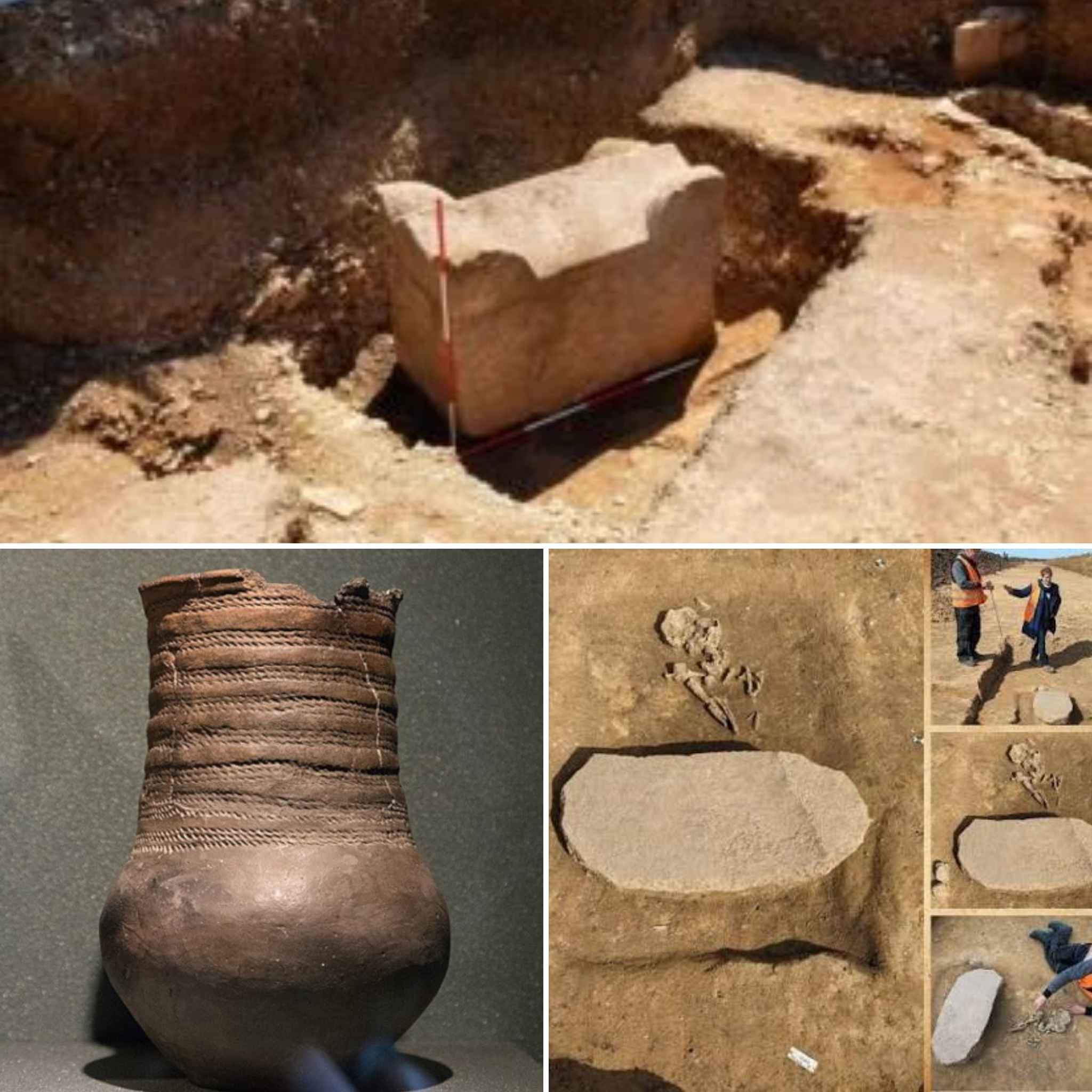
A Burial Out of Place
The excavation was part of preparatory work for the SuedOstLink power line, when archaeologists from the State Office for Heritage Management and Archaeology (LDA) Saxony-Anhalt stumbled upon the remains. Instead of a standard grave, the young man, estimated to be around 25 years old, was found curled on his right side inside a kiln pit, a functional structure used for firing ceramics. Such placement immediately signaled to researchers that this burial was highly unusual: the pit was not a recognized cemetery but a productive, utilitarian feature of the settlement landscape.
Even more disturbing were the signs of violence. The young man’s skull bore multiple fractures, consistent with blunt force trauma, likely inflicted at or near the time of death. The positioning of his body suggested that he was initially laid upon an organic base—perhaps mats or reeds—which had since decayed, leaving only the skeletal remains. His placement in a two-chamber underground kiln defied the traditional Corded Ware funerary norms, where men were typically buried in carefully aligned graves facing south, reflecting strict cultural protocols.
Evidence of Extreme Violence
The forensic analysis of the skull confirmed repeated impacts, suggesting deliberate blows with a heavy object. Researchers have debated the meaning of this violence, proposing three primary scenarios:
- Murder and Concealment: The young man may have been killed and hastily disposed of in the kiln, perhaps to hide evidence of the crime.
- Battle Casualty: He could have died during a conflict, with his remains placed in the kiln posthumously.
- Ritual Sacrifice: Given the presence of unusual deposits in prehistoric kilns, the interment may have been a ceremonial act, offering a human life to appease spiritual forces or commemorate a significant event.
While each scenario remains plausible, the ritual hypothesis gains weight when considering parallels across Neolithic and Copper Age Europe. Archaeologists have found cattle skeletons and butchered dog remains in kiln pits, suggesting that these structures occasionally served as sites for offerings to the supernatural. The inclusion of a human in this context is rare but not unprecedented, indicating that this young man may have been perceived as part of a symbolic or sacrificial practice.
A Landscape Steeped in Ritual
The hill near Gerstewitz has a long history of ceremonial activity, dating back roughly 6,000 years. Previous excavations have revealed:
- Baalberge culture burial mounds (c. 4000–3400 BC)
- Salzmünde culture ritual deposits (c. 3400–3100 BC)
These earlier cultures left behind animal and human bones, intact ceramic vessels, and burned rubble, reflecting complex ritual behaviors. The continuity of unusual deposits over millennia suggests that this location was a sacred or symbolic landscape, recognized across successive cultural groups.
The Corded Ware culture, to which the young man belonged, was widespread across Central and Northern Europe during the Late Neolithic (c. 2900–2350 BC). Known for its characteristic pottery, funerary customs, and social stratification, Corded Ware communities typically followed strict burial rites. Deviations from these norms, such as placing a body in a kiln, would have been highly conspicuous and culturally significant.
What the Burial Tells Us About Prehistoric Society
The Gerstewitz find provides critical insights into the social and ritual complexity of Corded Ware communities. The deliberate placement of a body in a kiln, combined with signs of violent trauma, suggests that these societies were capable of both ritualized violence and extraordinary symbolic acts. The young man’s death and deposition may have communicated messages about power, social transgression, or the relationship between humans and the divine.
Interestingly, other elements of the kiln pit hint at ceremonial practices:
- The dual-chamber layout of the pit may have segregated functional and symbolic spaces
- Displacement of the upper body implies the use of organic materials for ceremonial purposes
- Comparisons with animal sacrificial deposits suggest a continuum between ritual offerings of livestock and humans
This burial challenges the simplistic notion that prehistoric societies were “primitive” or uniformly peaceful. Instead, it underscores complex social hierarchies, ritual behaviors, and symbolic systems that governed life and death.
Investigating the Individual: Science Meets Prehistory
To better understand who this young man was, researchers are employing a suite of scientific techniques:
- Stable isotope analysis of tooth enamel to reveal geographic origin and childhood movements
- Ancient DNA extraction to trace ancestry and determine familial or regional ties
- Osteological study to detect evidence of malnutrition, occupational stress, or prior injuries
These methods will help establish whether he was a local community member, an outsider, or perhaps even a captive—information that may clarify why he was deposited in such an unusual location.
Kiln Pit Context and Corded Ware Practices
Corded Ware culture burials usually display east-west or south-facing alignments, often accompanied by ceramic pots, tools, and ornaments. Deviations from this pattern, such as the Gerstewitz kiln interment, suggest intentional signaling. Archaeologists speculate that:
- The young man’s placement may have marked social deviance or punishment
- The act could have served as a ceremonial intercession with supernatural forces
- The combination of trauma and burial context reflects a ritualized enactment of death, rather than random violence
Kiln pits, though primarily functional, may have served as liminal spaces—places bridging the mundane and the sacred.
Implications for Understanding Copper Age Europe
The Gerstewitz burial contributes to broader debates about institutionalized violence, social stratification, and ritual practice in prehistoric Europe:
- Human Sacrifice in Context: The find reinforces evidence that some Late Neolithic and Copper Age societies occasionally conducted human sacrifices, albeit selectively and symbolically.
- Complex Landscapes: The continuous ceremonial use of the hill demonstrates that ritual significance could persist across multiple cultural transitions.
- Violence and Community Regulation: Trauma analysis indicates that interpersonal or political violence was not random but potentially embedded in social or ritual norms.
By situating the burial within the broader Corded Ware and Copper Age framework, scholars can explore the intersection of daily life, symbolic practice, and social control in prehistoric Europe.
The Future of the Site
The Gerstewitz excavation is ongoing. Researchers plan to:
- Conduct geophysical surveys to detect additional burial or ceremonial features
- Compare artifacts with other Corded Ware sites in Central Europe
- Publish detailed osteological and isotopic profiles of the victim
- Explore the ritual and spatial organization of kiln pits in relation to habitation zones
These steps may shed further light on why this particular site was chosen for such an extraordinary burial, and what it tells us about the ideology, hierarchy, and spirituality of the Corded Ware culture.
Conclusion: A Window into the Past
The 5,000-year-old kiln pit burial near Gerstewitz is more than a gruesome curiosity; it is a window into the social, ritual, and violent dimensions of prehistoric Europe. The young man’s life, death, and placement in an abandoned kiln reveal a world where ritual, symbolic expression, and human agency intersected in complex ways. As science continues to analyze his remains, we gain unprecedented insight into how communities navigated life, death, and the sacred, challenging assumptions about the simplicity of Neolithic societies.
This single, enigmatic burial reminds us that prehistoric Europe was a landscape of meaning, power, and human experience, where even an abandoned kiln could serve as a stage for acts that still resonate across millennia.