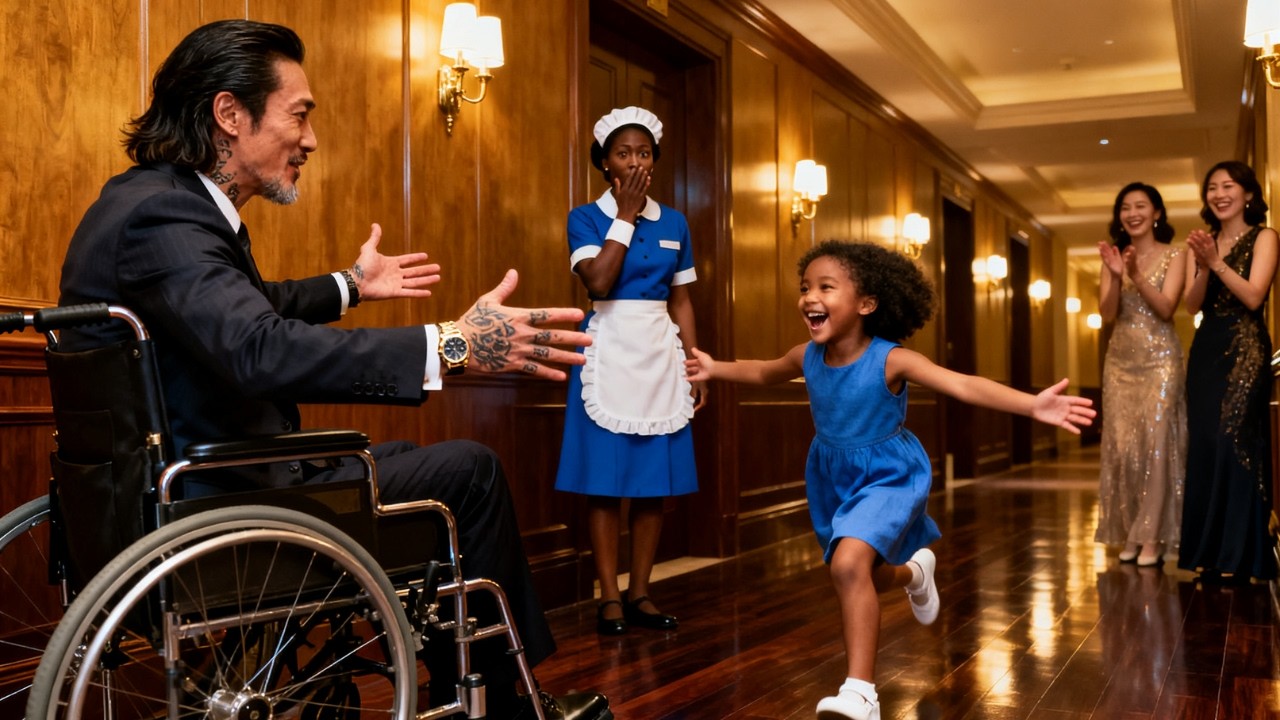
Kaito Tanaka once ruled half the underground logistics routes of the Kansai coast.
Not with noise. Not with spectacle.
With silence that made grown men lower their eyes before he even entered a room.
But that version of him no longer existed.
Now he sat in the top floor suite of the Shinsei Grand Hotel—glass walls overlooking a city that still whispered his name like a curse—trapped in a wheelchair, hands resting like they had forgotten how to belong to him.
Doctors called it neurological collapse.
His former allies called it karma.
The board called it “an unfortunate transition.”
And the staff called him, when they thought no one could hear, “the statue in Room 1401.”
He didn’t respond anymore.
Not because he couldn’t.
Because he had stopped believing anyone would listen.
The hotel itself had become his cage.
Once, this building was built from his money, his decisions, his enemies buried under contracts instead of concrete.
Now it felt like it belonged to everyone except him.
Especially the people who had replaced loyalty with ambition.
They visited him often.
Executives with polished shoes and careful smiles.
They spoke slowly, as if speaking to a child.
“We’ve taken steps to stabilize operations.”
“We’re restructuring decision-making authority.”
“Your presence is still… symbolic.”
Symbolic.
That word always lingered longer than the rest.
Because it meant he was no longer dangerous.
Just decorative.
And in the corner of those rooms, unnoticed by everyone important, was a cleaning cart.
Pushed quietly.
Moved carefully.
Belonging to someone who was never meant to be seen.
Sarah Williams.
She had worked at the hotel for six months.
Single mother. Quiet eyes. The kind of woman people assumed understood exactly how invisible the world could make a person.
Her daughter, Lily, waited for her after shifts in the employee lounge, drawing pictures of places she had never been.
Kaito noticed them long before anyone else did.
Not because they approached him.
But because they didn’t avoid him.
Most people walked around his suite like it was haunted.
Sarah cleaned it like it was just another room.
And Lily…
Lily looked at him like he was just a man sitting by a window.
Not a monster.
Not a king.
Just someone very still.
That alone unsettled the entire ecosystem of fear built around him.
The first time Lily spoke to him, it was unintentional.
She had wandered in while Sarah was changing linens.
She stopped when she saw him.
Tilting her head.
Then she walked straight up.
And hugged him.
No hesitation.
No calculation.
Just arms around a man who hadn’t been touched without fear in years.
The room froze.
A security guard moved forward instinctively.
Sarah dropped the cloth in her hand.
Even Kaito’s breath stalled.
Because no one had done that since before everything fell apart.
A child’s arms around his waist.
Warm. Unafraid. Real.
Lily looked up at him and said softly, like it was obvious:
“You look like you’re waiting for someone to come back.”
Something inside him cracked—but didn’t break.
It shifted.
Like a door that hadn’t been opened in years remembering it had hinges.
That night, for the first time in months, his fingers moved.
Not much.
Just a twitch.
But enough that he stared at his own hand until sunrise.
And the hotel, without realizing it, began to change.
Not all at once.
But in small fractures.
Executives still dismissed him in meetings.
But staff started noticing things.
The “statue” blinked longer when Lily was near.
His gaze followed Sarah when she spoke.
And sometimes, when no one else was in the room, his jaw tightened like he was trying to remember how to form words.
The board grew impatient.
“He’s declining mentally,” one executive whispered. “We should accelerate the transition.”
Sarah heard everything.
People forget cleaners are often closest to closed doors.
And closed doors never hide silence well.
She started paying attention.
Not to gossip.
To patterns.
Kaito’s condition didn’t behave like typical paralysis.
Some days he responded to sound.
Some days he didn’t.
Some days his eyes tracked movement with unsettling precision.
Other days, he was gone again.
Like something inside him was switching off and on.
One afternoon, Lily refused to leave his room.
She sat on the floor beside his wheelchair drawing him with crayons.
“You’re sad,” she said casually.
He didn’t react.
“You’re not broken,” she added, like correcting a mistake.
That was when the first sound came out of him.
Not a word.
A breath that sounded like it had been held for too long.
Sarah noticed immediately.
She had seen symptoms like this before in a hospital setting years ago, before life narrowed her choices.
Not paralysis.
Not injury.
Something else.
Something chemical.
Something slow.
That night, after her shift, she stayed behind.
Not cleaning.
Observing.
And what she found in the maintenance logs made her stop breathing for a full ten seconds.
Medication deliveries to Room 1401.
Unlisted.
Signed off by executive authority.
Not medical staff.
Board members.
The pattern wasn’t treatment.
It was control.
And then she saw the second layer.
Tiny inconsistencies in Kaito’s schedule.
Food deliveries altered by minutes.
Drinks swapped under “quality assurance.”
A neurological suppressant compound disguised in vitamin supplementation.
Sarah’s hands trembled slightly as she closed the file.
Because this wasn’t illness.
This was design.
Someone had been keeping him alive just enough to remain powerless.
And then Lily changed everything.
Because Lily wasn’t supposed to be there that day.
She had a fever.
Sarah had brought her anyway because she couldn’t afford a missed shift.
That accident placed Lily in the room during a private executive meeting.
And Lily, bored, walked straight to Kaito.
She climbed onto his lap.
And said, “You’re not sleeping. You’re hiding.”
The room went still.
Kaito’s fingers moved again.
Not twitching this time.
Gripping the armrest.
Hard.
His breathing changed.
Sharp.
Uneven.
And then—
He spoke.
One word.
“Stop.”
The entire room froze.
Because it wasn’t just a word.
It was command memory returning.
It was identity resurfacing.
Executives laughed nervously, trying to frame it as reflex.
But Sarah saw what they didn’t.
His eyes weren’t empty anymore.
They were calculating.
And terrified.
Because he remembered something they didn’t want him to remember.
That night, Sarah stayed after everyone left.
She brought him water.
He didn’t drink it.
He looked at her for the first time like he was actually seeing her.
And then his voice came again, rough like it had been buried underground.
“Why… her?”
Sarah didn’t answer immediately.
Because she wasn’t sure if he meant Lily.
Or everything.
But before she could speak, Lily pointed at his hand.
“You’re waking up,” she said.
And Kaito Tanaka, former king of a buried empire, cried without sound.
Not from weakness.
From recognition.
Because something in him understood what no boardroom ever could:
He hadn’t been losing control.
He had been losing time.
The twist came three days later.
Sarah accessed the full medical audit through a contact she hadn’t used in years.
Former hospital forensic unit.
What she discovered wasn’t just poisoning.
It was targeted neuro-inhibition therapy—an experimental compound designed to suppress motor function while preserving cognitive awareness.
Meaning he had been awake.
Fully aware.
Inside a body that had been locked by someone else.
And worse—
The authorization trail led to one signature.
His most trusted advisor.
The man who had stood beside him for fifteen years.
Who had smiled at Lily.
Who had called him “friend” in every press release announcing Kaito’s decline.
It wasn’t a fall from power.
It was containment.
When Kaito read the report, he didn’t react immediately.
He just stared at the name.
Then asked quietly, “How long?”
Sarah answered honestly.
“From the beginning of your collapse.”
Silence filled the room so completely it felt like sound had been erased.
Then Lily placed her small hand on his.
And said, “We can fix it.”
That was the moment everything changed direction.
Not revenge.
Not rage.
But clarity.
Kaito requested a meeting with the board.
For the first time in months, he arrived without being carried.
The wheelchair was still there—but he stood beside it.
Slow.
Unsteady.
Alive.
Executives entered smiling.
They left differently.
Because the man they thought was gone was speaking again.
And every word was remembered.
Contracts were exposed.
Medical falsifications revealed.
Internal surveillance unlocked.
By the end of the meeting, three board members had resigned in silence.
One had been escorted out.
And his former advisor could not meet his eyes.
There was no shouting.
Only recognition of something inevitable collapsing.
The moment of recognition came later, alone in the empty conference room.
Kaito stood by the glass window overlooking his empire.
Sarah beside him.
Lily asleep on a chair, holding one of his fingers like it was the most natural thing in the world.
He said quietly, “I thought I was dead.”
Sarah replied, “You were just unheard.”
He looked at Lily.
Then at the building.
Then at himself.
And for the first time, there was no king in his expression.
Only a man choosing what kind of legacy to leave behind.
Months later, the Shinsei Grand Hotel was no longer recognizable.
Not because of renovation.
Because of redesign.
Executives were replaced with social impact boards.
Rooms once reserved for power brokers became shelters for families in crisis.
Staff were no longer invisible.
And the man once feared as a crime lord became known—uncomfortably to many—as the one who refused to let anyone be erased inside his walls again.
Sarah was promoted, but never treated him as superior.
Lily still hugged him whenever she visited.
And every time she did, he stood a little steadier.
Because strength, for him now, wasn’t control.
It was presence.
One evening, as rain traced down the glass, Kaito watched guests laughing in the lobby below.
Not afraid.
Not obedient.
Just human.
Sarah stood beside him.
Lily drew on the floor again.
And Kaito said something he had never said in his entire life as the man he used to be:
“I built an empire to be untouchable.”
He paused.
Then looked at them.
“And I finally understand why it failed.”
Because no fortress survives without a bridge.
And no king survives long without learning how to be held without fear.


