The wind didn’t just fall across the Wyoming plains that night—it attacked.
It shoved snow sideways through fences, buried roads in minutes, and turned distance into something lethal. The kind of storm ranchers learn to respect the hard way, because respect is often the only thing standing between survival and disappearance.
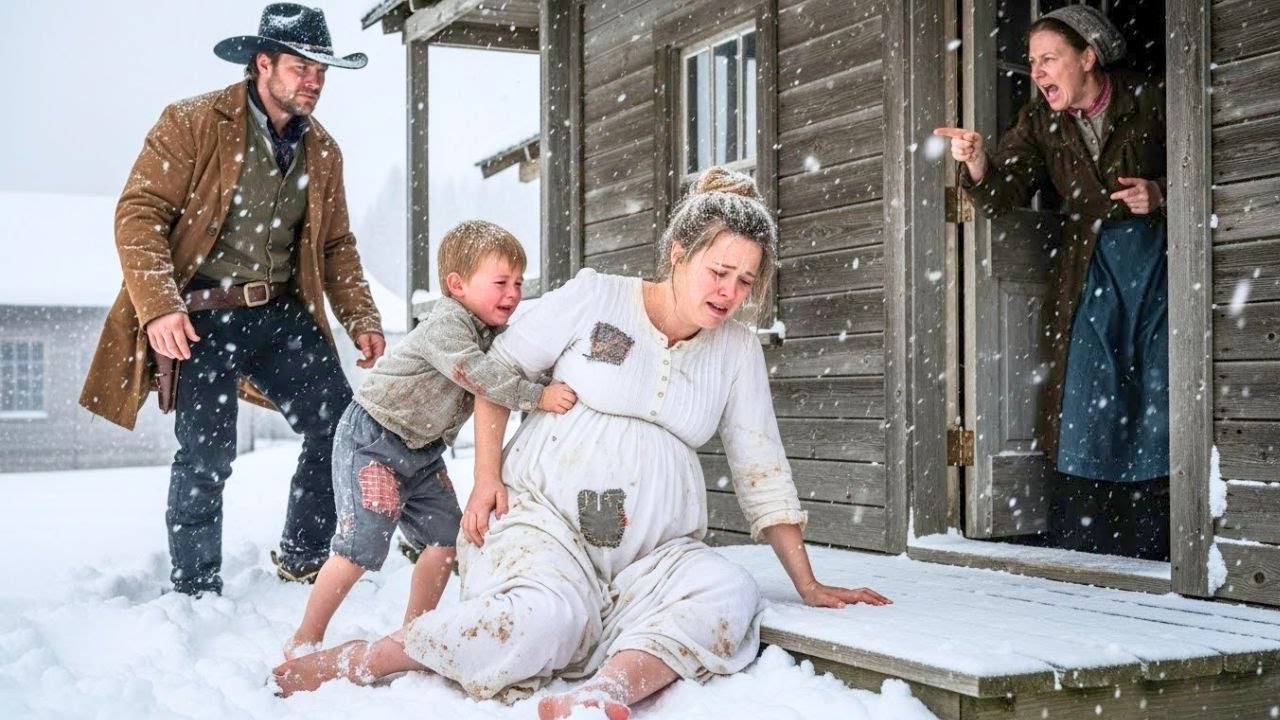
Evelyn Carter had already stopped feeling her legs by the time she hit the ground.
Not because she fell.
Because she was pushed.
The wooden porch behind her slammed shut with a finality that didn’t belong to human voices—it belonged to decisions already made long before she was dragged outside.
“I told you,” her mother-in-law’s voice cut through the storm, sharp and controlled, “you were never going to bring shame into this family line.”
Evelyn’s breath caught as another wave of pain hit her body, sharper than the cold.
She was pregnant.
Full term.
And the baby inside her was moving like it still believed the world was safe.
It wasn’t.
The man she had married stood behind the glass window, not moving forward.
Not stopping it.
Just watching.
That was the moment she understood something far worse than betrayal.
She understood replacement.
“They’ll take care of it,” her husband said flatly, not meeting her eyes.
And then the door closed.
Locking.
Not just her out.
Locking her out of existence.
The first hour in the storm was confusion.
The second was pain.
The third was survival without instruction.
Evelyn crawled more than walked, her hands breaking through snow that kept refilling itself like the land refused to acknowledge her effort. Her phone had died minutes after impact. Her boots were gone. Her coat had been half-removed in the struggle.
All she had left was breath.
And the baby.
At some point, she stopped screaming.
Not because she stopped hurting.
Because the wind swallowed sound like it was never meant to exist.
That was when the light appeared.
Faint.
Warm in a way that didn’t belong to the storm.
A lantern.
Moving steadily across the ridge.
Evelyn tried to call out, but her voice cracked into nothing.
The light stopped.
Then changed direction.
Coming closer.
Not fast.
Not rushed.
But deliberate.
Like whoever carried it already knew what they were going to find.
Jack Sullivan had seen enough winters to know when the world was trying to kill something.
His ranch sat too far from town to rely on anyone but himself, and too exposed to ignore storms that came down from the mountains like punishment.
That night, he had been checking fences when he saw the shape in the snow.
At first, he thought it was debris.
Then it moved.
He froze.
Because debris didn’t move like that.
It moved like a person refusing to stop existing.
Jack lowered the lantern slightly.
“Hey!” he shouted into the wind.
No response.
He moved closer.
And saw her.
Evelyn didn’t look up immediately. Her face was half-buried in snow, eyelashes frozen, lips cracked and trembling. One hand was curled protectively over her stomach.
That was the detail that changed everything.
Jack dropped to his knees instantly.
“Can you hear me?” he asked.
Her eyes fluttered open.
Barely.
“Please…” she whispered. “Don’t take me back.”
That sentence hit him harder than the storm.
“Back where?” he asked.
She tried to answer.
But another contraction ripped through her body, cutting the words off completely.
Jack didn’t hesitate after that.
He scooped her up immediately.
“You’re safe,” he said, though he didn’t fully believe the world was capable of that promise anymore.
But he said it anyway.
Because sometimes survival starts with lies that become true later.
The cabin was small.
Old wood. Old heat. Old survival habits carved into every wall.
Jack laid her near the fire and immediately started moving—water, blankets, wood, anything that could push back against the cold trying to reclaim her.
Evelyn’s breathing was shallow now, uneven.
“Stay with me,” he said firmly.
Her eyes opened slightly.
“They took my son,” she whispered.
Jack paused.
That detail didn’t belong in the storm.
“What?” he asked quietly.
Her hand tightened.
“After I signed nothing… they said I wasn’t fit. They took him. They said I was unstable.”
Jack’s jaw tightened.
People didn’t survive storms like this alone.
Not physically.
Not legally.
Not emotionally.
Evelyn let out a broken breath.
“I just wanted to leave,” she said. “That’s all I wanted.”
Another contraction hit.
This one stronger.
Jack moved immediately.
“You’re not doing this alone,” he said.
“I already am,” she whispered.
But she wasn’t.
Not anymore.
By dawn, the storm had not stopped.
But something inside the cabin had changed.
The baby had arrived.
Not peacefully.
Not gently.
But alive.
Evelyn collapsed back against the bedding, exhausted beyond language. Her face was pale, sweat and cold mixing together like the body couldn’t decide what was winning.
Jack sat nearby, holding the child carefully, stunned in a way he hadn’t felt since losing his own family years ago.
A silence filled the room that wasn’t empty.
It was heavy.
Meaningful.
“You did good,” he said quietly to Evelyn.
She let out a weak laugh.
“It doesn’t feel like it.”
Jack looked at the baby again.
“They’re wrong about you,” he said.
That was all he said.
But it landed like truth anyway.
The next morning, Jack rode to town.
Not for help.
For war.
Because what he had learned in the cabin wasn’t tragedy.
It was structure.
Legal manipulation. Custody theft. Institutional silence. A family that used wealth like a weapon.
And Evelyn didn’t have anything left to fight with.
Except survival.
So he decided to give her something else.
Proof.
The lawyer didn’t believe him at first.
Not until the documents started appearing.
Hospital records showing coercion.
Emails between family attorneys discussing “removal strategy.”
Financial transfers tied to custody timing.
And a recording from a private investigator hired years ago—never disclosed in court.
The truth wasn’t hidden.
It was just buried under confidence.
Evelyn stayed in the cabin through most of it, healing slowly.
Sometimes she asked if it mattered.
Jack always answered the same way.
“Yes.”
Not because it would fix what happened.
But because silence would let it continue.
When they asked her to appear in court, she hesitated.
“I don’t know how to stand in front of them,” she admitted.
Jack looked at her calmly.
“You already stood in front of worse,” he said.
That was the first time she smiled.
It didn’t last long.
But it was real.
The courtroom smelled nothing like snow.
It smelled like polished wood and controlled air.
The family arrived first.
Confident.
Composed.
Certain.
Evelyn sat at the back before the hearing started, holding her child close. Jack stood beside her, not as a witness, not as a guardian, but as something quieter.
Support that didn’t ask for recognition.
When proceedings began, the opposition presented their version quickly.
“She was unstable.”
“She abandoned responsibility.”
“She agreed to temporary custody.”
Words built like walls.
Until the evidence began.
The first document changed the tone.
Then the second.
Then the recordings.
Then the financial trail.
Then the contradiction between medical claims and physical reality.
The room shifted slowly.
Not dramatically.
But irreversibly.
When Evelyn was called to speak, she stood carefully.
Her voice shook at first.
Not from fear.
From memory.
“They said I didn’t deserve to keep him,” she said quietly.
A pause.
“But no one asked me what I was trying to survive.”
Silence followed.
Not the empty kind.
The heavy kind.
The kind that means truth has entered the room and no one can politely ignore it anymore.
The ruling came hours later.
Custody reversed.
Fraud exposed.
Protective action authorized.
The family did not speak after the decision.
Because there was nothing left to argue.
Outside the courthouse, snow had started again.
Soft.
Almost gentle.
Evelyn stood still for a long time, holding her child.
Jack stood beside her.
“You didn’t have to do all this,” she said.
He shrugged slightly.
“I know.”
A pause.
Then she asked the question she had been avoiding since the cabin.
“Why did you?”
Jack looked at the snow falling.
Then at her.
“Because I know what it feels like when no one shows up,” he said quietly.
Evelyn nodded slowly.
“So what now?” she asked.
Jack didn’t answer immediately.
Because he wasn’t thinking about revenge anymore.
Or justice.
Or systems.
He was thinking about something simpler.
A child asleep.
A mother holding on.
A storm that had finally passed.
Then he said:
“Now you stop surviving alone.”
Months later, the cabin was still there.
But it wasn’t empty anymore.
It had become something else.
A place where silence didn’t feel like abandonment.
Where mornings didn’t feel like threats.
Where a woman who had once been thrown into a storm learned how to sit in stillness without fear.
Evelyn never fully forgot what happened.
But it stopped defining what came next.
And Jack, who once believed he had nothing left to protect, learned something he didn’t expect.
That saving someone else doesn’t erase grief.
But it does give it somewhere to rest.
Because sometimes family is not what you are born into.
It is what survives the storm with you.
And refuses to let go when the world decides you don’t belong.