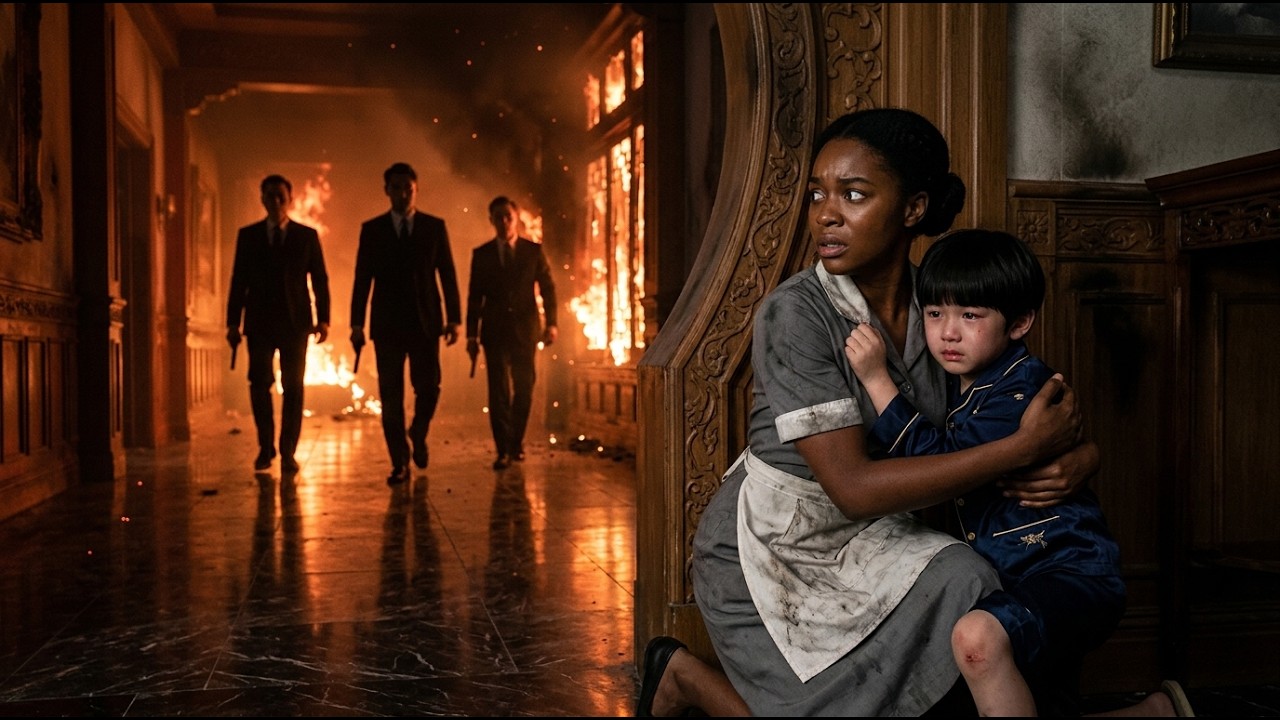
 The fire didn’t start with flames.
It started with silence.
A kind of silence that only exists in houses where money speaks louder than people, and people stop asking questions long before they stop breathing.
Seela Carter noticed it the moment she stepped into the Kang mansion that night.
The corridors were too still. The air smelled faintly of burned oil and expensive perfume trying to hide something older underneath. She was just a maid—barely twenty, hired through an agency that didn’t ask too many questions as long as the uniforms were returned clean.
But something about that night felt wrong in a way she couldn’t name.
Then she heard the first sound.
A crash upstairs.
Followed by shouting.
Then glass breaking.
And then—fire alarms screaming like the house itself had finally decided to confess.
She didn’t think.
That was important later.
Because thinking would have told her to run.
Instead, Seela dropped the tray she was carrying and ran toward the staircase as smoke began curling down like black fingers searching for something to hold.
“Everyone out!” someone screamed.
But the house was already too organized for panic. Too structured. Doors locked from the outside. Staff corridors blocked. Security systems overridden.
This wasn’t an accident.
It was an erasure.
Seela realized that when she saw the first guard lying unconscious near the hallway—his radio still blinking, still transmitting nothing.
Then she heard it.
A child crying.
Small.
Broken.
Coming from the west wing.
The room was locked.
Of course it was.
But the lock was old, and fear makes people stronger than training ever does.
Seela slammed her shoulder into the door once.
Twice.
The third time it gave.
Smoke poured out like the room had been holding its breath for too long.
And there he was.
A boy.
No older than six.
Crouched under a desk, coughing, clutching a small stuffed animal like it was the only real thing left in the world.
“Hey,” Seela called, dropping to her knees instantly. “Hey, look at me. You’re okay. I’m here.”
The boy looked up.
And something in his eyes stopped her for a fraction of a second.
Not fear.
Recognition.
As if even at that age, he already understood that survival was not something you were given.
It was something someone chose for you.
The ceiling cracked above them.
Time was collapsing.
Seela pulled him into her arms, shielding him as embers fell like angry rain.
“Don’t look back,” she told him.
“I’m scared,” he whispered.
“I know,” she said. “But you’re coming with me anyway.”
And she ran.
Through fire.
Through collapsing halls.
Through a world that was actively trying to erase them both.
She didn’t know the name Ji-ho Kang that night.
She only knew the weight of a child clinging to her neck like she was the only stable thing left in a burning universe.
And she didn’t know that by morning, the Kang family would be declared “unrecoverable.”
Or that the official report would say:
ACCIDENT.
Short circuit.
Structural failure.
No survivors.
Except one.
A missing child whose body was never found.
Seela left before anyone could question her too closely.
That was survival too.
Not just escaping fire—but escaping attention.
Because attention is what powerful people use when they decide something shouldn’t exist.
They called it a tragedy.
But inside the city’s quieter corners, the people who understood money and violence spoke in different tones.
The Kang empire hadn’t fallen.
It had been cut.
Cleanly.
Deliberately.
And whoever had done it had missed one piece.
The boy.
Twenty years passed like that.
Not all at once.
But in fragments.
Seela changed cities three times. Names twice. Jobs too many to count.
But she never forgot the boy.
Not because of duty.
But because of something worse.
Memory that refuses to soften.
Every few months, she would send anonymous support through intermediaries—school funding, medical coverage, housing deposits.
Always untraceable.
Always just enough.
Never more than necessary.
She told herself it was guilt.
But deep down, she knew the truth.
It was promise.
Even if no one had asked for it.
Ji-ho Kang grew up without a family.
That was the official story.
The unofficial one was more complicated.
Because families don’t disappear without leaving shadows behind them.
And shadows always attract people who know how to use them.
By the time Ji-ho was twenty-six, he wasn’t a missing child anymore.
He was an heir.
Not of inheritance.
Of control.
He didn’t build a business.
He built a structure.
And structures like his don’t rise because of ambition alone.
They rise because something underneath them has already collapsed.
The summons came on a rainy evening.
Seela almost didn’t open the envelope.
It was too clean.
Too precise.
No return address.
No signature.
Just her name.
Written in handwriting she had never seen.
But recognized anyway.
Inside was a single line:
“You don’t owe the past. But the past still owes you.”
And an address.
The building wasn’t a mansion anymore.
It was a fortress pretending to be an office.
Glass, steel, silence.
People moved through it like they were afraid of interrupting something larger than themselves.
Seela was escorted to the top floor without questions.
That was the first sign that this wasn’t an invitation.
It was acknowledgment.
He was standing by the window when she entered.
Older.
Not in age alone.
In weight.
In presence.
In the kind of stillness that comes after learning that trust is a currency most people bankrupt themselves trying to afford.
“Seela Carter,” he said.
Not a question.
A confirmation.
She didn’t respond immediately.
Because the boy in her memory and the man in front of her did not exist in the same reality.
And yet they did.
“I didn’t think you’d find me,” she finally said.
Ji-ho turned slightly.
“I didn’t find you,” he replied. “You were already inside everything I built.”
That made her pause.
Not because it was poetic.
But because it was accurate in a way that made her uncomfortable.
The first days after that meeting weren’t explanations.
They were exposure.
Ji-ho didn’t ask her to recount the fire.
He already knew parts of it.
More than she had told anyone.
Instead, he showed her things.
Records.
Transactions.
Board minutes.
Audio fragments recovered from corrupted servers buried under shell companies that didn’t officially exist anymore.
At first, Seela didn’t understand what she was looking at.
Then she did.
The Kang mansion fire wasn’t an accident.
It wasn’t even a takeover.
It was a cleanup.
A removal of the Kang family line from control over a network of assets tied to shipping routes, defense contracts, and offshore financial systems that had been quietly feeding multiple organizations for years.
The Kang family hadn’t just been rich.
They had been central.
And someone had decided they were no longer necessary.
“Your father trusted the board,” Ji-ho said one night, placing a file on the table between them.
Seela frowned. “I never knew his father.”
Ji-ho looked at her for a long moment.
Then opened the file.
Inside were photos.
Executives.
Directors.
Men in tailored suits smiling beside fire-damaged property reports.
“These are the people who ordered the fire,” he said.
Seela felt her stomach tighten.
“But the report said—”
“Accident,” Ji-ho finished. “Yes. That was the official version.”
He slid another folder forward.
“This is the real one.”
Seela opened it slowly.
And stopped breathing.
Because inside wasn’t just financial evidence.
It was testimony.
Recorded confessions.
Internal communications.
And at the center of it all—
A ledger.
Not digital.
Physical.
Hidden.
Written in coded entries that mapped not just money, but human movement. Staff transfers. Security rotations. Exit routes.
Her name appeared once.
Not as suspect.
Not as witness.
But as something else entirely.
Observer.
That was the moment everything shifted.
Because Seela realized something she had never allowed herself to consider.
She had not been just a maid that night.
She had been placed there.
Not by accident.
But by design.
Her employment records weren’t random.
They were selected.
Her presence in the mansion had been quiet enough to be invisible.
But consistent enough to be reliable.
Someone had ensured she would be there.
For one reason only.
To remove the boy.
Or save him.
And no one had told her which outcome was expected.
“You were part of the system,” Ji-ho said quietly, watching her reaction.
Seela shook her head. “No. I was just—”
“A variable,” he interrupted. “Not a participant. That’s worse, isn’t it?”
Silence.
Then:
“I don’t understand.”
Ji-ho leaned back slightly.
“I think you do.”
The twist wasn’t dramatic.
It was structural.
The ledger didn’t just expose the board members.
It exposed the architecture of the entire Kang downfall.
Every decision. Every miscommunication. Every “random” failure in security that night.
Mapped.
Controlled.
Optimized.
And somewhere buried in the annotations was a note that made Seela’s hands go cold.
“Primary heir extraction: successful.”
Secondary note:
“Observer integrity maintained.”
She looked up slowly.
“What does that mean?” she asked.
Ji-ho didn’t answer immediately.
Because this was the part that mattered.
Not the fire.
Not the betrayal.
But the purpose behind it.
Finally, he said:
“It means I wasn’t the only target that night.”
A pause.
“It means someone wanted me alive. And someone wanted me watched.”
Seela felt something shift inside her chest.
“That’s impossible.”
“Nothing about that night was accidental,” Ji-ho said.
Then, quieter:
“Not even you.”
The consequence was not vengeance.
It was removal.
Ji-ho didn’t call for executions.
He didn’t announce war.
He didn’t burn what remained of the Kang board.
He dismantled them.
Piece by piece.
Financial exposure. Legal intervention. Strategic collapse.
Every move precise enough to avoid chaos—but complete enough to ensure they would never reorganize again.
And through it all, Seela watched him not as a child saved from fire…
But as someone learning what it meant to inherit a truth that had been waiting twenty years to surface.
When the final board member was arrested, there was no public celebration.
No headlines about revenge.
Only quiet restructuring.
Companies renamed.
Assets redistributed.
Systems rewritten.
And somewhere inside that restructuring, Ji-ho made a decision that surprised even the people closest to him.
He didn’t rebuild power.
He redirected it.
The foundation was announced six months later.
Not under his name.
Under no name at all that carried ownership.
It was called simply:
THE KANG MERCY INITIATIVE.
Its purpose was not charity in the traditional sense.
It was recognition.
Of invisible workers.
Domestic staff.
Security personnel.
Caretakers.
People who existed inside systems but were never seen as part of them.
Seela was asked to lead it.
She refused at first.
Then she understood why he chose her.
Because she had once been invisible too.
Three years later, the world no longer remembered the fire the way it was reported.
It remembered the aftermath instead.
A system that collapsed not through violence, but exposure.
A foundation that grew faster than any corporation tied to it.
And a man who never spoke publicly about his past, but quietly ensured that no one inside his network ever became invisible again.
On an ordinary afternoon, Seela walked through one of the foundation centers.
Children played in open rooms.
Staff moved without fear of being erased by hierarchy.
She paused at a window.
Outside, Ji-ho was sitting on the ground with a small child building uneven blocks that kept falling over.
The child laughed every time.
Ji-ho didn’t correct him.
He just rebuilt with him.
Again.
And again.
Patient.
Present.
Human in a way the world never expected someone like him to become.
Seela watched quietly.
And for the first time in twenty years, the memory of fire didn’t burn.
It settled.
Not as trauma.
But as origin.
Because she finally understood something she had spent her whole life circling without naming.
The smallest act of courage is never small.
It is structural.
It changes what survives.
And what doesn’t.
The final truth wasn’t about mafia empires.
Or burned mansions.
Or hidden ledgers.
It was about what happens when someone refuses to let a single moment of mercy disappear into history.
Because in the end, Ji-ho Kang didn’t inherit power.
He inherited a question:
Who gets saved when everything is burning?
And Seela Carter—who once believed she was just a maid walking through smoke—had already answered it the only way that ever mattered.
By walking in anyway.


