For centuries, Roman dodecahedrons — small, hollow, twelve-sided objects made of bronze or stone — have puzzled archaeologists and historians alike. Found throughout Europe, mostly in France, Germany, and the Netherlands, their purpose remained unknown, leading to decades of speculation ranging from religious artifacts to measuring devices.

Recent studies combining 3D scanning, experimental archaeology, and contextual analysis have shed new light on these enigmatic objects. Researchers observed consistent wear patterns on specific edges and holes, suggesting repeated handling and use in precise ways rather than simple decoration. The findings indicate that the dodecahedrons likely served a functional purpose in day-to-day Roman life.
One leading theory supported by the new evidence proposes that these dodecahedrons were used as tools for calibrating distances in surveying, possibly related to agriculture or construction. The holes may have allowed measurements of field plots, water levels, or sightlines, revealing a sophisticated understanding of geometry and measurement in Roman times.
Experimental archaeologists replicated the dodecahedrons using ancient materials and discovered that aligning them at certain angles and distances produced surprisingly accurate results for measuring short distances and aligning structures. This suggests the Romans may have used them as portable, multipurpose tools, rather than the mystical or decorative objects once imagined.
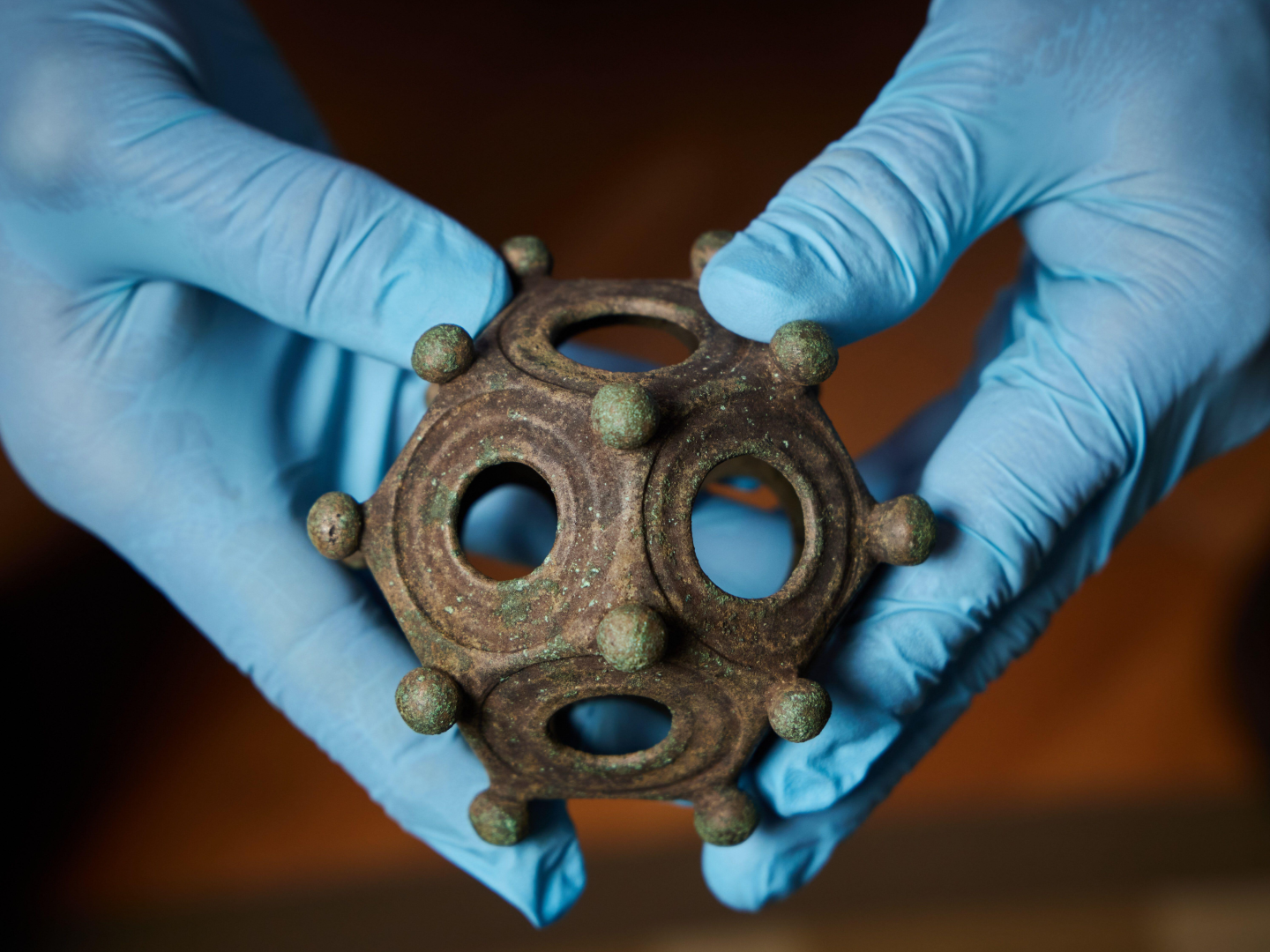
The discovery also highlights how cultural context is essential to understanding ancient artifacts. Many of the previous theories — from candlestick holders to ritual objects — relied on assumptions without testing practical functionality. Modern interdisciplinary methods finally allow these assumptions to be examined and either confirmed or dismissed.
While the findings resolve part of the mystery, some aspects remain unclear. Variations in size and material indicate that not all dodecahedrons were identical, suggesting that some may have had symbolic or secondary uses alongside practical applications. Researchers continue to explore whether regional differences reflect specialized uses or local adaptations of a broader Roman practice.
Ultimately, the Roman dodecahedron mystery is no longer purely speculative. The combination of experimental replication and scientific analysis demonstrates that these objects were highly functional tools, showing that Roman ingenuity extended into everyday objects in ways that continue to surprise modern scholars.