“Yikes”: The Brutal Reality Behind Nelly Korda’s Major Heartbreak at Hazeltine
In the world of professional golf, few names resonate as loudly as Nelly Korda. The 27-year-old American star has spent 2026 writing what many are calling one of the most dominant seasons in LPGA history. With four victories, nine top-10 finishes in just 9 starts, and leadership in Strokes Gained: Total, Strokes Gained: Tee to Green, and Strokes Gained: Off the Tee, Korda has set a benchmark reminiscent of Tiger Woods at his peak.
As the world No. 1 headed to Hazeltine National Golf Club for the KPMG Women’s PGA Championship, the stakes were high. Korda had already claimed two major titles that year—the Chevron Championship and the U.S. Women’s Open. A victory at Hazeltine would have given her a historic three-peat, only achieved before by Babe Zaharias in 1950 and Inbee Park in 2013.
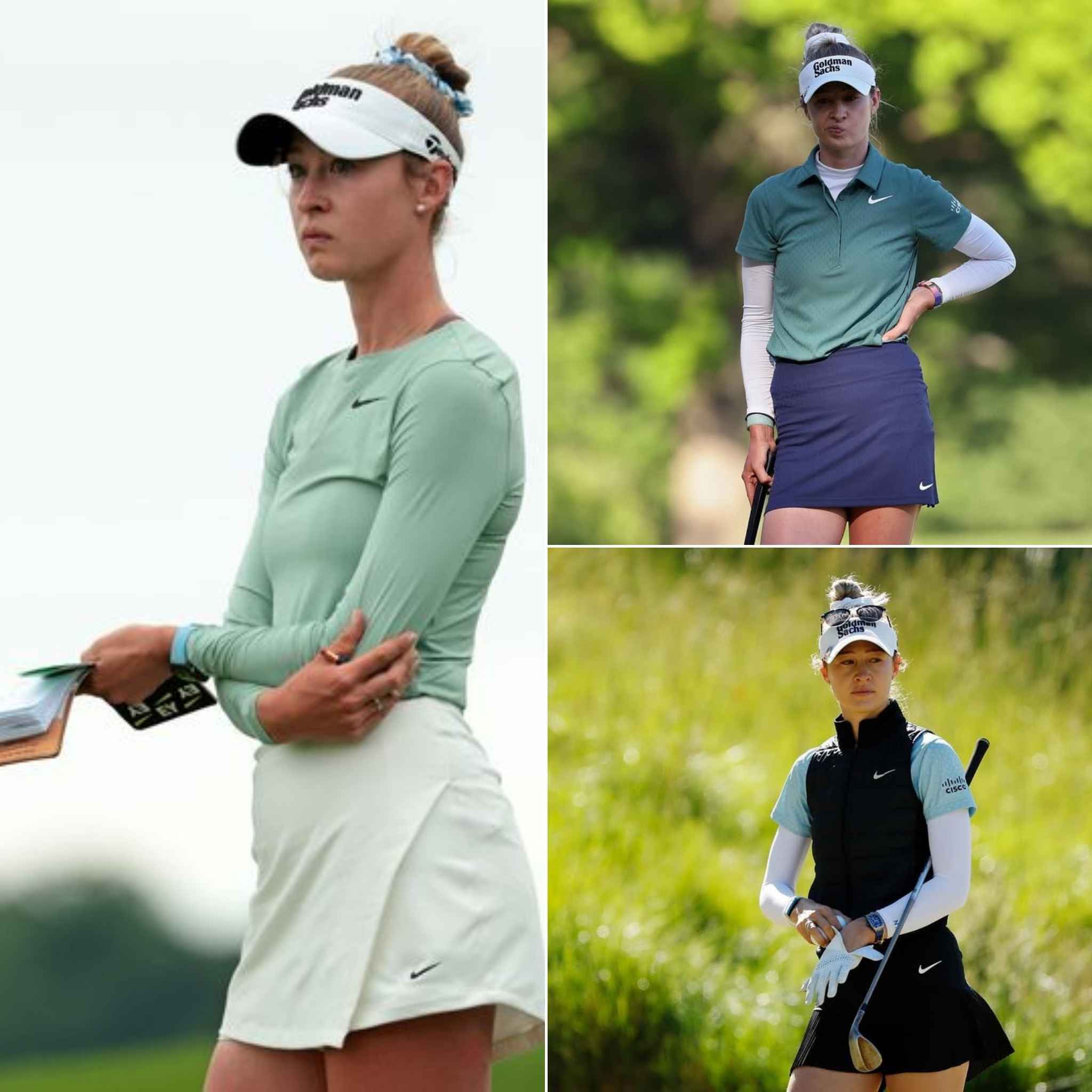
Yet, as professional golf often reminds us, perfection is fleeting. Despite a strong start, Korda struggled on key holes, particularly the 16th, where a double bogey shattered her momentum. She would ultimately finish 6-under-par 282, tied for eighth, falling short of history.
Dominance with a Shadow of Pressure
Golf analyst Justin Ray, speaking with Trey Wingo, offered insight into Korda’s final-round performance and the harsh realities of elite competition:
“Look, Nelly’s story—one, two, and three, right? When it comes to this tour right now. And when you tie for eighth at a major championship, and it’s viewed as some kind of disaster, that speaks to where you are in the sport. That tie is, by the way, tied for eighth, [the] tie [is] her worst stroke-play finish of 2026. Yikes.”
Even as a T8 finish may seem disappointing in context, it is a testament to the exceptional standard Korda has set this season. Across her 10 stroke-play events in 2026, she has finished first, second, or T2 seven times, underscoring the rare consistency of her play. Majors, of course, amplify every small misstep.
The Story Behind the Scorecard
Korda’s opening round at Hazeltine showed promise, scoring 2-under 70, despite a double bogey on the 16th. She described her approach candidly:
“No one can win an event in a single day, but you can certainly lose it after a very bad performance. So I was happy it wasn’t that bad for me.”
Round two brought a surge of momentum, with Korda shooting 4-under 68, featuring just one bogey and five birdies. Yet moving day proved more challenging. A 1-under 71 left her trailing the leaders, hampered primarily by inconsistent putting. Her Strokes Gained: Putting during the third round registered -1.170, ranking 55th in the field.
By the final round, Korda knew she had work to do. She began the front nine with a bogey on the opening hole but bounced back with a birdie on the second. The 16th hole, however, proved her undoing once more. After a tee shot into the hazard on the right and subsequent penalty, she carded another double bogey—the same hole that cost her in Round 1.
“I was just kind of disappointed in the way that I played this week, not that I came up short, really. I was just thinking about the way that I played,” Korda said after her final round.
Setting a Tiger-Woods-Like Standard
What makes Korda’s season so remarkable is not just the victories, but the statistical dominance. Through mid-2026:
- Strokes Gained: Total – 1st
- Strokes Gained: Tee to Green – 1st
- Strokes Gained: Off the Tee – 1st
- Top-10 finishes – 9 of 10 events
- Majors won – 2 of 3 before Hazeltine
This level of performance creates immense external expectations. When the T8 finish at Hazeltine occurred, it was not a poor performance by conventional standards; it was simply fractionally off from perfection, magnified by the season’s previous brilliance.
Justin Ray explained:
“Even a tie for eighth feels like a disappointment because she’s been so dominant. But we have to remember, that’s still a historically elite season.”
The Human Element: Pressure and Mental Fatigue
Korda herself acknowledged the mental strain of competing at the highest level week after week. Attempting to secure a third consecutive major added layers of pressure beyond the normal tournament stress.
“I was just trying to take it a shot at a time really. I didn’t know where the leaders were at, so I was just trying to focus on myself,” she said.
Sports psychologists often highlight that repeated exposure to high-stakes competition can magnify small technical errors into psychological hurdles. Korda’s double bogey on 16, a recurring challenge during the week, was a stark illustration.
This pattern resonates with other elite athletes. Scottie Scheffler, speaking after the Travelers Championship, emphasized how fractional errors in execution—speed on putts, slight misalignment, or subtle misreads—can make or break rounds at the professional level. Korda’s week at Hazeltine was a case study in that phenomenon.
Historical Context: The Three-Peat Challenge
Winning three consecutive majors in a single season is an extraordinary feat. Only Babe Zaharias (1950) and Inbee Park (2013) have achieved it. Korda, by mid-2026, had a genuine shot at joining that exclusive list.
Hazeltine, a challenging course with its narrow fairways and fast greens, proved unforgiving. Even minor errors were penalized heavily, as evidenced by Korda’s repeated troubles on 16.
While the T8 finish meant history was not made, Korda remains just two points shy of qualifying for the LPGA Hall of Fame, meaning a future major victory—or a pair of regular LPGA wins—would still secure that milestone.
The Resilience Factor
Korda’s response post-tournament was measured and forward-looking. She emphasized recovery, preparation, and future opportunities:
“Just chill for a few days and then practice. I’ll be heading to France to play the Amundi Evian Championship, and also the ISPS Handa Women’s Scottish Open.”
Her approach underlines a key trait of elite athletes: resilience under pressure. While a T8 finish may dominate headlines, Korda’s focus remains on long-term goals, not a single setback.
A Season Still for the Record Books
Despite the Hazeltine setback, Korda’s 2026 remains one of the most impressive campaigns in LPGA history:
- 4 wins, including 2 majors
- 9 top-10 finishes in 9 stroke-play events
- Leadership across multiple strokes gained metrics
- Close to LPGA Hall of Fame qualification
Even analysts like Justin Ray concede that the broader narrative should be one of dominance and consistency, rather than a single missed milestone.
Looking Ahead: Korda’s Next Steps
The immediate horizon includes:
- Amundi Evian Championship (July 9–12) – Another chance to win a major and move closer to a career Grand Slam.
- ISPS Handa Women’s Scottish Open – Maintaining competitive form while traveling internationally.
- Further Hall of Fame Points – One major or two regular LPGA victories will cement her eligibility.
Korda’s next weeks will test her ability to translate resilience into results, balancing recovery, practice, and competition.
Conclusion: Perspective on Pressure and Performance
Nelly Korda’s Hazeltine experience is a lesson in the paradox of dominance: the better you perform consistently, the harsher the spotlight on minor lapses becomes.
Even in a T8 finish, she remains far ahead of most peers statistically. The world No. 1’s challenge is not just competing on the course—it’s managing expectations, pressure, and mental fatigue, all while chasing history.
“I didn’t think about winning three in a row; I was disappointed in my play this week, not the outcome,” Korda said, encapsulating the mindset of an elite athlete navigating an extraordinary season.
For fans and aspiring golfers, the takeaway is clear: excellence is as much about persistence and recovery as it is about victories. Korda’s season proves that while heartbreaks may occur, the broader story is one of unmatched consistency, skill, and resilience.