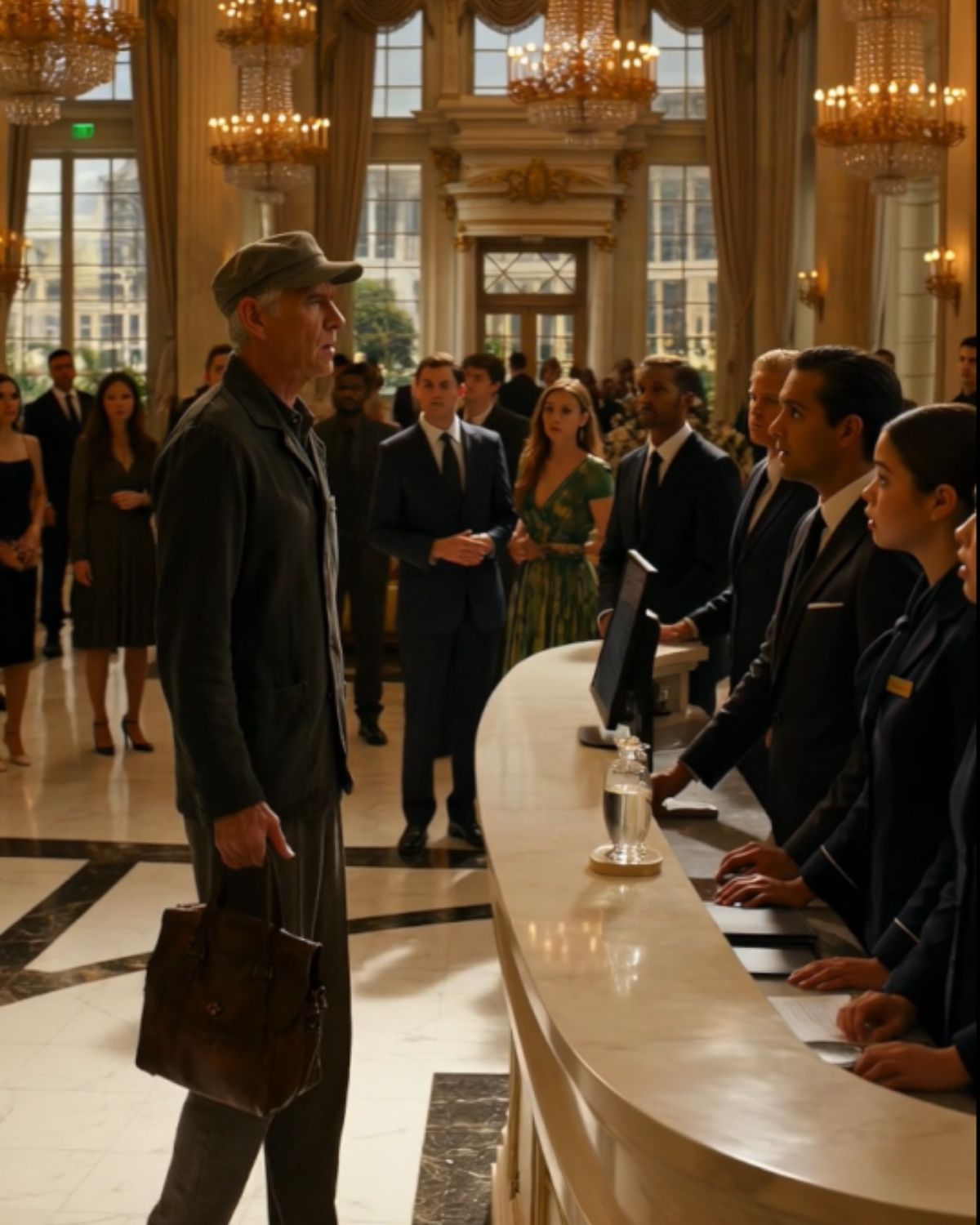
 The old man was thrown out of the luxury hotel before anyone realized he owned it.
He did not arrive in a limousine.
He did not wear a tailored suit.
He did not have an assistant walking behind him with a leather folder.
He came through the revolving glass doors of The Imperial Verdan Hotel wearing a faded brown coat, worn-out shoes, and an old wool cap pulled low over his silver hair. In his right hand, he carried a small canvas bag with one broken zipper.
The lobby was breathtaking.
Italian marble stretched across the floor like frozen water. Golden chandeliers hung from a ceiling painted with clouds. Tall vases of white lilies stood beside velvet chairs. Guests moved through the space in quiet waves of perfume, polished shoes, and expensive luggage.
The old man paused just inside the entrance.
A doorman glanced at him, then looked away.
A security guard near the elevator narrowed his eyes.
Two receptionists behind the front desk exchanged a look.
Nobody said welcome.
Nobody asked if he needed help.
Nobody smiled.
The old man calmly walked to the front desk and placed his old bag beside his feet.
“Good evening,” he said. “I need one room for tonight.”
The young receptionist in front of him was named Maya Chen. She was twenty-four, new to the hotel, and still believed hospitality meant helping people before judging them.
She opened her mouth to answer.
But before she could speak, a sharp voice cut across the lobby.
“Excuse me.”
The hotel manager, Adrian Vale, stepped out from behind the front desk.
Adrian was the kind of man who wore authority like perfume. His suit was dark, perfectly pressed, and more expensive than most of his employees’ monthly rent. His hair was slicked back. His shoes shone under the chandelier light. On his chest, a gold name badge read:
Adrian Vale
General Manager
He looked at the old man’s coat.
Then his shoes.
Then the old canvas bag.
His face tightened with disgust.
“This is a luxury hotel,” Adrian said sharply. “People like you don’t belong here.”
The words were loud enough for half the lobby to hear.
A woman sitting near the lounge lowered her glass of champagne.
A businessman at the concierge desk turned slightly.
One of the bellboys froze with a luggage cart in his hands.
The old man did not react.
He simply looked at Adrian and repeated, “I only need one room for tonight.”
Adrian laughed.
Not because anything was funny.
Because he wanted the old man to know he had no power there.
“One room?” he said. “Do you have any idea where you are?”
The old man’s eyes moved slowly across the marble lobby, the golden elevators, the grand staircase, the crystal chandelier, and the staff pretending not to listen.
“Yes,” he said quietly. “I know exactly where I am.”
Adrian’s jaw tightened.
He was used to people shrinking when he spoke to them that way. Delivery drivers apologized. Housekeeping staff lowered their heads. Guests without designer luggage suddenly became nervous. Adrian had built his rule over the hotel on one simple belief:
People were easier to control when they felt small.
But the old man did not feel small.
And that irritated him.
Adrian leaned forward slightly.
“Listen carefully,” he said. “Our rooms start at three thousand dollars per night. This lobby is for registered guests only. If you are looking for shelter, there are places for that.”
Maya’s face changed.
She glanced at the old man, then at Adrian.
“Sir,” she whispered, “maybe we should check his name first.”
Adrian turned his head slowly toward her.
The entire front desk seemed to freeze.
“What did you say?”
Maya swallowed. “I just mean… he may have a reservation.”
Adrian smiled without warmth.
“I don’t need to check anything.”
Maya lowered her eyes.
The old man watched her carefully.
He noticed the way her fingers trembled near the keyboard.
He noticed the way the other receptionist stepped back, pretending to adjust the printer.
He noticed the security guard looking at Adrian first instead of the guest.
Fear had a smell.
It was quiet, but it filled the lobby.
The old man reached into his coat pocket and took out a folded piece of paper.
“I have confirmation,” he said.
Adrian did not even look at it.
He waved his hand toward security.
“Throw him out before he scares our real guests.”
The lobby went silent.
Real guests.
The words landed like dirt thrown on a polished floor.
The security guard near the elevator, a tall man named Victor Reyes, stepped forward hesitantly. He had worked at The Imperial Verdan for nine years. He had seen drunk guests smash glasses and still receive apologies. He had seen wealthy men scream at staff and still be escorted politely to their suites.
But he had also seen people like this old man removed before they could even explain why they were there.
Victor did not like it.
But he had a mortgage, two children, and a manager who punished anyone who questioned him.
“Sir,” Victor said softly to the old man, “maybe you can step outside with me.”
The old man looked at him.
“Am I causing trouble?”
Victor’s lips parted.
He had no answer.
Adrian snapped, “Do your job.”
Victor reached for the old man’s bag.
Maya suddenly spoke again, this time a little louder.
“Mr. Vale, please. We should check.”
Adrian slammed his palm lightly on the marble counter.
The sound cracked through the lobby.
“Maya, one more word and you can clock out permanently.”
Her face went pale.
The old man slowly turned to her.
For the first time, something like sadness moved across his eyes.
Not fear.
Not embarrassment.
Sadness.
Because he had not come to test only the manager.
He had come to test the culture.
And the culture was already answering.
The Imperial Verdan had been built thirty-eight years earlier by a man named Samuel Hartwell.
At least, that was the name carved into the bronze plaque near the private elevator.
Samuel had started with one small roadside inn after returning from military service. He cleaned rooms himself. He fixed leaking pipes himself. He made breakfast for truck drivers, newlyweds, tired families, and stranded travelers who could not afford the full rate.
His first rule had been simple:
Never make a guest prove they deserve kindness.
Over the decades, that roadside inn became Hartwell International Hotels, a hospitality empire across fourteen countries. The Imperial Verdan was its crown jewel, the hotel where presidents stayed, celebrities hid from cameras, and business leaders signed deals over twenty-dollar coffee.
But after Samuel stepped away from daily operations, reports began reaching him.
Not official reports.
Those were always perfect.
Occupancy was high. Revenue was strong. Online photos were beautiful. The lobby smelled like fresh lilies. The board loved the numbers.
But the letters were different.
A retired schoolteacher wrote that she had been ignored for twenty minutes because she arrived in plain clothes after a delayed flight.
A delivery driver wrote that he was yelled at for entering through the wrong door while carrying flowers for a wedding.
A former housekeeper wrote that managers mocked employees who spoke with accents.
One handwritten note came from an unknown staff member.
It said:
“Chairman Hartwell, your hotel is still beautiful, but it has forgotten how to be decent.”
Samuel read that sentence at his kitchen table three times.
Then he placed the letter in his coat pocket and made a decision.
He would not announce a visit.
He would not arrive as chairman.
He would not bring lawyers, executives, photographers, or assistants.
He would walk through the front door looking like someone with nothing to offer and see how his people treated him.
Now he knew.
Adrian Vale looked at Victor again.
“Remove him.”
Victor gently picked up the old canvas bag.
Samuel’s eyes followed it.
“That bag belongs to me,” he said.
“And now it belongs outside,” Adrian replied.
A few guests gasped quietly.
Maya’s eyes widened.
Victor carried the bag toward the entrance, clearly uncomfortable.
Samuel followed, still calm.
He had almost reached the revolving doors when a sudden commotion came from the far side of the lobby.
The private elevator opened.
A woman in a charcoal business suit rushed out, followed by two executives and a senior security supervisor.
Her name was Evelyn Cross, Chief Operating Officer of Hartwell International Hotels.
She had received a call five minutes earlier from Samuel’s driver, who had been instructed to wait two blocks away but had become concerned when the chairman did not answer his phone.
Evelyn walked quickly into the lobby, scanning the room.
Then she saw the old man near the entrance.
The color left her face.
She stopped so abruptly that the executive behind her almost bumped into her.
For one stunned second, Evelyn simply stared.
Then she hurried forward and bowed her head deeply.
“Chairman,” she said, her voice shaken. “We didn’t know you were coming.”
The lobby went completely silent.
Not quiet.
Silent.
The pianist stopped playing.
The bellboy’s hands froze on the luggage cart.
A guest at the concierge desk slowly turned around.
Victor still held the old canvas bag in both hands.
Adrian’s face changed as if someone had turned off the lights behind his eyes.
He looked at Evelyn.
Then at the old man.
Then back at Evelyn.
“Chairman?” he whispered.
Samuel Hartwell removed his old wool cap.
Silver hair fell neatly across his forehead.
He reached into his coat pocket and pulled out a black identification card, worn at the edges but unmistakable.
Samuel Hartwell
Founder and Chairman
Hartwell International Hotels
Maya covered her mouth with one hand.
Victor nearly dropped the bag.
The second receptionist stepped backward into the printer stand.
Adrian stared at the card, and the confidence drained from his body one inch at a time.
His shoulders lowered.
His mouth opened.
His eyes moved over Samuel’s worn coat, the old shoes, the canvas bag, and the cap in his hand.
Only minutes earlier, those things had made Samuel worthless in Adrian’s eyes.
Now they had become evidence.
Evidence that Adrian had not made a small mistake.
He had revealed exactly who he was when he thought it did not matter.
Samuel looked at the staff.
Then at the guests.
Then finally at Adrian.
“I came here to test your character,” he said in a calm but powerful voice. “And today, you all failed.”
No one spoke.
Adrian swallowed hard.
“Chairman Hartwell, I… I didn’t recognize you.”
Samuel held his gaze.
“That was the test.”
Adrian blinked.
The words seemed to hit him harder than shouting would have.
He tried to recover, because men like Adrian always believed there was a sentence that could save them.
“Sir, we receive many people walking in from the street. We have to protect the hotel’s image.”
Samuel looked around the lobby slowly.
“At the cost of its soul?”
Adrian’s lips pressed together.
Evelyn Cross stood beside Samuel, her face tight with controlled anger.
“Mr. Vale,” she said, “did you refuse to check whether Chairman Hartwell had a reservation?”
Adrian opened his mouth.
Maya spoke before he could.
“Yes.”
Every head turned toward her.
Her voice was small, but it did not break.
“I asked him to check the name. Twice.”
Adrian’s eyes flashed.
“Maya, be careful.”
Samuel turned sharply toward Adrian.
“Do not threaten her.”
The sentence cut through the lobby like a blade.
Adrian froze.
Maya’s eyes filled with tears, but she stood a little straighter.
Samuel looked at her.
“What is your name?”
“Maya Chen, sir.”
“How long have you worked here?”
“Four months.”
“Were you trained to treat people differently based on appearance?”
Maya looked at Adrian.
Then at Evelyn.
Then back at Samuel.
“No, sir. But that is what happens.”
A murmur moved through the lobby.
Samuel did not interrupt her.
Maya continued, her voice trembling.
“Mr. Vale tells us luxury must be protected. He says people who don’t look like they belong make real guests uncomfortable. We’re told not to waste time on them unless they show proof they can pay.”
Adrian’s face reddened.
“That is completely out of context.”
Samuel looked at Victor, the security guard.
“Is she telling the truth?”
Victor still held the old canvas bag.
For years, he had survived by keeping his head down.
But the chairman was looking directly at him.
Not like he was a uniform.
Like he was a person.
Victor nodded slowly.
“Yes, sir.”
Adrian turned on him. “Victor.”
Samuel’s voice became colder.
“Mr. Vale, you will not intimidate one more employee in my lobby.”
That was the moment everyone saw it.
The shift.
The power Adrian had used like a weapon was no longer in his hands.
It had moved.
Not just to Samuel.
To the people who had been silent under him.
The housekeeping supervisor near the hallway stepped forward.
“We were told not to use the main elevator if VIP guests were present,” she said.
A bellboy added, “He told us to watch people’s shoes before offering luggage service.”
The café hostess near the lounge whispered, “He made us move a family to the back because their children were wearing school uniforms.”
Another receptionist said, “He told us complaints from standard rooms were low priority.”
Each sentence seemed to remove another piece of Adrian’s armor.
His face became pale again.
His eyes darted from person to person.
The staff he had controlled with fear were finally speaking, and he was discovering something too late:
Fear can silence people, but it cannot make them loyal.
Samuel listened to every word.
He did not look surprised.
That was what made Adrian more nervous.
“Enough,” Adrian said suddenly. “This is becoming a public spectacle.”
Samuel looked at him.
“You made it public when you tried to throw me out.”
Adrian’s mouth closed.
A guest near the grand staircase nodded.
Another lifted a phone, but Evelyn gently signaled for the senior security supervisor to stop recording without causing a scene.
Samuel did not want a viral scandal.
He wanted accountability.
But accountability was already happening in front of everyone who needed to see it.
He turned to Evelyn.
“Secure all lobby footage from today. Pull the last six months of guest complaints, staff turnover records, internal emails, and security removal reports.”
Evelyn nodded. “Immediately.”
Adrian stepped forward, panic entering his voice.
“Chairman, please. We should discuss this privately. I have delivered record revenue for this property.”
Samuel looked at him for a long moment.
“That may be true.”
Adrian seemed to take a breath.
Then Samuel continued.
“But if revenue requires cruelty, it is not success. It is rot.”
The words crushed the last trace of Adrian’s confidence.
He looked down.
For the first time that evening, he looked less like a manager and more like a man who had finally seen himself clearly.
His reflection stared back at him from the polished marble floor.
Dark suit.
Gold badge.
Perfect shoes.
Empty character.
Samuel pointed toward the entrance.
“You’re fired.”
The lobby did not erupt.
There was no applause.
No shouting.
No dramatic music.
Just the soft sound of Adrian inhaling sharply, as if he had been struck.
“You can’t mean that,” he said.
“I do.”
“After everything I’ve done for this hotel?”
Samuel stepped closer.
His voice remained calm.
“You forgot what this hotel was built for.”
Adrian looked around, searching for support.
No one came.
Not the receptionists.
Not security.
Not the bellboys.
Not even the guests who had once received his brightest smiles.
The senior security supervisor approached him carefully.
“Mr. Vale, please come with us.”
Adrian removed the gold name badge from his jacket with shaking fingers.
For a second, he held it in his palm as if it still meant something.
Then he placed it on the marble counter.
Maya watched him.
Victor watched him.
The staff watched him.
And Adrian finally understood what made the moment unbearable.
He had spent years deciding who belonged.
Now he was the one being escorted out.
He walked toward the revolving doors with his shoulders bent, his polished shoes clicking against the marble. The same entrance he had ordered Samuel through now became his own exit.
When the doors swallowed him, the lobby remained silent.
Samuel turned back to the staff.
Some looked relieved.
Some looked ashamed.
Some looked afraid that they would be next.
He let the silence sit for a few seconds.
Then he picked up his old canvas bag from Victor’s hands.
“Thank you,” he said.
Victor lowered his head. “I’m sorry, Chairman.”
Samuel looked at him. “For what?”
“For not stopping it sooner.”
Samuel nodded slowly.
“That is an honest answer.”
Then he turned to the entire lobby.
“I said you all failed,” he said. “But failure does not always mean the same thing.”
Nobody moved.
“Some of you failed because you were cruel. Some failed because you were afraid. Some failed because you watched wrong happen and hoped someone else would speak first.”
Maya lowered her eyes.
Victor’s jaw tightened.
The housekeeping supervisor folded her hands in front of her.
Samuel’s voice softened, but only slightly.
“I understand fear. I do not excuse it.”
That sentence settled heavily over the staff.
Evelyn stood beside him, already taking notes.
Samuel looked at Maya.
“You spoke when it was dangerous to speak.”
Maya blinked quickly.
He looked at Victor.
“You hesitated because you knew it was wrong. Next time, hesitation must become action.”
Victor nodded. “Yes, sir.”
Samuel looked toward the reception team, the bell staff, housekeeping, café workers, and security.
“Every person on duty tonight will remain employed until HR completes private interviews. Anyone who participated in abuse will be removed. Anyone who stayed silent out of fear will be retrained and protected. Anyone who was punished for showing kindness will be heard.”
A visible wave of emotion passed through the employees.
Not celebration.
Relief.
For the first time in a long time, the room felt like it could breathe.
Evelyn stepped forward.
“The front desk will temporarily pause check-ins for ten minutes,” she said. “All waiting guests will be assisted in the lounge with refreshments. Maya, please help coordinate.”
Maya looked startled. “Me?”
Samuel gave the smallest smile.
“You seem to remember what hospitality means.”
Maya nodded, wiping her cheek before turning to the guests.
Within minutes, the lobby began moving again.
Not perfectly.
Not smoothly.
But differently.
A bellboy offered water to an elderly couple who had been waiting by the sofa.
Victor escorted a delivery worker through the proper entrance instead of barking at him.
The housekeeping supervisor stood a little taller.
Guests whispered, but not with mockery now.
They had witnessed something rare.
A hotel remembering its soul in real time.
Samuel did not go to the presidential suite.
Instead, he asked for a standard room.
Maya personally checked him in.
Her hands still trembled as she typed.
“Chairman Hartwell,” she said softly, “I am sorry for what happened.”
Samuel accepted the key card.
“So am I.”
She looked down.
He added, “But I am glad I saw it.”
Maya looked up, surprised.
“Why?”
“Because hidden sickness is harder to heal.”
That night, Samuel did not sleep much.
He sat by the window of his standard room on the ninth floor, looking down at the city lights. His old canvas bag rested on the chair beside him. Inside it were three things: a change of clothes, a notebook, and the handwritten letter that had brought him there.
Your hotel is still beautiful, but it has forgotten how to be decent.
He read the line again.
Then he opened his notebook and began writing.
By morning, the investigation had already uncovered more than he expected.
Adrian Vale had created unofficial appearance-based policies. Staff had been instructed to delay service to guests who did not look wealthy. Security had removed people from the lobby without incident reports. Negative complaints from “non-premium” guests had been buried. Employees who objected had lost shifts, promotions, or preferred schedules.
There were emails.
There were messages.
There were witness statements.
There was footage.
At 10 a.m., Samuel called a mandatory meeting in the grand ballroom.
Every department attended.
Reception.
Security.
Housekeeping.
Food and beverage.
Valet.
Maintenance.
Administration.
The room was filled with uniforms, worried faces, and the quiet tension of people who knew a powerful man had finally looked behind the curtain.
Samuel stood at the front, no longer dressed as a poor man.
He wore a simple navy suit.
But the old canvas bag sat on the table beside him.
He wanted them to remember.
Evelyn presented the findings.
Three managers were terminated immediately for enforcing discriminatory practices.
Two supervisors were suspended pending further review.
Several employees who had been punished for helping guests were reinstated to better shifts.
A new anonymous reporting system was announced.
Guest treatment policies were rewritten.
Security removals would now require documented behavior, not appearance.
Overtime records would be audited.
Training would begin that week.
Then Samuel stepped forward.
“I founded this company with twelve rooms and one broken coffee machine,” he said. “Our first guests were truck drivers, factory workers, families sleeping three to a bed, and people who counted coins before asking for breakfast.”
The ballroom was silent.
“I did not build hotels so my employees could learn to worship expensive shoes.”
A few people lowered their heads.
“I built them because travel can make people vulnerable. A hotel is where strangers trust us with their rest, their safety, their dignity, and sometimes the worst day of their lives.”
He paused.
“That trust is sacred.”
Maya stood near the side wall, holding a folder to her chest.
Victor stood near the back with his hands clasped in front of him.
Samuel looked across the room.
“If you need to know someone’s wealth before you decide whether to be kind, you do not belong in hospitality.”
The sentence landed heavily.
Then Samuel picked up the old cap he had worn the night before.
He held it up.
“Yesterday, this cap made some of you decide I was not worth respect.”
He placed it back on the table.
“But clothing does not change a person’s value. It only reveals the values of the person judging.”
No one clapped.
Not yet.
They were not being entertained.
They were being corrected.
And deep down, many of them knew they needed it.
Samuel turned to Maya.
“Ms. Chen, please come forward.”
Maya’s eyes widened.
She walked to the front slowly, afraid she had done something wrong.
Samuel handed her a small envelope.
“This is a formal commendation for speaking up under pressure. You will be moved into the guest relations leadership program, if you accept.”
Maya stared at the envelope.
Her lips trembled.
“I accept,” she whispered.
Then Samuel turned to Victor.
“Mr. Reyes.”
Victor stepped forward.
Samuel looked at him for a long moment.
“You almost followed an order you knew was wrong.”
Victor nodded, ashamed. “Yes, sir.”
“But you told the truth when asked.”
“Yes, sir.”
“You will receive additional training and remain in your position. I expect you to become the kind of security leader who protects people, not pride.”
Victor’s eyes reddened.
“I will.”
Only then did the first clap begin.
It came from the housekeeping supervisor.
Then another.
Then the bell staff.
Then the reception team.
Soon the entire ballroom was clapping, not because everything was fixed, but because the truth had finally been given a place to stand.
Six months later, The Imperial Verdan was still grand.
The marble still shone.
The chandeliers still glittered.
Elegant guests still entered with designer luggage and private drivers.
But something important had changed.
The doorman greeted everyone.
Receptionists checked names before making assumptions.
Security watched behavior, not clothing.
Housekeeping staff used the main elevator when they needed to.
Delivery workers were guided respectfully.
A tired father arriving late with two children and one cheap suitcase was offered water before payment was discussed.
A woman in a nurse’s uniform was seated near the window in the café and treated like any other guest.
And near the front desk, where Adrian Vale had once placed his gold badge before being escorted out, a small bronze plaque was installed.
It carried no names.
Only one sentence:
Kindness is the first standard of luxury.
One evening, a new trainee asked Maya if the story was true.
“Did the chairman really pretend to be poor?” she whispered.
Maya looked across the lobby.
An old man in plain clothes had just entered, carrying a paper shopping bag. The doorman smiled and greeted him warmly. A bellboy stepped forward and asked if he needed assistance. Nobody stared at his shoes. Nobody blocked his path.
Maya smiled.
“Yes,” she said. “It was true.”
The trainee leaned closer. “And did he really fire everyone?”
Maya shook her head.
“No. That’s how people tell it online because it sounds dramatic.”
She glanced toward the bronze plaque.
“He fired the ones who were cruel. He corrected the ones who were afraid. And he promoted the ones who still had courage.”
The trainee looked toward the old man in the lobby.
“So what was the real lesson?”
Maya watched as the receptionist greeted him with the same warmth she would give a king.
“The real lesson,” she said, “is that character is not tested when the chairman walks in wearing a suit.”
She paused.
“It is tested when you think nobody important has entered the room.”
Because the person you dismiss today may not own the building, but they still deserve to be treated like they matter.