A Security Guard Was Ordered To Throw Out A Poor Woman — But He Recognized Her Secret Identity
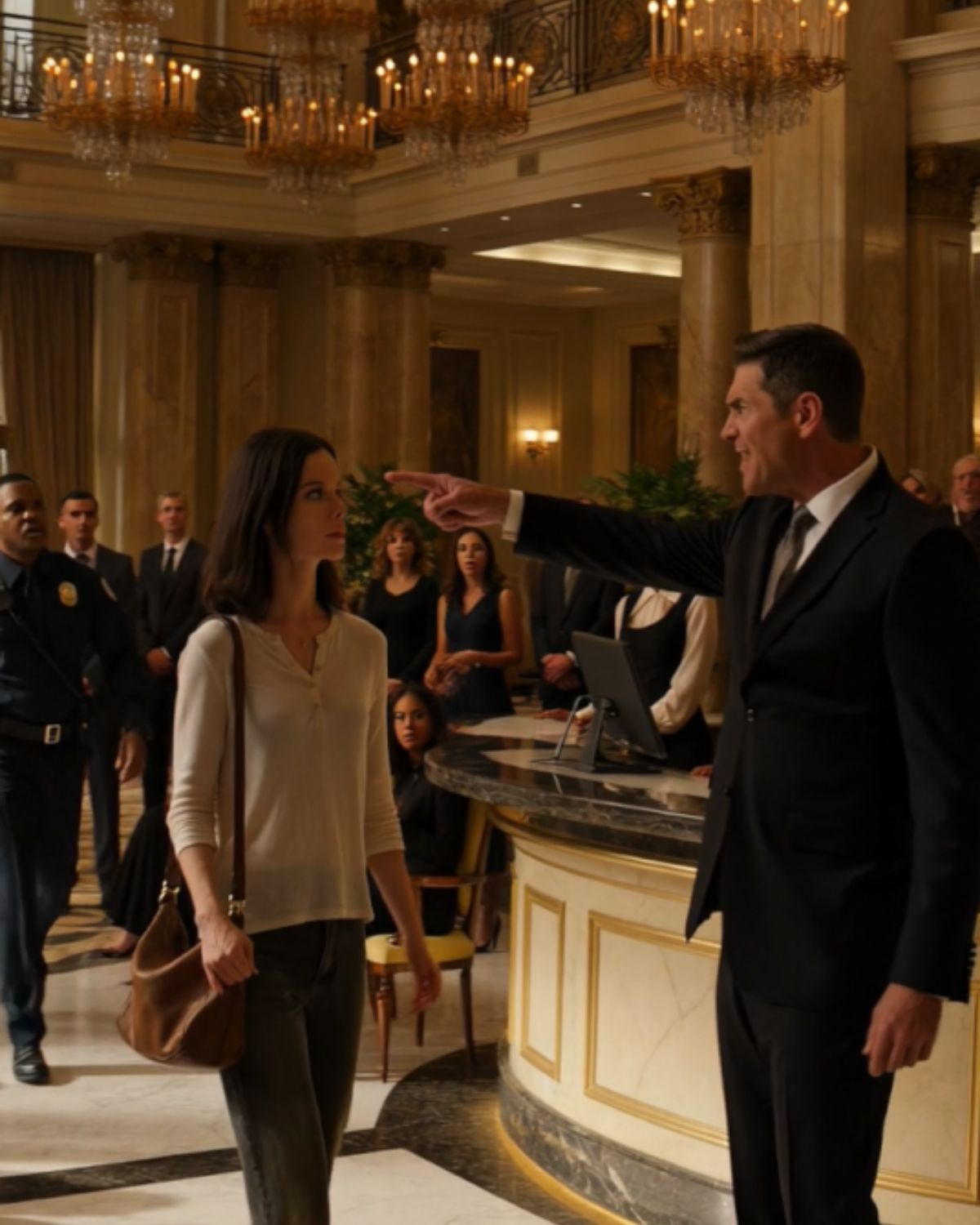
The woman had barely taken six steps into the lobby of The Aurelia Grand Hotel when the manager pointed at her like she was a stain on the marble floor.
“Security,” he said sharply. “Get her out. She doesn’t belong here.”
The lobby went quiet in that strange way expensive places go quiet when someone poor enters them.
Not completely silent.
Just quieter.
The soft piano continued playing near the fountain. Crystal glasses still clicked inside the lounge. The gold chandeliers above still poured warm light over polished marble, Italian leather chairs, and guests wearing watches that cost more than most people’s cars.
But eyes turned.
A receptionist froze with her hand over the keyboard. A bellman stopped beside a mountain of designer luggage. Two businessmen near the elevator paused mid-conversation.
And at the center of it all stood a woman in plain gray clothes, holding an old brown handbag with both hands.
Her shoes were worn. Her hair was tied back without effort. Her face looked tired, not in a dramatic way, but in the way people look when life has been asking too much of them for too long.
Still, she stood calmly.
“Please,” she said softly. “I just need to speak with someone.”
The manager, Adrian Cole, looked her up and down.
He had worked at The Aurelia Grand for six years and had spent most of that time perfecting the expression he was wearing now. A small frown. Raised chin. Polished smile missing all warmth.
It was the kind of expression that said he believed the hotel belonged to him, even though his name was not on a single brick.
“This is a luxury hotel,” Adrian snapped, “not a charity house.”
A few guests looked away.
Not because they disagreed.
Because watching cruelty in public is uncomfortable when no one wants to be the first to object.
The woman swallowed, but she did not lower her eyes.
“I understand,” she said. “But I have an appointment.”
Adrian gave a short laugh.
“With whom?”
She hesitated.
That was all he needed.
“With whom?” he repeated, louder this time, making sure the lobby heard him. “Because our presidential suites are fully occupied, our private dining floor is reserved, and our executive offices do not take walk-ins from people who wander in from the street.”
The receptionist behind him, Lily, pressed her lips together.
She was new. Twenty-four. Still soft enough to be disturbed by things everyone else had learned to ignore.
The woman opened her handbag with careful fingers.
“I have a letter,” she said.
Adrian stepped forward and snatched the envelope before she could fully remove it.
The envelope was cream-colored, old, and slightly bent at the corners. No logo. No embossed seal. Just a handwritten name on the front.
Adrian looked at it, then at her.
“This is not an appointment confirmation.”
“It was sent to me years ago,” the woman said. “By Mr. Whitmore.”
That name moved through the lobby like a draft.
Elias Whitmore.
The founder of The Aurelia Grand.
His portrait hung above the main staircase, painted larger than life in a black suit, one hand resting on a silver cane, his eyes looking down over the lobby as if he could still judge everyone beneath him.
Adrian’s face tightened.
“Do not use Mr. Whitmore’s name to gain sympathy.”
“I’m not.”
“You expect me to believe,” Adrian said, lifting the envelope slightly, “that Elias Whitmore sent a personal letter to you?”
The woman’s voice remained even.
“Yes.”
Adrian turned the envelope over, almost amused now.
“Then you should know Mr. Whitmore passed away twelve years ago.”
“I know.”
The simplicity of her answer made some people uncomfortable.
Adrian’s smile disappeared.
The lobby had begun paying full attention. A family of four near the concierge desk watched from behind their suitcases. A woman in pearls slowly lowered her phone. A waiter stood still with a tray of champagne glasses balanced on one hand.
Adrian seemed to notice the audience.
And like many people who mistake attention for authority, he became crueler.
“What is your name?” he asked.
“Margaret.”
“Margaret what?”
She paused again.
“Margaret Hale.”
Adrian looked to Lily at the reception desk.
“Do we have a Margaret Hale in the system?”
Lily typed quickly, though her fingers looked stiff.
“No, Mr. Cole.”
“Any reservation?”
“No.”
“Any appointment?”
Lily looked at the screen, then at the woman.
“No.”
Adrian spread his hands as if the matter had been settled by law.
“There you have it.”
Margaret held the old handbag closer to her body.
“I was told to come today.”
“By whom?”
She looked toward the private elevator at the far end of the lobby. It was gold-framed and guarded by a small access panel. Only board members, penthouse residents, and the Whitmore family were allowed to use it.
“I need to speak with the board,” she said.
This time Adrian laughed openly.
Not loudly.
Worse.
Quietly, with disbelief.
“The board.”
A businessman near the fountain smirked.
The woman in pearls looked down at her phone again, pretending not to be involved.
Adrian stepped closer.
“Listen carefully, Margaret. We host ambassadors, royalty, billionaires, and heads of state. People do not walk in here dressed like they lost a fight with a thrift store and ask to speak to the board.”
Lily flinched.
Margaret’s face changed only slightly.
A small tightening around the eyes.
But she still did not raise her voice.
“I am not here to cause trouble.”
“You already have.”
“I just need five minutes.”
“You will not get five seconds.”
Adrian turned his head.
“Daniel.”
A security guard standing near the entrance straightened.
Daniel Reyes was thirty-eight, broad-shouldered, and quiet. He had worked security for The Aurelia Grand for nine years, long enough to know the difference between danger and embarrassment.
This woman was not danger.
She was embarrassment.
And hotels like The Aurelia Grand feared embarrassment more than danger.
Daniel had seen it before.
A delivery driver made to wait outside in the rain because his shoes were muddy.
A housekeeper blamed for a missing diamond bracelet until the guest found it in her own makeup bag.
An elderly man in a faded jacket asked to leave the lounge, only for everyone to discover he owned three floors of the building next door.
But most of the time, the powerful stayed powerful, the quiet stayed quiet, and Daniel was expected to enforce decisions he did not make.
“Remove her,” Adrian ordered.
Daniel walked forward.
Margaret watched him approach. Not afraid. Not begging.
Just calm.
That calm bothered Adrian.
He wanted panic. Apology. Shame.
Anything that proved he had won.
Instead, the woman simply said, “Officer, I’m sorry for the trouble.”
Daniel stopped two feet from her.
“I’m going to ask you to come with me, ma’am,” he said carefully.
Adrian folded his arms.
“Outside.”
Daniel did not look at him.
Margaret nodded.
“I understand.”
She turned slightly, and as she did, the collar of her plain gray blouse shifted.
A small necklace slipped into view.
It was not flashy. Not the kind of jewelry guests wore to be noticed.
It was a simple gold chain with a tiny emblem hanging at the center.
A lion.
Not a roaring lion. A seated lion, holding a key beneath one paw.
Daniel’s hand froze mid-air.
His eyes narrowed.
Then widened.
For a moment, the entire lobby seemed to fall away.
He was no longer standing beneath the chandelier with Adrian barking orders behind him. He was a young man again, twenty-nine, freshly hired, sitting in a basement training room with twelve other security recruits.
The old head of security, Mr. Callahan, had stood in front of them holding a black folder.
“There are many important people who come through these doors,” Callahan had said. “Celebrities. Politicians. Investors. But there is one symbol you never ignore.”
He had shown them a photograph.
A small gold lion holding a key.
“The Whitmore family emblem,” Callahan said. “Very few people wear it. If you see it, you do not question them in public. You do not delay them. You notify executive protocol and escort them with respect.”
A recruit had asked, “What if we don’t recognize the person?”
Callahan’s answer had been firm.
“Then you recognize the symbol.”
Daniel stared at the necklace.
The lion.
The key.
Worn smooth at the edges, like it had been touched many times over many years.
He whispered before he could stop himself.
“Wait…”
Adrian’s head snapped toward him.
“What?”
Daniel looked at Margaret’s face again.
There was something in her eyes now.
Not fear.
Recognition.
As if she had been waiting to see whether anyone in the hotel still remembered what mattered.
Daniel’s voice dropped.
“I know that symbol.”
Adrian’s jaw tightened.
“Why are you standing there?” he barked. “Remove her.”
Daniel slowly turned toward him.
For the first time that afternoon, his voice was not careful.
It was firm.
“Sir… she is the founder’s daughter.”
The lobby went completely silent.
Even the pianist stopped playing.
Adrian’s face changed so quickly that everyone saw it happen.
The arrogance left first.
Then the color.
Then the certainty.
He stared at Margaret, then at the necklace, then back at Margaret again, as if hoping the truth might rearrange itself if he looked at it from another angle.
“That’s impossible,” he said.
Margaret did not reply immediately.
She reached into her handbag and took out the old cream-colored envelope Adrian had snatched earlier. Daniel had not noticed when she quietly retrieved it from the floor after Adrian tossed it back at her.
She held it gently, almost like it was fragile.
“My father gave me this necklace when I was nine,” she said. “He told me the lion was not there to show power. It was there to guard the key. He said anyone can build a hotel with marble and gold. But it takes character to open the door for the right reasons.”
No one moved.
Adrian swallowed.
“Your father?”
Margaret looked up at the portrait over the staircase.
“Elias Whitmore.”
A soft gasp came from behind the reception desk.
Lily covered her mouth.
The businessman near the fountain stopped smirking.
The woman in pearls slowly lifted her eyes.
Adrian shook his head, but there was no strength in it.
“Mr. Whitmore had no daughter named Margaret Hale.”
Margaret nodded once.
“That is true.”
Adrian’s confidence flickered, as if he had found a loose thread.
“There. You see? This is exactly why I said—”
“My legal name is Margaret Whitmore Hale,” she said.
The rest of his sentence died in his throat.
Margaret opened the envelope and removed a folded letter, yellowed with time. Her fingers were steady.
“My mother left this city when I was thirteen,” she said. “My father and I were not close afterward. That was private, and he wanted it kept that way. But he still wrote to me. He still asked me to come back one day. And he still left instructions for me.”
Daniel stepped slightly to her side.
Not in front of her.
Beside her.
That small movement shifted the room.
For the first time since she entered, Margaret was not alone.
Adrian noticed it. So did everyone else.
“Ms. Hale,” Daniel said quietly, “would you like me to call executive protocol?”
Margaret looked at him with gratitude.
“Not yet.”
Then she faced Adrian.
“I came through the front door today because my father always said the front door tells the truth.”
Adrian’s lips parted.
No sound came.
Margaret continued, her voice calm enough to make the moment sharper.
“He said people behave differently at the private elevator. They smile when they know your name. They bow when they know your title. They offer coffee, apologies, and respect when they think you can affect their future.”
Her eyes moved slowly across the lobby, taking in the reception desk, the guests, the guards, the bellmen, the polished gold railings, the perfect flowers arranged in crystal vases.
“Then he told me something I never forgot.”
She looked back at Adrian.
“He said, ‘Margaret, if you ever want to know what kind of place someone has built, don’t enter as someone important. Enter as someone they think they can ignore.’”
A bellman lowered his gaze.
Lily’s eyes filled with tears.
Adrian stood so still he looked like a man waiting for a verdict.
But the worst was not over.
Because the private elevator opened.
Three people stepped out.
A woman in a navy suit with silver hair.
A man carrying a leather portfolio.
And an older gentleman with rimless glasses who froze the second he saw Margaret.
The woman in the navy suit was Evelyn Carr, chair of the hotel board.
The man beside her was Thomas Reed, the hotel’s legal counsel.
The older gentleman was Victor Sloane, the only current board member who had worked with Elias Whitmore before his death.
Victor stared at Margaret like he had seen a ghost.
Then his face softened.
“Maggie,” he said.
The name landed harder than any document could have.
Margaret turned toward him.
“Hello, Victor.”
The chairwoman looked from Margaret to Adrian, then to the ring of guests watching in silence.
“What is going on here?” Evelyn asked.
No one answered.
Because everyone knew.
And because the truth was ugly when said out loud.
Daniel stepped forward slightly.
“Ms. Carr,” he said, professional but controlled, “Ms. Hale entered the lobby and asked to speak with someone. Mr. Cole ordered security to remove her.”
Evelyn looked at Adrian.
Adrian’s mouth opened.
“I was following guest protection standards.”
Daniel’s eyes did not move.
“She was calm. She was not disruptive. She stated she had business with the board.”
Adrian turned sharply.
“She had no appointment in the system!”
Lily, still behind reception, spoke before she lost courage.
“She asked for help,” she said.
Everyone looked at her.
Her voice trembled, but she continued.
“She said she had a letter. Mr. Cole took it from her and mocked her in front of the lobby.”
Adrian’s face hardened.
“Lily.”
The warning was clear.
But something had changed.
The fear that kept people quiet had begun moving in the opposite direction.
A guest near the concierge desk raised his hand slightly.
“I heard him call this place not a charity house.”
The woman in pearls added, quietly but clearly, “He also said she looked like she lost a fight with a thrift store.”
Adrian turned pale again.
“That was taken out of context.”
Victor Sloane stepped closer to Margaret.
His eyes were wet.
“Elias told me you might come one day,” he said. “He said you would come quietly.”
Margaret gave a small, sad smile.
“He knew me well.”
Evelyn Carr’s expression sharpened.
“Mr. Cole, is this accurate?”
Adrian looked around the lobby.
At Lily.
At Daniel.
At the guests.
At the board.
At Margaret.
For the first time, there was nowhere for his authority to hide.
“I was trying to protect the hotel’s image,” he said.
Margaret looked at him for a long moment.
Then she said the sentence that would be repeated by staff for years.
“No, Mr. Cole. You were protecting your idea of who deserves to be seen here.”
The words did not come loudly.
They did not need to.
Adrian’s face tightened as if he had been slapped.
His eyes moved to the marble floor. His shoulders, which had been squared with arrogance minutes earlier, slowly dropped.
That was the moment everyone saw it.
The recognition.
Not regret yet.
Not humility.
Recognition.
The terrible, public understanding that he had mistaken clothing for worth, silence for weakness, and a quiet woman for someone powerless.
His lips pressed together.
His face emptied.
And for the first time since Margaret entered the lobby, Adrian Cole had nothing to say.
Evelyn turned to Thomas Reed.
“Please document everything that happened here.”
Thomas opened his portfolio at once.
Evelyn looked at Lily.
“Save the reception footage.”
“Yes, ma’am,” Lily said quickly.
Then Evelyn looked at Daniel.
“Thank you for stopping this.”
Daniel gave a small nod.
“I was trained to recognize the emblem.”
Victor’s voice was low.
“You were trained to recognize dignity too. Not everyone remembers that part.”
Daniel did not respond, but his jaw tightened.
Adrian heard it.
So did everyone else.
Evelyn faced him again.
“Mr. Cole, you are relieved of lobby authority effective immediately. Please surrender your access card to security.”
Adrian blinked.
“Ms. Carr—”
“Now.”
The word cracked through the lobby.
For six years, Adrian had given orders in that room.
He had decided who looked expensive enough, who spoke confidently enough, who belonged before they could explain why they had come. Staff had learned to read his moods. Guests had learned to enjoy his deference. People beneath him had learned to shrink.
Now he reached slowly into his jacket pocket.
His hand shook.
He removed the black access card with the gold Aurelia crest and held it out.
Daniel took it.
No drama.
No speech.
Just the soft plastic click of power changing hands.
Margaret watched in silence.
The guests watched too.
Some with satisfaction.
Some with embarrassment.
A few with the discomfort of people realizing they had almost enjoyed the wrong side of the story.
Evelyn turned to Margaret.
“Ms. Hale, on behalf of the board, I am deeply sorry.”
Margaret folded the letter and placed it back into her handbag.
“Thank you,” she said. “But I did not come here for an apology.”
Victor nodded slowly.
“You came for the vote.”
Adrian’s eyes lifted.
“The vote?”
Margaret glanced at him, then looked toward the board members.
“My father’s final trust condition activates today,” she said. “Twelve years after his death.”
Thomas Reed adjusted his glasses.
“That is correct.”
Lily looked confused.
So did most of the lobby.
Evelyn’s face was serious now.
Margaret continued, “My father left his majority ownership in a family trust. The board has operated the hotel since then. But today, control of that trust transfers to me.”
The silence deepened.
Adrian’s face turned from pale to almost gray.
Margaret’s voice remained quiet.
“I came today to decide whether The Aurelia Grand should continue under its current leadership.”
No one breathed for a moment.
The businessman near the fountain looked down.
The bellman stared at the floor.
Lily pressed one hand against the desk to steady herself.
Adrian looked like a man who had just discovered the ground beneath him was not ground at all.
Margaret turned toward the lobby.
“My father built this hotel after arriving in this city with one suitcase. People forget that. They see the chandeliers and the private elevators and the suites with ocean views, but they forget that Elias Whitmore spent his first winter sleeping in the back room of a diner. The owner let him stay because he cleaned tables after closing.”
Victor closed his eyes briefly.
“He told that story often,” he said.
Margaret nodded.
“He told me too. And he told me that luxury should never become an excuse for cruelty.”
Her gaze returned to Adrian.
“Thank you for showing me how this hotel treats people when they think no one important is watching.”
The words landed softly.
That made them worse.
Adrian’s face crumpled for half a second before he forced it still again. His eyes shifted to the guests, then to the staff, then to Daniel holding his access card.
There was no anger left in him.
Only exposure.
Evelyn stepped beside Margaret.
“The boardroom is ready.”
Margaret looked at Daniel.
“Would you escort me?”
Daniel straightened.
“It would be my honor, ma’am.”
He gestured toward the private elevator.
But before they moved, Margaret turned to Lily.
“What is your name?”
“Lily Chen, ma’am.”
“Lily, thank you for telling the truth.”
Lily’s face flushed.
“I should have spoken sooner.”
Margaret’s expression softened.
“Most people should. Few do.”
Then she looked at Daniel.
“And you?”
“Daniel Reyes.”
“How long have you worked here, Mr. Reyes?”
“Nine years.”
Margaret nodded.
“My father used to say the person at the door understands the soul of a building better than the person in the corner office.”
Daniel did not know what to say.
So he said nothing.
That seemed to be enough.
They began walking across the lobby.
Slowly.
Not because Margaret wanted attention, but because every eye in the room followed her now.
The same marble floor she had been told she did not belong on reflected her worn shoes. The same chandelier light that had exposed her plain clothing now lit the gold emblem at her throat. The same guests who had watched her humiliation now watched her pass toward the private elevator.
Adrian remained near the reception desk, speechless.
No one asked him to move.
That was part of the consequence.
He had to stand inside the silence he created.
As Margaret and Daniel reached the elevator, Victor Sloane joined them. Evelyn and Thomas followed. The gold doors opened with a soft chime.
Before stepping inside, Margaret turned once more and looked back at the lobby.
Not at Adrian alone.
At everyone.
Guests. Staff. Managers. Witnesses.
“When someone walks through your door,” she said, “you do not know what they carry. It may be poverty. It may be grief. It may be history. It may be ownership papers in an old handbag.”
A few people smiled faintly through the tension.
Margaret did not.
“So treat them as human before you find out whether they are important.”
Then she stepped into the elevator.
Daniel stood beside her with quiet respect.
As the doors began to close, Adrian finally moved.
Just one step forward.
“Ms. Hale…”
His voice cracked.
The lobby watched.
Margaret held his gaze.
There was no cruelty in her face. No victory dance. No need to humiliate him further.
That somehow made it heavier.
“Yes, Mr. Cole?”
He looked at the floor, then at her.
“I’m sorry.”
The words came out small.
Margaret nodded once.
“I hope one day you mean that to someone who cannot change your career.”
The elevator doors closed.
For several seconds, nobody spoke.
Then the piano started again, softer this time.
Lily wiped her eyes and returned to her desk. The bellman picked up the designer luggage. The guests slowly resumed their lives, though not with the same ease as before.
And Adrian Cole stood in the middle of The Aurelia Grand lobby without his access card, without his authority, and without the illusion that everyone still admired him.
By evening, the footage had been reviewed.
By morning, staff received a letter from the new controlling owner of the Whitmore Trust.
Margaret Whitmore Hale announced three changes.
First, Adrian Cole’s employment was terminated after a formal review.
Second, every front-facing employee would receive new hospitality training built around one rule: respect before status.
Third, Daniel Reyes was promoted to Director of Guest Protection, with authority to override any manager who tried to remove someone based on appearance alone.
Lily Chen was promoted two months later to guest relations supervisor.
And on the wall beside the main entrance, beneath Elias Whitmore’s portrait, a small bronze plaque was installed.
It did not mention Margaret.
It did not mention Adrian.
It said:
“The door is the first test of who we are.”
Years later, people still told the story of the woman in worn shoes who walked into a seven-star hotel with an old handbag and changed the way everyone inside understood luxury.
Because real class is not proven by how you treat people who can reward you.
It is revealed by how you treat people when you think they have nothing to give.