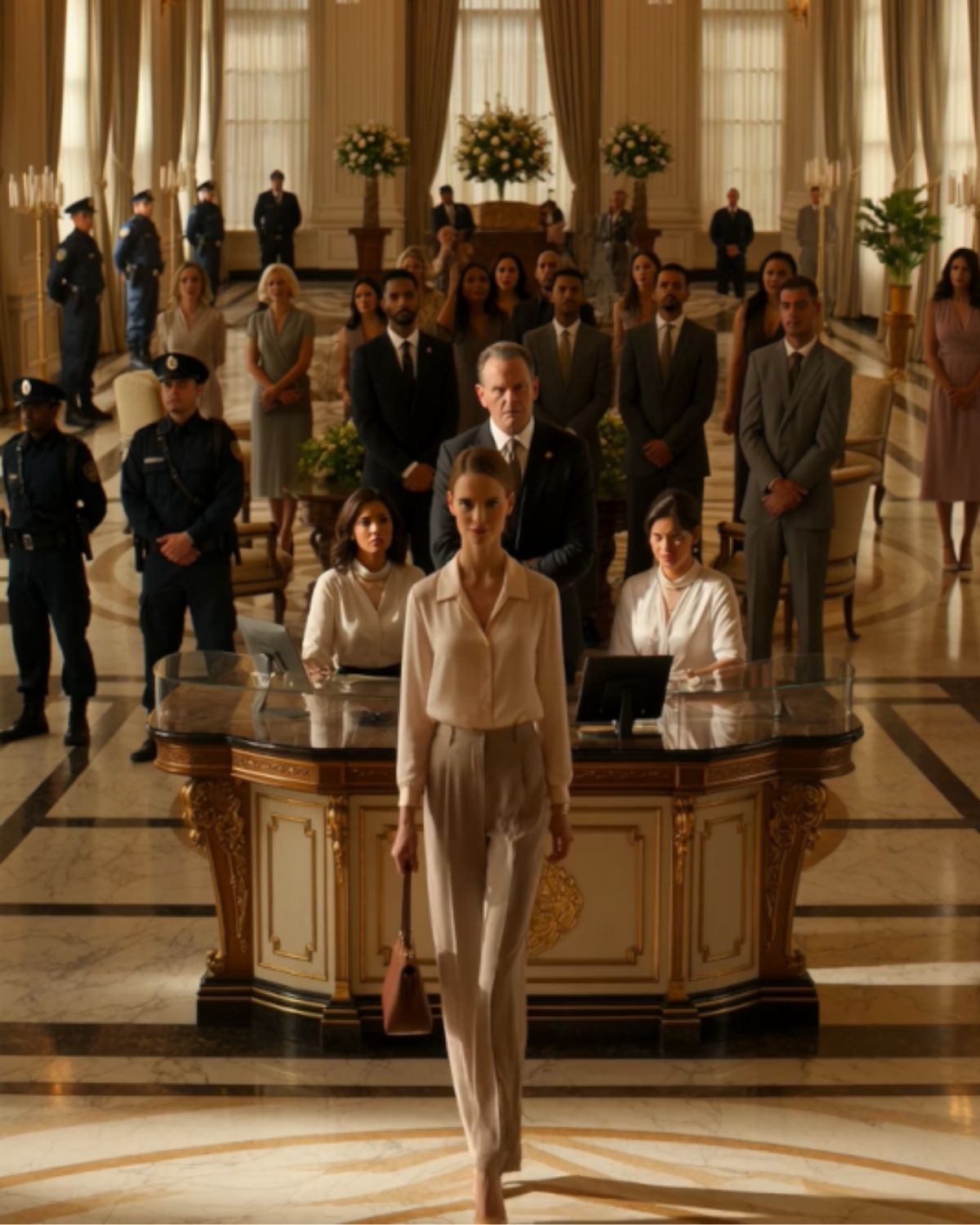
 He Refused Her A Room Because She Looked Poor — Then The Chairman Called Her “Madam Boss”
The woman walked into The Imperial Veridian Hotel at exactly 10:06 in the morning, carrying a small black handbag and wearing a simple cream blouse that looked freshly ironed but not expensive.
That was the first thing everyone noticed.
Not because she looked strange.
Because she looked ordinary.
And ordinary people did not usually walk alone into a seven-star hotel where the marble floors were polished so brightly they reflected the chandeliers above. The lobby was a cathedral of wealth, with gold columns, velvet chairs, white orchids in crystal vases, and guests who moved as if the building had been designed specifically for them.
A pianist played softly near the fountain.
Receptionists smiled behind a long curved desk.
Security guards stood near the doors.
Bellmen carried designer luggage past the elevators.
The air smelled of roses, leather, and money.
The woman paused near the entrance, not in fear, but to take in the room. Her name was Marianne Cole, though nobody in that lobby knew it yet. She was forty-six, with calm eyes, tired hands, and the quiet confidence of someone who had learned not to explain herself to people committed to misunderstanding her.
She walked toward the front desk.
A young receptionist named Sophie looked up.
“Good morning, ma’am. Welcome to The Imperial Veridian. How may I assist you?”
Before Marianne could answer, a man in a charcoal suit stepped in front of Sophie.
His name was Gregory Vance.
He was the hotel’s operations manager, and he had spent twelve years perfecting the art of smiling upward and sneering downward. To billionaires, he was warm. To celebrities, he was charming. To investors, he was invisible in exactly the right way.
But to staff, vendors, drivers, housekeepers, and anyone whose clothes did not announce money loudly enough, Gregory was a locked door.
His eyes moved from Marianne’s simple shoes to her handbag.
Then back to her face.
The smile he gave her was thin and cold.
“I’m sorry,” he said, though he did not sound sorry at all. “We have no rooms for people like you.”
Sophie froze.
A couple checking in beside them slowly turned their heads.
Marianne looked at Gregory calmly.
“I already have a reservation.”
Gregory’s mouth lifted into a smirk.
“This is a luxury hotel, not a place for beggars.”
The words landed hard enough to change the sound of the lobby.
The pianist kept playing, but softer.
A bellman stopped near a luggage cart.
Two women in silk scarves whispered to each other near the concierge desk.
A businessman in a navy suit looked over the top of his newspaper, then pretended to read.
Marianne did not flinch.
She simply placed her handbag gently on the counter.
“Please check the booking again.”
Gregory gave a dismissive wave.
“I don’t need to check anything. You can leave now.”
Sophie looked at the computer screen.
“Mr. Vance,” she said quietly, “I can check—”
Gregory turned his head.
“Sophie.”
One word.
That was all it took.
Her fingers stopped moving above the keyboard.
Marianne noticed.
She noticed the way Sophie lowered her eyes. She noticed the way the bellman suddenly became fascinated by the floor. She noticed the way the security guard near the entrance straightened, not because there was danger, but because an instruction was about to become his problem.
Marianne had seen places like this before.
Beautiful buildings with frightened people inside.
She looked back at Gregory.
“My reservation is under Marianne Cole.”
Gregory sighed dramatically.
“Madam, saying a name does not create a reservation.”
“I understand that.”
“Do you?”
Several guests heard that.
A few looked uncomfortable.
One man near the lounge gave a quiet laugh, then quickly hid it behind his coffee cup.
Gregory leaned both hands on the counter.
“Let me explain something to you. This hotel serves heads of state, executives, royal families, and private members. Our rooms start at a price that would likely make you dizzy.”
Marianne folded her hands in front of her.
“I am not dizzy.”
His smirk deepened.
“No. Just confused.”
The woman in the silk scarf whispered, “How embarrassing.”
Nobody knew whether she meant Marianne or Gregory.
Gregory chose to believe she meant Marianne.
That made him bolder.
“We have procedures,” he said. “Standards. Expectations. We cannot allow just anyone to walk into the lobby and claim they belong here.”
Marianne looked up at the chandelier above them.
Thousands of crystals glowed under the morning light.
“My late husband used to say the most dangerous word in hospitality is ‘belong.’”
Gregory blinked.
“Excuse me?”
“When a person at the door decides who belongs before asking why they came, the hotel has already failed.”
Sophie looked up.
Gregory’s face tightened.
“I don’t need a lecture on hospitality from someone carrying a handbag older than our lobby furniture.”
A sharper silence followed.
Even the guests who had been enjoying the scene looked down.
There was something about insulting an object poor people carried that felt more intimate than insulting their clothes. A coat could be changed. Shoes could be polished. But an old handbag often carried years of life inside it.
Marianne placed one hand gently over the handbag.
“My daughter gave this to me.”
Gregory did not care.
“Then perhaps your daughter should have given you directions to a motel.”
Sophie whispered, “Please, Mr. Vance.”
He ignored her.
Marianne’s eyes shifted toward the young receptionist.
“Thank you, Sophie.”
Gregory’s head snapped slightly.
“How do you know her name?”
Marianne looked at Sophie’s name badge.
“She wears it.”
A small sound came from the lounge.
Not quite laughter.
Not quite a cough.
Gregory’s face flushed.
“Security.”
The guard near the entrance stepped forward.
His name was Marcus Reed. He was tall, quiet, and had been working hotel security long enough to know that most public humiliations were not about safety. They were about power.
“Yes, sir?”
“Escort this woman out.”
Marcus glanced at Marianne.
She was not yelling. Not threatening anyone. Not blocking the desk. She was standing with the calm patience of someone who had every right to remain.
“Sir,” Marcus said carefully, “has there been an incident?”
Gregory turned slowly.
“The incident is that I gave an instruction and you are questioning it.”
Marcus’s jaw tightened.
“No, sir.”
“Then do your job.”
Marianne looked at Marcus, and something in her expression told him she was not afraid of him.
That made him feel worse.
“I’m sorry, ma’am,” he said quietly.
“You don’t have to be sorry for doing your work,” Marianne replied. “But be careful when someone asks you to turn work into cruelty.”
Marcus stopped.
Gregory snapped, “Enough.”
The lobby had fully gathered around the moment now.
A family near the elevators paused with their suitcases.
A man in a gray suit turned his phone camera toward the front desk, then lowered it when his wife touched his arm.
The concierge pretended to arrange brochures that were already arranged.
Gregory saw the audience and mistook it for support.
“Madam,” he said, raising his voice slightly, “I have been patient. You are not a registered guest. You are not a private member. You are not dressed appropriately for this establishment. You have been asked to leave.”
Marianne opened her handbag and removed a folded paper.
“I have a confirmation number.”
Gregory did not take it.
“I said leave.”
“Please check it.”
“I don’t need to check anything.”
“That is the part you will regret.”
The sentence was not threatening.
It was quiet.
Almost sad.
Gregory laughed once.
“People like you always say that before security walks them out.”
There it was again.
People like you.
Marianne watched him for one long second.
Then she placed the folded paper on the counter.
“If you will not check the booking, perhaps someone else will.”
Gregory picked up the paper and, without looking at it, slid it back toward her.
“No one here is required to entertain your fantasy.”
Sophie’s fingers curled into her palm.
Marcus took a step back, as if his body refused to participate further.
Marianne noticed that too.
She noticed everything.
Then the private elevator at the far end of the lobby chimed.
The sound was soft, but it shifted the entire room.
The private elevator did not open for ordinary guests. It served the chairman’s office, the penthouse residence, the boardroom, and the members’ club on the top floor. Staff knew to straighten when those doors opened.
This time, the doors parted and an elderly man stepped into the lobby.
He wore a dark three-piece suit and carried a silver-topped cane. His hair was white, his posture slightly bent with age, but everyone in the building recognized him instantly.
Harold Bennett.
Chairman of The Imperial Veridian Group.
He had built the hotel chain from one failing seaside property into an international empire. His signature hung in framed documents upstairs. His portrait appeared in annual reports. His approval could promote a person overnight or end a career before lunch.
Gregory turned toward him and immediately changed faces.
The cold manager vanished.
The servant of power appeared.
“Chairman Bennett,” Gregory said warmly, stepping away from Marianne. “Good morning, sir. We apologize for the disturbance. I was just handling a small issue at reception.”
Harold Bennett did not answer.
He had stopped walking.
His eyes were fixed on Marianne.
At first, the lobby saw surprise on his face.
Then recognition.
Then alarm.
His hand tightened around the cane.
The assistant walking beside him whispered, “Sir?”
Harold took one step forward.
Then another.
Gregory kept smiling, though uncertainty began to crawl into his expression.
“Sir, please allow me to clear this for you.”
Harold did not even look at him.
He looked at Marianne as if she were the only person in the lobby.
Then, in a voice filled with respect, he said, “Madam Boss… we’ve been waiting for you.”
The words dropped into the lobby like a chandelier falling.
Everything stopped.
The guests.
The staff.
The whispers.
Even Gregory’s smile.
Sophie stared at Marianne.
Marcus, the security guard, slowly straightened.
The businessman with the newspaper lowered it completely.
Gregory looked from Harold to Marianne, then back again.
“Madam… Boss?” he repeated, barely audible.
Marianne gave Harold a small nod.
“Good morning, Mr. Bennett.”
Harold immediately bowed his head.
“I am deeply sorry you were kept waiting.”
Gregory’s face lost color so quickly that Sophie thought he might faint.
Marianne picked up the folded confirmation paper from the counter and placed it back in her handbag.
“I wasn’t kept waiting,” she said. “I was refused.”
Harold’s expression changed.
Slowly.
Carefully.
He turned toward Gregory.
“What does that mean?”
Gregory opened his mouth.
No sound came out.
Harold’s voice hardened.
“Mr. Vance. What does that mean?”
Gregory swallowed.
“Chairman, there was a misunderstanding.”
Marianne looked at him.
“A misunderstanding is when two people hear different things. This was not that.”
The lobby was so quiet that the fountain sounded loud.
Harold turned back to her.
“Madam, please tell me what happened.”
Gregory quickly stepped forward.
“Sir, if I may explain first—”
Harold lifted one hand.
Gregory stopped.
That was the first visible shift in power.
A man who had spent the morning interrupting everyone had just been silenced by a raised hand.
Marianne did not raise her voice.
“I came to check in under a reservation. Mr. Vance looked at my clothes and said there were no rooms for people like me.”
Harold’s eyes narrowed.
Sophie’s face flushed.
Marianne continued, “I told him I already had a reservation. He said this was a luxury hotel, not a place for beggars.”
A murmur moved through the lobby.
Gregory looked around quickly, as if trying to locate a friendly face.
He found none.
Marianne looked at him directly.
“He refused to check the booking. He ordered security to remove me. He also insulted my handbag.”
Harold’s jaw tightened.
“Your handbag?”
“My daughter gave it to me.”
Something flickered across Harold’s face.
The staff did not understand it yet.
Gregory did.
Not fully, but enough to feel the floor tilt.
Harold turned toward Sophie.
“Is there a reservation under Mrs. Marianne Cole?”
Sophie’s fingers flew over the keyboard.
“Yes, Chairman.”
“What category?”
Sophie looked at the screen.
Then looked at Marianne.
Then at Harold.
Her voice came out smaller.
“The Chairman’s Residence Suite.”
The lobby reacted at once.
A soft wave of gasps.
The Chairman’s Residence Suite was not listed online. It was not offered to celebrities. It was not bookable through agents. It was reserved for owners, board members, and their personal guests.
Gregory’s lips parted.
Harold’s voice was controlled.
“Was the reservation confirmed?”
“Yes, sir.”
“Was payment required?”
“No, sir.”
“Why not?”
Sophie hesitated.
Marianne answered.
“Because I own the holding company that owns this hotel.”
The silence after that was absolute.
Gregory did not move.
His face seemed to collapse from the inside.
The woman he had called a beggar was not only a guest.
She was not only important.
She was the controlling owner.
Harold Bennett turned to the lobby, then back to Marianne.
“Madam Boss took majority ownership of The Imperial Veridian Group last month,” he said, each word slow and deliberate. “The announcement was scheduled for today’s board meeting.”
A few guests exchanged stunned looks.
Marcus looked at the floor.
Sophie covered her mouth.
Gregory stared at Marianne as if seeing her for the first time.
Not her blouse.
Not her shoes.
Not her handbag.
Her.
The recognition moved across his face in stages.
Confusion.
Fear.
Calculation.
Then something deeper.
Shame.
He remembered his exact words. Everyone did. They hung above the marble desk like smoke.
No rooms for people like you.
Not a place for beggars.
I don’t need to check anything.
Marianne watched him realize it.
She did not smile.
She did not look pleased.
That made the moment worse for him.
“Mrs. Cole,” Gregory said, voice thin, “I apologize. Had I known—”
“That is the problem, Mr. Vance.”
He stopped.
Marianne’s voice remained calm.
“You apologize because now you know. I needed you to behave properly before you knew.”
Gregory lowered his eyes.
Harold looked at him with visible disgust.
“How long did you work under my chairmanship?”
“Twelve years,” Gregory whispered.
“And after twelve years in hospitality, you still require a person’s status before offering basic respect?”
Gregory said nothing.
Harold turned to Sophie.
“Were you prevented from checking the reservation?”
Sophie froze.
Gregory looked at her sharply.
But this time, his stare did not have the same power.
Sophie took a breath.
“Yes, sir.”
“Speak clearly.”
“Yes, Chairman. Mrs. Cole gave her name. I saw the reservation in the system. Mr. Vance stopped me from proceeding.”
Harold nodded once.
“And security?”
Marcus stepped forward.
“I was instructed to escort her out, sir.”
“Was she disruptive?”
“No, sir.”
“Did she threaten anyone?”
“No, sir.”
“Did she refuse payment?”
“No, sir.”
“What did she do?”
Marcus looked at Marianne.
“She asked him to check the booking again.”
The simplicity of it embarrassed the whole lobby.
A woman near the concierge desk whispered, “Oh my God.”
Gregory heard it.
His face tightened.
For years, Gregory Vance had survived by making others feel small before they could defend themselves. He knew how to weaponize doubt. He knew how to make a person question whether they had the right to stand where they were standing.
Now the entire room was watching him experience the same thing.
Only this time, the facts were not on his side.
Marianne turned to him.
“Next time, don’t judge a guest before checking the truth.”
Gregory nodded quickly.
“Yes, madam. Of course. I understand.”
“No,” Marianne said.
He looked up.
“You don’t understand yet.”
The words were not loud, but they tightened the air.
Harold Bennett stepped slightly aside, giving her the room.
Marianne looked toward the reception desk, the staff, the security guards, the guests pretending not to listen, and the elegant lobby that had been designed to impress people before it welcomed them.
“When my husband and I invested in this group, he used to visit our hotels without notice,” she said. “Not through the private elevator. Not with assistants. Not with a car waiting outside. He came through the front door.”
Harold’s eyes lowered for a moment.
“He believed the front door tells the truth,” Marianne continued. “The boardroom tells you what people want you to hear. The lobby tells you what people actually do.”
Gregory swallowed.
Marianne’s hand rested again on the old handbag.
“My husband passed away eight months ago. Before he died, he asked me to take over the company personally for one year before deciding whether to keep it or sell it. He said, ‘Marianne, don’t read only the reports. Walk into the buildings. See who gets respect when no one knows your name.’”
The lobby seemed to lean toward her.
“So I did.”
Gregory’s eyes flickered.
That was when the twist fully landed.
This was not an accidental visit.
This was not a poor woman unexpectedly revealed as rich.
This was a test.
And Gregory had failed it in front of everyone.
Marianne opened her handbag and removed a small notebook.
“I have visited seven hotels in six weeks,” she said. “At some, I was welcomed. At some, I was ignored. At one, a housekeeper offered me tea because she thought I was lost. She was the only person in the lobby who noticed my hands were shaking.”
Her eyes moved to Sophie.
“Here, your receptionist tried to help.”
Sophie’s eyes filled.
“Your security guard hesitated before obeying an unfair order.”
Marcus looked down.
“Your manager refused to check a confirmed reservation because my clothes did not impress him.”
Gregory looked sick.
Harold Bennett’s grip tightened on his cane.
“Mrs. Cole,” Harold said quietly, “I take full responsibility for any culture that allowed this.”
Marianne turned to him.
“You will help me correct it.”
“Yes, madam.”
Then she faced Gregory again.
“Mr. Vance, do you know why I used this handbag today?”
Gregory shook his head.
Marianne lifted it gently.
“My daughter bought it with her first paycheck. She was nineteen. She worked all summer at a bookstore and saved enough to buy me something she thought looked elegant.”
Her voice did not tremble, but the lobby softened around her.
“She died four years later.”
Sophie’s tears spilled over.
Even Harold closed his eyes.
Marianne continued, “So when you mocked this handbag, you did not insult an accessory. You mocked the last gift my child ever gave me.”
Gregory’s face changed completely.
Not fear this time.
Pain.
The kind that arrives when a person finally understands they have stepped on something sacred.
His mouth opened.
Then closed.
His eyes fell to the handbag.
For the first time that morning, his apology had no polish.
“I’m sorry,” he whispered.
Marianne watched him.
“I believe you are sorry now,” she said. “But sorrow after exposure is not the same as character before consequence.”
Gregory’s shoulders dropped.
There was no comeback to that.
Harold turned to his assistant.
“Prepare immediate disciplinary action.”
Marianne raised a hand.
“Not disciplinary action.”
Harold paused.
Marianne looked at Gregory.
“Termination.”
The word moved through the lobby like a struck match.
Gregory’s head lifted.
“Madam Boss, please—”
“You were given authority over a door,” Marianne said. “You used it to humiliate people. That is not a training issue. That is a leadership issue.”
Gregory stepped forward, desperation breaking through his voice.
“I have served this hotel for twelve years.”
“And how many people did you turn away in those twelve years because they looked tired, ordinary, poor, foreign, old, or afraid?”
Gregory said nothing.
Marianne continued, “How many employees stayed silent because your title mattered more than their conscience?”
Sophie looked down.
Marcus looked at Gregory, then away.
A bellman near the luggage cart slowly raised his eyes.
The answer was in the room.
Marianne did not need him to say it.
Harold’s assistant walked to Gregory.
“Your access card, Mr. Vance.”
Gregory stared at him.
The black card hung from a silver clip on his belt. For years, it had opened executive offices, private lounges, staff corridors, guest records, and doors ordinary employees could not pass.
Gregory unclipped it slowly.
His fingers shook.
He handed it over.
The small click of the card leaving his hand sounded louder than it should have.
That was the sound of power changing owners.
Not because Marianne had raised her voice.
Because Gregory had revealed he could not be trusted with his.
Harold turned to Sophie.
“Ms…?”
“Sophie Lane, sir.”
“Sophie Lane, you are acting front desk lead for the remainder of the day.”
Sophie stared.
“Sir?”
Marianne nodded.
“You tried to check the truth. That matters.”
Sophie wiped her face quickly.
“Yes, madam. Thank you.”
Marianne looked at Marcus.
“And you.”
The security guard straightened.
“Yes, ma’am.”
“You hesitated.”
“I should have refused.”
“Yes,” Marianne said. “But hesitation means there is still a conscience fighting instruction. Don’t silence it next time.”
Marcus nodded slowly.
“I won’t.”
Harold looked around the lobby.
“Clear a path to the private elevator.”
“No,” Marianne said softly.
Everyone looked at her.
She picked up her handbag and turned toward the main staircase instead.
“I will walk across the lobby.”
Harold understood.
He stepped beside her, not in front of her.
The chairman of the hotel did not lead her.
He escorted her.
That difference was not lost on anyone.
Marianne began walking over the marble floor.
The same floor Gregory had decided she did not belong on.
Guests moved aside.
Staff stood straighter.
Sophie watched from behind the desk with tears still shining on her cheeks.
Marcus followed at a respectful distance.
Gregory remained near the front desk, pale and speechless, his hands empty where the access card had been.
Every step Marianne took seemed to replay the morning in reverse.
The woman who had been dismissed was now being honored.
The manager who had dismissed her was now invisible.
The guests who had whispered now had nothing clever to say.
Near the private elevator, Marianne paused.
Then she turned back toward the lobby.
“When someone walks through these doors,” she said, “they may be a guest. They may be an owner. They may be a job applicant. They may be lost. They may be grieving. They may be carrying the last gift their child ever gave them.”
No one moved.
“You do not need to know which one before you treat them with dignity.”
Harold bowed his head slightly.
The staff stood still, absorbing every word.
Marianne’s gaze settled on Gregory one last time.
“Mr. Vance, I hope you find another job. But before you do, I hope you find the part of yourself that stopped seeing people.”
Gregory’s face tightened.
His lips parted.
For a second, it looked as if pride might make him argue again.
Then his eyes moved to the handbag.
To Sophie’s tears.
To Marcus standing silent.
To Harold Bennett beside the woman he had called a beggar.
The last of his arrogance left his face.
What remained was smaller, quieter, and far too late.
“I’m sorry,” he said again.
This time, nobody responded.
That silence was his consequence.
The private elevator doors opened.
Harold gestured respectfully.
“Madam Boss.”
Marianne stepped inside.
The chairman followed her.
Just before the doors closed, Sophie looked at the computer screen again, at the reservation Gregory had refused to check.
Marianne Cole.
Chairman’s Residence Suite.
VIP ownership arrival.
Confirmed.
She stared at the word confirmed.
Then she looked at Gregory standing alone in front of everyone.
The truth had been on the screen the entire time.
All he had to do was check.
By evening, every employee of The Imperial Veridian received an email signed by Marianne Cole.
It announced Gregory Vance’s immediate termination.
It announced a full review of guest treatment, staff intimidation, and wrongful refusals of service.
It announced that no manager could remove a guest, visitor, or applicant from the lobby without documented cause and a second staff verification.
And at the bottom of the email was one sentence that staff would later print, frame, and place behind the reception desk:
“Check the truth before you trust your judgment.”
Three months later, The Imperial Veridian changed in ways guests could feel before they could name.
The front desk stopped asking questions like accusations.
Security guards received training in dignity, not just control.
Housekeepers were invited to report manager misconduct anonymously.
Vendors were allowed to use the lobby entrance during storms instead of waiting outside in the rain.
And every new employee heard the story during orientation.
Not as gossip.
As a warning.
They were told about the woman in the simple cream blouse who walked in with a small handbag and a confirmed reservation. They were told about the manager who thought he could decide who belonged by looking at shoes and fabric. They were told about the chairman who called her Madam Boss in front of the entire lobby.
But the best employees understood the real lesson.
The story was not about the danger of insulting someone rich.
That lesson is too small.
The real lesson was that nobody should need to be rich, connected, powerful, or secretly important to be treated like a human being.
Because the way you treat people before you know who they are is the truth of who you are.