 A Poor Boy Played Piano In The Hotel Lounge — Then A Billionaire Guest Started Crying.
The boy was not supposed to touch the piano.
Everyone in the lounge knew that without being told.
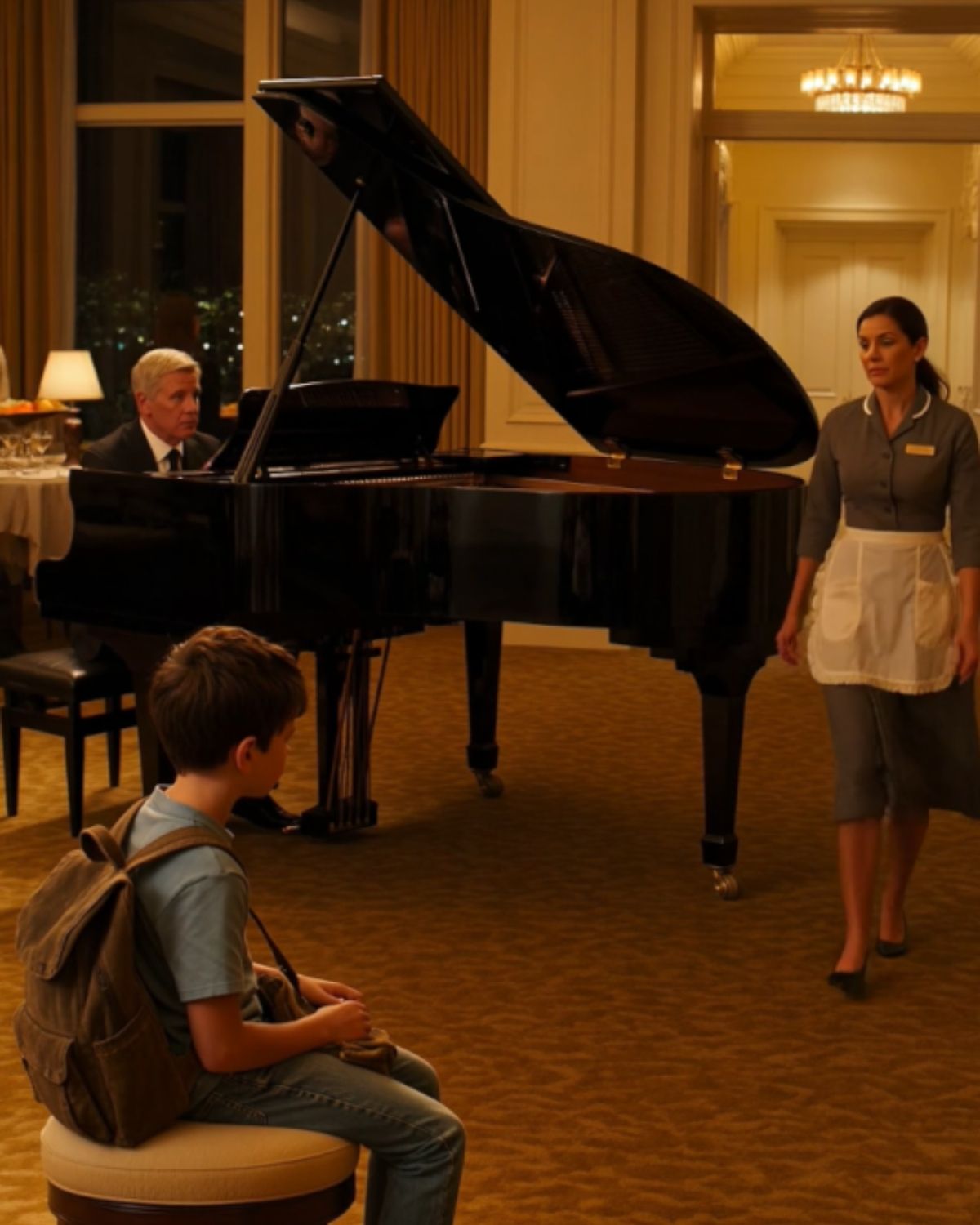
It was a black Steinway grand, polished so perfectly it reflected the chandelier above it. It stood near the tall window of the Aurelia Grand Hotel, facing the city lights twenty floors below. During the day, a professional pianist played soft jazz for brunch guests. In the evening, the piano became part of the room’s beauty, like the gold-framed mirrors, the velvet chairs, and the waiters in white jackets moving between tables with quiet precision.
But at 9:17 on a rainy Thursday night, the pianist had already gone home.
And a poor boy in a faded brown sweater sat near the piano bench, holding an old backpack with both hands.
His name was Noah Reyes.
He was twelve years old, small for his age, with dark hair that always fell into his eyes no matter how many times his mother tried to comb it flat. His sneakers were clean but worn at the edges. His jeans had been patched at one knee. He sat very still, the way children sit when they know they do not belong in a room but are trying hard not to give anyone a reason to notice.
Across the lounge, guests talked softly over expensive drinks.
A couple from Singapore laughed near the fireplace.
Two men in suits discussed a merger in low voices.
A woman in pearls took a photograph of her dessert.
Noah’s mother, Elena Reyes, stood beside him in a gray cleaning uniform, one hand resting lightly on his shoulder.
“Stay here,” she whispered. “Don’t wander. Don’t ask anyone for anything. I’ll be back in twenty minutes.”
Noah looked up at her. “I can wait in the staff room.”
Elena shook her head.
The staff room was three floors below, cramped, windowless, and full of metal lockers. Children were not allowed there anymore after a manager found a housekeeper’s daughter asleep beside a mop bucket during inspection week.
“You’ll be safer here,” Elena said, though she did not sound fully convinced. “Just sit quietly.”
Noah nodded.
Elena looked toward the lounge supervisor, who was speaking to a waiter near the bar. “I asked Mr. Patel. He said you can sit here until I finish the north corridor.”
“Okay, Mom.”
She adjusted his sweater collar the way mothers do when they are worried and have nothing else to fix.
Then she disappeared through a side door marked STAFF ONLY.
The camera would have followed her for a moment into the cleaning staff hallway, where the golden hotel disappeared at once. The carpet ended. The walls became plain white. A cart of towels stood beside a bucket. Fluorescent lights hummed overhead. Elena picked up a mop, took a breath, and went to work.
Back in the lounge, Noah sat alone.
He tried not to stare at the guests, but everything in the room looked like something from a world he had only seen through glass. The silver spoons. The folded napkins. The small flowers in crystal vases. The way people left half a dessert untouched because they were full, while he had eaten instant noodles before coming with his mother.
Then his eyes moved to the piano.
He had seen it before.
Every night his mother worked late, he waited near the lounge or by the service elevators. Every night, he looked at that piano.
He knew he should not touch it.
Still, his fingers moved slightly against the strap of his backpack, pressing invisible keys.
Noah did not know how to read sheet music.
He did not know scales properly.
He had never taken a lesson.
But he knew one song.
His mother had taught it to him on an old electric keyboard they found at a church sale for fifteen dollars. Three of the keys stuck. The left speaker crackled. The plastic stand leaned to one side. But to Noah, it was the most beautiful thing in their apartment.
Elena used to sit beside him after work, hands smelling faintly of lemon cleaner, and show him the melody slowly.
“No rushing,” she would say. “This song needs space to breathe.”
“Where did you learn it?” Noah once asked.
Elena smiled, but her eyes turned sad.
“From a woman who was kind to me when I needed kindness.”
That was all she said.
Now, in the lounge, the black grand piano waited under golden light.
Noah looked toward the staff hallway.
His mother was gone.
He looked toward the reception arch.
No one was watching him closely.
He stood up, walked three careful steps, and sat on the edge of the piano bench.
The bench was softer than any chair in their apartment.
He placed his backpack beside his feet.
Then he lifted the fallboard just enough to see the keys.
White and black.
Clean.
Perfect.
His fingers hovered above them.
He touched one key.
A single note rang through the lounge.
Soft.
Clear.
Too clear.
A waiter turned immediately.
He was young, maybe twenty-six, carrying a tray with two empty glasses. His name tag read: Daniel.
He walked over quickly but not cruelly.
“Hey,” he said softly. “You shouldn’t touch that.”
Noah snatched his hand back. “I’m sorry.”
Daniel looked toward the bar, then toward the staff hallway. “Are you Elena’s son?”
Noah nodded.
“You have to sit away from the piano, okay? Guests can complain.”
Noah looked down at the keys.
“I’m sorry,” he said again. “I only know one song.”
Daniel sighed. He was tired. His shift had started at noon. A guest had already yelled at him over ice cubes. Another had snapped his fingers at him like he was calling a dog.
But the boy’s voice stopped him.
It was not mischief.
It was longing.
Daniel glanced across the lounge. The supervisor was gone. Most guests were talking. The piano player was not scheduled again until morning.
“One song,” Daniel said quietly. “Very soft. Then you sit back down.”
Noah looked up, surprised. “Really?”
“One song,” Daniel repeated. “And if anyone asks, I told you to stop.”
Noah nodded quickly.
Daniel stepped back, pretending to rearrange a nearby table.
Noah placed both hands over the keys.
For a moment, nothing happened.
Then he began.
The first notes were hesitant. A little uneven. His left hand came in late. One chord landed too hard, and he winced as if apologizing to the piano itself.
But the melody was beautiful.
Not polished.
Not perfect.
Beautiful.
It moved slowly at first, like someone opening a door in a quiet house. Then it rose, tender and aching, the kind of tune that sounded like a memory trying not to disappear. Noah played with his shoulders slightly hunched, eyes fixed on his fingers, lips pressed together in concentration.
The conversations nearest to the piano faded first.
The woman with the dessert lowered her spoon.
The couple by the fireplace stopped laughing.
One of the men discussing the merger looked annoyed for half a second, then listened.
A waiter paused near the bar with a bottle in his hand.
The lounge did not go silent all at once.
It softened.
Like rain slowing against glass.
Near the far corner, in a private seating area partly hidden by tall palms, a man sat alone at a table for four.
His name was Richard Vale.
Almost everyone in the hotel knew he was important, though few had spoken to him directly. He owned a global shipping company, two private investment firms, and a foundation that had his late wife’s name on it. Newspapers called him a billionaire. Hotel staff called him Mr. Vale. Guests whispered when he passed.
That night, he sat alone because he preferred it that way.
A glass of water stood untouched beside him. A leather folder lay open on the table. He had come to the hotel for a board meeting the next morning and requested the quietest corner of the lounge.
He was reading a report when the first notes reached him.
His hand stopped on the page.
The melody continued.
Richard did not move.
Then his fingers tightened around the glass.
A close-up would have shown the tremor begin in his thumb, then move across his hand. Water rippled inside the glass.
He lifted his head slowly.
Across the lounge, the boy played with his eyes down, unaware that he had just reached into a stranger’s past and touched something still alive.
Richard’s face changed in a way money could not protect.
His wife, Margaret, had played that song.
Not at concerts. Not for crowds.
At home.
In the small music room of their first apartment before the company became successful. Later, in their country house on Sunday mornings. Sometimes in hospital rooms during the final year, when her hands became thinner and she had to pause between phrases.
It was not a famous song.
At least, not famous enough to hear by accident in a hotel lounge.
Margaret had written most of it herself when she was twenty-two, before they married. She used to call it “The Rain Window” because she composed it during a storm, waiting for Richard to come home from his first failed business meeting.
After she died, Richard had locked the sheet music in a cabinet.
He had not heard anyone play it in seven years.
Noah reached the middle section.
His timing faltered.
He missed one note.
Then he found the melody again.
That imperfection broke Richard more than perfection would have.
His eyes filled.
He whispered, almost without sound, “That was my wife’s song…”
His assistant, seated two chairs away reviewing emails, looked up. “Sir?”
Richard did not answer.
He pushed back his chair.
The sound was quiet, but several people turned.
At the piano, Noah felt the attention before he understood it. His fingers slowed. The final notes came softer, then stopped.
The last note hung in the lounge and faded into the hum of the air conditioning.
For one second, no one moved.
Then Noah looked up and saw people staring.
Fear rushed into his face.
He stood quickly. “I’m sorry. I’m sorry, I wasn’t supposed to—”
Daniel stepped forward. “It’s okay, kid.”
But Noah had already grabbed his backpack.
That was when Richard Vale walked toward the piano.
The room shifted around him. Guests recognized power even when it moved quietly. Waiters stepped aside. A manager near the bar straightened. Daniel’s expression tightened, as if preparing for trouble.
Richard stopped a few feet from Noah.
The boy clutched his backpack to his chest.
“I’m sorry, sir,” Noah said. “I didn’t mean to disturb anyone.”
Richard tried to speak.
For the first time in years, words failed him.
He looked at the boy’s hands, still hovering nervously near the backpack strap.
Then at the piano.
Then back at the boy.
“Who taught you that melody?” Richard asked gently.
Noah blinked.
He had expected anger.
Not that question.
“My mom,” he said.
Richard’s breath caught.
“Your mother plays piano?”
Noah shook his head. “Not really. Just that song. She taught me on our keyboard at home.”
“Where did she learn it?”
Noah looked down. “She said it was from a woman who was kind to her years ago.”
The lounge had gone completely quiet now.
Daniel looked toward the staff hallway.
Richard stepped closer, slowly, careful not to frighten the boy.
“What is your mother’s name?”
“Elena Reyes.”
Richard’s eyes sharpened.
Not with anger.
With recognition that had taken too long to arrive.
“Elena,” he repeated.
Noah nodded. “She works here. Cleaning staff.”
Richard turned toward the staff hallway.
At that exact moment, the side door opened.
Elena entered carrying folded cleaning cloths, expecting to find her son still in the chair near the window.
Instead, she saw him standing beside the grand piano, surrounded by silent guests, waiters, and one of the richest men in the country.
Her face went white.
“Noah,” she said.
She rushed forward. “What happened? Did he touch something? I’m sorry. He’s just waiting for me. Please, if there’s a problem, tell me, not him.”
Noah turned quickly. “Mom, I’m sorry. I played the song.”
Elena froze.
Not because of the piano.
Because Richard Vale was staring at her.
“Elena Reyes,” he said softly.
She looked at him properly.
For a moment, she did not understand. The billionaire in the suit was older than the man she remembered. His hair was grayer. His face carried more grief. But the eyes were the same.
Her hand rose slowly to her mouth.
“Mr. Vale?”
The guests began whispering.
Richard took one careful step toward her.
“You worked for Margaret,” he said.
Elena nodded, stunned. “Yes. Years ago. At the house on Briar Lane.”
Richard closed his eyes briefly.
Briar Lane.
The house he had sold after Margaret died because every room had become too loud with memory.
Elena’s voice trembled. “I was only there six months. I helped with laundry and cleaning while Mrs. Vale was sick.”
“I remember,” Richard said. “Margaret liked you.”
Elena looked down. “She was kind to me.”
Noah watched his mother, confused. “Mom?”
Elena swallowed.
“When I was pregnant with you,” she said, “I was working two jobs. Your father had already left. I used to clean Mr. and Mrs. Vale’s house in the mornings before going to the diner.”
Richard stood very still.
Elena continued, eyes on her son now. “Mrs. Vale found me crying in the laundry room one day. I was scared because I didn’t know how I would raise you alone. She didn’t ask too many questions. She just sat with me.”
The lounge remained silent.
Even the guests who had been ready to complain now listened like the room had turned into a church.
“She used to play that song after her treatments,” Elena said. “Sometimes I would be folding sheets in the hallway, and she would leave the music room door open. She told me music could hold things words couldn’t.”
Richard’s face tightened.
Elena looked at him. “When she got weaker, she asked me to sit with her once while she played. She said she had no children, and she wanted someone to remember the melody.”
Richard pressed his lips together.
Elena’s eyes filled. “After she passed, I remembered as much as I could. Not perfectly. I taught it to Noah because… because it was the first beautiful thing anyone gave me when my life felt ugly.”
Noah looked at his mother.
He had heard pieces before.
Never the whole story.
Richard turned toward the piano.
The black surface reflected his face, but not the way he remembered it. He looked older now. Smaller somehow.
“My wife wrote that song when we were young,” he said. “She used to play it when I came home defeated. She played it the night my first company failed. She played it the morning we found out she was sick. She said it made sadness sit beside you instead of on top of you.”
His voice broke on the last words.
The billionaire who had sat alone in a private corner, protected by money and silence, stood in the middle of a hotel lounge with tears running down his face.
No one looked away.
Not out of rudeness.
Out of respect.
Noah hugged his backpack tighter.
“I didn’t know,” he whispered.
Richard looked at him and shook his head. “You did nothing wrong.”
The lounge supervisor hurried over then, face tight with alarm.
“Mr. Vale, I apologize. The piano is not for unauthorized—”
Richard turned to him.
The supervisor stopped immediately.
“This child did not disturb me,” Richard said. “He gave me something I thought I would never hear again.”
The supervisor lowered his head. “Of course, sir.”
Daniel, the waiter, stood nearby, silent and relieved.
Richard noticed him. “Did you allow him to play?”
Daniel hesitated. “I told him one song, sir.”
The supervisor shot him a look.
Richard said, “Then you showed better judgment than many people with higher titles.”
Daniel looked down, but his face softened.
Richard turned back to Noah.
“Would you play it again?”
Noah’s eyes widened. “Now?”
“Only if you want to.”
Noah looked at his mother.
Elena wiped her eyes and nodded.
“Slowly,” she whispered. “Like I taught you.”
Noah sat back on the piano bench.
This time, no one tried to stop him.
Richard stood beside the piano, one hand resting lightly on its edge. Elena stood a few steps behind her son, hands clasped in front of her uniform. Daniel remained near the bar. Guests turned their chairs slightly, no longer pretending not to watch.
Noah placed his fingers on the keys.
He started again.
The melody came more gently this time.
He still missed a note.
He still played one chord too softly.
But now the mistakes felt human, like fingerprints left on glass.
Richard closed his eyes.
And for one minute, he was not in the Aurelia Grand Hotel.
He was in the small apartment before the money.
He was in the house on Briar Lane while rain moved down the windows.
He was standing in a hospital room watching Margaret smile at the piano because she was too tired to speak but still wanted to comfort him.
He was young.
He was loved.
She was alive in the shape of a song.
When Noah finished, his hands stayed above the keys for a second before he placed them in his lap.
Richard opened his eyes.
He did not applaud.
He walked around the piano and slowly lowered himself to one knee beside the boy.
A billionaire kneeling on the lounge carpet beside a child in worn sneakers.
The entire room held its breath.
Richard’s voice was quiet.
“You brought her back to me for one minute.”
Noah did not know what to say.
So he said the only thing he could.
“I’m glad she was kind to my mom.”
Richard looked at Elena.
“She was,” Elena said. “And I never forgot.”
Richard stood slowly, wiping his face with one hand.
Then he looked around the lounge, as if seeing it differently now—not as a luxury room full of paying guests, but as a place where invisible lives crossed every night.
He turned to Elena. “Are you still playing?”
She gave a small, embarrassed laugh through tears. “No. I only remember enough to teach him. And the keyboard at home barely works.”
Richard nodded.
He did not make a grand speech. He did not offer to buy them a mansion. Real grief does not turn people into fairy tales.
Instead, he asked a simple question.
“Noah, do you like playing?”
Noah looked at the piano. “Yes, sir.”
“Would you like to learn properly?”
Noah looked at his mother again, afraid to want too much in front of strangers.
Elena answered honestly. “Lessons are expensive.”
Richard nodded once, as if that settled it.
“My wife’s foundation funds music education programs,” he said. “Mostly in schools. But there is room for one more scholarship.”
Elena shook her head quickly. “Mr. Vale, you don’t have to—”
“I know,” he said gently. “That is why I want to.”
Noah’s eyes widened. “A scholarship?”
Richard looked at him. “Lessons. A proper keyboard. Transportation if needed. No promises of fame. No pressure. Just a chance to learn.”
Noah touched the edge of the piano bench.
His voice came out small. “I would practice.”
Richard smiled sadly. “I believe you.”
The supervisor tried to recover his authority. “We can arrange a private room for this conversation.”
Richard looked at him. “No. This conversation is fine here.”
The supervisor stepped back.
Elena wiped her eyes with the back of her hand, then seemed to remember she was in uniform and quickly straightened.
“I don’t know how to thank you,” she said.
Richard looked at the piano.
“Your son already did.”
By then, the lounge had changed.
No one was laughing too loudly anymore. No one complained about the music. The couple near the fireplace held hands quietly. The woman in pearls dabbed at her eyes with a napkin. One of the businessmen closed his folder and stared at the floor as if remembering something he had buried under meetings.
A young boy had played one imperfect song, and somehow the room had become more honest.
Later, when Elena’s shift ended, she and Noah walked through the service hallway together. The same fluorescent lights hummed above them. The same cleaning carts stood against the wall. But Noah held a business card in his hand like it was made of glass.
Richard Vale had written a number on the back.
Not an assistant’s number.
His own office line.
“Mom,” Noah said, “did Mrs. Vale really ask you to remember the song?”
Elena nodded. “She said beautiful things should not disappear just because someone leaves.”
Noah looked at the card. “Do you think I played it right?”
Elena smiled, tired and proud. “You played it honestly.”
The next week, a new keyboard arrived at their apartment. Not a concert piano. Not something absurd and cinematic. Just a good weighted-key digital piano with a bench, a stand, and headphones so Noah could practice without bothering the neighbors.
His first lesson was at a community music school funded by the Margaret Vale Foundation.
The teacher asked him what he wanted to learn.
Noah said, “I want to learn the song properly first.”
Months passed.
Noah learned posture, scales, rhythm, and how to read notes that had once looked like a secret language. He learned that music was not only feeling, but discipline. He learned that talent opened the door, but practice decided whether he could walk through it.
Richard came to one small recital six months later.
He sat in the back row, not in a private section.
Elena sat near the front, still wearing her work shoes because she had come straight from the hotel.
Noah played “The Rain Window” again.
This time, not perfectly.
But better.
When he finished, he looked toward Richard.
The older man nodded once, tears in his eyes, but smiling.
That was enough.
Years later, people at the Aurelia Grand still talked about the night a poor boy touched the grand piano when he wasn’t supposed to and made a billionaire cry.
Some told it like luck.
Some told it like destiny.
But Elena always corrected them.
“It wasn’t luck,” she would say. “It was kindness finding its way back.”
Because a sick woman once left her music room door open for a frightened cleaner. A mother carried that melody through years of hardship. A boy played it with imperfect fingers in a hotel lounge. And a grieving man heard, for one minute, the love he thought silence had taken forever.
The things we give with kindness rarely disappear; they wait quietly in someone else’s life until the day they return as a miracle we can finally recognize.