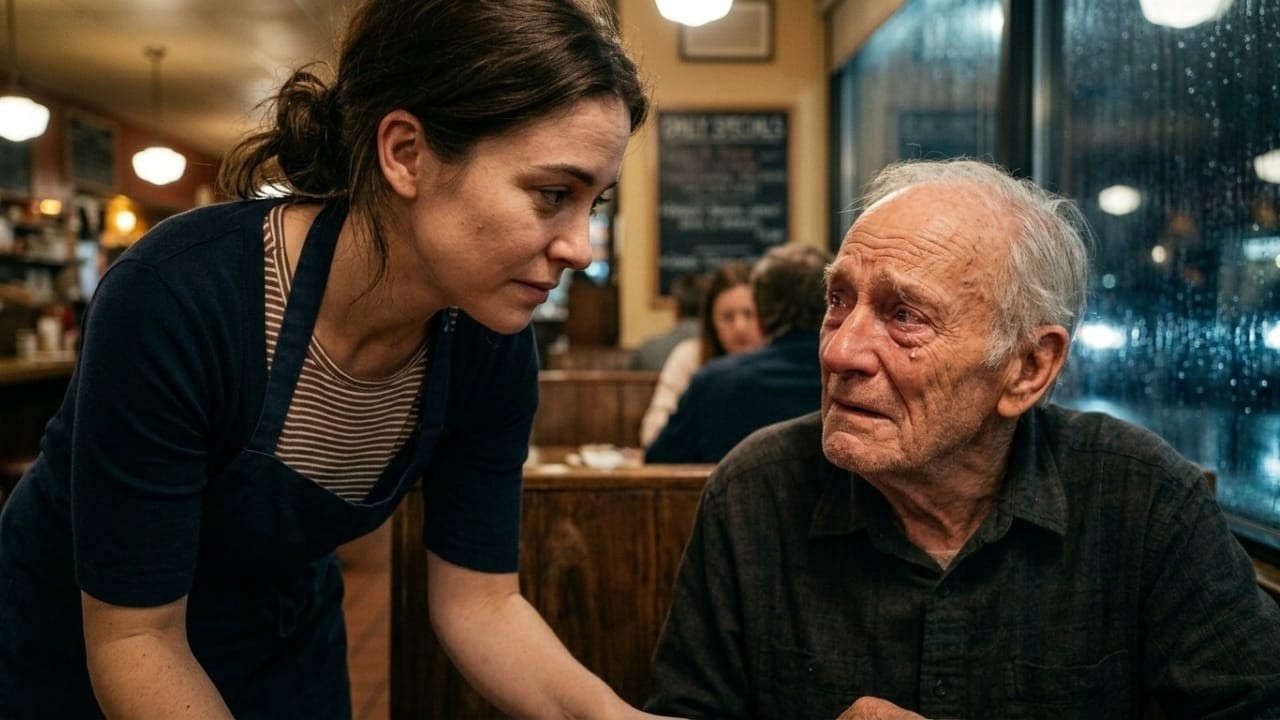
A tired old man with only $3 walked into a Chicago diner just before midnight.
The rain outside had turned the city streets into a blur of neon reflections—red taillights stretching across wet asphalt, the hiss of passing cars cutting through the cold. Inside “Maggie’s Diner,” the world was warmer but quieter. Booth lights glowed amber. A soda machine hummed in the corner. A few late-night customers sat hunched over coffee, staring into their plates like they were trying to solve problems that had no answers.
The bell above the door rang once.
The old man stepped in slowly.
He wore a worn-out brown coat that had seen too many winters. His shoes were clean but old, the soles slightly uneven. His hands trembled just enough to notice if you were paying attention. He paused at the entrance like he was deciding whether he still had permission to enter places like this.
Sarah Mitchell noticed him immediately.
She had been working a double shift.
Her feet hurt in a way that had stopped being surprising months ago. Her rent was overdue again. Her phone battery was at 11%. And her manager had already warned her earlier that night: “No comp meals. Not for anyone. We’re barely breaking even.”
Sarah nodded at the time.
Because that was what you did when you couldn’t afford to argue.
But when she saw the old man standing near the door, something in her chest tightened.
Not pity.
Recognition.
He looked like every person who had ever apologized for being hungry.
He approached the counter slowly.
“I… I just need something warm,” he said.
Sarah glanced at the register screen.
$3.18 total.
Not enough for a full meal. Not even close.
The dinner menu was simple but strict: soup $5.99, sandwich $7.49, coffee $2.50, pie $4.25.
The man placed three one-dollar bills on the counter.
“I’m sorry,” he added quietly, already turning slightly as if preparing to leave. “I thought I had a little more.”
Sarah looked at the bills.
Then at his hands.
Then at the empty booths behind him.
The manager’s voice echoed in her mind: no comp meals.
But another thought came faster.
He had already decided he didn’t deserve to eat here.
That was the part she couldn’t accept.
“Sit down,” she said gently.
The old man looked up. “I don’t want to cause trouble.”
“You’re not,” Sarah replied. “Sit in booth six. It’s warmer there.”
He hesitated.
Then slowly walked to the booth by the window.
Sarah turned toward the kitchen window.
“Soup of the day?” she asked the cook.
“Chicken vegetable,” he replied.
“And bread?”
He nodded.
“And coffee?”
Another nod.
Sarah exhaled quietly.
She plated it herself.
Soup. Bread. Fresh coffee. And, without thinking too long because thinking too long would make it harder, a slice of pie she knew she would pay for out of her own tips.
She carried it to booth six.
The old man looked up as she placed the tray down.
“I didn’t order all this,” he said quickly.
“I know,” Sarah replied.
“I only have three dollars.”
She smiled softly.
“Then tonight, it’s on the house.”
The man’s hands stopped moving.
For a moment, he didn’t speak.
People sometimes think gratitude is loud. But in that booth, it wasn’t.
It was stillness.
“I can’t accept that,” he said finally. “You don’t know me.”
Sarah leaned slightly closer.
“I know you’re hungry,” she said. “That’s enough for me.”
The old man’s eyes lowered.
He picked up the spoon.
But he didn’t eat immediately.
Instead, he looked at her.
“You’ll get in trouble for this,” he said quietly.
Sarah shrugged lightly. “Then I’ll deal with it.”
He finally ate.
Slowly at first.
Like someone who had learned not to trust warmth.
Then a little faster.
The soup steam rose between them like a soft curtain.
Sarah returned to the counter, trying not to think about the cost. Her tip jar was nearly empty. Her paycheck wouldn’t stretch far enough for rent this month. But she kept glancing back at booth six anyway.
Because something about the man didn’t feel random.
Not dangerous.
Just… contained.
Like someone trying very hard not to be seen.
When he finished, he sat there longer than necessary.
Sarah brought him a refill of coffee without asking.
“You didn’t have to do that,” he said.
“I know,” she replied again.
He nodded slowly.
“Thank you,” he said.
Then he stood up, placed the empty cup neatly on the tray, and walked out into the rain.
The bell above the door rang again.
And the diner returned to its normal rhythm.
Or at least, it tried to.
Sarah didn’t know it yet, but something had shifted.
Not in the room.
In the story.
The next morning, she arrived early for her shift and immediately sensed something was off.
Her manager, Carl Benson, stood behind the counter with his arms crossed.
He wasn’t angry.
That was worse.
He was careful.
“Sarah,” he said.
“Yes?”
“You served a comp meal last night.”
Her stomach tightened.
“It was a soup,” she said. “And bread. He had three dollars. He was hungry.”
Carl tapped a folder on the counter.
“We’ve reviewed the register logs,” he said. “And your till shows unauthorized items.”
Sarah blinked.
“I paid for it,” she said quickly. “Out of my tips.”
“That’s not the point,” he replied. “We have policies. If we start making exceptions, we lose control.”
A few staff members nearby went quiet.
Sarah felt heat rise in her chest.
“So we let people go hungry instead?” she asked.
Carl’s expression hardened slightly.
“You’re not paid to make emotional decisions,” he said. “You’re paid to follow procedure.”
That word—procedure—felt heavier than the plates she carried.
“Are you firing me?” she asked quietly.
Carl hesitated just long enough to make it real.
“Yes,” he said.
The word didn’t echo.
It just landed.
Sarah nodded once, slowly, like she needed her body to accept it before her mind could.
She removed her apron.
Folded it neatly.
Placed it on the counter.
No tears yet.
Not in front of him.
She walked out the same way the old man had the night before.
Through the diner door.
Into the cold morning air.
The city looked the same.
But she didn’t.
That afternoon, a black car pulled into the diner parking lot.
It didn’t belong there.
Not because it was too expensive—but because it was too quiet.
A man stepped out.
Well-dressed.
Simple suit. No visible branding. No entourage.
But the way he moved made people look twice.
He entered the diner and sat at the same booth six.
The staff noticed immediately.
Carl approached carefully.
“Sir, are you here for lunch?”
The man nodded.
“Yes.”
“What can I get you?”
He didn’t open the menu.
“I already ate here last night,” he said.
Carl frowned slightly. “We’re closed to complaints about—”
“I’m not here to complain,” the man interrupted gently.
Then he looked up.
“I’m here to ask about the waitress who worked last night.”
Carl’s posture shifted.
“Sarah Mitchell?”
“Yes.”
“She’s no longer employed here,” Carl said quickly. “Violation of policy.”
The man didn’t react immediately.
He just stared at the booth for a long moment.
Then he said, “Call the staff meeting.”
Carl blinked. “Sir?”
“I’d like everyone here in ten minutes.”
There was something in his tone that made resistance feel unnecessary.
Ten minutes later, the staff gathered near the counter.
Confused.
Tired.
Curious.
The man stood at the center of the diner.
“I owe you an explanation,” he said.
Carl crossed his arms. “And you are?”
A pause.
The man reached into his jacket and placed a small card on the counter.
Edward Collins.
Collins Hospitality Group.
Carl’s face changed slightly.
Not recognition of a face.
Recognition of ownership.
“…you own this chain,” Carl said slowly.
“I do,” Edward replied.
Silence spread.
Even the coffee machine seemed quieter.
Edward looked around the diner.
“Last night,” he said, “I came here with three dollars and no identification.”
Carl frowned. “Why?”
“To see what this place becomes when no one knows who I am.”
A slow realization spread through the room.
Edward continued, “I was served by Sarah Mitchell.”
A pause.
“She fed me without hesitation,” he said. “Not because it was allowed. But because I was hungry.”
Carl shifted uncomfortably. “She broke policy.”
Edward nodded.
“Yes,” he said calmly. “She did.”
The room tensed.
Then Edward added, “And she also did her job better than anyone else in this building last night.”
Carl opened his mouth.
No sound came out immediately.
Edward turned toward him.
“Tell me,” he said quietly, “what is the purpose of this diner?”
“To serve food,” Carl replied.
“And to whom?”
“Customers.”
Edward tilted his head slightly.
“Is hunger not enough to qualify?”
Carl didn’t answer.
Edward looked around the staff again.
“I don’t invest in restaurants,” he said. “I invest in people who understand what food means.”
A pause.
“Because I grew up without enough of it.”
No one moved.
Edward continued, “Sarah didn’t just give me soup. She gave me dignity I haven’t received in a long time.”
Carl looked uneasy.
“So… what happens now?”
Edward turned toward the back of the diner.
“The person who understands this place best is not the one who followed rules,” he said. “It’s the one who understood people.”
He paused.
“Where is Sarah Mitchell?”
Silence.
Carl cleared his throat. “She’s no longer employed here.”
Edward looked at him.
For the first time, his expression sharpened slightly.
“Rehire her,” he said simply.
Carl hesitated. “Sir, that would undermine—”
Edward raised a hand.
“I’m not finished.”
The room went still again.
“She will not return as a waitress,” Edward said.
Carl exhaled slightly, relieved.
Then Edward continued.
“She will return as assistant manager of this location.”
Carl froze again.
“That’s… a big leap,” he said carefully.
Edward nodded.
“It is,” he agreed. “That’s why it’s deserved.”
He reached into his pocket and placed an envelope on the counter.
“And this is for her.”
Carl looked at it.
“What is it?”
“A gesture,” Edward said. “Not a payment for kindness. Kindness doesn’t have a price. But consequences do.”
Inside the envelope was a check for $10,000.
Carl’s eyes widened slightly.
Edward continued, “And one more thing.”
He looked around the diner.
“This place will begin a new program starting immediately. Any unsold food at closing will be distributed to shelters within the area. And staff will be trained to identify and support food insecurity cases without punishment.”
A pause.
“That is not optional.”
Carl nodded slowly. “Understood.”
Edward turned toward the door.
Then stopped.
He looked back once more.
“Sarah didn’t change my company,” he said. “She reminded me what it was supposed to be.”
Then he left.
The bell above the door rang softly.
Two days later, Sarah returned.
Not as a waitress.
But as assistant manager.
She stood behind the counter, slightly unsure of the new uniform, watching the same booths she used to serve.
Carl avoided her eyes at first.
But slowly, the diner adjusted.
Not perfectly.
Not instantly.
But meaningfully.
Weeks later, a small chalkboard appeared near the entrance:
“If you are hungry and cannot afford a meal, tell us.”
No slogans.
No marketing font.
Just a sentence.
Sarah added it herself.
One evening, she looked at booth six.
The same booth where a man once ate soup he thought he didn’t deserve.
She didn’t know where he was now.
But she didn’t need to.
Because the ripple had already moved past him.
It was in the families who ate together without fear.
It was in the staff who no longer questioned whether kindness was allowed.
It was in the small, quiet understanding that lived in the corners of the diner now.
That one moment of compassion is never just one moment.
It is the beginning of everything it touches afterward.
And sometimes, the people who seem like strangers at your table are the ones quietly deciding what your future will become.