CLASSIFIED FILE – RESTRICTED ACCESS
FORT HARRISON, VIRGINIA
05:13 A.M.
Fog clung to the concrete like ash that refused to settle. The base was still suspended in that uneasy silence that exists just before dawn operations begin. But on training field Alpha-7, metal hitting the ground shattered the stillness.
A rifle dropped.
Not thrown. Not slipped.
Placed down—deliberately. Like a statement no one was supposed to hear.
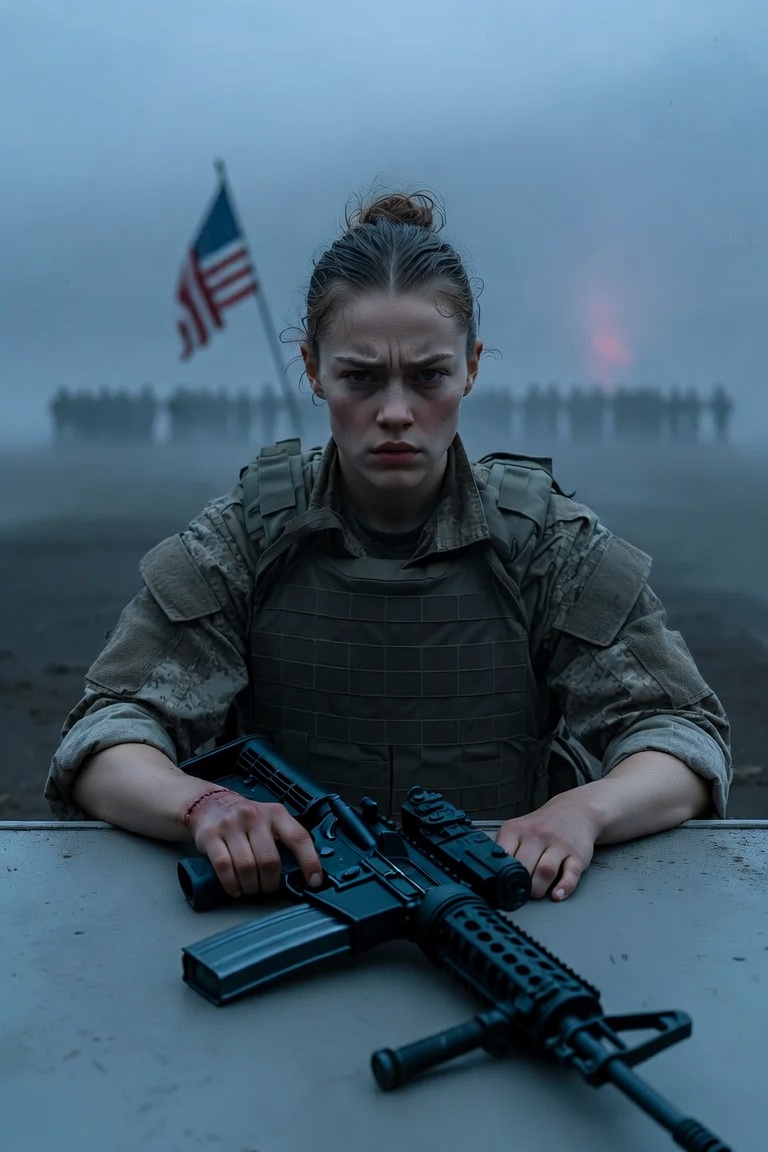
Specialist Riley Hart stood behind it.
25 years old. Infantry.
Hair tied tight at the nape of her neck. Her Kevlar vest was two generations outdated. On her left wrist, a long scar cut across the skin like something dragged a blade and never apologized for it. No one asked. She never offered.
She stood straight.
No salute.
No movement.
Just watching the training lane where other soldiers were preparing for the morning tactical evaluation.
Then came the sound of boots.
One step. Two. Three.
No one needed to look up to know who it was.
General Marcus Caldwell.
56 years old. Operational Commander, Atlantic Theater.
A man whose signed orders had erased entire mission files so thoroughly that after-action reports simply read: “Objective completed. No survivors remaining to confirm details.”
He moved down the formation line.
Saying nothing.
Stopping for nothing.
Until his gaze landed on the rifle at Riley’s feet.
He halted.
The air changed instantly—like oxygen had been drained from the field.
Two officers behind him exchanged a look.
“Sir?” one whispered.
Caldwell didn’t answer.
His eyes stayed locked on the weapon.
Then shifted to the soldier behind it.
Riley Hart did not blink.
Did not move.
Did not react.
She stood like she had already lived through this exact moment before.
A cold wind passed across the field. The American flag on the central mast snapped sharply, a dry metallic sound in the air.
Caldwell stepped closer.
His attention dropped to the receiver of the rifle.
And then he saw it.
The marking.
Not painted unit insignia.
But engraved—deeply—into the metal where morning light struck at an angle that made it impossible to ignore.
A three-layer symbol.
Not recognized by any branch in the U.S. military database.
Not in NATO archives.
Not in any clearance tier Caldwell had ever held.
A black circle fractured by three parallel diagonal cuts—like reality itself had been sliced and stitched incorrectly.
Below it, a code:
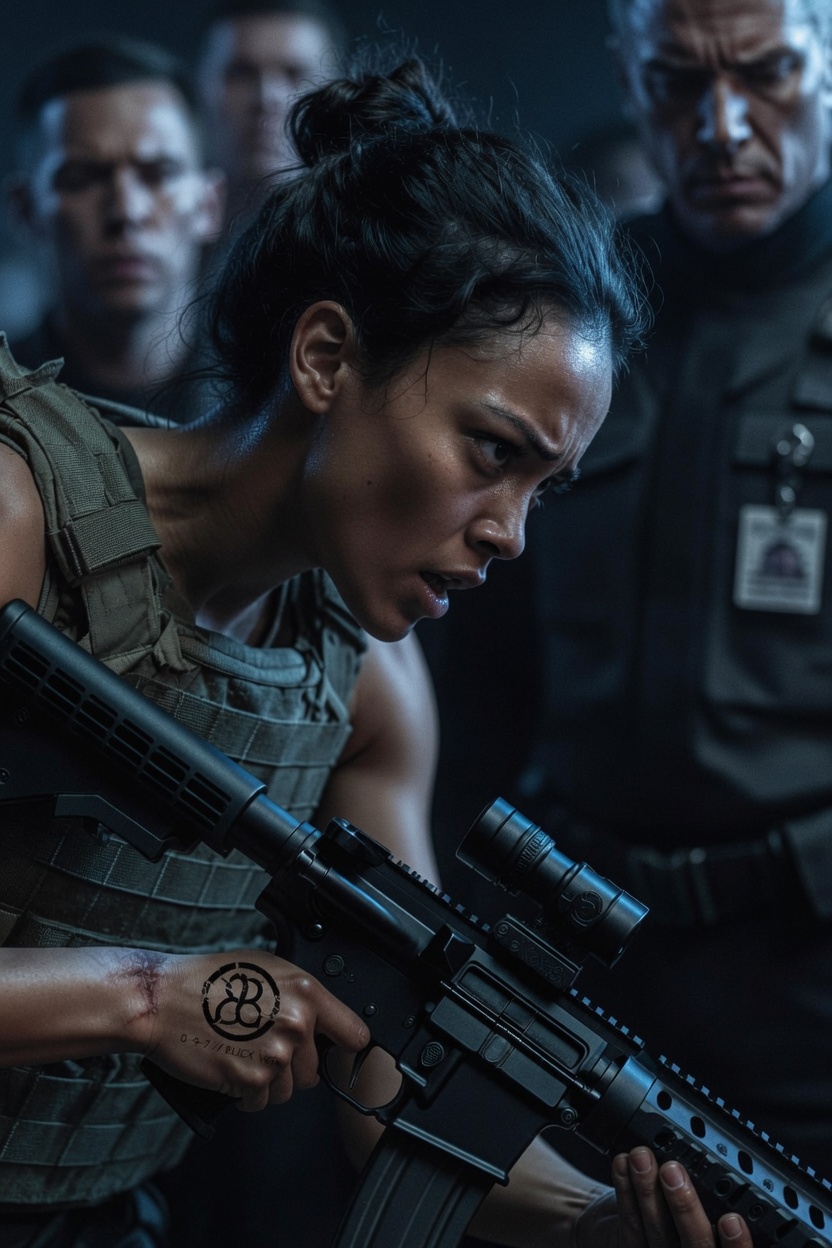
“0-9-7 // BLACK VEIL”
Caldwell didn’t speak for three full seconds.
But something in his expression shifted.
Not anger.
Not confusion.
Something closer to recognition he wished he didn’t have.
“Where did you get this rifle?” he asked.
His voice was controlled.
But it carried weight enough to freeze nearby movement.
“From the armory, sir,” Riley answered.
“Don’t play games with me.”
He stepped closer.
Now the distance between him and the weapon was almost nothing.
“Black Veil is not authorized. Not active. Not real.”
A nearby officer spoke under his breath, tense:
“Sir… there is no record of that designation.”
No record.
No existence.
No file.
Yet it was here.
On a rifle.
On a base where everything was supposed to be accounted for.
Caldwell reached out.
His fingers hovered over the engraved symbol.
And the moment he touched the metal—
Riley spoke.
Quietly.
“Sir… you might want to stop touching that.”
Not a warning.
Not a threat.
A statement of fact.
Caldwell paused.
“Why?”
Riley met his eyes.
And for the first time, something cracked in her composure.
“Because it remembers who held it last.”
Silence.
Then—
A sudden burst of electrical static echoed through the base intercom system, even though no one had triggered it.
A faint click came from inside the rifle.
Not the safety.
Not the trigger.
Something deeper. Mechanical. Intentional.
Caldwell pulled his hand back immediately.
“Lock down this area!” he barked.
But before anyone could move—
A black, unmarked vehicle rolled into the perimeter gate.
No clearance request.
No identification broadcast.
The gate opened automatically.
As if the system already knew it belonged.
The door opened.
A man stepped out.
No standard uniform.
No visible rank insignia.
Only a matte black credential plate clipped to his collar.
Caldwell saw it—and for the first time that morning, he shifted his stance.
“Director Hale…” one officer murmured.
The man walked forward.
He didn’t look at Caldwell.
Didn’t acknowledge the soldiers.
His eyes went straight to the rifle.
“Seal it,” he said.
“Sir?” Caldwell responded sharply.
Hale finally looked at him.
And that look made a decorated general feel like he was standing in the wrong chain of command entirely.
“General… you were not cleared to see that emblem.”
The air tightened again.
Riley said nothing.
But her grip on the rifle tightened slightly.
Hale stepped closer.
Stopped in front of the weapon.
He didn’t touch it.
Just observed it.
For a long moment.
Then he spoke:
“Black Veil wasn’t disbanded.”
A pause.
“It was erased.”
Caldwell’s jaw tightened.
“Erased… by who?”
Hale turned his gaze toward Riley.
Like she was not a soldier.
But an answer.
Riley slowly bent down.
Picked up the rifle.
The moment her fingers wrapped around it—
the engraved symbol seemed to darken, almost reacting to her presence.
No one moved.
No one breathed properly.
Riley finally spoke again.
“By people who are still inside this base.”
The wind stopped.
The base fell silent in a way that felt unnatural.
And Director Hale’s tablet suddenly refreshed on its own—despite being fully locked down.
One line appeared:
BLACK VEIL ACTIVE STATUS: CONFIRMED
LOCATION: FORT HARRISON
UNIT: UNKNOWN
OPERATOR ID: RILEY HART
Caldwell turned slowly toward her.
His voice dropped:
“Soldier… what did you do to this base?”
Riley tightened her hold on the rifle.
“Sir,” she said softly.
“I didn’t do anything.”
A beat.
“I just came back.”
And at that exact moment—
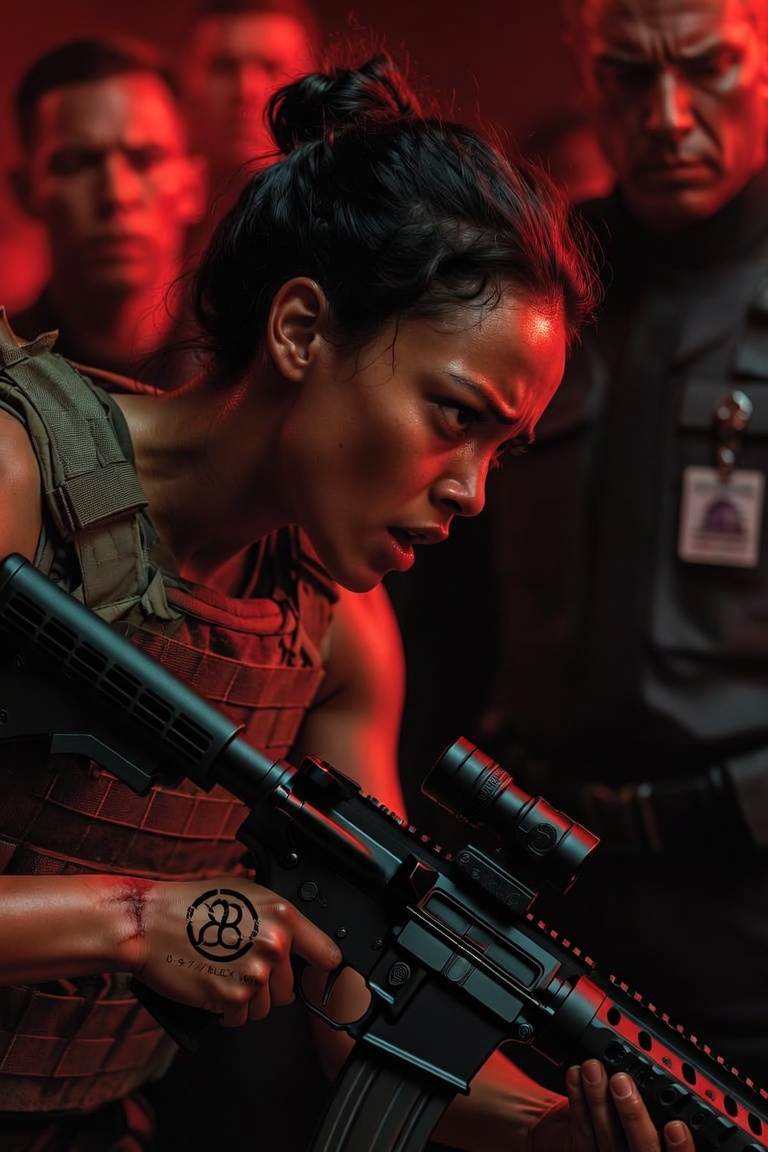
every security light across Fort Harrison turned red.