At 19, Elena Marrow learned that silence could be louder than screaming.
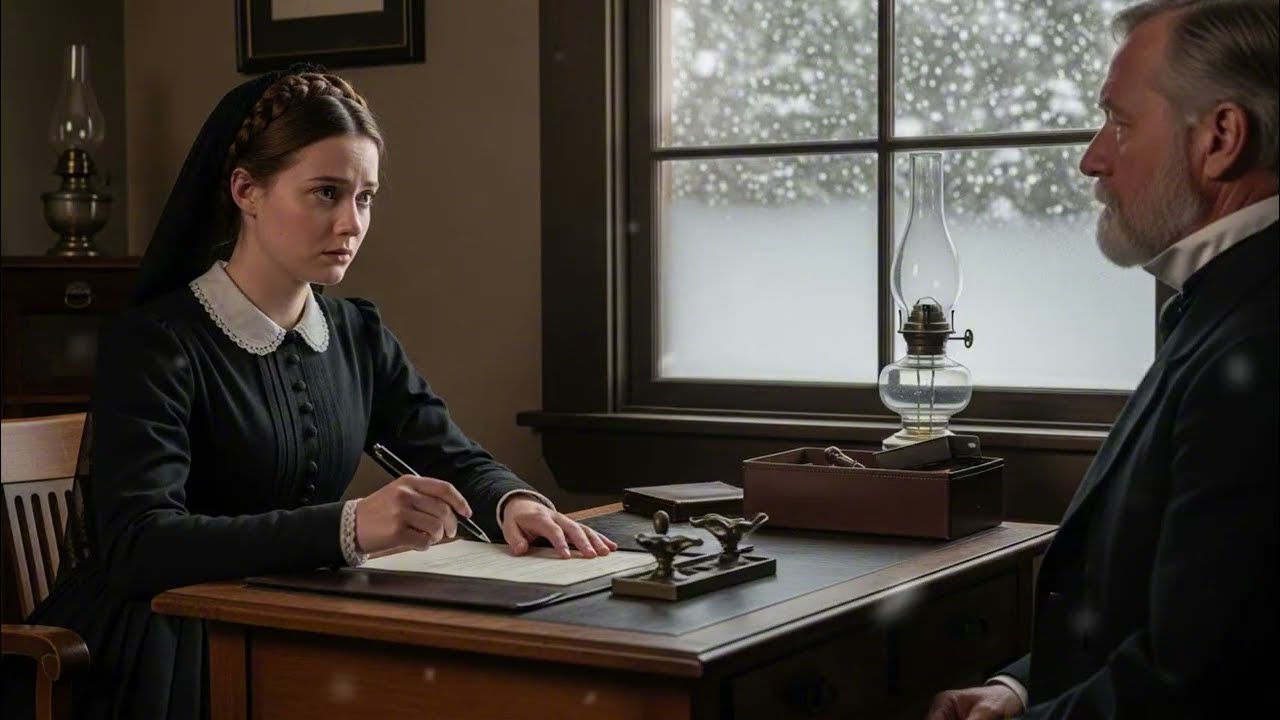
It happened on a cold Sunday morning in 1912, in the back room of her uncle’s feed store in Red Creek, Montana. Snow pressed against the windows. The stove gave off a weak orange glow. And three men sat around a wooden table deciding the rest of her life as if they were discussing the price of oats.
Her uncle, Warren Pike, did not look at her when he spoke.
“Caleb Rusk needs a wife,” he said. “You need a roof. That settles it.”
Elena stood beside the flour sacks with her hands folded in front of her dress. She had been living with Warren for six months since fever took her mother and a mining accident buried her father under a wall of stone. In those six months, she had cooked, cleaned, kept the store accounts, and slept in a narrow pantry behind the shelves.
She had never asked for anything.
Not once.
Across the table sat Caleb Rusk, owner of the largest cattle spread north of the river. He was forty-two, broad-shouldered, sunburned, and tired in a way that seemed carved into his bones. Everyone in Red Creek knew two things about him: his wife had died the year before, and he had five children who ran through housekeepers the way prairie fire ran through dry grass.
No woman in town wanted that life.
So Warren offered Elena.
“You’ll be fed,” Warren added, finally glancing at her. “And Rusk will pay the debt your father left on the store.”
Elena’s eyes moved to the paper on the table. She recognized her father’s signature. She also recognized the amount.
It was wrong.
Her father had owed less than half of what Warren had written there.
She knew because she had copied the ledger herself before Warren locked it away.
But she said nothing.
Caleb Rusk looked at her only once. His expression was not cruel, but it was not kind either. He looked at her the way a man looks at a fence post he is about to buy because the old one broke.
“She’s young,” he said.
“She works,” Warren replied.
That was all the recommendation she received.
By noon, the arrangement had spread down Main Street faster than smoke. Mrs. Bell from the bakery whispered it to the preacher’s wife. The blacksmith stopped hammering long enough to watch Elena cross the street carrying a small carpetbag. Two boys outside the mercantile pointed openly.
“That’s her,” one said. “The girl given to Rusk.”
Elena kept walking.
No tears.
No begging.
No scene for the town to enjoy.
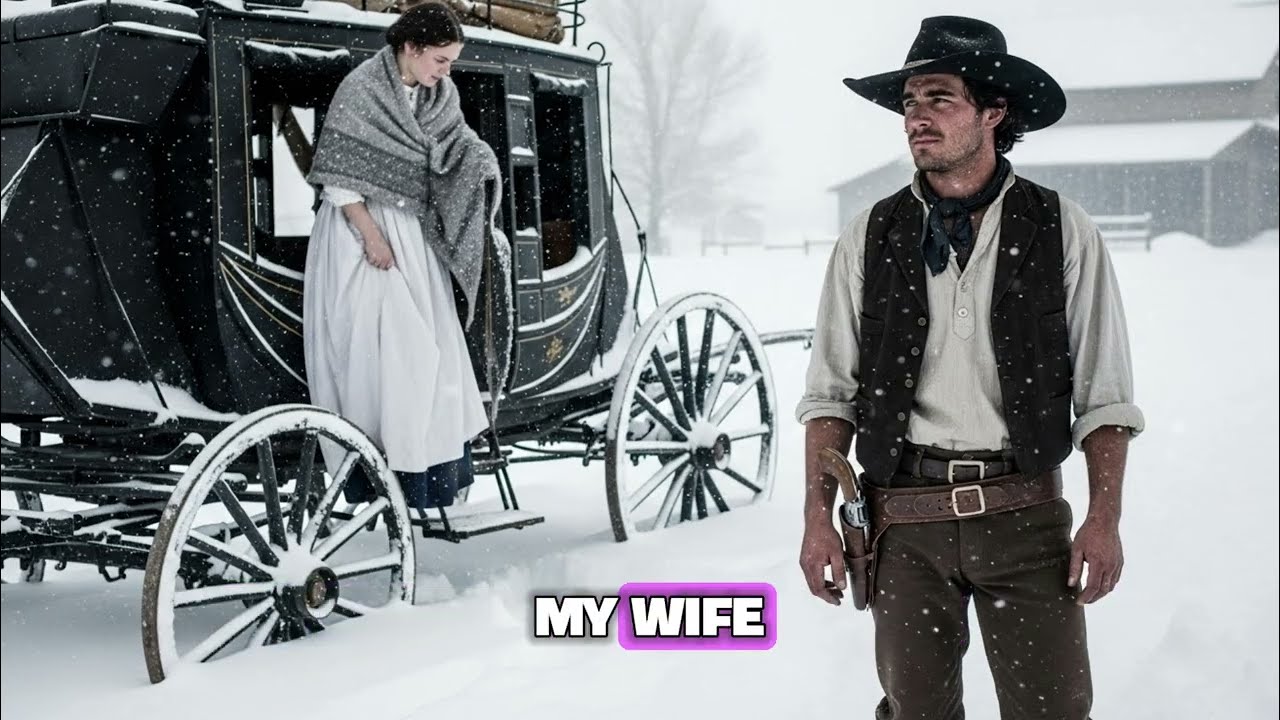
Caleb’s wagon waited near the hitching post. In the back were sacks of grain, a coil of rope, and an old wooden crate with a broken hinge. He helped her up without speaking, then flicked the reins.
As they rolled out of Red Creek, Elena looked back once. Her uncle stood in front of the feed store with his arms crossed, smiling as if he had settled a troublesome account.
She made herself remember that smile.
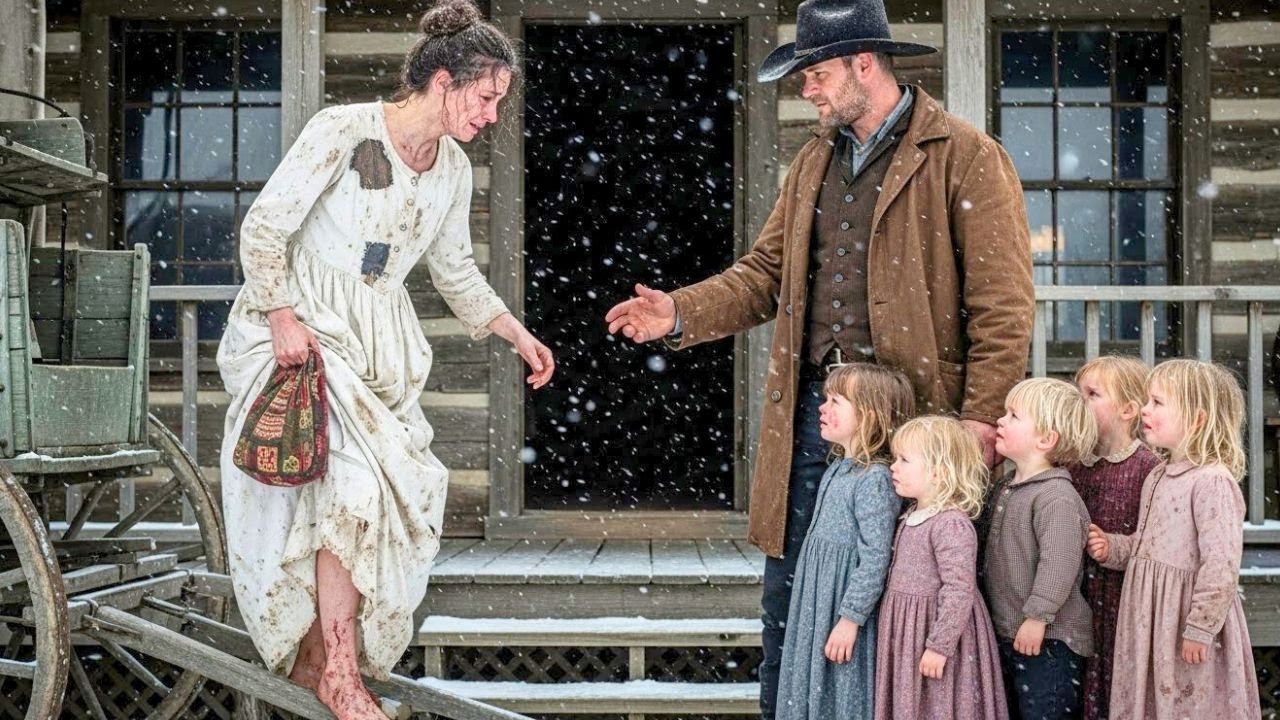
The Rusk ranch sat eight miles outside town where the land opened wide and hard beneath the winter sky. The house was bigger than Elena expected, but neglected. One shutter hung crooked. The porch sagged near the steps. Smoke slipped from the chimney in thin, uneven breaths.
Then she saw the children.
Five of them stood in the yard like a jury.
Thomas, the oldest, was fourteen and already nearly as tall as his father. He had a split lip and the watchful eyes of someone used to being blamed. Ruth was twelve, thin as a fence rail, with her arms crossed over her chest. The twins, Samuel and Silas, nine years old, were barefoot despite the cold and grinning in a way that promised trouble. The youngest, Maisie, could not have been more than five. She held a rag doll by one leg and stared at Elena without blinking.
Caleb climbed down first.
“This is Elena,” he said. “She’ll be staying.”
Not wife.
Not stepmother.
Staying.
Ruth let out a small laugh. “For how long?”
Caleb’s jaw tightened, but Elena answered before he could.
“As long as I’m needed.”
The children looked surprised that she had spoken at all.
Inside, the house smelled of smoke, sour milk, and damp wool. Dishes were stacked in the basin. Ash spilled from the stove. A broken chair lay on its side near the table. Someone had drawn a horse on the wall in charcoal. Someone else had crossed it out with a knife.
Elena set down her carpetbag.
The twins watched from the doorway, waiting for her to gasp or scold or run.
She did none of those things.
She rolled up her sleeves.
By dusk, the stove was cleaned, the dishes washed, and a stew simmered with potatoes, onions, and the last strip of salted pork she found in the pantry. No one thanked her. Thomas ate silently. Ruth refused to touch the food until Maisie took a bite. The twins dropped buttons into Elena’s water cup and laughed when she noticed.
Elena removed the buttons, placed them beside the plate, and kept eating.
That bothered them more than anger would have.
For three days, the children tested her.
They hid her shoes in the hayloft. They loosened the lid on the flour barrel so it spilled across her skirt. They put a garter snake in her bedding and waited outside the door to hear her scream.
She did scream at first.
Not loudly.
Just enough for the twins to slap hands in victory.
Then she carried the snake outside, set it gently in the grass, and came back with the same calm face.
On the fourth morning, Ruth found Elena in the barn before sunrise, mending a torn harness by lantern light. Caleb had ridden out early to check the north fence. Thomas was supposed to do the mending, but his hands were bruised from splitting wood.
Ruth stood there in her shawl, watching.
“You don’t have to do that,” she said.
Elena pulled the thread tight with her teeth. “It needs doing.”
“You trying to make Pa like you?”
“No.”
“Then why?”
Elena looked up. “Because if that strap breaks while he’s crossing the creek, the wagon could turn.”
Ruth had no answer for that.
Later that week, Caleb returned from town with a face like iron. He had heard the talk.
At the well, two ranch hands from the Miller place had joked that Rusk had bought himself a child bride and a free servant in one bargain. At the mercantile, Mrs. Bell had said it was only a matter of time before Elena ran back crying.
Caleb said none of this at supper, but the silence around him was heavy.
Then Thomas knocked over a cup of milk.
Caleb’s hand hit the table so hard every child froze.
“Can’t this house go one meal without something breaking?” he snapped.
Thomas lowered his eyes.
Elena reached for a cloth and wiped the milk before it reached Caleb’s ledger.
“It didn’t break,” she said quietly.
The room went still.
Caleb turned toward her. “What?”
“The cup,” she said. “It fell. It didn’t break.”
It was a small correction.
Too small, maybe, for any sensible person to risk.
But the children heard it.
So did Caleb.
For a moment, his face darkened. Then he pushed back from the table and walked outside without finishing his meal.
That night, Elena lay awake in the small room off the kitchen, listening to the wind scratch at the walls. She thought of her uncle’s false ledger. She thought of the town calling her helpless. She thought of Caleb’s children, each one carrying grief differently: Thomas with silence, Ruth with sharp words, the twins with mischief, Maisie with those solemn little eyes.
Near midnight, she heard a soft sound.
Not the wind.
A child crying.
Elena rose and stepped into the hallway. The sound came from the corner room where Maisie slept. The door was cracked open. Inside, moonlight fell across the child’s bed.
Maisie sat upright, clutching her rag doll.
When she saw Elena, she whispered, “Don’t tell Pa.”
Elena crouched beside the bed. “About what?”
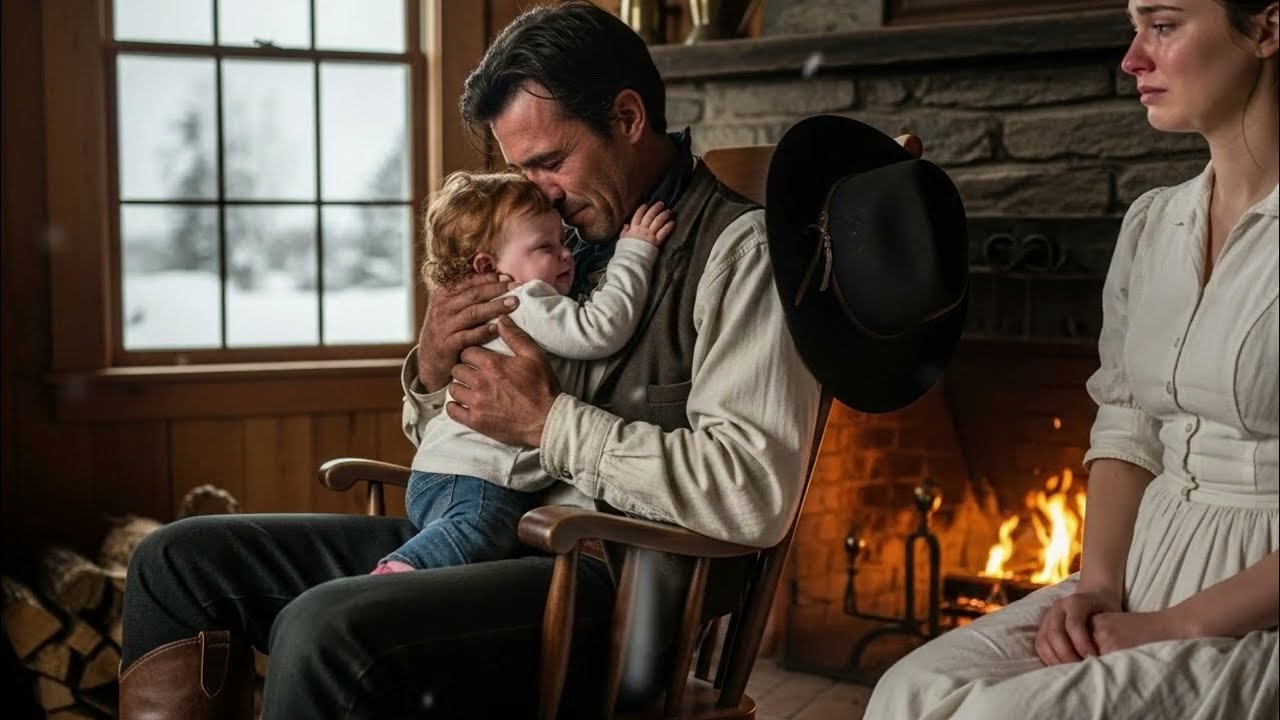
Maisie’s chin trembled. “I forgot Mama’s voice.”
The words struck harder than any insult the town had thrown.
Elena sat on the edge of the bed and did not pretend to have an answer. She simply took the child’s small hand and held it until the crying stopped.
The next morning, Maisie followed her into the kitchen.
By the end of the week, she was following Elena everywhere.
That was when Ruth began watching more closely.
And Thomas, though he still said little, started leaving chopped wood by the back door before Elena woke.
For the first time, the Rusk house began to change.
Not loudly.
Not all at once.
But in small ways the town could not see.
Then, on the twelfth day, a letter arrived.
It came in a cream envelope sealed with red wax, delivered by a rider from town. Caleb was in the corral when Thomas brought it inside. Elena was kneading bread at the table. Ruth stood near the stove. The twins were arguing over a bent nail. Maisie sat on the floor, dressing her doll in a scrap of blue cloth.
Thomas looked at the name written on the envelope.
Then he looked at Elena.
“It’s for you.”
Elena wiped the flour from her hands and took it.
The handwriting was familiar.
Too familiar.
Her uncle Warren.
She broke the seal carefully.
Only three lines were written inside.
By the time she finished reading them, Ruth had stopped stirring the pot. Thomas was staring at her face. Even the twins had gone quiet.
Elena folded the letter once.
Then again.
And for the first time since arriving at the Rusk ranch, her hands began to shake.