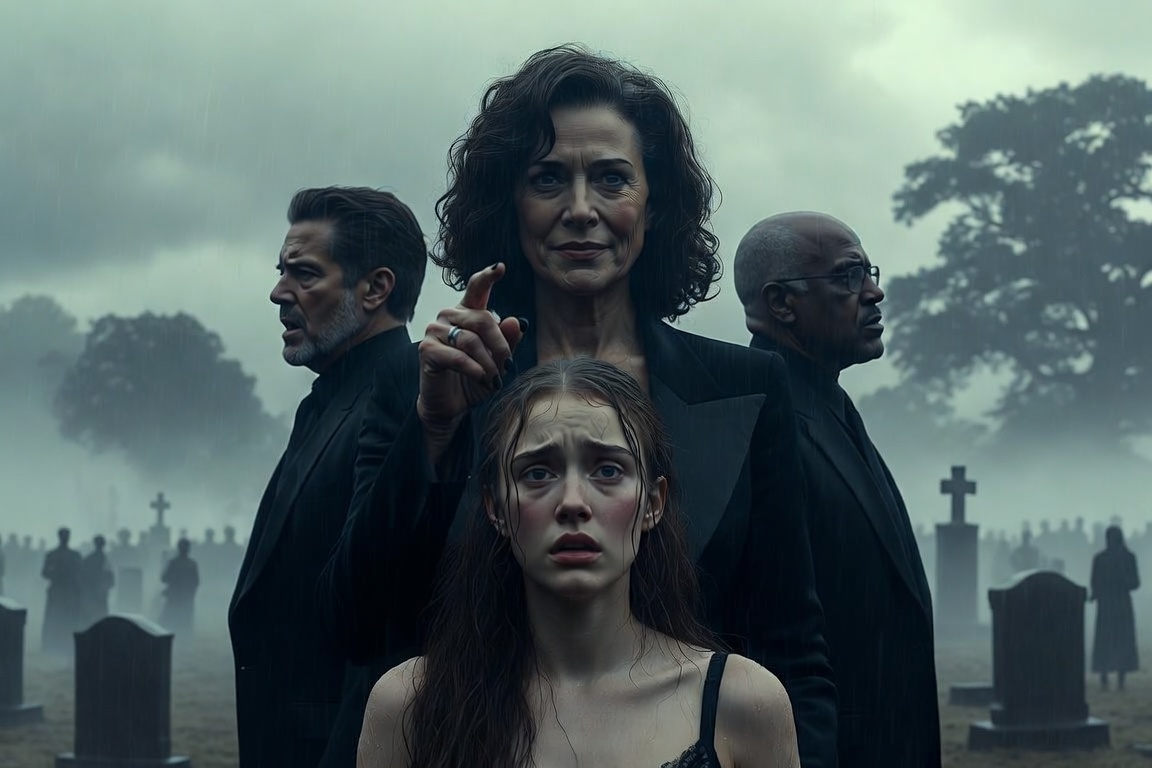
The first time my stepmother called me a stranger, my father was lying six feet away in a mahogany casket.
The chapel had gone quiet after the hymn. Not peaceful quiet. Not holy quiet. The kind of quiet that happens when grief has exhausted a room and everyone is waiting for someone else to tell them when to breathe again.
Rain moved down the tall windows of Briarwood Funeral Home in silver threads. The air smelled of lilies, wet wool, old carpet, and coffee left too long on a warmer. My father’s photograph stood beside the casket: Graham Whitfield in a navy sweater, one hand resting on the rail of his sailboat, smiling like the sun had said something just to him.
I sat in the front row with both hands folded in my lap.
Not beside family.
Near family.
There was a difference.
My stepmother, Celeste, stood from the first pew just as the minister closed his Bible.
Her black dress fit like a warning. Her hair was swept into a smooth silver twist. A diamond brooch glittered at her chest, catching the candlelight every time she moved.
She did not look like a grieving widow.
She looked prepared.
“Before we continue,” Celeste said, voice soft enough to sound wounded, “there is something Graham would have wanted clarified.”
My stomach tightened.
Across the aisle, her son Blake leaned back in his chair, one ankle resting on his knee. Her daughter Marissa lowered her eyes, but the corner of her mouth moved.
The minister blinked. “Mrs. Whitfield, perhaps this is better suited for—”
“No.” Celeste lifted one hand. “This family has carried enough confusion.”
Every head turned toward me before she said my name.
They knew.
Or they wanted to.
Celeste faced the room.
“Evelyn has been treated with kindness by this family for many years,” she said. “But in light of Graham’s passing, I cannot allow emotion to cloud truth.”
The word truth sounded strange in her mouth.
Like a stolen ring.
“She is not Graham’s biological daughter.”
The chapel air vanished.
Someone gasped.
My fingers did not move.
Celeste’s eyes settled on me at last.
“Graham loved helping people. He was generous. Sometimes too generous. But generosity does not create blood. And blood matters when legacy is at stake.”
Blake looked down, hiding a smile.
Marissa pressed a tissue to her mouth.
My aunt Ruth whispered, “Dear God.”
I stared at my father’s photograph.
Not because I was calm.
Because if I looked at Celeste too long, I might become the version of myself she had been trying to create for fifteen years.
Unstable.
Ungrateful.
Dramatic.
The orphan girl who should have been thankful for a chair near the table.
Celeste turned toward the mourners again, gaining strength from their silence.
“Out of respect for my husband’s true heirs, I ask that Evelyn not participate in any family decisions regarding Graham’s estate. She has no legal claim, no blood claim, and no moral right to disrupt this family’s healing.”
The minister’s face had gone pale.
My father’s lawyer, Mr. Alden Price, sat two rows back.
He was seventy-three, narrow-shouldered, with a cane resting against his knee and reading glasses folded neatly in his breast pocket. He had said nothing all morning. Not when Celeste moved me away from the family car. Not when she told the funeral director I would not be speaking. Not when Blake asked whether I was “still using the Whitfield name professionally.”
Now he stood.
Slowly.
The cane tapped once against the floor.
Celeste noticed him.
Her lips tightened.
“Alden,” she said, “not now.”
Mr. Price stepped into the aisle.
“Oh,” he said quietly, “I believe your timing is precisely why now is necessary.”
The room shifted.
Celeste’s smile thinned.
“This is a private family matter.”
“No,” he said. “You made it a public allegation.”
He reached into the inside pocket of his coat and removed a cream envelope sealed with dark blue wax.
My name was written across the front in my father’s handwriting.
Evelyn.
My throat closed.
Mr. Price held the envelope in one hand and looked at Celeste.
“Graham prepared for this moment.”
Celeste’s face changed.
Not much.
Just enough.
A crack beneath porcelain.
Mr. Price turned toward the room.
“For the record, before anyone repeats Mrs. Whitfield’s statement outside this chapel, I advise silence. What she just said is incomplete, legally irrelevant, and—depending on what she knew when she said it—potentially defamatory.”
Blake dropped his foot to the floor.
Celeste’s chin lifted.
“She is not his daughter.”
Mr. Price looked at me.
Then back at her.
“Mrs. Whitfield,” he said, “Graham Whitfield adopted Evelyn when she was four years old. The adoption was finalized in this county, sealed by court order, and reaffirmed in every estate document he signed for the next twenty-nine years.”
The room went still.
My heartbeat filled my ears.
Celeste’s lips parted.
Mr. Price continued.
“And if you are referring to biology, I suggest you let me finish before you embarrass yourself any further.”
A murmur moved through the chapel.
Celeste gripped the back of the pew.
“What does that mean?”
Mr. Price’s eyes did not leave hers.
“It means Graham knew the truth before you did.”
He lifted the envelope.
“And he left instructions for what should happen if you ever tried to use it as a weapon.”
The rain struck harder against the windows.
For the first time since my father died, Celeste looked afraid.
My name is Evelyn Whitfield.
For thirty-three years, I believed family was something proven through endurance.
I endured birthday dinners where Celeste placed me at the far end of the table because “the young people sit together,” even when I was thirty. I endured Christmas mornings where Blake and Marissa opened heirloom ornaments while I received gift cards signed by the housekeeper. I endured Celeste introducing me as “Graham’s first wife’s child” when she wanted to sound generous, and “Evelyn” when she did not.
But my father never introduced me that way.
To him, I was Evie.
His daughter.
He said it in grocery stores, at school plays, in hospital waiting rooms, at the DMV, to strangers on airplanes, and once to a judge when I was seventeen and crashed his old Volvo into a mailbox.
“That’s my daughter,” he said, standing beside me while the homeowner yelled.
Not my adopted daughter.
Not the girl I raised.
My daughter.
I was three when my birth mother died of a stroke. I do not remember her voice. I remember a yellow scarf, maybe. Or maybe I invented that because children hate empty spaces. Graham had been her best friend from college, according to the story he told me. He took me in “temporarily,” then permanently, then completely.
He never married my mother.
He never said why she chose him.
When I was little, I asked if he was my real dad.
He set down the wooden train he was fixing, wiped sawdust from his fingers, and said, “Real is who stays.”
That answer became the floor of my life.
I did not ask again.
Celeste arrived when I was eighteen.
By then, Dad owned Whitfield Marine Supply, a family-run business that started with boat parts and grew into coastal equipment contracts, warehouse properties, and enough money for people to become strangely interested in his loneliness. Celeste was forty-one, elegant, widowed, and very good at listening to men talk about their burdens.
She had two children from her first marriage.
Blake, twenty-two then, already wore entitlement like cologne. Marissa, nineteen, smiled with her mouth closed and watched rooms carefully.
At first, Celeste was kind to me.
Not warm.
Kind.
She bought me a blue scarf my first Christmas and said, “I know girls your age like color.”
I was in college. I thanked her.
The shift began after she married Dad.
Small things.
A moved photograph.
A changed holiday plan.
A locked cabinet.
A new family group chat without me because “you’re so busy, sweetheart.”
Dad noticed some of it.
Not enough.
Or maybe he noticed all of it and thought love could outlast strategy.
That was his weakness.
He believed people became better when trusted.
Celeste believed people became useful when positioned correctly.
For fifteen years, they played a quiet war around me.
Dad pulling me closer.
Celeste smiling while moving the chair.
When he was diagnosed with pancreatic cancer, Celeste turned grief into administration.
She controlled visitor schedules. Medication charts. Doctor calls. Meal trains. Bank statements. The house.
“You overwhelm him,” she told me after I drove four hours to see him and found my name removed from the approved visitor list at the private care center.
“I’m his daughter.”
“And I’m his wife.”
She said it without raising her voice.
That was how Celeste won rooms.
She made cruelty sound like policy.
I called Dad from the parking lot that night.
He answered on the third ring, voice thin but bright.
“Evie?”
“They won’t let me in.”
Silence.
Then I heard sheets rustle.
A nurse murmured.
Dad’s voice changed.
“Put the phone on speaker.”
I did.
Ten minutes later, I was in his room.
He was smaller than he had been the week before. His skin had gone gray beneath the hospital lights. But when I stepped inside, he held out one hand.
“There she is,” he said.
I sat beside him and pressed my face into his palm like I was seven years old again.
Celeste stood by the window, arms folded.
Dad looked at her.
“My daughter does not need permission to see me.”
Celeste’s eyes shone.
“I was trying to protect your rest.”
“I know,” he said. “That’s what worries me.”
She left the room.
He watched the door close.
Then he turned to me.
“Evie,” he said, “if she ever says something to you after I’m gone, let Alden speak first.”
My blood went cold.
“What does that mean?”
His fingers tightened weakly around mine.
“It means I should have told you more sooner.”
“About what?”
His eyes filled.
“About how much people can hate what they cannot replace.”
A nurse came in then.
The conversation broke apart.
Three weeks later, he was gone.
And at his funeral, Celeste stood up and tried to erase me before the flowers had wilted.
Mr. Price did not read the envelope in the chapel.
That was not his style.
He let the words hang long enough for everyone to feel their edges.
Then he turned to the minister.
“Reverend, I apologize for the interruption. Graham asked for dignity today. Some of us are still attempting to honor that.”
The minister swallowed.
“Yes. Of course.”
Celeste sat down slowly.
Not because she wanted to.
Because her knees had changed their minds.
Blake leaned toward her, whispering sharply. Marissa stared at me now, not smiling.
I remained seated.
My hands had begun to tremble, so I pressed them flat against my lap.
The service continued.
A hymn.
A prayer.
A eulogy from Dad’s oldest friend, Martin, who spoke about sailing through a storm off Cape Hatteras and how Graham laughed only after everyone else was safe.
I heard almost none of it.
Adopted.
Finalized.
Reaffirmed.
Graham knew the truth before you did.
Biology.
The word moved around my mind like a bird trapped in a room.
After the service, the mourners formed a receiving line that no one wanted but everyone obeyed. People hugged Celeste. They touched my shoulder. They avoided my eyes or held them too long.
Aunt Ruth gripped both my hands.
“Your father loved you,” she whispered.
“I know.”
But my voice sounded like I was asking.
She squeezed harder.
“I mean he loved you in ways people like Celeste cannot understand.”
Across the room, Celeste watched us.
Her face had repaired itself.
That frightened me more than the crack.
Grief can make people honest.
Ambition makes them efficient.
At the burial, rain turned the cemetery grass dark and soft beneath our shoes. The tent snapped lightly in the wind. Dad’s casket rested above the open earth, polished wood beaded with water. The minister read final words. Celeste accepted the folded flag from Dad’s veteran’s association honor guard because he had served in the Navy before I was born.
I had not known he arranged that.
Another thing.
Another hidden room.
When it was over, Mr. Price appeared beside me.
“Evelyn,” he said gently, “Graham requested a private meeting before the reception.”
Celeste heard.
She turned.
“There is no private meeting.”
Mr. Price looked at her.
“Your husband disagreed.”
Blake stepped forward.
“My mother is his widow.”
“And Evelyn is his daughter.”
The sentence landed simply.
Legally.
Finally.
Blake’s jaw tightened.
Marissa touched his arm.
“Not here,” she said.
Celeste smiled.
“We’ll all go. Transparency is best.”
Mr. Price adjusted his glasses.
“Transparency would have been best twenty minutes before your announcement in the chapel. Now we are following Graham’s instructions.”
Celeste’s face hardened.
“I will contest anything that excludes me.”
“I expected that,” Mr. Price said.
Then, almost kindly, “So did Graham.”
We met in the library at Dad’s house.
Not the formal living room where Celeste liked to serve cocktails under the portrait of her first husband’s family. The library. Dad’s room. Dark walnut shelves, green reading lamps, leather chair worn at the arms, old nautical maps framed on the walls. The windows looked out toward the bay, where rain blurred the line between water and sky.
I stood near Dad’s desk.
I could still smell him there.
Cedar soap. Coffee. A faint trace of pipe tobacco he pretended not to smoke after his diagnosis.
Mr. Price closed the door.
Only three of us were inside: him, me, and his assistant, Naomi, who carried a laptop and a black binder thick enough to make my stomach twist.
Mr. Price placed the envelope on the desk.
“Before I give this to you, Evelyn, I need to explain some facts.”
I nodded.
My throat hurt.
“Your father adopted you on May 17, 1994. He did so with full legal knowledge that he was not listed on your birth certificate.”
I gripped the edge of the desk.
“He told me my mother was his friend.”
“She was.”
“But?”
Mr. Price removed his glasses.
The small gesture made him look older.
“But that is not the whole story.”
Rain tapped the glass.
A branch scraped softly against the window.
“Your birth mother, Lillian Mercer, and Graham were close friends at university. They remained close afterward. Lillian became involved with a man named Victor Hale.”
The name meant nothing to me.
“Victor was wealthy, married, and dangerous in the quiet ways wealthy men can be dangerous. Lillian became pregnant. Victor denied paternity and threatened to use his influence to take custody if she embarrassed him publicly.”
My fingers went numb.
“Custody of me?”
“Yes.”
“Why would he want custody if he denied I was his?”
“Control. Reputation. Punishment. People do not have to love a child to fight over ownership.”
I sat down before my legs failed.
Mr. Price continued carefully.
“Lillian named Graham as your guardian in a handwritten document before her death. Victor challenged it briefly. Graham fought him. The adoption sealed the matter.”
My voice came out thin.
“Did Dad know who my biological father was?”
“Yes.”
“Did Celeste?”
Mr. Price’s face changed.
There.
The blade.
“Celeste found an old investigator’s report six months ago.”
I closed my eyes.
The room swayed.
“She knew.”
“She knew enough to know you were adopted. She did not know the full contents of Graham’s later documents.”
“Why didn’t he tell me?”
Mr. Price was quiet for a moment.
“Because Graham believed knowledge should protect you, not burden you. Whether he was right is another matter.”
I looked at the envelope.
Dad’s handwriting waited.
“Open it,” I said.
Mr. Price handed it to me.
The wax seal broke under my thumb.
Inside was a letter, four pages, written in blue ink.
My Evie,
If Celeste has forced this into the open, then I failed to protect you from the moment but not, I hope, from the truth.
You were four when the court made official what my heart had already decided. I did not become your father because a judge allowed it. I became your father the first night you woke crying for Lillian and let me sit beside your bed.
You asked me once if I was your real dad. I told you real is who stays. That was true. It was not complete.
Your birth father was Victor Hale. He hurt your mother. Not in the dramatic ways stories prefer. He hurt her with money, threats, silence, and doors closed by men who owed him favors. When she died, he wanted you hidden, controlled, or erased depending on what served him.
I chose you.
Not as charity.
Not as obligation.
As joy.
If Celeste tells you blood matters, remember this: blood can abandon. Blood can deny. Blood can sign checks and still refuse love. Fatherhood is not biology pretending to be destiny. It is a thousand daily choices, and you were mine every day.
There are documents in Alden’s care. I made decisions Celeste will hate. Let her hate them. Let anyone hate them.
Do not give away your place at my table because someone arrives with a louder voice.
You are my daughter.
You are my heir.
You are my brave girl.
Dad
The letter blurred.
I pressed my fist to my mouth, but the sound came anyway.
Small at first.
Then not small.
Mr. Price turned toward the window.
Naomi looked down at her binder.
I folded over the desk like grief had finally found where I was hiding.
For years, I thought Dad’s love was simple.
Now I saw it had been a fortress.
Silent, imperfect, but built stone by stone around me.
When I could breathe again, Mr. Price placed a box of tissues near my hand.
“What happens now?” I asked.
He sat across from me.
“Now we read what your father prepared for the rest of them.”
Celeste insisted the will be read after the reception meal.
She said it would be “civilized.”
What she meant was public enough to pressure me and formal enough to perform innocence.
The dining room had been arranged with white roses, silver trays, and framed photos of Dad. Caterers moved around family members who ate too little and drank too much. The house was warm, almost suffocating. Rain pressed against the windows. The bay beyond the lawn was a sheet of pewter.
I sat at the far end of the long table.
Celeste had placed me there.
Mr. Price moved my name card before sitting.
He put me to the right of Dad’s empty chair.
Celeste watched him do it.
Said nothing.
That silence was not surrender.
It was storage.
Blake sat beside his mother, jaw tight. He was thirty-eight, tan, athletic, and used to calling other people “kid” when he wanted to avoid their names. He managed one of Dad’s warehouses badly and called himself vice president. Marissa sat across from him, elegant and tense, twisting her wedding ring. She had always been kinder than Blake when alone and crueler when watched.
My aunt Ruth came too, along with Dad’s cousin Peter, two business partners, and Naomi with the black binder.
Mr. Price stood at the head of the table.
“Graham requested certain statements be read aloud before distribution of estate documents.”
Celeste smiled faintly.
“Of course he did.”
Mr. Price looked at her.
“He anticipated interruption as well.”
Her smile disappeared.
He opened the binder.
“First: Graham Whitfield affirms that Evelyn Rose Whitfield is his legally adopted daughter, with all rights, status, inheritance standing, family standing, and personal recognition belonging to a child of his body and heart. Any attempt to suggest otherwise is false in law and false in spirit.”
The room went quiet.
My chest tightened.
Blake scoffed.
Mr. Price turned a page.
“Second: Graham acknowledges his marriage to Celeste Whitfield and provides for her as follows.”
Celeste straightened.
Here it came.
The throne she had been waiting to inherit.
“She receives lifetime occupancy of the primary residence, provided she does not attempt to sell, mortgage, transfer, encumber, or remove estate property from the home without trustee approval.”
Her face stiffened.
“Lifetime occupancy?”
Mr. Price continued.
“She receives annual support from a marital trust sufficient to maintain reasonable living expenses, medical care, and personal transportation.”
Blake leaned forward.
“What about control of the company?”
Mr. Price ignored him.
“Third: controlling interest in Whitfield Marine Supply, associated warehouse properties, and all voting shares are transferred to Evelyn Rose Whitfield.”
The room erupted.
Celeste’s hand struck the table.
“No.”
Blake stood so fast his chair fell backward.
“That’s insane.”
Marissa whispered, “Blake.”
He pointed at me.
“She doesn’t even work there.”
My voice surprised me by coming out steady.
“I worked there every summer from fourteen to twenty-two.”
“You answered phones.”
“I learned inventory systems, vendor contracts, shipping routes, and payroll because Dad made me rotate departments.”
“You left.”
“I built my own career.”
“Exactly,” Blake snapped. “You don’t need it.”
Mr. Price tapped his cane once.
“Sit down.”
Blake stared at him.
Mr. Price’s voice did not rise.
“Or leave without receiving the remainder of Graham’s instructions.”
Blake looked at his mother.
Celeste gave one small nod.
He lifted his chair and sat.
Color burned along his neck.
Mr. Price resumed.
“Blake Harrington is removed from all operational authority effective immediately.”
Blake’s mouth opened.
“Reason: documented misuse of company accounts, unauthorized vendor discounts, and repeated attempts to transfer warehouse equipment to a privately held entity.”
Marissa’s eyes flew to him.
“Blake?”
He looked away.
Celeste’s fingers trembled.
Mr. Price turned another page.
“Marissa Harrington receives the educational trust already established for her children and a separate personal trust, contingent upon no involvement in litigation against the estate.”
Marissa began to cry silently.
Not because she was cheated.
Because she had expected worse.
Then Mr. Price looked at Celeste.
“Celeste Whitfield receives what Graham described as ‘more mercy than she would have offered my daughter.’”
The sentence landed like a slap.
Celeste went pale.
Mr. Price read on.
“In the event Celeste publicly challenges Evelyn’s status as my daughter, attempts to remove Evelyn from funeral, estate, business, or family proceedings, or uses knowledge of Evelyn’s adoption to inflict reputational harm, the marital trust shall be reviewed for reduction under the no-contest and conduct clauses attached herein.”
Celeste stood.
“This is cruel.”
Mr. Price closed the binder halfway.
“No. This is specific.”
Her eyes filled, but there were no tears yet.
“You helped him do this to me?”
“I helped him protect his daughter.”
“She is not—”
Mr. Price’s voice cut through the room.
“Finish that sentence carefully.”
Celeste stopped.
Her mouth trembled with fury.
I looked at her then.
For the first time all day, truly looked.
At the woman who had spent fifteen years polishing her place in my father’s house while fearing the one thing she could not replace: his choice.
“You knew,” I said.
Her eyes shifted to mine.
“You knew I was adopted before today.”
She lifted her chin.
“I found a file.”
“And saved it for his funeral.”
Her face hardened.
“You were going to take everything.”
“I didn’t know about any of this.”
“That never stopped you from being in the way.”
There it was.
The truth beneath the legal language.
Not blood.
Not legacy.
Not grief.
Space.
She had wanted mine.
“You had him for fifteen years,” I said.
Celeste’s voice shook.
“And you had him first.”
The words were childish.
Raw.
Honest.
Blake stared at his mother like he had never considered her capable of wanting anything that badly.
Celeste’s eyes shone now.
“You think I didn’t see it? Every room changed when you entered. He softened. He listened. He forgave you absences he would have condemned in anyone else. I managed his appointments, his medication, his home, his meals, his last months. And still, when he woke in pain, he asked for Evie.”
The room held its breath.
My anger shifted.
Not into forgiveness.
Into understanding sharp enough to hurt.
Celeste did not hate me because I was not his blood.
She hated me because I had not needed blood to be loved.
“You could have loved him without trying to erase me,” I said.
A tear slid down her cheek.
“I did.”
“No,” I said softly. “You competed with a child.”
Her face crumpled.
Only for a second.
Then she sat, spine rigid, pride repairing her like a bad surgeon.
Mr. Price opened the binder again.
“There is one final provision.”
Blake groaned.
Mr. Price ignored him.
“Graham created the Lillian Mercer Foundation for Legal Guardianship Support, funding representation for children caught in custody disputes involving coercion, intimidation, or financial abuse. Evelyn is named founding trustee.”
My father’s photograph sat on the sideboard behind Mr. Price.
Smiling.
Like he had saved one more thing for after the storm.
I covered my mouth.
Mr. Price looked at me gently.
“He said you would know why.”
I did.
My birth mother.
The woman with the yellow scarf I might have invented.
The woman who had chosen Graham to protect me from a man with money and teeth.
Dad had not only protected me.
He had built a door for others.
Celeste whispered, “Lillian.”
The way she said it made me look up.
She knew the name too.
Of course she did.
For six months, she had held pieces of my life in her hands and chosen the sharpest one for the funeral.
Mr. Price closed the binder.
“That concludes Graham’s preliminary instructions. Full copies will be distributed to counsel.”
Blake stood again.
“This isn’t over.”
“No,” I said.
Everyone turned.
My voice was quiet.
“It isn’t.”
Blake frowned.
I looked at Celeste.
“For fifteen years, I let you decide whether I was welcome in rooms my father built around me. That ends today.”
Celeste’s jaw tightened.
“I was his wife.”
“Yes,” I said. “And I was his daughter. Neither fact erases the other. But only one of us tried.”
No one spoke.
Outside, the rain stopped.
The sudden silence after it felt almost violent.
The first week after the funeral was made of paper.
Lawyers.
Notices.
Trust documents.
Business passwords.
Board meetings.
Emergency audits.
Dad’s company offices sat near the harbor in a long brick building with blue doors and salt-stained windows. I walked in on Monday morning wearing a black suit, low heels, and my father’s old watch on my wrist.
The lobby smelled of coffee, copy toner, and seawater.
People stopped talking when they saw me.
Some faces warmed.
Others calculated.
Blake had spent years telling employees I was “outside the business.” Maybe he believed it. Men like Blake often mistake absence from their meetings for absence from the world.
Dad’s operations manager, Lena Ortiz, met me near the stairs.
She was fifty-six, short, sharp-eyed, with steel-gray hair and a handshake that could reset your spine.
“Ms. Whitfield,” she said.
“Evelyn.”
She studied me for half a second.
“Your father said you’d say that.”
My throat tightened.
Lena led me to the conference room, where department heads sat around a long table. Through the windows, cranes moved slowly over the harbor. Gulls cried overhead. Rainwater dripped from the roofline in bright strands.
Blake was already there.
In Dad’s chair.
I stopped in the doorway.
He smiled.
“You’re late.”
Lena did not move.
The room waited.
I looked at the chair.
Then at Blake.
“Get up.”
His smile widened.
“Come on, Evelyn. We all know you don’t want to run a marine supply company. Let’s not turn grief into theater.”
I crossed the room slowly.
Every step sounded against the polished floor.
At the table’s far end, Dad’s empty coffee mug sat beside a yellow legal pad. Someone had left it there.
Maybe Lena.
Maybe habit.
I stopped beside Blake.
“Get up,” I said again.
His expression flickered.
Then he leaned back.
“Make me.”
Lena placed a folder on the table.
“Blake, your company access was terminated at 7:00 a.m.”
His eyes snapped to her.
“What?”
“The locks were changed at the south warehouse,” she continued. “Finance froze discretionary accounts. HR has your separation packet.”
Blake stood.
Not because I made him.
Because the floor had moved.
“You can’t do that.”
I looked at Lena.
“She already did.”
Blake’s face flushed.
“My mother will bury you in court.”
I met his eyes.
“Then she can start with the audit showing your shell company invoices.”
The room went cold.
One of the department heads looked down.
Blake’s jaw clenched.
“You don’t know what you’re talking about.”
“Maybe not,” I said. “That’s why forensic accountants are useful.”
He stepped closer.
Lena moved half a step between us.
Small woman.
No fear.
Blake noticed.
So did I.
He grabbed his phone and stormed out.
The glass door shook behind him.
For a moment, nobody spoke.
Then Lena pulled out the chair Blake had occupied.
“Evelyn,” she said, “your father’s chair.”
I looked at it.
My chest tightened painfully.
“I’m not ready.”
Lena’s face softened.
“Then sit beside it until you are.”
That was how the first meeting began.
Not with triumph.
With me sitting one chair away from Dad’s, trying not to cry while reviewing warehouse security.
Soft revenge rarely feels like victory at first.
Mostly, it feels like responsibility arriving before sleep does.
Celeste filed a petition within ten days.
The wording was elegant.
Emotional manipulation usually is.
She alleged undue influence. Claimed Dad was medically vulnerable. Suggested I had exploited his affection. Challenged the adoption disclosure process, the no-contest clause, the business transfer, and the foundation.
She did not accuse me directly of fraud.
Celeste was too careful for that.
She let the implication wear perfume.
Mr. Price and my litigation attorney, Denise Okafor, filed response documents so clean they felt almost cruel.
Adoption decree.
Annual letters from Dad naming me as daughter.
Medical competency evaluations.
Video statements recorded three weeks before his death.
Board approvals.
Emails from Celeste referencing my “legal daughter status” before the funeral.
That was the piece that changed everything.
Celeste had written to her own attorney two months earlier:
If Graham insists Evelyn remains legally treated as his daughter, what can be done after his death?
Legally treated.
Not surprised.
Not confused.
Prepared.
When Denise showed me the email, we were sitting in her Baltimore office on a rainy Thursday. The room smelled of leather, mint tea, and printer ink. Denise wore red glasses and the expression of a woman watching a chess opponent knock over their own king.
“She knew the legal status,” Denise said.
I stared at the email.
“So the funeral announcement—”
“Was not a misunderstanding.”
My hand tightened around the paper.
“It was a strategy.”
“Yes.”
A strategy.
My grief had been a stage.
My father’s casket had been her microphone.
For a moment, I felt the old urge to collapse under the weight of being hated that deliberately.
Then I heard Dad’s letter.
Do not give away your place at my table because someone arrives with a louder voice.
I set the email down.
“What do we do?”
Denise smiled faintly.
“We let her keep talking.”
Celeste did.
At depositions.
Through relatives.
In carefully worded social media posts about “truth, legacy, and betrayal.”
Then one of her friends leaked a version of the adoption story to a local society columnist.
Not my name.
But close enough.
Daughter of prominent marine businessman faces questions over inheritance status.
Denise filed for sanctions, defamation review, and enforcement of the conduct clause.
The judge was not amused.
Courtrooms have their own weather.
This one was cold.
Celeste sat at the respondent table in navy, pearls, and restrained outrage. Blake sat behind her. Marissa sat three rows back, alone, no longer pretending she agreed with anyone.
I sat with Denise.
Mr. Price sat behind us, both hands folded over his cane.
The judge, a woman with silver hair and a voice like a locked drawer, reviewed the documents silently for what felt like a year.
Then she looked at Celeste.
“Mrs. Whitfield, did you know before the funeral that Ms. Whitfield had been legally adopted by Graham Whitfield?”
Celeste’s attorney stood.
“Your Honor, my client’s understanding was emotionally complicated—”
The judge lifted one hand.
“I asked Mrs. Whitfield.”
Celeste swallowed.
“Yes.”
The word barely sounded.
“Did you announce at the funeral that she was not his real daughter?”
Celeste’s lips tightened.
“I said she was not his biological daughter.”
“Did you clarify that she was his legally adopted daughter?”
“No.”
“Did you imply she had no claim to the estate?”
Celeste’s attorney whispered something.
Celeste’s jaw trembled.
“Yes.”
The judge leaned back.
“During her father’s funeral.”
The silence that followed did more than any scolding could have.
Celeste looked down.
For the first time, shame reached her face before pride could stop it.
The judge enforced the conduct clause.
Celeste retained lifetime occupancy but lost a significant portion of discretionary marital trust benefits. All estate communications would go through counsel. She was barred from using my adoption, birth history, or legal status in public statements. Blake’s claims were dismissed pending separate fraud review. The foundation remained intact.
It was not dramatic.
No one fainted.
No one screamed.
But when the judge’s gavel came down, Celeste flinched like the sound had struck bone.
Outside the courtroom, she approached me.
Denise moved closer.
Celeste noticed.
Her mouth twisted.
“Do you feel satisfied?”
I looked at her.
She looked smaller outside curated rooms. Still elegant. Still dangerous. But smaller.
“No.”
That seemed to surprise her.
“You got what you wanted.”
“No,” I said. “Dad died. You used his funeral to try to erase me. A judge had to tell you I was his daughter. There is nothing satisfying about that.”
Her eyes filled.
This time, I thought the tears might be real.
“I loved him,” she said.
“I know.”
She blinked.
I continued.
“That’s the saddest part. You loved him and still tried to destroy someone he loved.”
Her face crumpled.
Only briefly.
Then she turned and walked away.
Blake followed.
Marissa did not.
She waited until Celeste was down the hall, then came toward me.
“I’m sorry,” she said.
I was too tired to be graceful.
“For what?”
She accepted that.
“For laughing sometimes. For staying quiet more often. For taking things from your father and pretending they were mine because Mom said you didn’t care.”
My throat tightened.
Marissa’s eyes shone.
“I don’t want to fight you.”
“Then don’t.”
She nodded.
“I won’t.”
It was not reconciliation.
It was a ceasefire.
Some families must learn peace through legal boundaries before they can attempt kindness.
Winter passed into spring.
I moved into Dad’s office at Whitfield Marine but left his chair empty for three months.
People thought it was grief.
It was.
But it was also fear.
Fear that sitting there meant replacing him.
Fear that I would fail.
Fear that Celeste was right in some secret place: that I had been given a name, a company, a legacy I did not deserve by blood.
The mind can reject cruelty in daylight and still hear it whisper at 2:00 a.m.
Lena caught me standing behind the chair one April morning, coffee growing cold in my hand.
“Your father hated that chair,” she said.
I looked up.
“What?”
She leaned against the doorway.
“Said it made him feel like he should know more than everybody. He did his best thinking on the warehouse floor.”
I looked at the leather chair.
“Why keep it?”
“Your stepmother picked it. Said executives needed executive furniture.”
That made me laugh.
First time in days.
Lena smiled.
“Sit somewhere else.”
So I did.
We turned Dad’s office into a working room. Replaced the throne-chair with a round table. Added maps, operations boards, old photographs from the early company days. I placed Dad’s coffee mug on a shelf beside a framed copy of my adoption decree.
Not hidden.
Not displayed for argument.
Just present.
The company stabilized.
Blake’s shell invoices led to a settlement and his permanent removal from all Whitfield entities. Celeste paid his legal bills until the trust monitor stopped her. Marissa began bringing her children to visit the harbor office. They called me Aunt Evie, cautiously at first, then loudly.
The Lillian Mercer Foundation opened in June.
We used a renovated storefront near the courthouse: exposed brick, warm lamps, a children’s play corner, private consultation rooms with blue doors, and a mural of a lighthouse painted by a local artist who refused to make it “too cheerful.”
“People don’t come here because life is cheerful,” she said.
She was right.
The first mother we helped was twenty-seven, with a toddler on her hip and a custody threat from a man whose family owned half her town. When our attorney told her representation was covered, she stared at us.
“Why?”
I thought of Lillian.
The yellow scarf.
The woman who had trusted my father with her child.
“Because someone should have stood beside you sooner,” I said.
She cried then.
So did I, later, in the bathroom, quietly and without shame.
On opening day, Mr. Price handed me a second envelope.
I groaned.
“How many letters did that man write?”
“Enough,” he said.
This one was shorter.
Evie,
If you are standing inside the foundation, then something good survived all my secrets.
Lillian wanted to be a teacher. She wanted children to have safe adults. I could not save her. I saved you. That was not enough, but it was everything I had then.
Make it more.
Dad
I framed that letter in my office at the foundation.
Not the one where he called me heir.
The one where he asked me to make it more.
One year after the funeral, I returned to Briarwood Funeral Home.
Not for death.
For a memorial scholarship event the foundation hosted in Dad and Lillian’s names. I chose the venue deliberately, then regretted it every day until the event arrived.
The chapel looked different without a casket.
Chairs arranged in a circle. No lilies. No heavy perfume. The windows open to spring air. Rain threatened but held back, leaving the room washed in pale light.
Families came. Lawyers. Social workers. Former employees from Whitfield Marine. Aunt Ruth. Lena. Mr. Price, pretending he did not need his cane until Naomi handed it to him with raised eyebrows.
Marissa came with her children.
Celeste came alone.
She stood at the chapel entrance for a long moment, wearing a simple gray dress and no brooch. Her hair was still perfect, but her face looked unguarded in a way that made me uneasy.
I walked toward her.
Every step remembered the funeral.
The announcement.
The gasp.
The lawyer rising.
My father’s envelope.
Celeste held a small box in both hands.
“I can leave this and go,” she said.
“What is it?”
She opened the box.
Inside was a yellow scarf.
Faded.
Soft with age.
My breath caught.
“Where did you get that?”
“Graham kept it in the back of his closet.” Her voice was low. “I found it when I packed his winter coats. There was a note. Lillian’s scarf.”
The room blurred.
The yellow scarf.
Not invented.
Real.
My hand hovered above it, afraid touch would make it vanish.
Celeste continued.
“I should have given it to you months ago.”
“Yes.”
She flinched.
“I almost threw it away.”
I looked at her.
The honesty was ugly.
Useful.
“Why didn’t you?”
Her fingers tightened around the box.
“Because for the first time, I understood he had a life before me that was not an insult.”
I said nothing.
She swallowed.
“And because I have done enough taking.”
I took the scarf.
It was lighter than I expected.
A piece of fabric carrying more truth than blood ever had.
Celeste’s eyes glistened.
“I am sorry for the funeral.”
The sentence was plain.
No decoration.
No explanation.
I waited.
She did not add but.
Good.
“I am sorry,” she continued, “for saying real when I meant biological. For saying blood when I meant control. For trying to turn your grief into evidence against you.”
The chapel sounds faded around us.
I looked at the woman who had tried to erase me.
I did not see a monster.
That would have been easier.
I saw a woman who loved possession more than love, who feared being second so deeply she attacked a daughter at her father’s casket.
A woman responsible for her choices.
“I’m not ready to forgive you,” I said.
Her mouth trembled.
“I know.”
“But I’ll take the scarf.”
She nodded.
“That’s more than I deserve.”
“Yes,” I said.
A tiny, broken laugh escaped her.
Then she stepped aside and let me enter first.
It was the first time she had ever given me a doorway without making me earn it.
During the event, I spoke from the same place the minister had stood a year earlier.
My hands shook slightly around the scarf, now folded beside my notes.
“I spent most of my life believing family was proven by who stayed,” I began. “I still believe that. But I have learned something else. Family is also proven by who protects your name when you are not in the room. Who tells the truth when a lie would be easier. Who refuses to let paperwork become a weapon against a child.”
I looked at Mr. Price.
He lowered his eyes.
“I was adopted. I was chosen. I was loved. None of those truths compete.”
The room stayed silent.
Not the funeral silence.
Something gentler.
“My father kept secrets. Some protected me. Some hurt me. That is the complicated work of loving imperfect people. This foundation exists so fewer children have to depend on secrecy for safety.”
A woman in the second row wiped her face.
I touched the yellow scarf.
“My birth mother, Lillian, chose a guardian. My father chose to stay. Today, we choose to make sure families with less money and less power still have choices.”
Applause rose slowly.
Then stronger.
Through it, I saw Celeste near the back.
She was crying.
Quietly.
No performance.
No tissue pressed for effect.
Just a woman standing in a room where the truth she once used as a knife had become a door.
Afterward, Marissa hugged me.
Aunt Ruth cried into my shoulder.
Lena complained that the coffee was terrible and then drank two cups.
Mr. Price handed me a folder of new case applications and said, “Your father would be insufferably proud.”
I laughed.
That laugh surprised me.
It sounded like healing before I recognized it.
The house sold two years later.
Not because Celeste was forced out.
Because she chose to leave.
Lifetime occupancy meant she could have stayed until death, haunting the rooms she had tried to control. Instead, she moved to a smaller townhouse near Marissa and her grandchildren. The marital trust monitor approved the sale. The proceeds funded the foundation, my mother’s memorial scholarship, and a final settlement that allowed Celeste to live comfortably without commanding halls she no longer owned.
Before closing, Celeste asked me to come by.
I almost refused.
Then I went.
The house was half-empty. Rugs rolled. Walls pale where paintings had hung. Dust floated in late afternoon light. The bay glittered beyond the windows, blue and indifferent.
Celeste stood in the library.
Dad’s shelves were bare.
No leather chair.
No maps.
No coffee mug.
Just rectangles of unfaded wood where his life had rested.
She held a small brass key.
“I found this taped beneath Graham’s desk drawer,” she said.
I took it.
“What does it open?”
“I don’t know.”
We searched together.
That was strange.
Quietly opening drawers, cabinets, old boxes. Two women who had wasted years fighting over belonging now united by a dead man’s habit of hiding meaningful objects in ridiculous places.
The key opened a small locked compartment inside Dad’s old map chest.
Inside was a stack of photographs.
Me at five, missing a front tooth, sitting on Dad’s shoulders.
Me at twelve, holding a fishing rod and looking furious.
Me at my college graduation, Dad crying behind sunglasses.
Lillian, young, laughing, yellow scarf around her hair.
And one photograph I had never seen.
Dad at maybe thirty-two, sitting on a hospital floor, asleep beside a little girl in a pink sweater.
Me.
My small hand curled around his finger.
On the back, Dad had written:
First night she slept after Lillian. Stayed until morning. Real begins here.
I sat on the floor.
Celeste sat beside me.
Not touching.
Just near.
For a long time, neither of us spoke.
Finally, she said, “He really did choose you every day.”
I looked at the photograph.
“Yes.”
Her voice broke.
“I thought that meant he chose me less.”
I turned toward her.
The old answer would have been sharp.
Maybe he did.
Maybe you deserved that.
Maybe love isn’t math, Celeste.
All true in different ways.
Instead, I said, “I think Graham loved like a man trying to repair every room and running out of daylight.”
She nodded, tears slipping down her face.
“I wasted so much time standing in doorways.”
“Yes.”
She laughed through tears.
“You don’t soften things, do you?”
“I used to. It made people careless.”
Celeste looked at the photographs again.
“I don’t expect you to call me family.”
“I won’t.”
She nodded.
“But,” I added, surprising myself, “you can send Marissa with the photos when she visits.”
Her eyes lifted.
It was not forgiveness.
It was not friendship.
It was a narrow bridge with weight limits.
For now, that was enough.
I left the house with the photographs, the yellow scarf, and the brass key.
Celeste locked the door behind us.
This time, she did not stand between me and anything my father had left.
Years later, people would ask about the funeral story.
Not directly.
They would say, “I heard there was drama when your father passed.”
Drama.
Such a small word for being erased beside a casket.
I learned to answer simply.
“My father prepared well.”
That was true.
But not complete.
The real story was this:
A woman tried to use biology as a blade.
A lawyer used the law as a shield.
A father used paper, ink, signatures, memory, and love to stand up after death.
And I learned that being chosen is not fragile.
Not when the choice is repeated.
Not when it is written in court records, bedtime stories, hospital floors, business plans, and letters sealed for the day someone mistakes cruelty for truth.
On the third anniversary of Dad’s death, I visited his grave at sunrise.
The cemetery grass was wet with dew. No rain this time. Just pale gold light spreading over the headstones. I brought coffee in a paper cup, black with one sugar, the way he drank it when he pretended his doctor had not forbidden it.
Lillian’s name had been added to the foundation memorial wall, but she was buried in another state. I wore her yellow scarf anyway.
I sat beside Dad’s grave and leaned one shoulder against the cool stone.
“Company’s still standing,” I said. “Lena scares everyone into competence. The foundation has twenty-six active cases. Mr. Price refuses to retire. Celeste moved. Blake is still Blake, but farther away, which helps. Marissa’s kids think I own every boat in America.”
A breeze moved through the trees.
I smiled.
“I found the photo. The hospital floor one.”
My voice changed.
“I wish you had told me everything sooner.”
A bird called somewhere behind me.
“But I understand why you were scared.”
I touched the engraved name.
Graham Whitfield
Father. Builder. Keeper of Safe Harbor.
That last line had been my choice.
Not husband.
Not businessman.
Not philanthropist.
Keeper of Safe Harbor.
“You stayed,” I whispered.
The sun lifted over the cemetery wall.
For a moment, the yellow scarf warmed against my throat.
I stood, brushed damp grass from my coat, and walked back toward the car.
At the gate, my phone buzzed.
A message from Marissa.
Kids want to know if Aunt Evie is coming for dinner Sunday. No pressure.
I looked back once at Dad’s grave.
Then typed:
Tell them I’ll bring dessert.
I got into the car.
The day opened ahead, bright and ordinary.
No courtroom.
No casket.
No woman standing in a chapel trying to rename me.
Just a road, a scarf, my father’s watch ticking on my wrist, and a life no one could take from me by saying I did not belong.
I belonged because he stayed.
I belonged because I stayed too.
And somewhere between the law, the letters, and the love he left behind, I finally stopped hearing Celeste’s voice.
I heard Dad’s.
Real is who stays.