 Rain fell softly over the entrance of the Sterling Grand Hotel.
It was the kind of rain that made the city lights blur into gold and silver across the wet pavement. Black cars glided into the circular driveway. Doormen opened umbrellas before guests stepped out. Bellboys rolled designer luggage over the polished stone. Inside the glass doors, the lobby glowed with chandeliers, marble floors, and the quiet warmth of money.
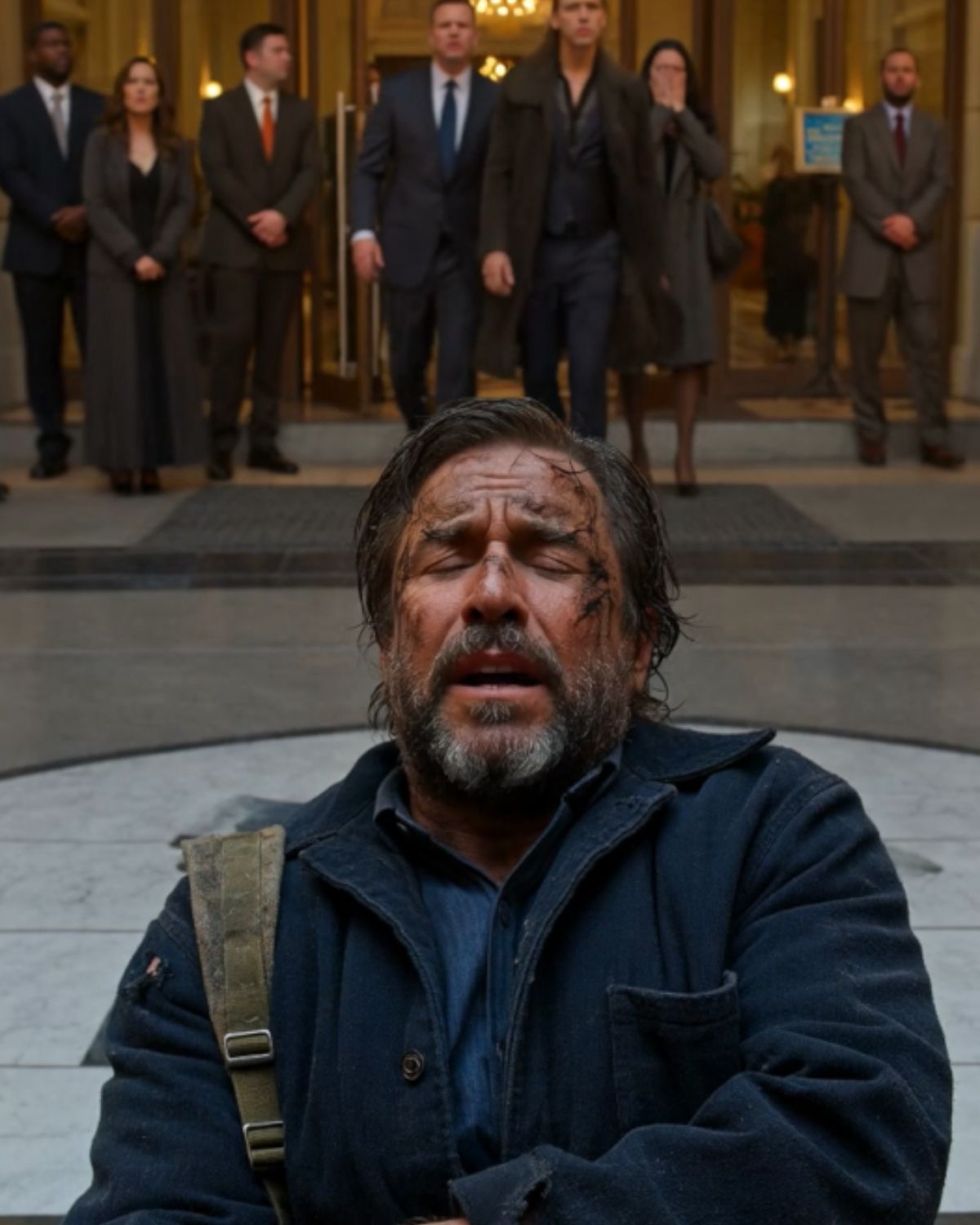
But just beyond the edge of the red carpet, under the covered sidewalk near a stone column, a homeless man slept with an old blanket pulled over his shoulders.
His name was Samuel Reed.
Most people passing by did not know that.
To them, he was only a shape beneath a faded army-green blanket. A pair of worn boots. A gray beard. A soaked backpack used as a pillow. A man who had chosen the wrong place to be poor.
Samuel had not meant to stop there.
He had walked for hours after the shelter reached capacity. The rain had started before midnight, cold and steady, soaking through his coat and into his bones. He had tried sleeping beneath a bridge, but the wind came sideways. He had tried the bus station, but security moved everyone out after the last bus left.
By the time he reached the Sterling Grand, he was shaking.
The awning outside the hotel was wide and dry.
So he sat down.
Just for a few minutes.
Then exhaustion took him.
He slept curled beside the column, one hand tucked beneath his chest, the other resting near his backpack. On his wrist was an old rescue bracelet, its metal scratched and dull, the faded letters barely readable:
S. REED — RESCUE UNIT 17
Beside the bracelet was a scar across the back of his hand, pale and raised, shaped like a crooked line of lightning.
Elegant guests walked past him.
A woman in a silver evening gown slowed, looked down, and tightened her grip on her husband’s arm.
“Is he allowed to sleep there?” she whispered.
Her husband frowned. “Not at a hotel like this.”
A young couple waiting for valet service moved closer to the entrance to avoid him.
A man in a dark suit glanced at Samuel and muttered, “This city is falling apart.”
Samuel did not hear them.
Or maybe he did, somewhere inside the kind of sleep that never becomes rest.
Inside the lobby, everything was warm.
The Sterling Grand was one of the finest hotels in Chicago. Golden chandeliers hung above the marble floor. Fresh white lilies stood in tall glass vases near the reception desk. A pianist played softly near the lounge. Receptionists smiled at guests with the careful politeness of people trained never to look tired.
At the security desk, a guard watched the entrance cameras.
The night manager, Caroline Vale, stood near reception reviewing check-in notes on a tablet. She was sharp, efficient, and known for keeping the hotel spotless. Nothing out of place. Nothing unpleasant. Nothing that could make a guest feel the city outside had followed them in.
A receptionist leaned toward her.
“Ms. Vale, several guests have mentioned the man outside.”
Caroline did not look up.
“What man?”
“The homeless man sleeping under the awning.”
Caroline lifted her eyes toward the glass doors.
Through the rain-streaked windows, she saw Samuel’s shape near the column.
Her mouth tightened.
“How long has he been there?”
“Maybe thirty minutes.”
Another guest approached the desk, lowering his voice but not enough.
“My wife is uncomfortable walking past him. We’re paying for a suite. This shouldn’t be at the entrance.”
Caroline gave him a polished smile.
“I apologize, sir. We’ll handle it immediately.”
When the guest walked away, her smile vanished.
She turned toward security.
“Move him away.”
The guard, Luis, hesitated.
“It’s raining pretty hard.”
Caroline looked at him sharply.
“He’s disturbing our guests.”
“He’s asleep.”
“He is at our entrance. That is enough.”
Luis glanced at the camera feed.
Samuel had not approached anyone. He had not shouted. He had not blocked the door. He had simply found a dry strip of pavement on a cold night.
But Luis had worked hotel security long enough to know that discomfort from wealthy guests often became orders.
“Yes, ma’am,” he said.
He took his coat from the chair and walked toward the entrance.
The automatic doors opened, releasing warmth into the rain for half a second before closing behind him.
Outside, the cold returned immediately.
Luis stepped under the awning and approached Samuel slowly.
“Sir?”
No response.
Luis crouched, careful not to touch him too suddenly.
“Sir, wake up.”
Samuel stirred.
His eyes opened slowly, unfocused at first. Then his body tensed, the way people tense when waking has often meant danger.
Luis held up one hand.
“It’s okay. I’m hotel security.”
Samuel pushed himself upright with effort. The blanket slid from his shoulder. His clothes were damp. His face was lined deeply, not only by age, but by years of being overlooked.
“I’m sorry,” Samuel said immediately.
Luis paused.
The apology came before any accusation.
“I just needed a dry place for one night,” Samuel continued softly. “I wasn’t bothering anyone.”
Luis looked toward the lobby doors.
Caroline stood inside watching.
“I understand,” Luis said quietly. “But you can’t sleep here.”
Samuel nodded as if he had expected nothing else.
“I’ll go.”
He reached for his backpack, then winced.
His hand shook.
Luis noticed.
“You need help standing?”
Samuel shook his head.
“No. Thank you.”
He gathered the blanket slowly, trying to fold it with dignity even though it was wet at the edges. The guests near the entrance watched from under umbrellas. Some with pity. Some with impatience. Some with the relief of people seeing an inconvenience removed.
Caroline stepped outside, standing just beneath the hotel canopy where the rain could not touch her.
“Luis, please clear the entrance quickly.”
Samuel looked up at her.
His voice remained soft.
“I’m going, ma’am.”
Caroline’s eyes moved over him.
The worn coat.
The dirty backpack.
The old boots.
The scarred hand.
The bracelet.
She saw all of it and understood none of it.
“This is private property,” she said. “You cannot loiter here.”
Samuel swallowed.
“I understand.”
“You should go to a shelter.”
A tired smile moved across his face and disappeared.
“They were full.”
Caroline looked uncomfortable for half a second, then hardened again.
“That is not something we can manage here.”
Luis looked down.
The sentence sounded reasonable.
That was the problem.
Cruelty often sounded most acceptable when it borrowed the language of policy.
Samuel pulled the backpack strap over one shoulder and tried to stand. His knee buckled slightly.
Luis reached out instinctively, but Samuel steadied himself against the column.
At that exact moment, a black luxury car turned into the driveway.
The hotel staff immediately straightened.
The car stopped beneath the canopy.
The driver stepped out and opened the rear door.
A man in a long charcoal coat emerged into the rain.
Daniel Whitmore.
Owner of the Sterling Grand Hotel.
Forty-two years old.
Reserved, disciplined, and known for visiting his properties without warning. He had inherited part of his father’s hospitality empire but had built the Sterling Grand brand himself. Business magazines called him demanding. Staff called him fair, though not warm. He noticed details others missed: crooked flowers, slow elevators, unhappy guests, employees hiding panic behind smiles.
That night, he had returned from a late charity dinner across town. He was tired, but when he stepped from the car, he immediately noticed the scene near the entrance.
The security guard standing awkwardly.
The night manager tense beneath the canopy.
The homeless man clutching a wet blanket.
The guests pretending not to watch.
Daniel walked closer.
Caroline moved quickly toward him.
“Mr. Whitmore, good evening. I apologize for the disturbance. We’re removing him now.”
Daniel did not answer.
His eyes were on Samuel.
At first, he saw what everyone else saw.
A homeless man. Wet clothes. Bent shoulders. A tired face partly hidden by a gray beard.
Then Samuel shifted the backpack strap on his shoulder.
His sleeve pulled back.
The bracelet showed.
Daniel’s steps slowed.
The old metal band caught the light from the hotel entrance.
S. REED — RESCUE UNIT 17
Daniel’s face changed.
Not recognition yet.
Something deeper.
A memory unlocking.
Rain against glass.
Smoke.
The smell of gasoline.
A seatbelt jammed across his chest.
A voice shouting, “Stay with me, kid!”
Daniel took another step.
Then he saw the scar on Samuel’s hand.
The crooked pale line across the back of it.
His breath caught.
Twenty-one years disappeared.
He was twenty-one again, driving home from a winter conference in his father’s car. Too tired. Too confident. Too fast on an icy road. The car skidded near the old bridge outside Rockford, struck the guardrail, rolled once, and slammed into a tree.
He remembered waking upside down.
Blood in his eyes.
His leg trapped.
Smoke filling the cabin.
The driver unconscious.
His own hands shaking uselessly against the seatbelt.
He remembered heat spreading from the engine.
He remembered coughing.
Then a man’s voice through the broken window.
“Hey! Look at me. Don’t close your eyes.”
A stranger had crawled through glass and smoke to reach him.
Daniel remembered the man’s hand gripping his wrist.
A hand torn open across the back, bleeding badly.
The man had cut the seatbelt with a rescue knife and dragged Daniel out just before flames swallowed the front of the car.
Daniel had spent two weeks in the hospital.
His father had tried to find the responder who saved him, but the official reports were messy. There had been multiple rescue workers, passing motorists, volunteer units, bad weather, and confusion. Daniel had remembered only a name half-heard through pain.
Reed.
And the bracelet.
Rescue Unit 17.
For years, Daniel had wondered about him.
For years, he had carried the memory of that scarred hand pulling him through smoke.
Now that hand was holding a wet blanket outside his hotel.
Daniel’s voice came out barely above a whisper.
“Where did you get that bracelet?”
Caroline blinked.
Samuel looked confused.
“What?”
Daniel stepped closer, eyes fixed on the bracelet.
“That bracelet. Rescue Unit 17.”
Samuel looked down at his wrist as if he had forgotten anyone else could see it.
“Oh.”
His fingers touched the worn metal.
“It’s mine.”
Daniel’s throat tightened.
“You were rescue?”
“Volunteer search and rescue. Long time ago.”
The rain tapped softly against the canopy.
Daniel’s voice was unsteady now.
“And the scar?”
Samuel looked at his hand.
“Glass.”
Daniel could barely speak.
“What happened?”
Samuel studied him more carefully, unsure why a man in a fine coat looked like he had seen a ghost.
“I pulled a man out of a burning car years ago,” Samuel said. “Cut my hand through the window. I don’t remember every detail.”
Daniel’s eyes filled.
Caroline’s expression shifted from irritation to confusion.
Luis looked between them.
Daniel asked, “Near Rockford? Winter. A bridge road. Two men in the car.”
Samuel’s face changed slowly.
The old memory returned through the fog of time.
“Yes,” he said. “Young man trapped in the passenger side. Driver was unconscious. Fire started under the hood.”
Daniel stepped back as if the words had struck him.
Samuel continued, quieter now.
“He kept saying he couldn’t breathe. I told him to look at me. I told him not to sleep.”
Daniel covered his mouth with one hand.
Samuel frowned.
“Sir?”
Daniel lowered himself to one knee on the wet pavement.
The guests gasped softly.
Caroline froze.
Luis stared.
Daniel Whitmore, owner of the Sterling Grand, knelt in front of the homeless man his staff had been removing from the entrance.
Daniel’s voice broke.
“That man was me.”
The lobby behind the glass doors went completely silent.
Even through the rain, the moment seemed to stop everything.
Samuel stared at him.
For a long second, he did not understand.
Then his eyes moved over Daniel’s face.
The age was different. The boy from the wreck had been young, bloodied, terrified, barely conscious. This man was older, polished, powerful.
But the eyes were the same.
Samuel’s mouth parted slightly.
“You?”
Daniel nodded, tears slipping before he could stop them.
“You saved my life.”
Samuel looked down, overwhelmed.
“I didn’t know if you made it.”
Daniel let out a shaken breath.
“I made it because of you.”
Caroline’s face drained of color.
The guests who had complained stood behind the glass, suddenly ashamed of every whispered word.
Luis removed his hat slowly.
Daniel stayed kneeling.
“I looked for you,” he said. “After the hospital. My father’s people tried. The report had partial names, unit numbers, wrong spellings. We never found you.”
Samuel’s eyes lowered to the wet pavement.
“I left the unit a few years later.”
“What happened?”
Samuel gave a small, tired shrug.
The kind that tries to make pain shorter.
“Life.”
Daniel did not accept the word as an answer, but he did not push him in the rain.
He stood slowly and turned toward Caroline.
His face had changed completely.
The emotion remained, but beneath it was authority.
“Prepare a room.”
Caroline swallowed.
“Sir?”
Daniel’s voice sharpened.
“He is not sleeping outside tonight.”
“Yes, sir. Of course.”
“Not a storage room. Not a staff break room. A proper room.”
“Yes, sir.”
“And call the kitchen. Hot food. Dry clothes. Medical evaluation if he agrees.”
Caroline nodded quickly, her face pale.
Daniel looked toward Luis.
“Help me.”
Luis stepped forward immediately.
Together, he and Daniel supported Samuel as he stood.
Samuel looked uncomfortable, almost embarrassed.
“Mr. Whitmore, I don’t need—”
Daniel turned to him.
“Daniel.”
“What?”
“My name is Daniel.”
Samuel shook his head faintly.
“I just needed a dry place for one night.”
Daniel’s eyes softened.
“Then you should have been given one before anyone knew who you were.”
The words reached Caroline like a blow.
Samuel looked toward the lobby doors.
“I don’t want trouble.”
“You are not trouble.”
Daniel picked up Samuel’s wet backpack himself.
A bellboy hurried forward to take it, but Daniel held it for a moment longer.
He looked at the staff watching through the glass.
Then he handed the backpack gently to Luis.
“Carefully.”
The automatic doors opened.
Warm air rushed out.
Daniel walked beside Samuel into the hotel.
The transition from rainy sidewalk to luxury lobby felt like entering another world.
Water dripped from Samuel’s coat onto the marble floor. His blanket was soaked. His boots left dark prints across the polished stone. The same guests who had complained now stepped aside in silence.
Nobody asked about the floor.
Nobody whispered now.
The pianist stopped playing without realizing it.
Receptionists stood behind the desk with their hands folded tightly. A bellboy lowered his eyes. The guest who had complained to Caroline earlier looked away first, then down, as if he had suddenly remembered something important he had lost.
Samuel tried to shrink into himself.
He was used to being removed from warm places.
Not escorted into them by the owner.
Daniel noticed and placed one steady hand near his back, not pushing, just present.
“You’re safe here,” he said quietly.
Samuel looked at him.
Those words seemed harder for him to accept than the room.
Caroline hurried ahead toward the reception desk.
“Suite 804 is available,” she said quickly. “We can prepare it immediately.”
Daniel stopped.
“Use the Lakeview Suite.”
Caroline’s eyes widened slightly.
That was one of the hotel’s best suites.
“Yes, sir.”
Daniel turned toward the staff.
“I want everyone here to listen carefully.”
The lobby froze.
His voice was controlled, but every word carried.
“This man saved my life twenty-one years ago. But that is not why he should be treated with dignity tonight.”
No one moved.
Daniel looked at the guest who had complained, then at the receptionists, then at Caroline.
“He should be treated with dignity because he is a human being standing in the rain.”
Caroline’s eyes filled, but she forced herself to stand still.
Daniel continued.
“If a guest sleeping in silk asks for a blanket, we bring one. If a man sleeping on the sidewalk asks for a dry place, we call it a disturbance. That is not service. That is cowardice dressed as policy.”
The words landed hard.
Samuel whispered, “Daniel, please.”
He was not used to attention.
Daniel immediately softened.
He turned away from the lobby and back to Samuel.
“You’re right. Let’s get you upstairs.”
Luis stepped forward.
“I’ll bring the elevator.”
The private elevator opened near the side corridor.
As Daniel and Samuel moved toward it, Caroline took one step forward.
“Mr. Reed?”
Samuel stopped.
She stood near the reception desk, face pale with shame.
“I’m sorry.”
Samuel looked at her.
She continued, voice quieter.
“I saw you outside and treated you like a problem to remove. I didn’t ask your name. I didn’t ask if you were safe. I’m sorry.”
The lobby waited.
Samuel seemed unsure what to do with the apology.
Finally, he nodded.
“Thank you.”
It was not forgiveness.
It was not anger.
It was simply more grace than the room deserved.
Caroline lowered her eyes.
The elevator doors closed behind Daniel and Samuel.
Inside, the silence was different.
No guests.
No chandeliers.
No performance.
Just two men reflected in the polished elevator walls: one wealthy and shaken, one homeless and exhausted, connected by a night neither had ever forgotten.
Daniel looked at the bracelet again.
“I kept wondering who you were.”
Samuel leaned against the elevator wall.
“I wondered if you lived.”
“I did.”
“I’m glad.”
The simplicity of it nearly broke Daniel.
The man had saved his life, disappeared into the world, and carried only the hope that the stranger survived.
Daniel asked softly, “Why didn’t you stay with the rescue unit?”
Samuel’s jaw tightened.
The elevator rose.
“My wife got sick. Cancer. I took every job I could find. Missed shifts. Missed training. Sold the truck. Lost the apartment. After she died, I couldn’t keep up with anything.”
Daniel listened.
Samuel continued, “People think homelessness happens when someone stops trying. Sometimes it happens after a person tries until there’s nothing left to sell except pride.”
Daniel closed his eyes briefly.
“I’m sorry.”
Samuel shrugged.
“Everyone is sorry when they hear the long version.”
The elevator doors opened to the eighth floor.
A hotel supervisor waited with towels, dry slippers, and a room key. She looked nervous but respectful.
Daniel took the key himself.
“I’ll take him in.”
The Lakeview Suite overlooked the city and the dark water beyond it. The room was warm, quiet, and larger than the last apartment Samuel had lived in. A fire glowed behind glass. Thick curtains framed the windows. A clean bed stood under soft lights.
Samuel stopped at the doorway.
“I can’t stay here.”
Daniel turned.
“Why not?”
Samuel looked at the carpet.
“I’ll ruin it.”
Daniel’s face tightened.
Not with anger at Samuel.
With anger at every night that had taught him to say that.
“You won’t ruin anything.”
Samuel stepped in carefully, as if the room might reject him.
A staff member brought hot soup, bread, tea, and fresh clothes still folded in paper. Another brought a medical kit.
Daniel asked, “May we have someone look at you? Just basic care. No pressure.”
Samuel hesitated.
Then nodded.
A nurse from the hotel’s on-call medical service arrived thirty minutes later. She checked Samuel’s blood pressure, temperature, oxygen level, and the infected blister on his heel. She recommended rest, food, dry clothing, and a clinic visit the next day.
Samuel accepted the treatment quietly.
He kept glancing at Daniel as if expecting the kindness to expire.
Daniel stayed.
After the nurse left, Samuel sat at the small dining table with soup in front of him.
He picked up the spoon, then set it down.
Daniel noticed.
“What is it?”
Samuel looked embarrassed.
“Just been a while since I ate at a table like this.”
Daniel pulled out the chair across from him and sat.
“Then I’ll join you.”
“You don’t have to.”
“I know.”
Daniel called room service and ordered tea for himself. Not a full meal. He did not want to turn Samuel’s hunger into a spectacle.
Samuel ate slowly at first.
Then the warmth reached him.
His hand trembled around the spoon.
Daniel looked toward the window to give him privacy.
After a while, Samuel said, “Your father came to the hospital?”
Daniel looked back.
“Yes.”
“He was angry?”
“Terrified.”
Samuel nodded.
“He shouted at me before the ambulance left. Asked my name. I told him, but the storm was loud. Someone else was calling from the road. I didn’t think he heard.”
Daniel smiled sadly.
“He didn’t hear enough.”
“I didn’t save you alone,” Samuel said. “There were others. A woman called 911. Another man pulled your driver away from the car. The fire crew came fast.”
“I know,” Daniel said. “But you were the one at my window.”
Samuel looked down.
“I was closer.”
“No,” Daniel said gently. “You were brave.”
Samuel’s mouth tightened.
“Brave people don’t end up sleeping outside hotels.”
Daniel leaned forward.
“That is not true.”
Samuel gave a small laugh without humor.
“You don’t know much about outside.”
The words could have been insulting.
They were not.
They were accurate.
Daniel accepted them.
“You’re right.”
Samuel looked up, surprised.
Daniel continued.
“I know boardrooms. Hotels. Contracts. Guest complaints. I know how to build places that make people feel important. But tonight I realized I don’t know enough about the people sleeping under the awnings of those places.”
Samuel stirred his tea.
“Most people don’t want to know.”
Daniel looked at him.
“Will you tell me?”
Samuel did not answer quickly.
Trust did not arrive because a rich man felt guilty.
But the soup was warm.
The room was quiet.
And twenty-one years ago, Samuel had pulled this man through fire without asking who he was.
So he told him some of it.
Not all.
Enough.
He told Daniel about his wife, Mara, who loved old songs and planted basil in coffee cans on the windowsill.
He told him how her illness took her strength first, then their savings, then his work schedule, then their apartment.
He told him about sleeping in his truck until the truck was towed.
He told him about shelters with no beds, paperwork without addresses, jobs that required a phone, clinics that required insurance, and people who said “get help” as if help were a door everyone could open from the outside.
Daniel listened without interrupting.
That mattered.
At one point, Samuel said, “You’re quiet.”
Daniel answered, “I’m ashamed.”
Samuel looked down.
“I didn’t tell you so you’d feel ashamed.”
“I know,” Daniel said. “That’s why it matters.”
Downstairs, the lobby was not the same after Daniel disappeared into the elevator.
Caroline stood behind the reception desk with the guest complaint log open in front of her.
The complaint was still there:
Unpleasant homeless man sleeping near entrance. Disturbs hotel atmosphere.
She stared at the sentence until it stopped looking professional and started looking ugly.
Luis returned to the security desk and sat down slowly.
Theo, one of the bellboys, whispered, “Did Mr. Whitmore really say that man saved his life?”
Luis nodded.
Theo looked toward the entrance.
“We were about to send him back into the rain.”
No one answered.
Because everyone knew it was true.
Caroline walked to the security desk.
“Luis.”
He stood.
“Yes, ma’am?”
She looked tired now. Different.
“Next time someone is outside in weather like this, we don’t just remove them.”
Luis waited.
She continued, “We call outreach services. We offer water. We check if there’s a shelter with space. We treat them like a person before treating them like a problem.”
Luis nodded.
“Yes, ma’am.”
Caroline swallowed.
“And tomorrow, I want a list of local organizations that help with emergency housing.”
Theo looked surprised.
Caroline saw his expression.
“What?”
He shook his head quickly.
“Nothing. That’s good.”
She looked back through the glass doors at the wet pavement where Samuel had been sleeping.
“Good would have been doing it before tonight.”
That was the first honest thing she had said all evening.
The next morning, Daniel returned to the suite at 8 a.m. and found Samuel already awake, sitting near the window with his backpack packed.
Daniel stopped in the doorway.
“You’re leaving?”
Samuel looked uncomfortable.
“I don’t want to overstay.”
“You’ve been here one night.”
“That’s usually enough for people to change their minds.”
Daniel stepped inside slowly.
“I haven’t.”
Samuel looked at him.
There was caution in his face, but also exhaustion. The kind that comes from holding yourself ready to be rejected at all times.
Daniel placed a folder on the table.
“I made some calls.”
Samuel’s body stiffened.
Daniel noticed.
“Not police. Not reporters. Not anyone to take over your life.”
Samuel relaxed by a fraction.
“What calls?”
“There’s a medical clinic that can see you today. I can drive you, or Luis can, or no one if you prefer. There is also a transitional housing organization with available space for veterans and former rescue workers.”
“I’m not a veteran.”
“I know. But you served in volunteer rescue. They partner with emergency responders too.”
Samuel looked toward the lake.
Daniel continued.
“I also found someone from Rescue Unit 17. A man named Paul Henson. He remembers you.”
Samuel’s face changed.
“Henson?”
“Yes.”
“He’s still alive?”
“Very much. He called you stubborn twice in three minutes.”
For the first time, Samuel smiled.
A real smile.
Small, but real.
Daniel sat across from him.
“I don’t want to manage you. I don’t want to turn you into a charity story. But if you’ll allow me, I want to help you rebuild what should not have been allowed to collapse.”
Samuel’s eyes narrowed slightly.
“Why?”
Daniel did not say because you saved my life.
That would be true, but incomplete.
And too easy.
“Because I can,” he said. “Because I should have been doing more already. Because the man who pulled me out of fire should not have to sleep under the entrance of a hotel I own.”
Samuel looked down at the bracelet on his wrist.
“I didn’t pull you out because I thought you’d owe me.”
“I know.”
“That matters.”
“It does.”
Samuel was silent for a long time.
Then he said, “I’ll go to the clinic.”
Daniel exhaled softly.
“Good.”
“But I keep my own papers.”
“Of course.”
“And no interviews.”
“No interviews.”
“And if I say no to something, you hear it.”
Daniel nodded.
“I hear it.”
Samuel looked at him, measuring whether power could listen.
Finally, he nodded.
“All right.”
The clinic visit led to antibiotics, wound care, and a social worker named Denise Walker who had no patience for rich men trying to shortcut systems for emotional reasons.
She looked Daniel directly in the eye and said, “If you are here because gratitude feels dramatic today, leave before you hurt him.”
Daniel replied, “I’m here tomorrow too.”
Denise did not smile.
“We’ll see.”
Samuel did not move into permanent housing overnight.
He spent several days at the hotel, then transitioned to a small furnished room through the outreach program. Daniel paid for support services through proper channels, not by throwing cash at the problem. He learned quickly that money could open doors, but trust still had to walk through them at its own pace.
Samuel saw a doctor.
Then a counselor.
Then Paul Henson.
That reunion happened in a modest office with beige walls and bad coffee.
Paul was older, heavier, and walking with a cane, but when Samuel entered, he stood so quickly the chair nearly tipped.
“Reed,” Paul said.
Samuel froze.
Then Paul crossed the room and hugged him.
“You old fool,” Paul whispered. “We thought you died.”
Samuel gripped the back of Paul’s jacket and closed his eyes.
For years, he had believed he had disappeared without being missed.
He had been wrong.
Daniel watched from the doorway, letting the moment belong to them.
Later, Paul brought old records, photographs, and paperwork proving Samuel’s years in search and rescue. That documentation helped with housing, medical access, and a small emergency responder relief fund Samuel had never known he qualified for.
The bracelet, once just a relic of a life lost, became evidence of a life lived in service.
At the hotel, changes came slowly but visibly.
Daniel ordered the Sterling Grand to create a formal extreme-weather response policy. Not a publicity stunt. A real system.
Security staff received training on how to approach unhoused people with dignity.
The hotel partnered with local shelters and outreach teams.
A small side room near the service entrance was stocked with bottled water, blankets, socks, basic hygiene kits, and information cards.
Staff were instructed that no one should be publicly shamed, photographed, mocked, or pushed into dangerous weather just to preserve the appearance of luxury.
Caroline led the implementation.
Not because Daniel forced her to.
Because the shame of that night had become a responsibility.
At the first staff training, she stood in front of the team and said, “I gave an order that could have sent a man back into the rain without knowing his name. I was wrong.”
No one spoke.
Caroline continued.
“But I want to be clear. I was not wrong because he saved Mr. Whitmore’s life. I was wrong before we knew that.”
Luis nodded.
Theo looked down, remembering the wet blanket.
Caroline’s voice grew steadier.
“Our job is hospitality. If it disappears the moment someone cannot pay for a room, then it was never hospitality. It was performance.”
The words spread through the staff faster than any memo.
Months passed.
Samuel gained weight.
His beard was trimmed, though he refused to shave it completely because, as he told Daniel, “A man should keep at least one thing that annoys people.”
He began volunteering twice a week with the outreach team that had helped him. At first, he only sorted supplies. Then he started accompanying workers during cold-weather nights because people on the street trusted him faster than they trusted clipboards.
He knew where people slept.
He knew who hid illness.
He knew which questions sounded like help and which sounded like judgment.
One evening, Daniel joined the outreach team at Samuel’s request.
Not with cameras.
Not with assistants.
Just a coat, gloves, and instructions to listen.
They found a young man sleeping behind a closed pharmacy, shaking from fever. Samuel crouched beside him and spoke gently.
“Hey. My name’s Sam. You cold?”
The young man opened his eyes, frightened.
Daniel watched Samuel use the same voice he must have used twenty-one years ago beside a burning car.
Stay with me.
Don’t close your eyes.
You’re not alone here.
Afterward, Daniel stood under a streetlight, unable to speak.
Samuel looked at him.
“You okay?”
Daniel nodded.
“I keep thinking about that night.”
“The accident?”
“Yes.”
Samuel looked down the street.
“I do too sometimes.”
“You pulled me out.”
“And somebody once pulled me out.”
Daniel turned to him.
Samuel continued, “Not all at once. Not like you and the car. Little ways. A woman at a church who let me sleep in a hallway. A nurse who cleaned my foot when I couldn’t pay. Luis, who woke me gently instead of kicking me. You, eventually.”
Daniel absorbed that.
Samuel looked at the outreach van.
“People like stories where one person saves another. Truth is, most of us survive because a lot of people stop being cruel for five minutes at the right time.”
Daniel never forgot that.
One year after the rainy night, the Sterling Grand hosted a private dinner for emergency responders, hotel workers, and community outreach organizations.
Samuel almost refused to attend.
“I’m not wearing a suit,” he told Daniel.
“You don’t have to.”
“I’m not giving a speech.”
“You might.”
“I knew there was a trick.”
Daniel smiled.
“No trick. Just dinner.”
Samuel came in a clean dark sweater, the rescue bracelet still on his wrist.
The lobby looked the same as it had that night: marble, flowers, chandeliers, polished brass, warm light.
But this time, when Samuel entered, staff greeted him by name.
Luis clasped his shoulder.
Theo brought him coffee.
Caroline approached him with visible humility.
“Mr. Reed,” she said.
“Samuel.”
“Samuel,” she corrected. “I’m glad you’re here.”
He nodded.
“Me too.”
That was more forgiveness than she expected.
She did not waste it.
At dinner, Daniel stood to speak.
He looked around the room at firefighters, nurses, outreach workers, hotel employees, security guards, and people who understood service without needing it framed in gold.
Then he looked at Samuel.
“Twenty-two years ago,” Daniel began, “I was trapped in a burning car. I was young, afraid, and certain I was about to die. A volunteer rescuer named Samuel Reed crawled through broken glass and smoke to pull me out.”
The room quieted.
“Last year, Samuel slept outside this hotel in the rain. My staff saw him as a disturbance. Guests saw him as discomfort. I saw him first as a memory, then as the man I should have recognized without needing a scar or a bracelet.”
Samuel looked down.
Daniel continued.
“I have spent much of my career building hotels that promise comfort. But comfort means very little if it requires us to ignore suffering at the door.”
Caroline wiped one tear quickly.
Daniel’s voice grew firmer.
“Samuel saved my life once in a dramatic way. But this past year, he saved it again in a quieter way. He reminded me that success can become a locked room if you stop opening the door.”
The room remained still.
Daniel lifted his glass.
“To the people who run toward danger. To the people who serve without applause. To the people sleeping outside buildings full of empty rooms. And to the truth that no one should have to be recognized as a hero before being treated as human.”
Applause rose.
Samuel stood awkwardly.
He had not planned to speak.
But then he touched the bracelet on his wrist and looked at the staff, the responders, the outreach workers, and Daniel.
“I don’t have much to say,” he began.
Daniel smiled.
“That’s never true.”
Samuel shot him a look, and the room laughed softly.
Then he continued.
“When I pulled Daniel out of that car, I didn’t know his name. I didn’t know his family. I didn’t know he owned anything. I saw a person trapped and did what I was trained to do.”
He paused.
“When I slept outside this hotel, most people didn’t know my name either. They saw a problem. Some saw dirt. Some saw danger. A few saw a man.”
Luis lowered his eyes.
Samuel’s voice stayed calm.
“I’m not saying every hotel can solve homelessness. I know better than that. But every person can decide whether they add shame to someone’s worst night.”
The room went silent again.
“That night, Luis woke me like I was still a person. Daniel brought me inside. Caroline changed policy instead of just saying sorry. That matters.”
Caroline cried openly now.
Samuel looked around.
“I saved one life years ago. This year, a lot of people helped save mine.”
He lifted his glass of water.
“So thank you.”
The applause came slowly, then fully.
Not loud in the empty way rich rooms often clap.
Full in the chest.
After dinner, Samuel stepped outside under the hotel awning.
The rain had started again.
He stood near the same stone column where he had slept a year earlier.
Daniel joined him.
For a while, neither spoke.
Cars moved through the wet driveway. Doormen opened umbrellas. Guests walked in and out under golden light.
Then a bellboy appeared carrying a folded blanket and a small bag.
A man in worn clothes stood hesitantly near the curb, soaked and uncertain.
The bellboy approached him respectfully.
“Sir, it’s cold tonight. We can call an outreach team if you’d like. There’s coffee inside the service area too, if you want to warm up for a few minutes.”
The man looked surprised.
“Is this a trick?”
The bellboy shook his head.
“No, sir.”
Samuel watched quietly.
Daniel looked at him.
“Policy working?”
Samuel smiled faintly.
“Humanity working.”
The man accepted the coffee.
The bellboy held the door open.
Not the main glass doors with chandeliers behind them.
A side door, quieter, warmer, stocked with supplies and dignity.
Samuel looked at Daniel.
“That’s better than a speech.”
Daniel nodded.
“Yes, it is.”
Years later, people would tell the story of the homeless man outside the Sterling Grand and the hotel owner who realized he had been saved by him years before.
Some would focus on the scar.
Some on the rescue bracelet.
Some on the dramatic moment when Daniel Whitmore knelt in the rain and said, “That man was me.”
But the people who knew the whole story understood the deeper truth.
Samuel Reed had always been worthy of shelter before anyone knew he was a hero.
The bracelet did not make him human.
The scar did not make him deserving.
The past rescue did not create his dignity.
It only forced everyone else to finally see what had been there all along.
A man.
Cold.
Tired.
Forgotten by many.
Still carrying the proof that he had once run toward fire when another life depended on it.
And Daniel learned that night that gratitude is not real if it only honors the hero after the reveal.
Real gratitude changes the door.
It changes the policy.
It changes the way staff are trained, guests are answered, and strangers are seen.
Because sometimes the person sleeping outside your place of comfort is not a disturbance.
Sometimes he is someone’s answered prayer.
Sometimes he is the hand that once pulled a stranger from flames.
And sometimes the greatest test of a luxury hotel is not how it welcomes the rich, but whether it can still recognize humanity in the rain.