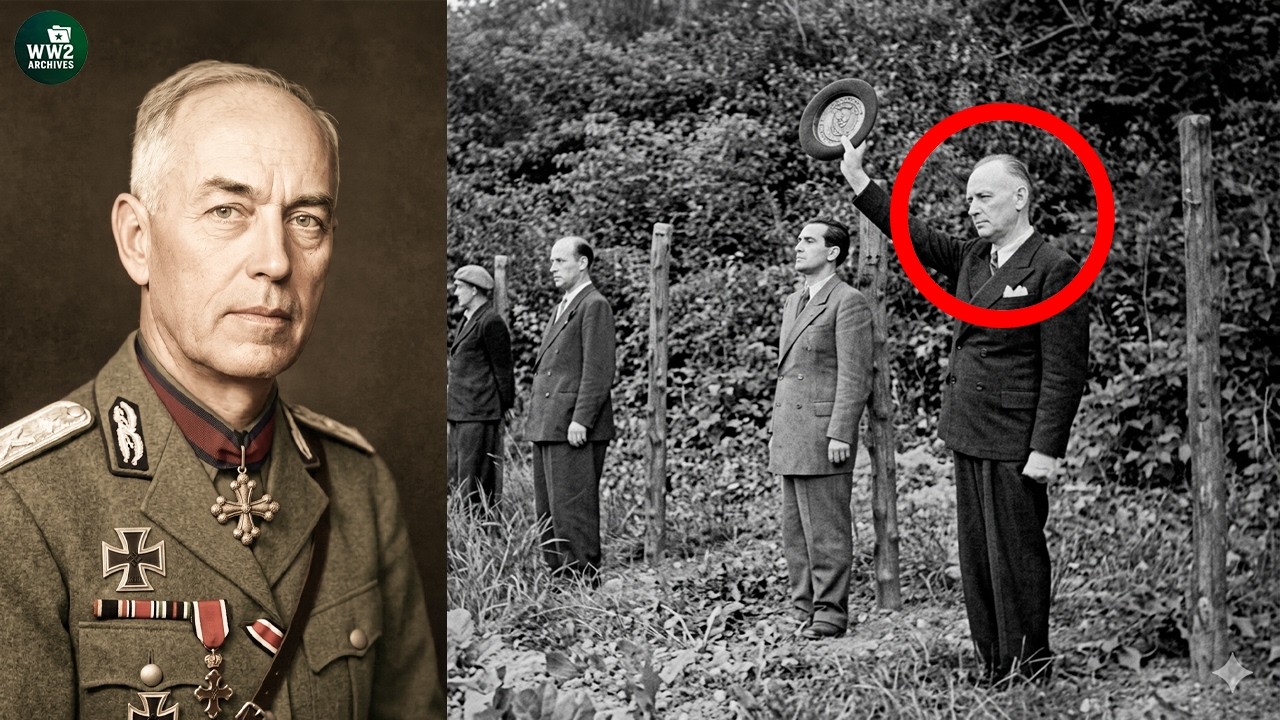
On the morning of June 1, 1946, the courtyard of Jilava Prison felt colder than it should have.
The war was over. The flags had changed. The speeches had changed. The men who once bowed their heads in fear had begun speaking in courtrooms, in offices, in whispers that no longer needed to stay hidden.
And in the middle of that gray prison yard stood Ion Antonescu.
A man who had once held Romania in the palm of his hand.
He did not ask for a chair.
He did not ask for mercy.
He refused the blindfold.
The soldiers raised their rifles.
For a few seconds, the Marshal of Romania — the man who had called himself a defender of the nation — stared directly at the firing squad made up of his own countrymen.
That was the terrible paradox of his life.
A man once presented as Romania’s shield had become a man Romania itself had decided must be executed.
To understand how a soldier who claimed to love his country ended up dying as a convicted war criminal, you have to go back long before Jilava. Long before the trial. Long before Hitler. Long before Odessa.
You have to go back to the kind of man Ion Antonescu was trained to become.
He was born in Pitești, into a family where military discipline was not just respected — it was worshipped. His father had been a cavalry officer, and from an early age, Antonescu learned that order mattered more than emotion, command mattered more than compromise, and weakness was something to be crushed before it spread.
He was not lazy. He was not foolish. That made him more dangerous.
Antonescu was disciplined, intelligent, ambitious, and brutally certain of himself. He believed societies could be repaired the same way armies were commanded: by force, by obedience, by fear, by removing anyone who got in the way.
Early in his career, he proved he had the talent of a real military officer.

He graduated with distinction from cavalry school. He rose quickly. He impressed superiors. He understood logistics, strategy, and battlefield pressure. During World War I, he helped defend Romania at a moment when the country could have collapsed completely.
That part of his story was real.
But so was something darker.
In 1907, during a peasant uprising, when desperate rural workers rose against poverty and abuse, Antonescu responded with force. Not negotiation. Not restraint. Force.
Cavalry. Weapons. Violence.
The poor were not treated as citizens in pain. They were treated as disorder to be eliminated.
And the lesson Antonescu took from that moment was not caution. It was reward.
His harshness gained praise from the highest levels of power. To him, it confirmed a belief that would follow him for the rest of his life: fear worked.
That is where many tragedies begin.
Not when a man becomes powerful.
But when a man learns that cruelty can be mistaken for strength.
As the years passed, Antonescu became more polished, more experienced, and more convinced that democracy was too weak for the age he lived in. He served abroad. He observed France and Britain. He watched Europe tremble under economic crisis, nationalism, revenge politics, and militarism.
By the late 1930s, he was no longer merely a soldier.
He had become a man waiting for a broken country to hand him power.
And in 1940, Romania broke.
The country was humiliated by territorial losses. The Soviet Union took Bessarabia and Northern Bukovina. Hungary gained Northern Transylvania. Bulgaria received Southern Dobruja. To ordinary Romanians, it felt as if the country was being cut apart while its leaders stood helpless.
King Carol II’s reputation collapsed.
The streets filled with anger. Political factions turned on each other. People wanted a savior, not a debate. They wanted order, not process.
That was the opening Antonescu needed.
On September 4, 1940, he was brought in as the man who could restore control. Within days, he had transformed crisis into command.
King Carol II was forced to abdicate. The young Michael I became king, but real power no longer sat on the throne. It sat with Antonescu.
He became Conducător — leader.
A title that sounded national, almost protective.
But behind the word was a military dictatorship.
Antonescu centralized power with the confidence of a man who believed history had chosen him. He spoke of saving Romania. He spoke of recovering lost lands. He spoke of honor, borders, and national survival.
Those words mattered to people who were afraid.
But fear is one of the easiest emotions for ambitious men to exploit.
Soon, Antonescu made the choice that would stain Romania’s history for generations.
He tied the country to Nazi Germany.

To him, Hitler was not a moral problem. Hitler was leverage.
Germany needed Romania’s oil fields at Ploiești to fuel its war machine. Antonescu needed German support for his dream of recovering territory and building a stronger state. It was not friendship. It was a bargain between two cold political minds.
Oil for protection. Loyalty for weapons. Romania’s future for a place beside the Nazis.
Inside Romania, Antonescu also had to deal with the Iron Guard, a violent fascist movement that had helped poison the country’s politics. For a time, they shared power uneasily. But two groups built on arrogance rarely share anything for long.
In January 1941, the Iron Guard rebelled.
The result was brief but bloody.
Antonescu, with Hitler’s support, crushed them using tanks, troops, and machine guns. By the end, there was no rival fascist faction left to challenge him.
Romania now had one master.
And that master was preparing to march east.
On June 22, 1941, Nazi Germany launched Operation Barbarossa against the Soviet Union. Romania joined the invasion. Antonescu presented it as a campaign to recover stolen territory, especially Bessarabia and Northern Bukovina.
Many Romanians believed him.
That was the tragedy.
There were soldiers who thought they were fighting for their homeland. There were families who thought sacrifice might bring justice. There were officers who believed national humiliation could be repaired through war.
But Antonescu’s war did not stop at recovery.
It became conquest.
It became revenge.
And then it became mass murder.
Odessa was the turning point that exposed what his regime truly was.
The city was strategically important, and Antonescu wanted it badly. Capturing Odessa would prove Romania was not merely Hitler’s junior partner. It would prove his army could conquer, his state could command, and his personal prestige could rise.
But the siege was costly. Romanian soldiers died in huge numbers. The campaign dragged on. Frustration hardened into rage.
Then came the explosion at Romanian headquarters in Odessa.
Antonescu’s response was not investigation. It was punishment.
And punishment meant civilians.
Under orders from his regime, Jews in Odessa were rounded up, shot, hanged in public, packed into buildings and burned alive. People were not killed because of what they had done. They were killed because of who the regime decided they were.
Street by street, fear became policy.
The dead were not only soldiers. They were families. Shopkeepers. Children. Elderly people. People whose names were erased first by hatred, then by paperwork, then by flames and pits and silence.
What happened in Odessa was not an accident of war.
It was the result of a worldview.
Antonescu did not see these people as human beings with lives equal to his own. He saw them as contamination, as enemies inside a fantasy of national purification. The language of “security” became the mask for murder.
And Odessa was not the end.
In Transnistria, including places like Bogdanovka, the killing continued on a terrifying scale. Deportations, starvation, shootings, disease, exposure, massacres — the machinery of death did not always need gas chambers to do its work. Sometimes it needed only guards, lists, trains, barns, bullets, and leaders willing to call extermination “order.”
This is where the story of Ion Antonescu stops being the story of a hard soldier who made harsh choices.
It becomes the story of a man who crossed the final moral line and kept walking.
The numbers were enormous.
But numbers can become another kind of hiding place.
Behind every figure was a face. Behind every face was a home. Behind every home was a life interrupted by people who said they were defending civilization while destroying it.
And still, Antonescu believed he was the man history needed.
That belief began to crack at Stalingrad.
In the winter of 1942, the Axis war machine met a reality no speech could defeat. Romanian armies, positioned along vulnerable flanks, were hit with devastating force by the Red Army. They were under-equipped, overstretched, and sacrificed in a campaign driven largely by German priorities.
The losses were catastrophic.
Romanian soldiers died, froze, surrendered, disappeared into Soviet captivity. Families back home waited for letters that never came. Villages lost sons. The army’s confidence collapsed.
For the first time, the myth of inevitable victory began to look like what it truly was.
A lie paid for in blood.
Antonescu’s loyalty to Hitler became harder to defend. Germany was no longer the unstoppable protector he had gambled on. It was a sinking empire dragging its allies into the depths.
By 1944, Soviet forces were approaching Romania. The country was exhausted. The war had turned. The cost was unbearable.
But Antonescu remained stubborn.
Even when survival required negotiation, he hesitated. Even when Romania needed a way out, he clung to the alliance that had helped destroy its moral standing and strategic future.
Inside the royal palace, King Michael I understood something Antonescu refused to accept.
If Romania did not break with Hitler, Romania might be crushed completely.
On August 23, 1944, the young king summoned Antonescu to the palace.
It was supposed to be another meeting of power.
Instead, it became the moment power changed hands.
Michael demanded that Antonescu agree to an armistice. Antonescu refused. He still wanted control. He still wanted to decide the timing. He still believed the nation’s fate belonged to him.
Then the order came.
Arrest him.
For a moment, the man who had commanded armies stood in a royal room and realized the floor beneath him had vanished.
There were no crowds cheering his speeches. No officers rushing to save him. No German tanks outside the door ready to restore his authority.
Just silence.
That silence was the sound of a dictatorship ending.
Antonescu was taken away.
Romania changed sides, accepted an armistice with the Soviets, and declared war on Germany. The decision did not erase what had happened. It did not undo the massacres. It did not bring back the dead. But it ended Antonescu’s rule.
The man who had once arrested others now became a prisoner.
After the coup, he passed through secret detention, Soviet custody, and interrogation. The uniform remained, but the command was gone. The man who had spoken in orders now had to answer questions.
In May 1946, he was brought back to Bucharest to stand trial.
The courtroom was not a battlefield, but for Antonescu, it may have been the first place where force could no longer protect him.
The charges were grave: betrayal of national interests, participation in aggressive war, responsibility for mass killings, and crimes against Jews and Roma under his regime.
Evidence was presented. Places were named. Odessa. Transnistria. Deportations. Executions. Camps. Orders. Consequences.
What had once been hidden behind military language was brought into daylight.
Antonescu did what men like him often do when history finally corners them.
He argued that he had been forced by circumstances.
He claimed he had acted for Romania.
He presented himself as a soldier, not a criminal.
But the dead cannot cross-examine a dictator.
They can only remain as evidence.
Witnesses spoke. Documents spoke. Graves spoke. The scale of the crimes spoke louder than his explanations.
And still, he did not truly bow his head.
There were reports of his coldness, his complaints, his insistence that he had done what was necessary. Even in defeat, he seemed unable to understand the difference between discipline and cruelty, between patriotism and extermination, between defending a nation and poisoning its soul.
On May 17, 1946, Ion Antonescu was sentenced to death.
Appeals failed. Requests for clemency failed.
And so the story returned to Jilava.
The courtyard.
The soldiers.
The final minutes.
Antonescu walked out trying to preserve the image he had spent a lifetime building: the hard soldier, the unshaken leader, the man who would not tremble.
He refused the blindfold because he wanted one last symbol.
But symbols cannot save a man from what he has done.
The firing squad prepared.
The man who had once sent others to death now stood waiting for death himself.
There is a particular kind of silence that happens before a public fall. It is not empty. It is crowded with memory.
In that silence were the peasants crushed in 1907. The soldiers lost at Odessa and Stalingrad. The Jewish families rounded up under his regime. The Roma victims deported and abandoned. The citizens who had believed promises of national salvation and received dictatorship instead.
Then the rifles fired.
Ion Antonescu fell.
The man who had ruled by command was finally beyond giving orders.
His execution did not heal Romania overnight. No execution can repair mass graves. No verdict can restore a murdered child to a parent’s arms. No courtroom can fully balance the scale when the crime is historical.
But it did mark a reversal.
A man who had used the nation as justification for violence was judged by that nation and condemned by history.
That is the lesson Antonescu never understood.
A country is not saved by destroying the humanity of the people inside it. Patriotism without conscience becomes cruelty with a flag. Order without justice becomes terror in uniform. Power without humanity does not protect a nation — it prepares its grave.
In the end, Ion Antonescu did not die because he loved Romania too much.
He died because he forgot that no nation is worth saving if saving it requires becoming a monster.