Chapter One — The Woman at the Fence
The rifle range at Camp Rutherford smelled like scorched metal, wet sand, and men trying too hard not to fail.
A hard gray sky pressed down over the training field. Wind dragged dust across the concrete lanes and slapped it against rows of Marines crouched behind barricades. Somewhere beyond the berm, a range officer’s whistle cut through the morning.
“Move!”
Boots exploded forward.
Twenty-four Marines sprinted from cover, dropped to one knee, raised their rifles, fired, rolled, crawled under wire, and charged again toward the next marker. Their uniforms were soaked dark at the spine. Their faces were streaked with mud and gunpowder. Their breaths came out like smoke.
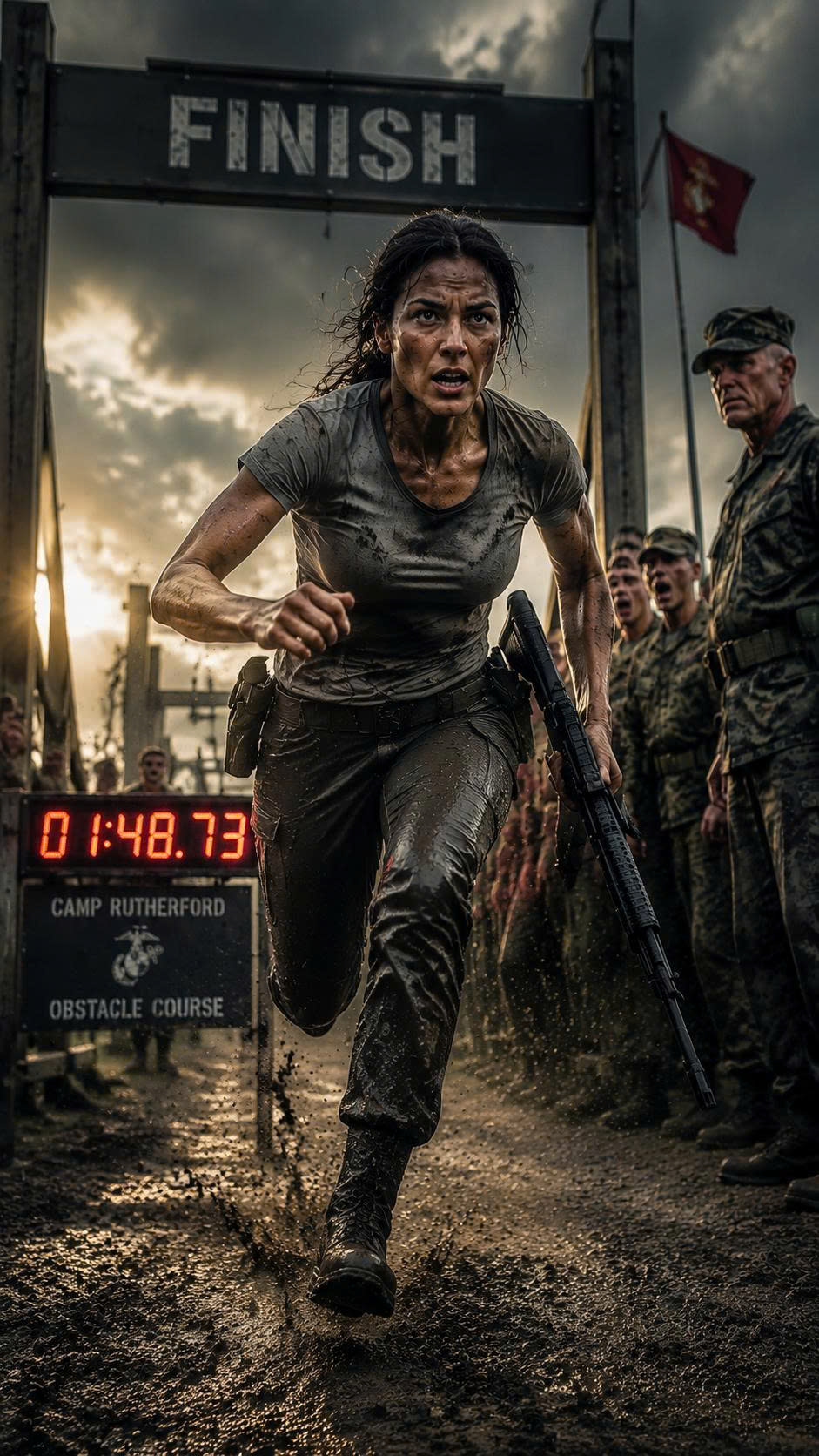
At the far end of the course, a digital timer burned red numbers into the damp air.
02:41.88.
Sergeant Major Boone Maddox stared at it as if the machine had personally insulted him.
“No,” he said.
The range fell silent except for the wind.
Captain Elias Ward lowered his clipboard. “Sergeant Major?”
Maddox didn’t look at him. His jaw worked once. The old scar along his right cheek pulled tight.
“I said no.”
The Marine who had just finished the course stood bent over with both hands on his knees, chest heaving, sweat dripping from his chin onto the gravel. Lance Corporal Dugan Pike was twenty-three, broad-shouldered, fast, and already wearing the grin of a man expecting applause.
It died on his face.
Maddox walked toward him slowly.
Each step was measured.
Not angry.
Worse.
Disappointed.
“You missed two steel plates,” Maddox said.
Dugan swallowed. “Wind pushed the shots, Sergeant Major.”
Maddox turned his head toward the flags snapping violently along the range line. Then he looked back at Dugan.
“The wind pushed your eyes?”
No one laughed.
Behind the safety fence, near a row of parked government trucks, a woman stood with a paper visitor badge clipped to her plain navy jacket.
She had arrived ten minutes earlier in a white maintenance van with a cracked windshield and a toolbox in the passenger seat. Most of the Marines had glanced at her once and dismissed her immediately.
Civilian contractor.
Maybe communications.
Maybe medical inspection.
Maybe somebody’s wife who had taken a wrong turn.
She was not tall. Maybe five foot six. Lean, narrow through the shoulders, with dark hair pulled into a low knot at the back of her neck. No makeup. No jewelry except a thin black watch. Her face had the stillness of a person who had spent years learning not to react.
A gust of wind lifted the edge of her jacket.
For half a second, a faded scar showed above her left wrist.
Then the sleeve fell back into place.
She watched the course without blinking.
Dugan straightened, trying to recover his pride. “I can run it again.”
“You will,” Maddox said. “After lunch. With a rucksack. Since apparently your rifle needs extra company.”
A few Marines shifted their weight.
Captain Ward checked the timer again. “Still the best time this month.”
Maddox’s eyes moved toward him.
Ward stopped writing.
“This month doesn’t matter,” Maddox said. “This course has a record. Fifteen years old. One minute, fifty-nine seconds. Clean hits. Full movement. No penalties.”
He turned, letting his voice carry across the range.
“Every class comes here thinking they’re special. Every class leaves learning the same thing. Speed without discipline is just panic in boots.”
The woman behind the fence tilted her head slightly.
One minute, fifty-nine seconds.
Her eyes moved across the course.
Wall. Low crawl. Window breach. Tire lane. Sandbag lift. Moving targets. Final sprint.
The Marines saw obstacles.
She saw timing.
Angles.
Breathing windows.
Places where fear made men waste half a second.
Maddox raised his arm toward the next group. “Reset!”
The range snapped back to motion. Targets dropped. Safety officers moved down the lanes. Marines checked magazines. Someone cursed under his breath when mud swallowed his glove.
The woman stepped closer to the fence.
A young corporal noticed her.
He was carrying a crate of dummy rounds, his face still soft enough that war had not fully settled into it yet.
“Ma’am, you lost?”
She looked at him.
Not sharply.
Not rudely.
Just directly enough that he stood a little straighter.
“No.”
The corporal shifted the crate against his hip. “Observation area is behind the yellow line.”
She glanced at the yellow line. Her boots were two inches past it.
She stepped back exactly two inches.
The corporal blinked.
“Thanks,” she said.
Her voice was low. Calm. American South under something harder to place.
The corporal nodded and moved away, suddenly unsure why he felt as though he had been corrected.
On the range, the next Marine launched into the course.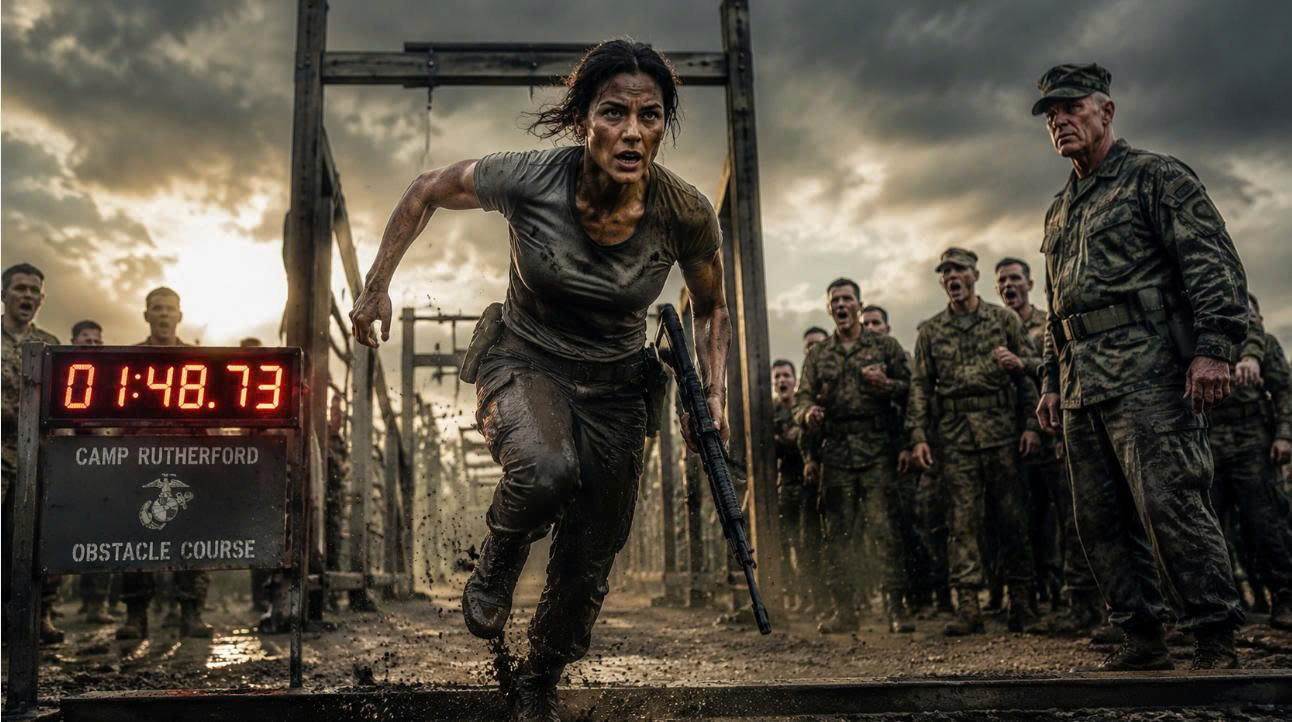
He was fast. Faster than Dugan through the first wall. He vaulted, landed, rolled, came up firing. The first three plates rang clean. Then he hesitated at the window breach.
Only half a second.
Maddox saw it.
So did the woman.
She exhaled through her nose.
The Marine finished at 02:47.13.
Maddox didn’t speak for a long moment.
The silence hurt more than shouting.
The woman’s fingers tapped once against the fence.
Metal clicked beneath her nail.
Captain Ward heard it.
He turned.
Their eyes met.
For an instant, the field seemed to narrow around them.
Ward was thirty-eight, lean, tired around the eyes, with the careful posture of an officer who had learned to hide pain under procedure. A faint burn scar touched the left side of his neck, disappearing under his collar. He had the face of a man who listened more than he spoke and remembered more than people wanted him to.
He looked at her visitor badge.
MARA VANCE
TRAINING SYSTEMS CONSULTANT
His expression changed.
Not recognition.
Concern.
He walked toward the fence.
“You’re early,” he said.
“I was told Marines valued punctuality.”
“They value warning more.”
Her mouth almost moved into a smile. Almost.
Ward lowered his voice. “Does Boone know you’re here?”
“He knows a consultant is coming.”
“That’s not what I asked.”
Another whistle screamed behind him.
Another Marine started the course.
Mara Vance watched the first movement. “He loads too high on the wall.”
Ward glanced back. “What?”
“He’s using his arms like a ladder. Legs should drive first. He’ll burn out before the low crawl.”
The Marine hit the ground beneath the wire and immediately slowed.
Ward said nothing.
Mara’s eyes stayed on the course. “You changed the tire lane.”
“New regulation spacing.”
“No,” she said. “The third tire is four inches wider than the rest.”
Ward stared at her.
A faint crease appeared between his brows.
“You saw that from here?”
She finally looked at him. “Didn’t you?”
Before Ward could answer, Sergeant Major Maddox’s voice cracked across the range.
“Captain.”
Ward turned.
Maddox was staring at them.
At Ward.
Then at Mara.
The old sergeant major began walking toward the fence.
Every Marine nearby found a reason to become quiet.
Maddox stopped three feet from Mara.
Up close, age showed in him only where pain had carved a place to sit. Silver at the temples. Thick hands. A Marine Corps tattoo faded along one forearm. Eyes like cold river stones.
His gaze dropped to her visitor badge.
“Mara Vance,” he read.
She said nothing.
“You the systems consultant?”
“That’s what the badge says.”
Ward’s shoulders tightened.
Maddox looked at him once, then back at her.
“You here to tell Marines how to run a Marine course?”
Mara’s eyes moved past him to the timer.
“No.”
“Good.”
She looked back at him.
“I’m here to find out why they’re losing time.”
A few Marines heard it.
Their heads turned.
Maddox’s face did not change, but something dangerous settled behind his eyes.
“Is that right?”
Mara rested both hands lightly on the fence. “Yes.”
“This is not a software problem, Miss Vance.”
“I didn’t say it was.”
“These are Marines.”
“I noticed.”
A quiet sound passed through the nearby group.
Not laughter.
More like oxygen leaving lungs.
Captain Ward stepped in. “Sergeant Major, Ms. Vance was brought in to review the new sensor integration. Her contract—”
Maddox lifted one hand.
Ward stopped.
Maddox leaned closer to Mara.
“Tell me what you saw.”
Mara looked at the course again.
The current Marine was halfway through, struggling at the sandbag carry.
“Your fastest men attack the obstacles like they’re separate fights,” she said. “They reset their minds after every station. Costs them rhythm. Your shooters hold their breath too long after movement. Costs them vision. The wall takes strength from the arms when it should borrow momentum from the hips. The low crawl is too loud. The window breach creates hesitation because the landing zone is blind from approach. The sandbag station is placed where fatigue peaks, but your men lift like they’re proving something instead of conserving structure.”
Maddox did not blink.
Mara continued.
“And your record is still standing because everyone is chasing the number instead of the course.”
Wind moved between them.
Ward looked at the ground.
Not because he disagreed.
Because he knew Boone Maddox hated being told the truth by someone outside the wire.
The Marine finished.
03:02.44.
Maddox kept staring at Mara.
“You military?”
“No.”
“Ever been?”
“No.”
The lie landed soft.
Too soft.
Ward’s eyes flicked toward her.
Maddox heard it too.
Not the words.
The space behind them.
“You ever run a course like this?”
Mara looked at the mud. The wall. The wire. The timer.
Her fingers curled once around the fence.
Then relaxed.
“Something like it.”
A smile touched Maddox’s mouth.
There was no warmth in it.
“Something like it,” he repeated.
He turned toward the Marines.
“Listen up!”
Every head snapped toward him.
Maddox pointed at Mara without looking at her.
“Ms. Vance here thinks she has identified inefficiencies in our movement.”
A few faces hardened.
One Marine muttered, “Here we go.”
Maddox’s smile widened.
“So let’s be professional. We will receive civilian feedback with humility.”
The way he said humility made it sound like a weapon.
Mara’s gaze stayed steady.
Maddox turned back to her.
“You want to explain it to them?”
“I already did.”
“No,” he said. “You described it. Marines don’t learn from descriptions.”
He stepped closer to the gate and unlatched it.
The metal swung open with a shriek.
The range went still.
Maddox held the gate wide.
“They learn from demonstration.”
Captain Ward moved fast. “Sergeant Major—”
Maddox didn’t look at him. “Problem, Captain?”
“She’s not cleared for course participation.”
“She’s a consultant. Consulting.”
“She’s a civilian.”
Maddox looked at Mara.
“Then she can decline.”
Every eye on the range shifted to her.
Some curious.
Some amused.
Some offended.
Dugan Pike, still angry from his failed record attempt, crossed his arms and looked her up and down.
Not cruelly.
Worse.
Dismissively.
Mara felt it.
She had felt that look in boardrooms, airports, hospital corridors, and once through the dust of a foreign road while a boy with a radio detonator decided whether she was worth killing.
Her face did not change.
Captain Ward lowered his voice. “Mara.”
She glanced at him.
In his eyes, she saw the warning.
Not about the Marines.
About herself.
Her left hand drifted toward her wrist scar.
Stopped.
Dropped.
Then Mara Vance stepped through the gate.
Boots crunched on gravel.
The Marines parted just enough to let her pass.
Not out of respect.
Out of curiosity.
Maddox watched her walk toward the starting lane.
“No gear,” he said.
Mara removed her jacket and handed it to Ward.
Underneath, she wore a plain gray T-shirt tucked into dark field pants. Her arms were lean, roped with old strength. A pale scar crossed the outside of her right shoulder. Another disappeared beneath the collar of her shirt.
The air changed.
Dugan noticed first.
So did Maddox.
Civilian contractors did not usually carry themselves like people who knew exactly where every exit was.
Mara looked toward the weapons table.
A range officer hesitated.
Maddox nodded once.
The man handed her a training rifle.
Mara took it without flourish. Checked the chamber. Checked the weight. Rolled one shoulder. Adjusted her grip.
A Marine near the back whispered, “She knows what she’s doing.”
Dugan heard him.
“Knowing how to hold it isn’t running the course.”
Mara walked to the start line.
The timer reset.
00:00.00.
The wind rose.
Dust crossed her boots.
Maddox stood beside the timer with his arms folded.
“Standard rules,” he said. “All targets hit. Penalties added. No shortcuts. You stop when the course safety calls stop. You fall, you get up. You quit, you walk off my range.”
Mara looked at the first wall.
“Understood.”
Maddox waited.
Maybe for fear.
Maybe for hesitation.
Maybe for the small laugh civilians made when they realized pride had carried them too far.
None came.
Captain Ward stood outside the line, Mara’s jacket folded over one arm.
His face had gone pale.
Not because he thought she would fail.
Because he was beginning to understand why she had come.
Maddox raised his whistle.
“Ready.”
Mara lowered into position.
The range narrowed.
Wind.
Mud.
Steel.
Breath.
For the first time that morning, Sergeant Major Boone Maddox looked uncertain.
The whistle blew.
Mara moved.
Not fast at first.
Clean.
That was what struck them.
She did not explode forward like the Marines had. She seemed to fall into motion, as if gravity had chosen her direction and she simply agreed.
Three strides to the wall.
One foot hit the brace.
Her hips drove up.
Her left hand touched the top.
Not grabbed.
Touched.
She flowed over and dropped on the far side with barely a sound.
Dugan’s arms unfolded.
Maddox’s eyes narrowed.
Mara hit the first firing point, rifle already seated.
Three shots.
Three plates sang.
Not loud.
Final.
She was moving before the echoes died.
At the low crawl, she did not dive. She slid. One shoulder dipped, knees driving behind her in short brutal pulses. Mud streaked across her shirt. Wire trembled above her back but never caught.
A safety officer leaned forward.
His stopwatch hand froze.
Mara came out of the crawl with the rifle tucked tight and turned into the window breach.
No hesitation.
She did not look through the window.
She looked at the shadow beneath it.
At the landing.
At the angle.
She went through sideways, shoulder first, boots clearing the frame by inches, body turning in the air. She landed already facing the next target.
Two shots.
Two rings.
The Marines were no longer quiet because they had been ordered to be.
They were quiet because something impossible was happening in front of them.
Timer: 00:47.19.
Maddox stepped closer to the display.
Mara entered the tire lane.
Her feet touched only where they needed to. No wasted lift. No panic correction. Third tire, wider than the rest, disappeared beneath her as if she had measured it yesterday.
At the sandbag station, she did not muscle the weight up.
She dropped low, hooked it against her body, rose with her legs, and moved.
Her face tightened once.
Pain flashed across it.
There and gone.
Ward saw it.
His fingers closed around her jacket.
The old injury.
The one no medical board had ever fully written down.
Mara carried the sandbag to the mark, dumped it clean, turned, fired twice from a knee, and struck both moving targets as they crossed between black panels.
Timer: 01:22.06.
Someone whispered, “No way.”
Maddox heard it.
He did not correct him.
Mara hit the final sprint.
That was when the course changed.
Until then, she had been efficient.
Now she became violent.
Not wild.
Not reckless.
Violent like a locked door kicked open by someone who had run out of patience.
Her boots tore through the mud. Her breath came sharp. Her eyes fixed on the last barricade where the final three plates waited at staggered heights.
The wind shoved hard from the west.
Every Marine knew that gust.
It had stolen shots all morning.
Mara dropped behind the barricade, but instead of settling into the standard kneel, she shifted half a foot left, braced against the post, and fired between heartbeats.
One.
Two.
Three.
Three plates snapped backward.
She rose.
Crossed the finish line.
The range officer slapped the timer.
Red numbers froze.
01:48.73.
For three seconds, no one moved.
The wind pushed dust across the display as if trying to erase it.
It did not erase.
01:48.73.
Fifteen years gone.
Broken by more than ten seconds.
Mara stood beyond the finish line, chest rising and falling, rifle angled safely down, mud on her cheek.
She looked smaller now somehow.
Not weaker.
Farther away.
As if some part of her had remained inside the course and had not yet returned.
Then Dugan Pike said the wrong thing.
“That’s not possible.”
Mara turned her head.
Dugan stepped forward, face flushed. “She knew the layout.”
“So did you,” Maddox said.
Dugan ignored him. “No civilian runs that clean. Not cold.”
Mara’s eyes held on him.
There was no triumph in them.
That unsettled him more than arrogance would have.
Maddox walked to the timer.
Looked at the numbers.
Then at Mara.
His expression had changed.
Not softened.
Sharpened.
“Who trained you?”
Mara handed the rifle back to the range officer.
“No one you’d know.”
Maddox took one step closer.
“I know a lot of ghosts.”
Ward moved toward them. “That’s enough.”
Maddox did not look away from Mara.
“Not yet.”
Mara wiped mud from her jaw with the back of her hand. Her fingers came away trembling.
Only Ward saw.
Maddox saw where Ward looked.
And then he saw it too.
The tremor was not exhaustion.
It was memory.
A siren wailed somewhere beyond the administration buildings.
Not part of the exercise.
Every Marine turned.
The sound rose across Camp Rutherford, thin and urgent.
A black SUV came hard around the access road, tires spitting gravel. It stopped near the fence before the driver had fully braked. A major in dress blues stepped out, face tight, phone pressed to his ear.
He searched the range.
Found Captain Ward.
Then Mara.
His expression broke.
Ward’s voice dropped. “What happened?”
The major lowered the phone.
No one spoke.
Even the wind seemed to wait.
The major looked at Mara Vance as if her name had just become dangerous.
“Ma’am,” he said, “we need to talk about Operation Glass Harbor.”
Mara did not move.
But the color left her face.
Captain Ward closed his eyes for half a second.
Sergeant Major Maddox heard the name and went still.
Dugan looked from one officer to another, confused.
“What’s Glass Harbor?” he asked.
No one answered him.
Mara stared at the major.
Her voice came out quiet.
“I buried that operation.”
The major swallowed.
“Yes, ma’am.”
He looked past her, toward the young Marines standing in the mud, toward the timer still glowing with the record she had just shattered.
Then he said the words that turned the training field into something colder than war.
“Someone dug it up.”
Chapter Two — The Record Was Not the Problem
The room they put her in had no windows.
Camp Rutherford called it a briefing room, but Mara knew an interrogation room when she saw one. Fluorescent lights hummed overhead. The walls were painted government beige. A long table divided the space into two uneven countries: the side with questions, and the side expected to bleed answers.
Mara sat on the wrong side.
Her visitor badge lay on the table.
Mud had dried along the edge of her sleeve. A small cut on her knuckle had opened during the course, and blood had traced a thin line toward her wrist before clotting there.
Captain Elias Ward stood near the door with his arms crossed.
Sergeant Major Boone Maddox stood behind the empty chair opposite Mara.
The major who had arrived from headquarters was named Samuel Rusk. Forty-six. Clean uniform. Careful eyes. The kind of officer who looked calm because he had trained every human part of himself to wait until later.
He placed a sealed folder on the table.
No one touched it.
Mara looked at the folder the way some people looked at a coffin.
Rusk cleared his throat. “Before we begin—”
“Don’t,” Mara said.
The word landed flat.
Rusk paused.
Mara leaned back, but her shoulders stayed tight. “Don’t begin like this is clean.”
Ward looked down.
Maddox studied her.
Rusk opened the folder anyway.
Inside were photographs.
He slid the first one across.
A desert road at night.
Burned vehicles.
A drone image, grainy and cold.
Mara did not look away.
Rusk slid the second.
A younger Mara in combat gear, face half-covered with dust, eyes bright with a fury she no longer wore in public.
The third photograph showed twelve people lined against a wall.
Faces blurred.
Hands zip-tied.
A red circle marked one figure near the center.
Mara’s fingers pressed into her palm beneath the table.
Maddox noticed.
Rusk tapped the photograph. “This man resurfaced three days ago.”
Mara’s voice was barely audible. “No.”
“Yes.”
“He died in Al Mazrah.”
“We believed that.”
“I watched the building fall.”
“You watched part of it fall.”
Her eyes lifted to his.
Something in the room lost temperature.
Rusk continued carefully. “His name is Arman Valez. Former intelligence asset. Later turned broker. Responsible for the leak that compromised Glass Harbor.”
Maddox’s face hardened. “You’re saying the man who got her team killed is alive.”
Mara’s gaze snapped to him.
Not because he was wrong.
Because he knew.
Maddox did not apologize.
Rusk nodded once. “Alive, moving under a new identity, and possibly connected to a security breach involving this base.”
Ward stepped forward. “This base?”
Rusk slid another image across the table.
A satellite still of Camp Rutherford’s training grid.
Mara’s range course was highlighted.
So were the sensor towers.
So was the ammunition depot.
Ward’s mouth tightened. “When was this taken?”
“Forty-eight hours ago.”
“By who?”
Rusk did not answer.
That was answer enough.
Mara stared at the image.
The course.
The wall.
The wire.
The lane she had just run.
Something inside her rearranged itself.
Not fear.
Recognition.
“He wasn’t watching the base,” she said.
Rusk looked at her. “What?”
She touched the highlighted training course.
“He was watching this.”
Maddox’s brow lowered. “Why would a dead intelligence broker care about a Marine obstacle course?”
Mara’s fingers hovered over the image.
She saw the line of movement again.
Wall.
Crawl.
Window.
Tire lane.
Sandbag.
Final barricade.
But now she saw something else.
Spacing.
Angles.
Sight lines.
Kill corridors.
Her stomach tightened.
“Because it isn’t just a course,” she said.
Ward moved closer.
Mara looked up.
Her face had become very still.
“It’s a rehearsal.”
Silence filled the room.
Rusk’s phone buzzed once on the table.
No one reached for it.
Maddox leaned over the photograph. “For what?”
Mara stared at the final barricade in the image.
At the three staggered targets.
At the west wind line.
Then she looked at Ward.
He already knew.
She saw it in the way his face had gone gray.
Mara spoke slowly.
“For an assault on someone who thinks they’re protected by Marines.”
Rusk finally picked up his phone.
Read the message.
His lips parted.
Ward said, “Major?”
Rusk looked at them.
“The Secretary of Defense arrives here tomorrow morning.”
Maddox swore under his breath.
Mara pushed back from the table.
The chair legs screamed against the floor.
Ward reached for her arm. “Mara—”
She pulled away before he touched her.
Not violently.
Instinctively.
His hand stopped in the air.
The small moment struck harder than shouting.
Maddox saw it.
So did Rusk.
Mara looked at the folder again.
At the ghosts inside it.
Then she looked at the door.
“You brought me here for the sensors,” she said.
Rusk closed the folder.
“No.”
Ward’s eyes cut to him.
Rusk did not flinch.
“We brought you here because three people in Washington still believe you are the only operator who ever understood how Valez thinks.”
Mara gave a short laugh.
There was no humor in it.
“I was never an operator.”
Maddox’s voice was rough. “Then what were you?”
Mara turned to him.
For the first time, something like anger broke through.
“I was the person they sent when operators stopped coming back.”
The room went silent.
Outside, boots passed in the hallway. Young voices. A burst of laughter. Someone alive, unaware how close the past had moved.
Mara looked down at her hands.
They had stopped trembling.
That frightened her more.
Rusk said, “We need your help.”
“No.”
“Mara—”
“No.”
Ward stepped closer. “Listen first.”
She looked at him then, and whatever history lived between them moved like a shadow across the table.
“You don’t get to say that to me.”
Ward absorbed it without defense.
Maddox looked from one to the other.
There it was.
The thing no one had said on the range.
Not romance.
Not exactly.
Something older.
Worse.
Survival shared badly.
Rusk opened the folder again, slower this time.
He removed one final photograph.
Did not slide it across.
He simply turned it around.
Mara looked.
The photograph showed a young Marine.
Early twenties.
Brown skin.
Close-cropped hair.
A shy smile.
The kind of smile men still had before the institution taught them how to hide softness.
Mara’s breath stopped.
Ward whispered, “No.”
Rusk’s voice lowered. “Corporal Jonah Reyes. Communications specialist. Disappeared last night from the north service road. His access card was used at 0213 near the sensor control hub.”
Mara stared at the face.
The room blurred at the edges.
Rusk continued, “He is alive as of six hours ago. We received a proof-of-life clip.”
Maddox’s hands curled on the chair back.
“That’s my Marine.”
Mara did not look away from the photograph.
In it, Jonah Reyes stood beside a younger woman in a graduation gown. His sister, maybe. One arm around her shoulders. Proud but embarrassed by the camera.
Mara swallowed.
Her voice came out different.
Not cold now.
Hollow.
“Valez doesn’t take hostages unless he wants a door opened.”
Rusk nodded. “We believe he wants you.”
Mara closed her eyes.
For one second, the briefing room disappeared.
In its place: smoke, broken concrete, a man laughing over a radio, and Elias Ward screaming her name from somewhere beneath fire.
When she opened her eyes, Sergeant Major Boone Maddox was watching her with the first trace of something that looked like respect.
Not for the record.
For the wound.
Mara picked up Jonah’s photograph.
Her thumb touched the edge but not his face.
“What did Valez say?”
Rusk hesitated.
Mara looked at him.
The old stillness returned.
“Say it.”
Rusk placed a small recorder on the table and pressed play.
Static filled the room.
Then a man’s voice emerged, smooth and intimate, speaking as if he stood just behind Mara’s shoulder.
“Hello, Sparrow.”
Ward’s face tightened.
Maddox looked at Mara.
Sparrow.
The name struck her like a hand across the mouth.
The recording continued.
“I heard you left the sky and started fixing machines. That made me sad. You were always so much more beautiful when falling.”
Mara’s fingers tightened around Jonah’s photograph.
Valez laughed softly.
“Bring her to the old course before sunrise. No armor. No team. No heroes. Or the boy learns why records are meant to be broken.”
The recorder clicked off.
No one spoke.
Mara looked at the table.
Then at Ward.
Then at Maddox.
Outside, thunder rolled over Camp Rutherford.
The storm that had been waiting all morning finally reached the base.
Rain struck the roof in hard silver bursts.
Maddox stepped away from the chair.
His voice was low.
“What old course?”
Mara stood.
The fluorescent light sharpened every scar on her arms.
“The one they buried under the east ridge.”
Ward’s face changed.
Rusk whispered, “You know it?”
Mara looked toward the wall, but her eyes had gone somewhere far beyond it.
“Yes.”
Maddox asked, “Why would he choose that?”
Mara folded Jonah’s photograph once, carefully, and slipped it into her pocket.
“Because that’s where I died the first time.”
And before anyone could stop her, she walked to the door.