CHAPTER ONE — THE EMPTY ARM
The music started.
And my father was not there.
That was the first thing I noticed.
Not the flowers.
Not the candles.
Not the hundred guests turning in their seats beneath the warm glow of the glass chapel.
Not the string quartet playing the song I had chosen six months earlier because my father once told me it reminded him of my mother.
Only one thing.
The empty space beside me.
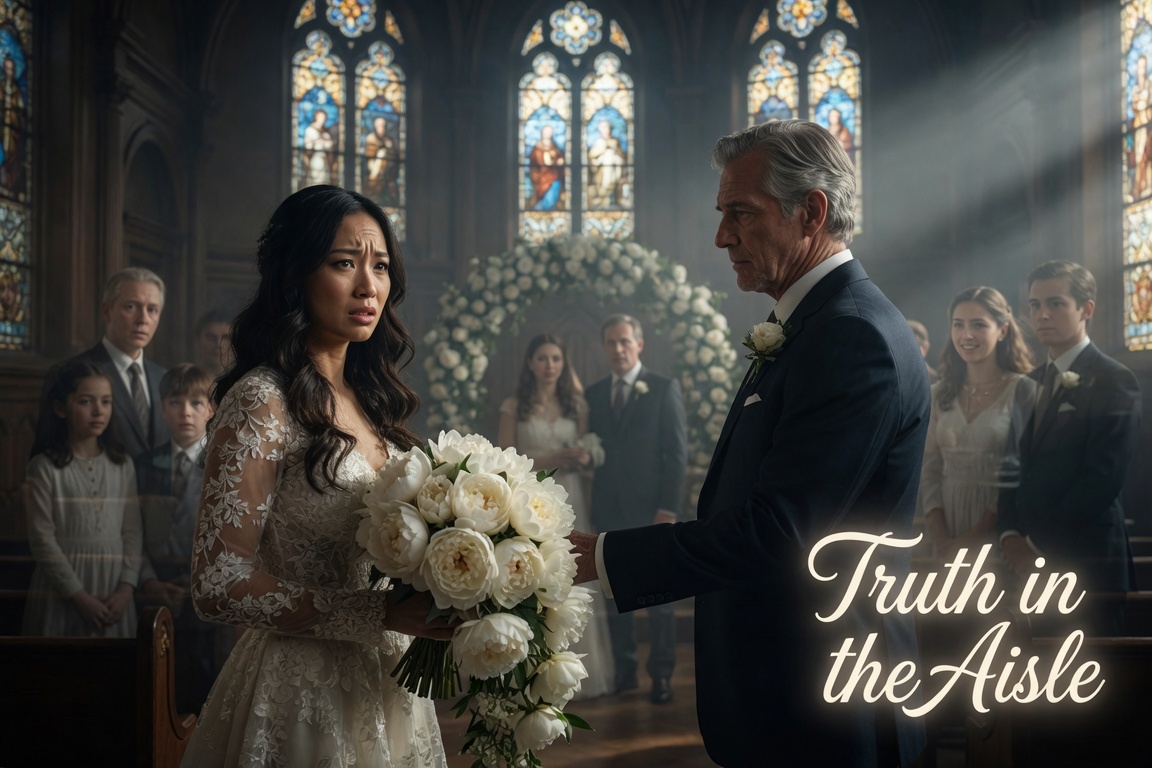
I stood at the back of the aisle in a dress that took eleven months to design, holding a bouquet of white garden roses that had cost more than my first car payment.
The doors were open.
The aisle stretched ahead.
My future waited at the other end.
But the person who was supposed to walk me there had disappeared.
The wedding coordinator approached with a smile that was already fading.
“Emma?”
I looked at her.
She lowered her voice.
“Your father hasn’t returned yet.”
Returned.
Not arrived.
Returned.
A strange word.
Like he had been somewhere else.
Like he had left.
I glanced toward the side entrance.
Nothing.
My hands tightened around the bouquet.
The lace on my gloves pressed into my skin.
“Where is he?”
The coordinator hesitated.
That hesitation told me more than an answer would have.
“Emma…”
The chapel doors at the far end suddenly opened.
Everyone turned.
My heart jumped.
For one impossible second, I thought:
There he is.
He remembered.
He’s coming.
Then I saw my sister.
Claire.
She stepped into the chapel wearing a pale blue dress, her blonde hair curled perfectly, one hand resting lightly on my father’s arm.
My father.
Richard Hayes.
My father was walking my sister down the aisle.
Not me.
The music did not stop immediately.
That was the cruelest part.
The violin continued.
Beautiful.
Elegant.
Completely unaware that my wedding had just cracked open.
A murmur moved through the guests.
Someone whispered.
Someone gasped.
My mother stood halfway from her chair.
“Richard?”
My father stopped.
Only for a second.
Then he looked toward me.
And I saw it.
The expression every child recognizes before anyone speaks.
Regret.
But not enough regret to undo the choice.
Claire looked uncomfortable.
Almost.
Almost.
Then she leaned closer to him.
And my father kept walking.
Toward me.
But not with me.
He reached the end of the aisle beside Claire and gently released her arm.
The chapel was silent.
My fiancé, Daniel, stood near the altar, staring at my father with disbelief.
I looked at my dad.
Waiting.
For an explanation.
For an apology.
For anything.
Instead, he whispered:
“She needed me.”
Four words.
That was all.
My wedding day.
My father’s explanation.
She needed me.
I looked at Claire.
She looked down.
For once, she did not look like the favorite.
She looked like someone who knew she had taken something.
My father stepped toward me.
“Emma—”
I moved back.
Not dramatically.
Not enough for anyone to call it a scene.
Just one step.
A small movement.
A boundary.
His face changed.
“Emma.”
I swallowed.
“You were supposed to walk me.”
“I know.”
“No.”
My voice came out quieter than I expected.
“You don’t.”
The chapel was still.
Every person who had come to celebrate me was now watching me decide whether I would break.
I looked at the empty space beside me.
The space where my father should have been.
Then I looked down the aisle.
Daniel was waiting.
Not perfectly.
Not knowing what to do.
But waiting.
And suddenly I understood something.
The person who should have carried me forward had chosen not to.
That did not mean I stayed behind.
I lifted my bouquet.
I stepped into the aisle.
Alone.
One step.
Then another.
The sound of my heels against the floor was louder than the music.
Halfway down, something unexpected happened.
A chair moved.
Third row.
Near the window.
A man stood.
The entire chapel seemed to shift.
He was older.
Late sixties maybe.
Silver hair.
Dark suit.
A face I did not recognize.
But my father did.
My father froze.
The color drained from his face.
The stranger walked into the aisle.
Not quickly.
Not dramatically.
Like he had been waiting for the right moment.
He stopped beside me.
Looked at my father.
Then looked at me.
And said quietly:
“May I?”
I stared at him.
“I’m sorry?”
His expression softened.
“I know I’m late.”
The words made no sense.
Then he extended his arm.
“Your father was supposed to give you away.”
A pause.
“But someone should still walk beside you.”
The chapel held its breath.
My father whispered:
“Thomas.”
The stranger looked at him.
“Hello, Richard.”
And for the first time that morning…
my father looked afraid.
CHAPTER TWO — THE MAN MY FATHER NEVER MENTIONED
His name was Thomas Bennett.
And my father had spent thirty years pretending he did not exist.
I learned that later.
Much later.
Because at that moment, standing in the aisle of my own wedding, all I knew was that a stranger had offered me the thing my father had taken away.
An arm.
A choice.
A moment where I did not have to walk alone.
I looked at Daniel.
He nodded.
Just once.
A quiet permission.
A quiet promise.
So I placed my hand on Thomas’s arm.
And we walked.
Together.
The whispers followed.
Of course they did.
People love mystery more than they love kindness.
I heard fragments.
“Who is that?”
“Does Emma know him?”
“Richard looks sick.”
I did not look back.
Not until I reached Daniel.
Not until I stood beneath the flowers I had chosen.
Not until the officiant began speaking.
Then I saw my father sitting beside Claire.
My mother beside him.
And Thomas in the third row.
Watching.
Not like a guest.
Like someone remembering something.
My name is Emma Hayes.
I was thirty-five years old on my wedding day.
I was the daughter everyone described as “easy.”
That was never a compliment.
Easy children are the ones adults ask to understand.
Easy children do not need rescuing.
Easy children can wait.
My younger sister Claire was three years younger.
She was beautiful in the effortless way people notice immediately. Golden hair. Bright smile. A talent for making strangers feel like they had known her forever.
When Claire entered a room, people turned.
When I entered a room, people asked if I could help.
Mom called us different.
“Claire feels everything,” she said.
“Emma handles everything.”
And that became our family language.
Claire needed.
I handled.
Claire struggled.
I adjusted.
Claire made mistakes.
I understood.
The first time I realized there was a difference was when I was twelve.
I had won a statewide science competition.
My project was about water filtration systems.
I spent six months building it.
The award ceremony was on a Saturday morning.
My father promised he would come.
“I wouldn’t miss it,” he said.
I believed him.
Because children believe promises before they learn patterns.
That same morning, Claire called from her soccer tournament.
She had twisted her ankle.
Nothing serious.
But she was crying.
My mother called my father.
He left my award ceremony before my name was announced.
I stood on stage holding the certificate while the audience applauded.
My seat in the front row was empty.
When I got home, Dad hugged me.
“I’m proud of you.”
I asked:
“Were you proud enough to stay?”
He froze.
Only for a second.
But children notice seconds.
He said:
“Claire needed me.”
The same sentence.
Different year.
Different dress.
Same wound.
The wedding reception was supposed to be perfect.
That was the word everyone used.
Perfect.
The ballroom overlooked the ocean. White flowers hung from the ceiling. Candles reflected in glass tables. The waves outside crashed against the rocks beneath the sunset.
I should have been happy.
Instead, I was sitting at the head table wondering why my father had chosen my sister on the one day he knew I could not pretend it did not hurt.
Daniel reached for my hand.
“You okay?”
I smiled automatically.
That was another thing I had mastered.
Making pain look organized.
“I’m fine.”
He looked at me.
“No, you’re not.”
I looked down.
The diamond ring on my finger caught the candlelight.
“I don’t know why I’m surprised.”
Daniel frowned.
“Because you expected your father to show up.”
The sentence hurt because it was true.
Across the room, Thomas sat alone.
He had declined the head table.
Declined introductions.
Declined attention.
The mysterious stranger who somehow knew my father better than I did.
I watched him for a moment.
Then stood.
Daniel looked up.
“Where are you going?”
“To ask a question.”
Thomas was standing near the balcony doors when I approached.
The ocean wind moved his silver hair slightly.
“You know my father.”
It was not a question.
He looked at the waves.
“Yes.”
“How?”
A long silence.
Then:
“Your father and I were best friends.”
I stared at him.
“Were?”
His jaw tightened.
“We were brothers.”
The words surprised me.
“What happened?”
Thomas looked back toward the ballroom.
At my father.
At Claire.
At the family portrait they were creating without me.
“Your father made a choice.”
My stomach tightened.
“What choice?”
Thomas looked at me.
“The same one he made today.”
The ocean crashed below us.
“He chose the person who needed him most.”
I looked away.
Because hearing someone else say it hurt more.
Thomas continued.
“Your father was not always like this.”
“Then what happened?”
His eyes softened.
“Fear.”
I frowned.
“Fear?”
“Yes.”
He looked toward the ballroom.
“Your father spent his entire life believing love meant preventing disappointment. So when someone was upset, he fixed it. When someone was angry, he repaired it. When someone cried, he surrendered.”
“That sounds like kindness.”
“It does.”
A pause.
“Until the wrong people learn they can use it.”
I looked at him.
“And Claire?”
Thomas sighed.
“Claire learned early that your father could not handle seeing her hurt.”
The words landed.
Because I knew.
Everyone knew.
Just nobody said it.
The next morning, I found the letter.
Not because I was searching.
Because Thomas brought it.
We met at a quiet coffee shop two blocks from the hotel. The morning was gray. The city moved around us. Cars splashed through puddles. People hurried with umbrellas. The world had continued despite my wedding breaking into something else.
Thomas placed an envelope on the table.
My name was written on it.
Emma.
My handwriting recognition failed before my heart accepted it.
“Dad wrote this?”
Thomas nodded.
“When?”
“Two weeks before your wedding.”
I stared.
“Why do you have it?”
“Because he asked me to keep it.”
“Why?”
Thomas looked down.
“Because he was afraid.”
That word again.
Fear.
The family’s favorite inheritance.
I opened the envelope.
The first line destroyed me.
Emma,
If you are reading this, something happened that I was too afraid to prevent.
I stopped.
The coffee shop blurred.
Thomas looked away.
Giving me privacy.
I continued.
Your whole life, I told myself I was protecting people from pain. But sometimes protection is just another name for avoiding courage.
I should have walked beside you.
Not because tradition demanded it.
Because you deserved to know you were chosen.
My hand covered my mouth.
The letter continued.
Claire has always been afraid of being forgotten. I know that because I gave her that fear. I taught her that love arrives when she is hurting. I taught her that being in crisis guarantees attention.
And I taught you the opposite.
I taught you that being strong means needing nothing.
I was wrong.
My eyes filled.
The final paragraph was shorter.
Thomas knows the truth about my past. He knows the truth about our family. If I failed to tell you myself, listen to him.
Because he loved me enough to tell me when I was wrong.
Something inside me stopped.
The letter ended:
I hope you forgive me.
Not because I deserve it.
Because I want you to be free.
Dad.
I looked at Thomas.
“What truth?”
He was quiet.
Then he said:
“Your father and I built our first company together.”
I blinked.
“What?”
“Before your mother. Before Claire. Before everything.”
He explained.
My father had been struggling financially when I was young. Thomas helped him start a construction company that eventually became successful. Years later, Thomas left after discovering Richard had been secretly transferring ownership shares to Claire’s future.
“Why would he do that?”
Thomas looked uncomfortable.
“Because your father believed Claire needed security.”
“And me?”
Thomas looked at me.
“You were the one person he thought would be okay.”
The sentence almost made me angry.
Almost.
Because it was the same poison wrapped differently.
Strong enough.
Responsible enough.
Fine.
Thomas reached into his briefcase.
He removed another document.
“Your father changed that six months ago.”
I looked down.
A trust agreement.
My name.
“What is this?”
“Your father realized too late that he had spent years rewarding dependence and ignoring strength.”
My fingers moved across the paper.
“He left me this?”
“Yes.”
“Why?”
Thomas’s voice softened.
“Because he finally understood something.”
“What?”
“That the child who needs less help is often the child who needed the most love.”
The coffee shop became silent.
Outside, rain began again.
Soft.
Steady.
Almost like the wedding day.
I went home that afternoon and looked at my wedding photographs.
Hundreds of them.
The flowers.
The dress.
The ocean.
Daniel smiling.
Thomas beside me.
My father in the background.
For years, I thought the worst moment of my wedding was when my father failed to walk me down the aisle.
I was wrong.
The worst moment was realizing I had spent my whole life waiting for someone to finally choose me.
And the most important moment was realizing I could choose myself.
The stranger in the third row had not replaced my father.
No one could.
He had simply reminded me that being abandoned in one doorway did not mean I had to stand there forever.
The next morning, I called my father.
He answered on the second ring.
“Emma.”
His voice sounded old.
“I read the letter.”
Silence.
Then:
“I’m sorry.”
I closed my eyes.
For years, I imagined that apology would fix everything.
It did not.
But it mattered.
“Why did you do it?”
A long pause.
“Because Claire asked.”
The honesty hurt.
“What did she say?”
“That she was scared. That she felt like everyone was moving forward without her.”
“And what did you think I felt?”
Silence.
Longer.
“I didn’t ask.”
My throat tightened.
“No.”
“I know.”
The simplicity of it almost hurt more.
“I spent years thinking because you were capable, you were okay.”
“You were wrong.”
“Yes.”
Another pause.
“I was wrong.”
I sat on the edge of my bed.
The wedding dress hung in the closet.
Beautiful.
Expensive.
A symbol of a day that changed everything.
“Dad.”
“Yes?”
“I don’t know if I can forgive you yet.”
“I know.”
“But I want to try.”
His breath shook.
“Thank you.”
“No.”
I looked out the window.
“I’m not doing it for you.”
A pause.
“I’m doing it because I don’t want your choices to decide who I become.”
And for the first time in my life…
my father had no answer.