The rain came down hard outside the Marlowe Hotel that evening.
Black umbrellas opened beneath the golden entrance lights. Guests in tuxedos and silk dresses stepped carefully from luxury cars, laughing as photographers captured every perfect arrival.
Inside, a wedding was about to begin.
White roses lined the lobby. Crystal lights reflected on the marble floor. A sign near the ballroom doors read:
“Celebrating The Wedding Of Clara Whitmore & James Ellis.”
Near the entrance, an elderly man stood under the edge of the canopy, holding a worn violin case against his chest.
His name was Arthur Bell.
His coat was old. His shoes were soaked. Rainwater dripped from the ends of his gray hair.
He was not there for the wedding.
He had been playing violin three blocks away when the storm started. By the time he reached the hotel, his hands were stiff from the cold, and his only thought was to protect the instrument he had owned for forty years.
Arthur stepped quietly into the lobby.
A security guard noticed him immediately.
“Sir,” the guard said, walking over, “this is a private event. You cannot stay here.”
Arthur lowered his eyes.
“I only need a few minutes to dry my violin.”
The guard hesitated, but a hotel coordinator in a black suit leaned in and whispered, “He will ruin the atmosphere.”
Several wedding guests turned to look.
One woman tightened her grip on her purse. Another man smirked at Arthur’s wet coat.
Arthur heard them.
He did not argue.
He simply nodded.
“I understand.”
The guard pointed gently toward the doors.
“I’m sorry, sir. You’ll need to leave.”
Arthur walked toward the entrance, then stopped near a quiet corner beside the grand piano.
He set the violin case down.
For a moment, he just looked at it.
Then he opened it carefully, wiped the wood with the corner of his sleeve, and lifted the violin to his shoulder.
He played softly.
Not for money.
Not for attention.
Just to make sure the instrument was still warm enough to survive the rain.
The melody was gentle and old, almost like a lullaby.
In the bridal preparation room down the hallway, Clara Whitmore froze.
A makeup artist was pinning her veil. Her bridesmaids were laughing softly behind her.
But Clara stopped breathing for a second.
“That song…”
The room went quiet.
Her maid of honor looked at her. “Clara?”
Clara stood slowly, tears already forming.
“My father used to play that.”
Before anyone could stop her, she lifted the edge of her dress and hurried into the hallway.
The music grew clearer with every step.
In the lobby, Arthur had just lowered the violin.
The guard was waiting by the door.
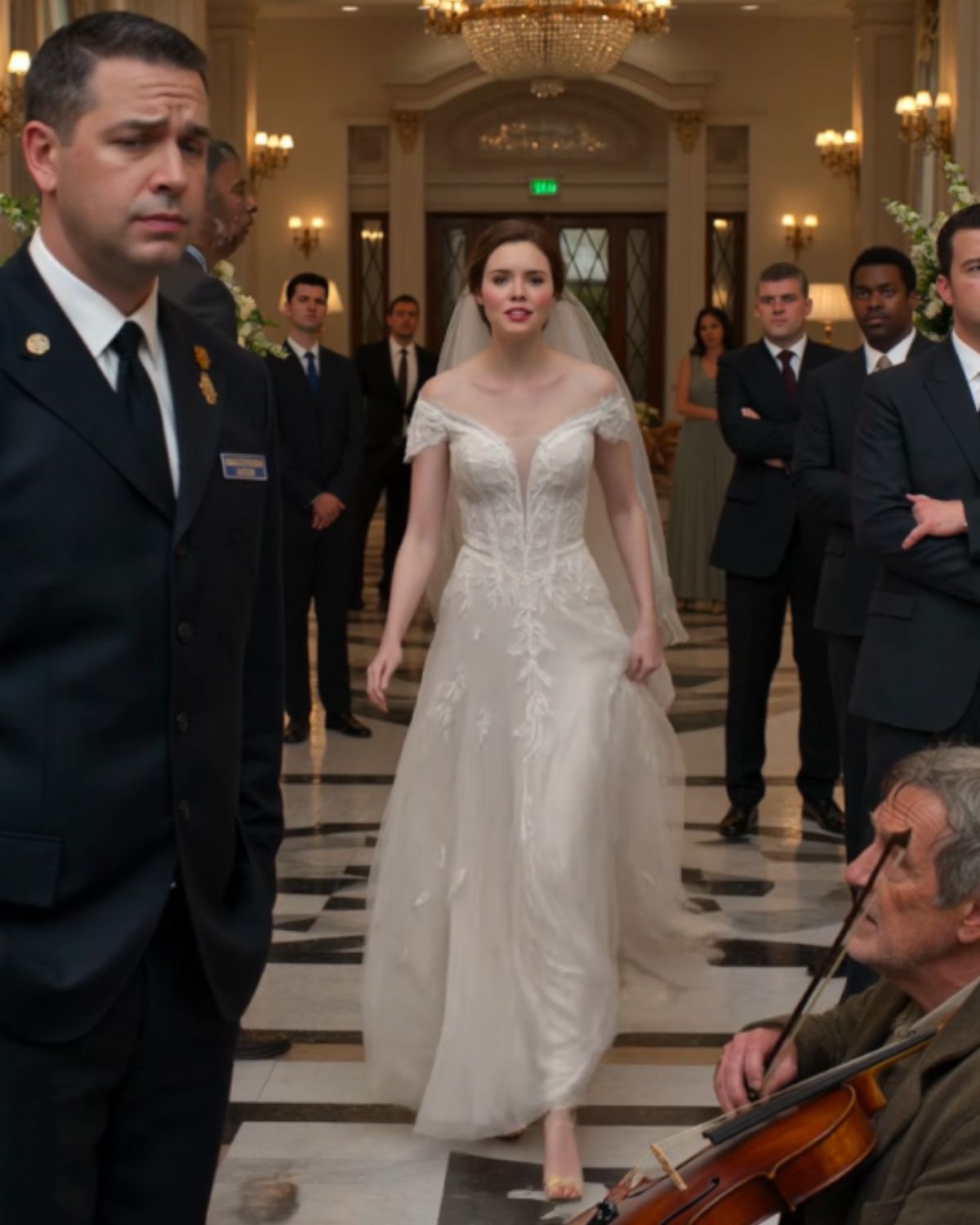
Then the bride appeared.
Everyone turned.
Clara walked straight toward the elderly musician, her white dress moving across the marble floor like light.
Her voice broke.
“Please… don’t stop playing.”
Arthur looked confused.
“I’m sorry, miss. I was just leaving.”
Clara shook her head, tears falling now.
“My father used to play that song for me before he passed away.”
The lobby became completely silent.
No one whispered.
No one laughed.
The coordinator’s face changed first. Then the guests who had stared at Arthur’s coat looked down at the floor.
Clara stepped closer.
“He played it every night when I was little,” she said. “And I kept wishing he could be here today.”
Arthur held the violin gently at his side.
“I didn’t know,” he said.
Clara turned toward the staff.
“He stays,” she said. “He is my guest.”
No one argued.
A few minutes later, Arthur stood inside the wedding ballroom near the grand piano.
The rain was still hitting the windows outside, but inside, no one moved.
Clara stood at the entrance with her bouquet in her hands.
Arthur raised the violin.
And the same melody filled the room.
This time, it did not sound like a street musician trying to stay dry.
It sounded like a father’s love finding its way back into the room.
Clara closed her eyes as the first notes carried through the ballroom.
Her mother began to cry in the front row.
James, waiting at the aisle, wiped his face and smiled.
Arthur played with quiet dignity, his wet coat now replaced by a dry black jacket someone had brought from the staff room.
When the final note faded, nobody clapped at first.
They just sat in the kind of silence that means something sacred has happened.
Then Clara walked over and took Arthur’s hand.
“Thank you,” she whispered.
Arthur bowed his head.
Outside, he had been treated like a problem.
Inside, he became part of the memory everyone would carry forever.
Because sometimes the person others try to remove from the room is the one carrying the only thing the heart came there to hear.