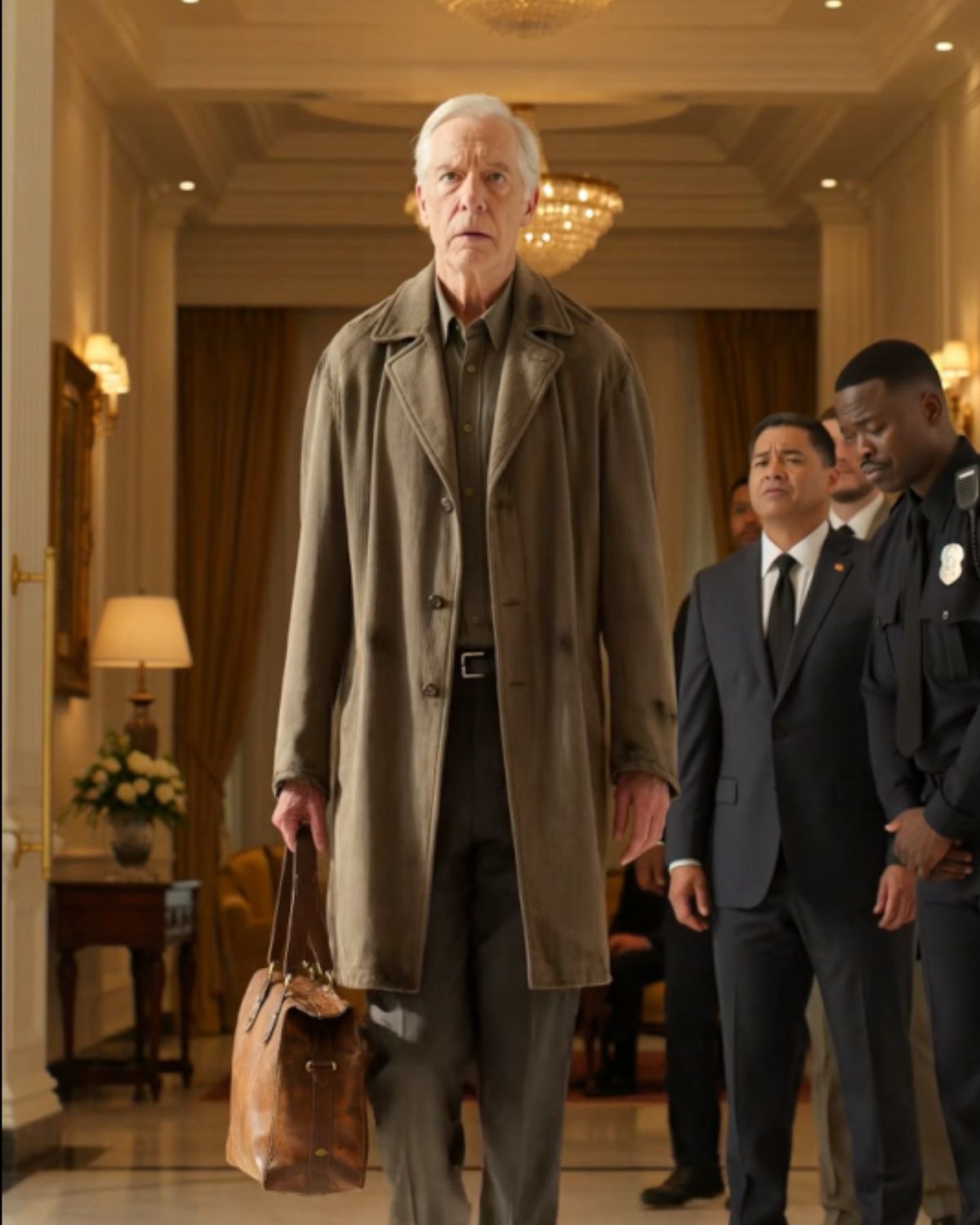
The afternoon sun reflected off the glass doors of the Halston Grand Hotel.
Expensive cars arrived beneath the entrance canopy. Bellboys carried polished luggage. Guests in tailored coats walked across the marble steps like they belonged there.
Near the edge of the driveway, an elderly man paused with a small old bag in his hand.
His name was Thomas Whitaker.
His coat was worn at the sleeves. His shoes were clean, but cracked from years of use. He moved slowly, not because he was lost, but because his knees no longer trusted him the way they used to.
He looked up at the hotel for a long moment.
Then he stepped inside.
The lobby was bright and elegant. Golden lights hung from the ceiling. Fresh flowers stood near the reception desk. The marble floor still curved in the same pattern he remembered.
Thomas smiled faintly.
He walked toward a quiet chair near the window and sat down with a tired sigh.
A hotel manager noticed him within seconds.
The manager’s name was Derek Lane. His suit was sharp, his shoes were polished, and his eyes moved quickly from Thomas’s old coat to his small bag.
“Sir,” Derek said coldly, “this area is for our guests.”
Thomas looked up politely.
“I understand. I only need a few minutes to rest.”
“Do you have a reservation?”
“No.”
“Are you meeting someone here?”
Thomas glanced toward the lobby, as if searching through time.
“Not exactly.”
Derek’s expression hardened.
Several guests began to watch.
Thomas placed both hands on the handle of his bag.
“I used to know this place,” he said softly.
Derek gave a thin smile.
“I’m sure you did. But we can’t have people sitting in the lobby without purpose.”
He turned toward security.
“Please escort him outside.”
A young employee at the reception desk looked up.
Her name was Maya Chen, and she had only been working at the hotel for three months. She watched as the security guard approached Thomas.
The old man did not argue.
He simply stood, slowly, carefully, with the small bag in one hand.
But before he moved toward the door, his eyes stopped on the large framed wall near the hallway.
The hotel history wall.
Old photographs. Opening-night newspaper clippings. Architectural drawings. A ribbon-cutting image from 1978.
Maya followed his gaze.
Something about the way he looked at those pictures made her step closer.
Not like a guest admiring history.
Like a man recognizing an old friend.
She walked to the wall and read the small brass plate beneath a black-and-white photo.
Architectural Design: Thomas E. Whitaker.
Her breath caught.
She looked at the photograph.
A younger man stood in front of blueprints, sleeves rolled up, one hand resting on a model of the hotel lobby.
The same eyes.
The same quiet posture.
Maya turned slowly.
“Wait…”
Everyone looked at her.
She pointed to the wall.
“That’s him.”
Derek frowned. “What?”
Maya’s voice trembled.
“He designed this hotel.”
The lobby went silent.
The security guard stopped beside Thomas.
Guests turned toward the history wall. A bellboy stepped closer. Even the receptionist behind the desk stood still.
Derek walked to the framed photo and stared at it.
Then he looked back at Thomas.
The confidence on his face disappeared piece by piece.
Thomas lowered his eyes, almost embarrassed.
“I was just passing by,” he said. “I wanted to see if the lobby still caught the afternoon light.”
Maya looked at him gently.
“You’re Mr. Whitaker?”
He nodded.
“I was, once.”
Derek swallowed.
“Sir, I didn’t realize…”
Thomas looked around the lobby.
At the curved staircase.
At the wide windows.
At the chairs placed beneath the sunlight.
“I built this place so everyone would feel welcome,” he said quietly.
No one had an answer for that.
Derek lowered his head.
“I’m sorry, Mr. Whitaker.”
Thomas did not shame him.
He simply nodded.
Maya stepped forward.
“Would you like to sit by the window?”
For the first time, Thomas smiled fully.
“Yes,” he said. “That was always my favorite seat.”
A few minutes later, staff members gathered near the history wall as Maya brought him tea.
Guests who had watched in silence now looked at him with respect.
Derek stood beside the chair, no longer giving orders.
Just listening.
Thomas opened his old bag and took out a yellowed sketch of the lobby, drawn by hand decades earlier.
“The owners wanted something impressive,” he said. “I wanted something warm.”
Maya looked from the sketch to the room around them.
“It still is,” she said.
Thomas ran his fingers along the edge of the paper.
“Only if the people inside remember why it was built.”
That evening, the hotel added a chair beneath the founder wall with a small brass sign:
Designed by Thomas E. Whitaker, whose vision welcomed the world through these doors.
And as Thomas walked slowly through the lobby he had created, every staff member stood a little straighter.
Not because he was rich.
Not because he was powerful.
But because they finally understood that history can walk through the door wearing an old coat, and dignity should never need a reservation.