In April 1945, British soldiers crossed the gates of Bergen-Belsen expecting to liberate a prison camp.
What they found instead was something many later admitted they had never imagined possible.
Bodies lay everywhere.
Some were stacked in piles beside dirt roads. Others remained where they had collapsed, too weak to take another step. Thousands of corpses had not been buried. The smell of death hung over the camp, carried by the spring wind across rows of collapsing wooden barracks.
Those who were still alive barely resembled the people they had once been.
Their faces were hollow.
Their skin stretched tightly over bones.
Many could no longer stand. Some no longer had the strength to speak. Typhus, dysentery, starvation, and dehydration had spread unchecked through the overcrowded camp during the final months of the war. Even after liberation, thousands would die because their bodies had already been pushed beyond the limits of survival.
The British Army filmed everything.
They knew the world might not believe what they were seeing.

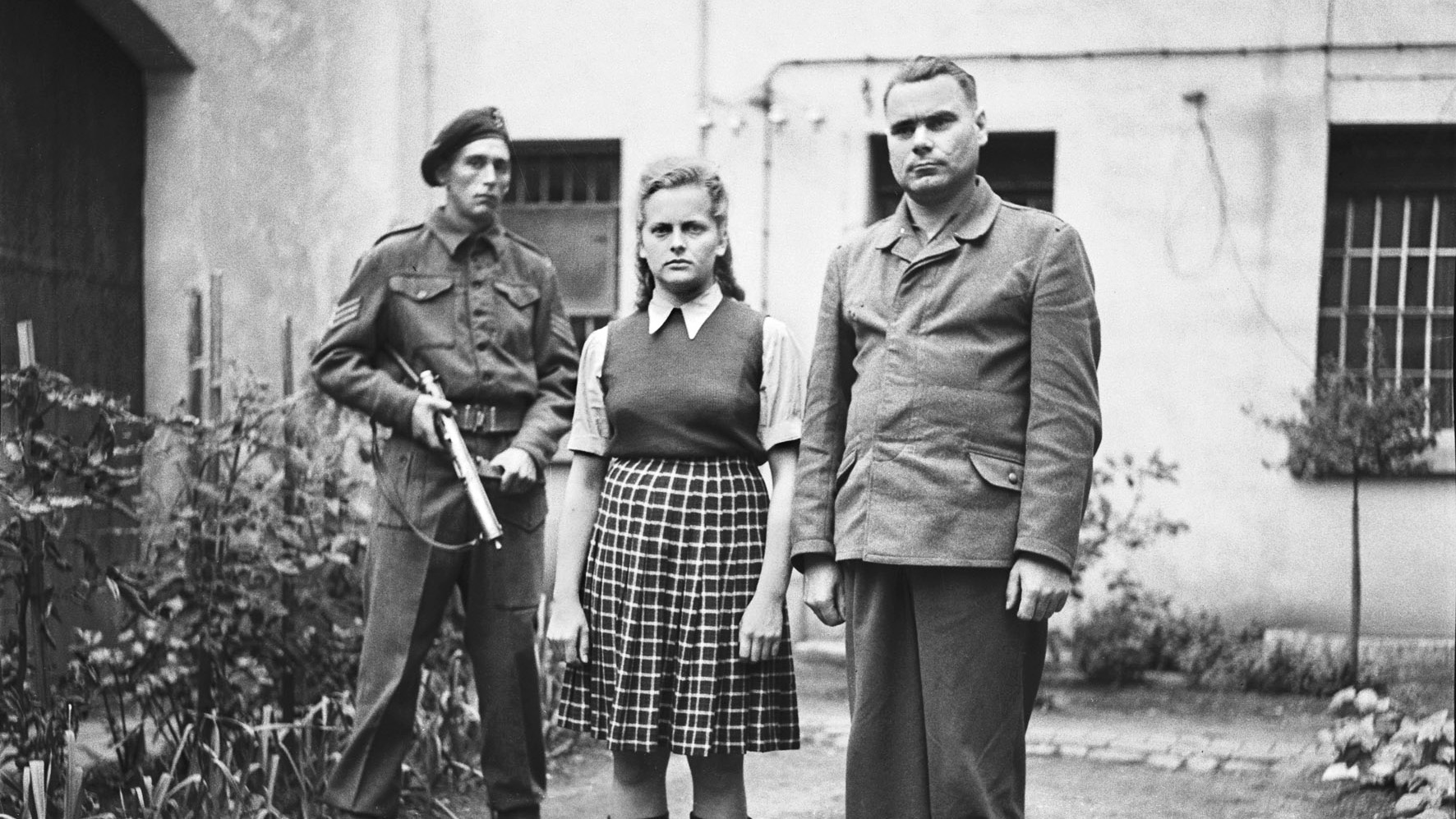
As soldiers began searching the camp and arresting its personnel, they encountered dozens of SS guards who had not escaped before the British arrival.
Among them stood a young blonde woman.
She was only twenty-two years old.
Witnesses remembered her calm expression. Others recalled that she seemed almost detached from the devastation surrounding her. Standing in her SS uniform, she hardly looked like the image people associated with one of the most feared guards in the Nazi concentration camp system.
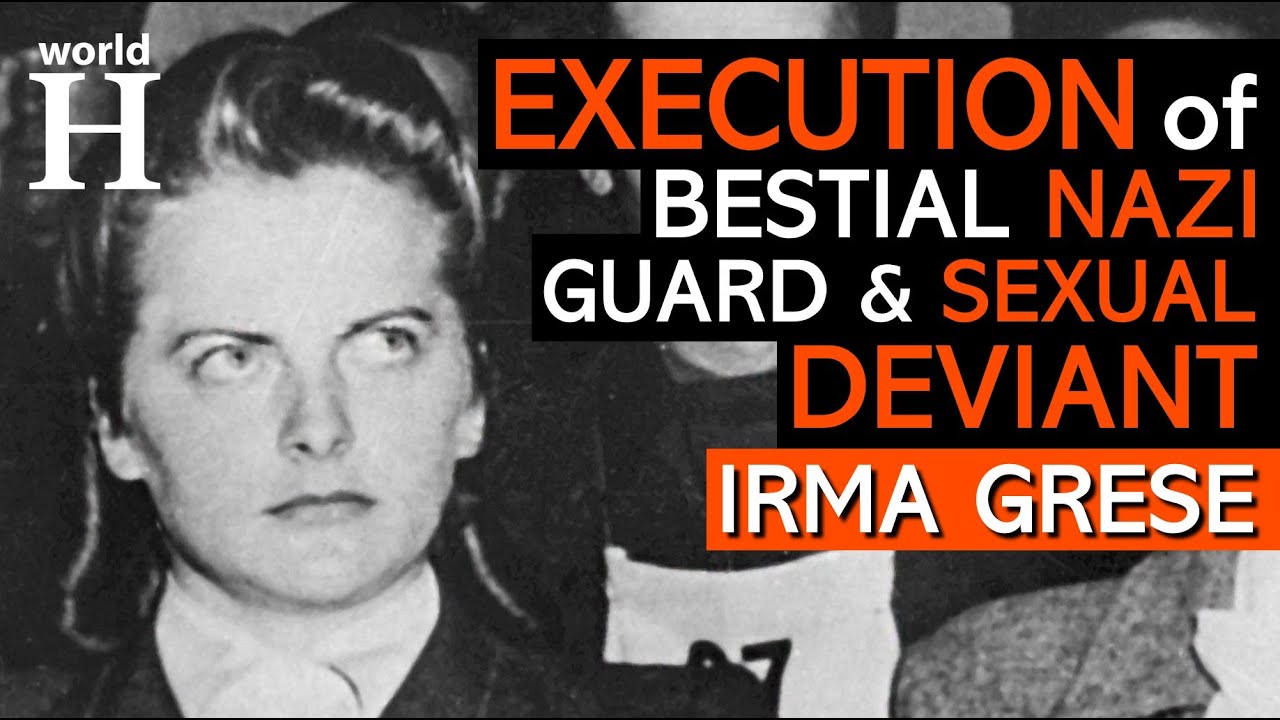
Her name was Irma Grese.
Within months, newspapers across Europe would call her “The Beautiful Beast,” “The Blonde Angel of Death,” and one of the most notorious female war criminals ever brought before a British military court.
Survivors from Auschwitz and Bergen-Belsen accused her of beatings, selections, abuse, and acts of extraordinary cruelty.
Some testified that merely hearing her boots approach was enough to send prisoners into panic.
But Irma Grese had not been born inside a concentration camp.
She had not entered the world as a symbol of Nazi brutality.
Like every perpetrator whose name became infamous after the Second World War, her story began somewhere far more ordinary.
Irma Ida Ilse Grese was born on October 7, 1923, in the small village of Wrechen, located in Mecklenburg, northern Germany.
Germany at the time was a country struggling to recover from defeat in the First World War.
The German Empire had collapsed.
The new Weimar Republic faced political violence, economic instability, and deep social divisions. Hyperinflation had destroyed savings during the early 1920s, while unemployment and uncertainty continued to shape daily life for millions of families.
The Grese family lived modestly.
Irma was one of five children.
Her parents earned their living through dairy farming and agricultural work, leading a life that reflected the routines of rural northern Germany rather than politics or public power.
From the outside, there was little reason to believe that one child from this ordinary household would one day become one of the best-known female guards in the Nazi camp system.
Yet history rarely announces its turning points in advance.
While Irma was growing up, Germany itself was changing.
Economic hardship, political instability, and public frustration created fertile ground for extremist movements. Adolf Hitler and the National Socialist German Workers’ Party promised national revival, restored pride, employment, and unity after years of humiliation following the Treaty of Versailles.
In January 1933, Hitler became Chancellor of Germany.
Within months, democratic institutions were dismantled.
Political opponents were silenced.
Independent organizations disappeared.
Schools, youth groups, newspapers, churches, and cultural institutions increasingly came under the influence of Nazi ideology.
For German children, this transformation was impossible to ignore.
Education no longer focused only on mathematics, literature, or history.
Every classroom became a place where politics entered daily life.
Portraits of Adolf Hitler hung prominently on classroom walls.
Students often began lessons with the Nazi salute.
Textbooks were rewritten to glorify German nationalism, racial superiority, military sacrifice, and unquestioning loyalty to the Führer.
Science lessons incorporated racial theories presented as objective truth.
History classes emphasized Germany’s humiliation after World War I and portrayed the Nazi movement as the nation’s rightful savior.
Teachers who opposed the new system risked dismissal or worse.
Those who remained were expected to reinforce Nazi values inside and outside the classroom.
The influence extended far beyond school hours.
Organizations such as the Hitler Youth for boys and the League of German Girls for girls became central institutions in shaping young minds. They offered uniforms, outdoor activities, competitions, songs, sports, and a sense of belonging that many adolescents found appealing.
Participation increasingly became a social expectation rather than a personal choice.
Children who stayed away often found themselves isolated from classmates whose identities were becoming closely tied to the Nazi state.
Irma’s father, Alfred Grese, was reportedly skeptical of National Socialism.
A strict, deeply religious man, he did not initially support his daughter’s involvement with Nazi youth organizations. Unlike many parents who enthusiastically embraced the new regime, Alfred attempted to keep some distance between his family and Nazi political life.
But resisting the influence of the state proved extraordinarily difficult.
Even if a child never formally joined a youth organization, Nazi ideology surrounded them every day.
It was present in school.
It appeared in newspapers.
It echoed through radio broadcasts.
It filled public ceremonies, festivals, films, posters, and speeches.
The regime did not rely on a single moment of persuasion.
It relied on repetition.
Children learned not simply to obey authority but to admire it.
They learned that loyalty was virtue.
That sacrifice was honorable.
That enemies of Germany were dangerous.
And that individual morality mattered less than service to the nation.
Whether every child fully believed these messages is impossible to know.
What is certain is that few could entirely escape them.
For Irma, ideological pressure was only one part of her childhood.
Life inside the Grese household became increasingly unstable after a devastating family tragedy.
In 1936, when Irma was still a young teenager, her mother, Berta Grese, died by suicide.
According to accounts from family members and later historical research, the suicide followed the discovery of Alfred Grese’s extramarital affair.
The event shattered the family.
For any adolescent, losing a parent under such circumstances would have been profoundly traumatic.
Instead of growing up in a home marked by emotional security, Irma entered adolescence surrounded by grief, silence, and unresolved conflict.
Her father became an even stricter authority figure after his wife’s death.
Accounts describe him as deeply religious, emotionally distant, and inclined toward harsh discipline. Physical punishment was reportedly not uncommon within the household, reflecting disciplinary practices that, while not unusual in some families of the period, created an atmosphere dominated by fear rather than affection.
The children learned obedience long before they learned independence.
For historians, these experiences raise important questions but do not provide simple answers.
Many people suffered bereavement, poverty, authoritarian parenting, or political indoctrination without becoming perpetrators of mass violence.
Personal tragedy alone does not explain later crimes.
Nor does propaganda.
Nor does difficult family life.
History is rarely so straightforward.
What these experiences did provide was the environment in which Irma Grese’s worldview began to take shape—a world where authority demanded obedience, where violence could be normalized inside the home, and where the state increasingly rewarded absolute loyalty over independent judgment.
As Germany moved toward war, opportunities for young women were also changing.
The Nazi regime encouraged girls to view themselves as servants of the nation, whether through motherhood, labor, or direct support of state institutions. Careers that had once seemed ordinary became intertwined with the machinery of dictatorship.
For ambitious young Germans seeking purpose, belonging, or advancement, the expanding institutions of the Third Reich offered opportunities that earlier generations had never known.
Irma Grese had not yet stepped into the concentration camp system.
She was still a teenager living in a country that was changing faster than she could fully understand.
But the foundations were already being laid.
The collapse of democracy.
The normalization of propaganda.
The loss of a mother.
The authority of a harsh father.
The constant demand for obedience.
Each by itself explained nothing.
Together, they formed the background against which one of history’s most infamous female concentration camp guards would soon begin her journey into the machinery of Nazi terror.
The uniform she would eventually wear had not yet been issued.
But the road leading toward it had already begun.