The instructor looked down the firing line and said, “Hit the target, or pack your gear.”
Nobody laughed.
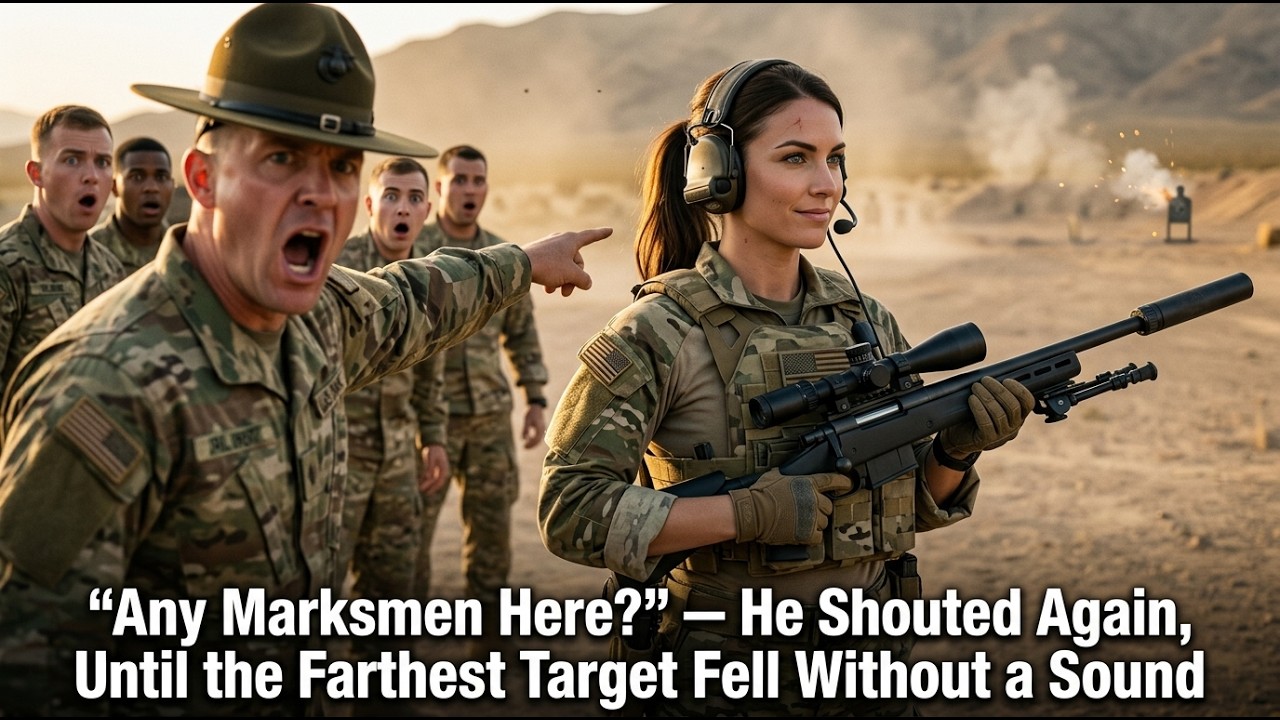
The sun was sitting high over the outdoor range, hard and white, turning the dust into a thin brown haze that clung to boots, uniforms, and throats. Spent brass glittered on the ground like little warning signs. Every few seconds, a gust of wind dragged dirt across the concrete pads and slapped it against the recruits’ faces.
It was qualification day.
For the young soldiers standing behind the firing line, this was not just another test. This was the day their names either stayed on the board or disappeared from it.
Accuracy. Speed. Calm under pressure.
That was what Sergeant Major Cole Harlan had written on the whiteboard that morning.
Then he underlined the last word twice.
Harlan was a former Marine sniper with the kind of face that looked carved more than aged. Gray at the temples, jaw tight, eyes that made people correct their posture before he said a word. He had spent more years in combat zones than most of the recruits had spent as adults, and he carried that history like a loaded weapon.

He did not raise his voice often.
He did not need to.
“When you step onto my line,” he said, walking slowly in front of them, “your excuses stay behind you. Wind doesn’t care about your nerves. Distance doesn’t care about your feelings. A target does not become kinder because your hands are shaking.”
A few recruits swallowed.
At the far end of the group stood a woman in her early thirties.
She wore a plain field uniform with no rank on the chest, no unit patch on the sleeve, and no name tape visible from where the others stood. Her hair was tied back neatly. Her boots were dusty but polished beneath the dust. She held no rifle, no range card, no gear except a clipboard.
On the clipboard, beside her temporary pass, one word had been written in black marker:
Observer.
That was enough for the recruits to decide what she was.
Admin.
Support staff.
Maybe someone from headquarters sent to watch the process and write a report nobody would read.
One private whispered, “She doesn’t even have a unit.”
Another said, “Probably never fired outside a simulator.”
The woman heard them.
She did not look over.
Sergeant Major Harlan stopped at the center of the line and turned toward the group.
“This range has embarrassed better people than you,” he said. “Some of you think you’re shooters because you qualified once at a shorter distance. Some of you think confidence is the same as skill.”
He let the silence sit.
Then he asked, loud enough for the entire range to hear:
“Any real marksmen here?”
No one moved.
Rifles hung from nervous hands. Eyes dropped to the dirt. A few recruits glanced sideways, hoping someone else would be foolish enough to answer.
Harlan’s mouth barely moved into something that was not quite a smile.
“That’s what I thought.”
Then, from the side of the formation, a calm voice said, “What distance?”
Every head turned.
The woman with the clipboard had spoken.
For the first time that morning, Sergeant Major Harlan looked directly at her.
“Excuse me?”
She kept her voice even. “You asked if there were any marksmen here. I asked what distance.”
A few recruits smirked. One of them actually laughed under his breath.
Harlan walked toward her slowly.

“You’re listed as an observer.”
“Yes.”
“Observers observe.”
“Yes.”
“They don’t handle weapons on my range.”
The woman nodded once. “Understood.”
That should have ended it.
But Harlan looked at the recruits, then back at her, and something in his pride made him continue.
“You ever fire a precision rifle before?”
“Yes.”
“Where?”
“A few places.”
The recruits laughed louder this time.
Harlan’s eyes narrowed.
“A few places,” he repeated. “That supposed to impress me?”
“No, Sergeant Major.”
He stepped closer.
“Then let me be clear. This is not a public demonstration. This is not a morale event. This is qualification. People fail here. Publicly.”
“I understand.”
“No second chances.”
“I understand that too.”
Harlan stared at her for a long moment.
Then he turned to the range officer.
“Bring her a rifle.”
The laughter stopped.
The range officer hesitated. “Sergeant Major, her file says—”
“I can read,” Harlan snapped. “Bring her a rifle.”
A rifle was placed on the bench in front of her.
Standard issue. No special adjustments. No personalized scope. No lucky sling. Nothing prepared for her.
Harlan pointed downrange.
“Three hundred meters. Five rounds. Center mass.”
The woman set the clipboard down.
That small movement changed the air.
She did not rush. She did not perform. She checked the rifle with the quiet familiarity of someone who respected tools, not someone trying to look impressive holding one.
One recruit muttered, “Watch her miss the paper.”
Another whispered, “This is going to be bad.”
Harlan heard them and did not correct them.
The woman settled behind the rifle.
Dust moved across the mat. The wind flag twitched left, then snapped right. She watched it for two seconds.
Then she fired.
One shot.
The target marker moved.
A hit.
Then the second.
Hit.
Third.
Hit.
The recruits stopped shifting.
Fourth.
Hit.
Fifth.
Hit.
The range officer checked through the spotting scope, then looked up.
“All five. Tight group.”
For the first time all morning, Sergeant Major Harlan said nothing.
The woman stood, cleared the rifle, and stepped back from the mat.
No smile.
No speech.
Just a calm breath through the nose, as if she had done exactly what she expected and nothing more.
But Harlan was not finished.
“Three hundred meters proves you can follow instructions,” he said. “It doesn’t make you a marksman.”
The recruits glanced at each other. The mood shifted again. Some looked relieved. They wanted him to put her back in her place because her success had made them uncomfortable.
Harlan pointed farther downrange.
“Six hundred.”
The range officer looked at him.
The wind had picked up.
At six hundred meters, small mistakes became large ones. Bad breathing, bad trigger control, poor wind reading—everything showed up on paper like a confession.
The woman simply nodded.
She returned to the mat.
This time, the range was quiet.
Even the recruits who had mocked her leaned forward.
Harlan stood behind her with arms crossed.
“Whenever you’re ready, Observer.”
He made the word sound like an insult.
She fired.
The first round landed just right of center.
The second corrected.
The third touched close.
The fourth and fifth landed so near the previous marks that the range officer lowered the spotting scope and looked again, as if the glass had lied to him.
“Five hits,” he said. “Group is… excellent.”
Someone behind the line whispered, “No way.”
The woman cleared the rifle again.
Harlan’s expression hardened.
It was not admiration yet. It was resistance.
There are people who cannot accept skill when it appears outside the uniform they expected, the age they expected, or the authority structure they understand. So they keep moving the test until the result matches their prejudice.
Harlan walked toward the bench.
“Seven hundred fifty meters,” he said.
The range officer said quietly, “Sergeant Major, that’s not part of today’s qualification.”
“It is now.”
The recruits froze.
The woman looked at the far target.
At that distance, the wind was no longer a detail. It was part of the shot. Heat shimmer rose from the ground. The target seemed to swim behind it.
Harlan leaned down just enough for her to hear.
“You can stop here. Nobody expected you to get this far.”
She looked at him.
“I didn’t come here for expectations.”
A few of the recruits heard it.
Their faces changed.
Not because she sounded arrogant.
Because she didn’t.
She sounded tired of being measured by people who had never asked what she could actually do.
She got behind the rifle again.
The first shot cracked through the range.
The target marker did not move.
Miss.
A wave passed through the recruits.
There it was.
Proof.
Permission to doubt her again.
Harlan tilted his head.
The woman did not react.
She adjusted. Not much. Almost nothing.
Second shot.
Hit.
Third.
Hit.
Fourth.
Hit.
Fifth.
Hit.
The range officer looked through the spotting scope for a long time.
“Four hits,” he called. “One miss. Corrected after first round.”
The recruits were silent now.
Completely silent.
Harlan’s jaw moved once.
He turned toward the woman. “Lucky correction.”
She stood and cleared the weapon.
“No,” she said quietly. “Bad first read.”
That answer did something worse than arguing.
It showed ownership.
No excuse. No drama. No attempt to protect her ego.
Just the truth.
And that made her harder to dismiss.
Harlan looked at the clipboard lying on the bench.
“Who sent you?”
“Training Command.”
“For what?”
“To observe.”
“Observe what?”
She picked up the clipboard and turned one page.
“Instructional standards.”
The range became so quiet that even the wind seemed loud.
Harlan stared at her.
A recruit near the back whispered, “Oh.”
But Harlan still did not understand.
Or maybe he refused to.
“Name,” he said.
She turned the clipboard slightly so he could read the printed authorization.
Dr. Elena Voss.
Below that:
Ballistics Consultant, Joint Precision Training Review.
The color left the range officer’s face first.
Because he knew the name.
Then another instructor stepped closer, squinted at the page, and went still.
Harlan saw their reactions before he processed the words.
Dr. Elena Voss was not support staff.
She was the woman who had helped redesign the long-range wind correction curriculum used across three training centers. Her research notes were in the manuals sitting in the classroom behind them. Her field evaluations had changed how instructors taught breathing cadence, scope tracking, and first-round correction under crosswind.
The recruits had been trained from pages she helped write.
And all morning, they had laughed at her for not wearing a patch.
Harlan looked from the clipboard to her face.
That was the moment.
Not loud. Not cinematic.
Just a hard man realizing in front of everyone that he had mistaken humility for weakness.
His shoulders dropped half an inch. His mouth opened, then closed. The sharpness in his eyes disappeared, replaced by something heavier.
Recognition.
The recruits saw it too.
Nobody smiled.
Nobody needed to.
The power on the range had shifted without anyone raising their voice.
Dr. Voss set the clipboard back down.
“For the record,” she said, “your safety discipline is strong. Your pressure testing is useful. But your evaluation language creates bias before performance begins.”
Harlan did not interrupt.
She continued, calm as ever.
“You asked for marksmen, then mocked the only person who asked for parameters. You changed the test after the result challenged your assumption. And your recruits followed your tone.”
A few young soldiers looked at the ground.
Not because they were being yelled at.
Because they had participated.
Harlan’s face tightened, but he did not defend himself.
The range officer shifted uncomfortably.
Dr. Voss looked down the firing line.
“Skill does not always arrive wearing the symbol you expect. Sometimes it arrives quietly, without rank, without decoration, and without needing your permission to be real.”
The words landed harder than any shot that morning.
Harlan turned to the recruits.
For once, his voice was lower.
“Formation.”
They moved quickly.
He stood in front of them, but he no longer looked like a man performing authority. He looked like a man deciding whether he was strong enough to correct himself publicly.
Then he faced Dr. Voss.
“Ma’am,” he said, “I owe you an apology.”
The word ma’am hit the recruits like thunder.
Dr. Voss nodded once.
“Accepted.”
Harlan turned back to the line.
“And I owe all of you a correction.”
Nobody moved.
“What happened here is exactly how bad teams lose good people,” he said. “Not because the good people lack ability. Because the room decides who they are before they get a chance to show it.”
He looked at the recruits who had laughed.
“Every one of you will shoot again today. But before that, you will each explain your wind call out loud. No mocking. No guessing. No hiding behind confidence.”
Then he looked back at Dr. Voss.
“And Dr. Voss will evaluate my instruction.”
That consequence was worse than punishment.
It was accountability.
For the rest of the day, the range changed.
The recruits still missed. Some missed badly. But now, when they did, nobody laughed. They corrected. They learned. They asked better questions.
And Harlan, the hardest man on the field, did something none of them expected.
He listened.
When Dr. Voss suggested changing the way he briefed first-time shooters, he wrote it down.
When she pointed out that public humiliation increased panic in weaker shooters instead of improving discipline, he did not argue.
When she demonstrated how to read shifting wind across uneven terrain, the entire line gathered around her like students around a master.
By late afternoon, the dust was still there. The heat was still brutal. The brass still covered the ground.
But the fear had changed into focus.
At the end of the day, the lowest-performing recruit from the morning stepped onto the mat again. His hands still shook, but this time he spoke his process out loud.
Wind left to right.
Hold slightly off center.
Slow breath.
Press, don’t slap.
He fired.
Hit.
The line erupted.
Not wild cheering. Just the kind of applause soldiers give when they know someone earned it.
The recruit looked back, stunned.
Dr. Voss gave him a small nod.
Harlan looked at the target, then at the young soldier.
“Again,” he said.
But this time, it did not sound like a threat.
It sounded like belief.
Two weeks later, a revised qualification memo went out from Training Command.
New language standards.
New evaluation sequence.
No informal labels before performance.
No public dismissal based on rank visibility, age, gender, assignment, or observer status.
At the bottom of the memo were two signatures.
Dr. Elena Voss.
And Sergeant Major Cole Harlan.
People later talked about her shooting, of course. They talked about the five-round group at six hundred meters. They talked about the correction at seven hundred fifty. They talked about the look on Harlan’s face when he realized who she was.
But the people who were there remembered something bigger.
They remembered that she never raised her voice.
They remembered that she never bragged.
They remembered that the strongest person on that range was not the one who had the loudest authority.
It was the one who could prove the truth calmly, then use it to make everyone better.
Because real excellence does not need to announce itself.
It only needs one fair chance.
And sometimes, the person everyone underestimates is the one who wrote the standard they are being judged by.