They Didn’t Know She Was a Sniper — Until She Cleared the Field Without Saying a Single Word
The first shot missed so badly it struck dirt six feet left of the steel target.
Nobody laughed.
Not at first.
The sound rolled across the sniper range like a warning—flat, metallic, swallowed by the dry Texas wind. Heat shimmered over the long field. Dust curled around boots. Somewhere beyond the berm, a crow lifted off a fence post and vanished into the white glare of morning.
Then Sergeant First Class Grady Voss lowered his spotting scope.
“Well,” he said, loud enough for the whole firing line to hear, “that was educational.”
A few soldiers chuckled.
The woman behind the rifle did not move.
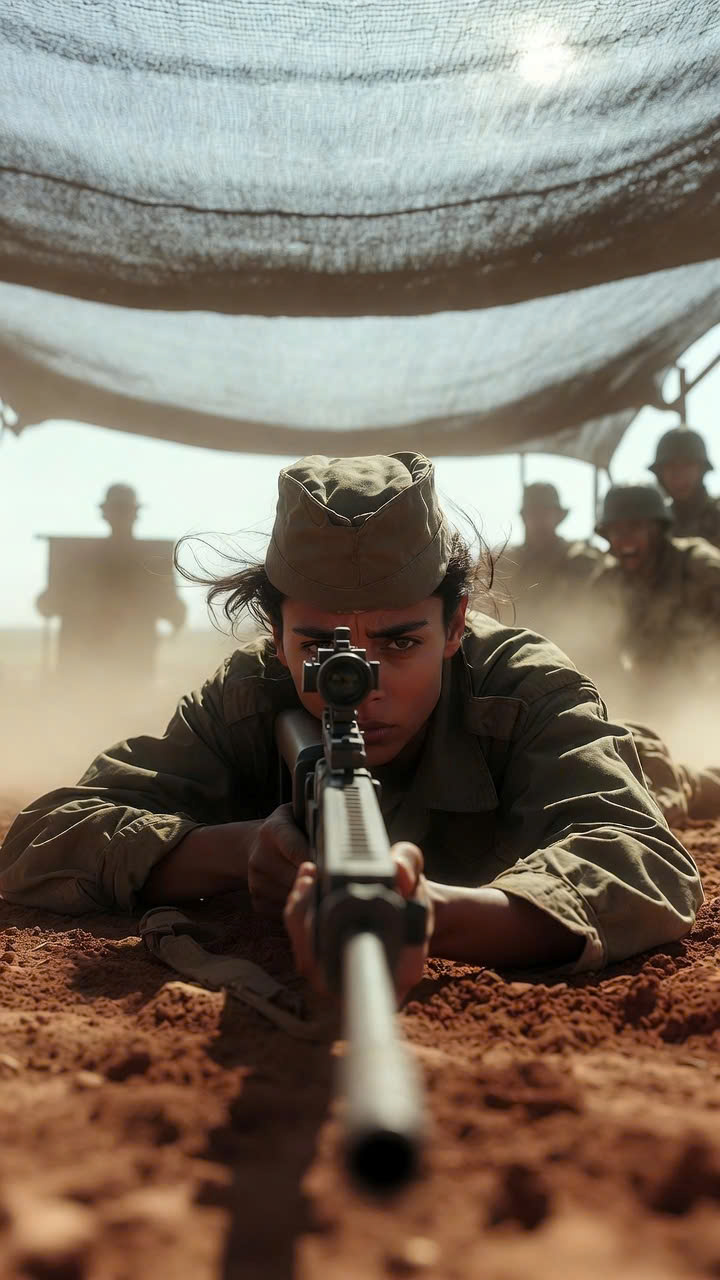
She lay prone on the red dirt, elbows planted, cheek pressed lightly against the stock of an old training rifle that had seen too many hands and too little care. Her cap was pulled low. Strands of dark hair had escaped beneath it, sticking to the sweat at her temple. She wore no name tape on her chest, only a plain field jacket, faded at the shoulders, sleeves rolled with exact, almost old-fashioned care.
To the men waiting behind her, she looked like an administrative mistake.
Too still.
Too quiet.
Too old for the class and too calm for humiliation.
“Hey,” called Private Larkin from the shade net, “you sure you’re on the right range, ma’am?”
More laughter now.
Captain Owen Pike didn’t laugh. He stood near the scoring table with his arms folded, watching the woman instead of the target. The sun caught the scar under his jaw, a pale hook of skin from a convoy blast eight years ago. He had seen panic before. He had seen pride. He had seen shooters try to hide shaking hands with jokes.
This woman wasn’t hiding anything.
She simply reached forward, opened the bolt, and ejected the spent casing into her palm.
Not onto the dirt.
Into her palm.
Like evidence.
Grady Voss noticed too. His smile thinned.
“Second round,” he barked.
The range went quiet again.
The woman slid the cartridge in, closed the bolt, settled behind the rifle, and breathed once.
Pike watched her finger.
It did not hunt for the trigger.
It waited.
The wind flag halfway downrange snapped left, then sagged. Heat rippled over the target lane. Somewhere behind them, an engine coughed to life, then died.
The rifle cracked.
The steel plate at eight hundred yards rang clean.
Center mass.
The laughter stopped so fast it felt like someone had cut power to the field.
The woman opened the bolt again.
Caught the casing again.
Grady looked into the spotting scope. His jaw shifted once.
“Lucky correction,” he said.
She did not answer.
She did not look at him.
She fired the third round.
Then the fourth.
Then the fifth.
Three distant plates sang one after another, each note sharper than the last.
Ping.
Ping.
Ping.
At the tenth shot, the range had become so quiet the only sound between rounds was the soft scrape of brass touching her palm.
Pike felt something old move in his chest.
Recognition, maybe.
Or fear.
Because nobody shot like that by accident.
And nobody stayed that silent unless silence had once saved their life.
By noon, the wind had grown mean.
It came across Fort Callahan’s sniper training field in long, invisible hands, shoving dust into eyes, rattling the canvas shade, snapping paper score sheets against clipboards. The range stretched out like a punishment: berms, scrub brush, rust-colored lanes, distant steel targets half-swallowed by heat mirage.
The sniper candidates were two weeks into selection. Most were young infantrymen with sunburned necks, hard mouths, and the kind of confidence that had not yet met real consequence. Their instructors liked it that way. Confidence could be shaped. Arrogance could be broken. Fear could be taught to kneel.
Grady Voss believed all three.
He had spent twenty-two years in uniform and carried them like stones in his pockets. His left knee clicked when he walked. His right shoulder never healed right after Helmand. His hair had gone iron gray at the temples, but his voice still cut like a field knife.
He hated surprises.
He hated paperwork.
Most of all, he hated people being placed on his range because someone above him thought a story mattered more than standards.
And the woman with no name tape had arrived as a story.
Her orders came sealed. Her file was incomplete. No unit history attached. No recent qualification sheet. No biography. Just one signature from a colonel Voss disliked and a note that said: Candidate will be assessed without distinction.
Without distinction.
Voss had stared at that phrase that morning until the paper blurred.
Now he watched her from behind his sunglasses as she cleaned the old rifle at the far end of the bench. Not performatively. Not nervously. She broke it down with spare, economical movements, wiping carbon from the bolt face with a strip of cloth she had cut from something olive green. Her hands were narrow, darkened by sun, knuckles scarred white.
“Name,” Voss said.
She looked up.
For a second, he saw her eyes clearly.
Gray.
Not soft gray. Not pretty. Storm gray. The kind of gray the sky gets before lightning finds a tree.
“Evelyn Cross,” she said.
Her voice was low and even.
No rank.
No explanation.
“Cross,” Voss repeated, as if testing whether the name would reveal something. “You always miss your first shot by six feet?”
“No.”
The candidates behind him exchanged looks.
Voss stepped closer. “Then why did you?”
She placed the bolt on the cloth. “Rifle was pulling left.”
“You knew that before you fired?”
“Yes.”
“And you fired anyway?”
“Yes.”
His mouth tightened. “Why?”
She looked down at the rifle, then back at him.
“To see if I was right.”
A few men smiled.
Voss did not.
Captain Pike felt the shift before anyone else did. He had known Voss for three years, long enough to recognize the small signs: the stillness in his shoulders, the breath held too long, the thumb rubbing once across the side seam of his trousers.
Voss was not angry because she had failed.
He was angry because she had been correct.
“Range closes in twenty,” Voss said. “Tomorrow we test movement. Unknown distance. No warmup. No mercy.”
Evelyn Cross nodded once.
No salute. No apology.
Voss walked away.
Larkin leaned toward the man beside him. “She talks like a funeral.”
Evelyn heard him.
Her hand paused over the rifle.
Only for half a second.
Then she kept cleaning.
That night, Fort Callahan smelled of hot metal and cut grass.
The barracks were low concrete buildings built in a decade that believed comfort weakened discipline. Fluorescent lights buzzed in the corridors. Boots thudded. Showers hissed. Men argued over cards, over radios, over whose score had been ruined by wind and whose had been ruined by nerves.
Evelyn sat alone outside on the back steps.
She had chosen the darkest corner, where the security light barely reached and the moths did not gather. A paper cup of coffee cooled beside her boot. In her lap lay a small notebook with a cracked black cover.
She had written only one line.
Do not let the field become the valley.
The pen rested across the page.
Her thumb moved over an old scar on her wrist, a thin crescent just below the pulse point. It was not the worst scar on her body. Not even close. But it was the one she touched when she needed to remember that she was here, not there.
Here was Texas.
There was the valley.
Here was a training range, wind flags, steel targets, arrogant boys, and one instructor who smelled danger in silence.
There was smoke low over a dry riverbed. A radio screaming half a call sign. A boy named Teague whispering for his mother with half his face pressed into Afghan dust. Her own rifle broken under rockfall. Her spotter gone. Her hands buried in red mud, digging because she could still hear breathing beneath the stones.
She closed the notebook.
A door creaked behind her.
Captain Pike stepped outside carrying two bottles of water.
He did not sit beside her. He stayed at the rail, leaving space between them.
“Coffee here can strip paint,” he said.
She didn’t answer.
He set one bottle on the step near her. “Hydrate anyway.”
“I’m fine.”
“People usually say that when they aren’t.”
Her eyes moved toward him.
He held up one hand. “I know. None of my business.”
For a while they listened to the far sound of trucks on the service road.
Pike was thirty-nine, though the war had folded extra years into the corners of his face. He had been a good shooter once, before the blast left a tremor that visited his right hand when he was tired. He hid it well. Too well. The Army had rewarded him by making him an instructor, then punished him by asking him to teach what he could no longer fully do.
He watched Evelyn’s hands.
No tremor.
No wasted motion.
“What unit were you with?” he asked.
She stood.
The movement was not rude.
It was defensive.
“Good night, Captain.”
She picked up the notebook and walked back inside.
Pike remained under the buzzing light, looking at the abandoned coffee cup.
On its white rim, where her thumb had rested, there was a faint smear of dust shaped like a crescent moon.
The second day began under a sky the color of bone.
Voss placed the candidates in pairs and sent them through the movement lane: crawl, observe, estimate distance, engage hidden targets from improvised positions. The task was simple when described on paper and brutal when performed under sun, wind, and time pressure.
Men who had boasted at breakfast now lay panting behind mesquite scrub, trying to calculate range through mirage. One fired too early and exposed his position. Another forgot to account for uphill angle. A third cursed loud enough to lose points before touching the trigger.
Evelyn moved last.
Voss had arranged it that way.
“Cross,” he called, “you’re alone.”
Pike turned. “Sergeant—”
“She came alone,” Voss said. “She can run alone.”
The candidates watched.
Evelyn adjusted the strap of her rifle. “Understood.”
The lane began with a low crawl across open dirt. Most candidates churned dust like panicked animals. Evelyn vanished into it.
Not completely.
Not magically.
She simply understood the ground.
She moved when the wind moved the grass. She froze when the range tower glass caught sunlight. She slid into shallow shadows no one else seemed to notice. At four hundred yards, her uniform had become another patch of earth.
Larkin squinted. “Where’d she go?”
No one answered.
Voss lifted his binoculars.
For the first time all morning, his face changed.
Evelyn reached the first firing point behind a broken concrete culvert. She did not raise the rifle immediately. She took out a small field card, sketched three marks, checked wind, checked light, checked the slope of land toward a rusted vehicle shell near the far berm.
Then she fired.
The hidden target dropped.
She moved again.
At the second point, she used the shadow of a burned-out tire. At the third, she fired from behind a fence post no wider than her shoulder. At the fourth, she did not fire at all.
Voss lowered his binoculars. “Why isn’t she engaging?”
Pike looked through his scope.
Evelyn lay motionless near a patch of yellow grass.
The target was visible.
Barely.
A helmet shape behind brush.
But the wind flag beyond it hung wrong.
Pike felt his neck tighten.
“Target’s false,” he said quietly.
Voss looked at him.
Pike kept watching. “Brush in front isn’t moving with the flag. Someone rigged it.”
Voss said nothing.
Evelyn crawled past the false target without touching the trigger.
Ten yards later, she stopped, angled left, and fired once into what looked like empty scrub.
A steel plate rang.
The candidates stared.
Larkin whispered, “No way.”
By the end of the lane, Evelyn had cleared all real targets and ignored both decoys.
Her time was not the fastest.
Her score was perfect.
When she came back, dust coated one side of her face. A small cut crossed her cheek where thorn brush had caught skin. Blood had dried in a thin line toward her jaw.
Voss held out the score sheet.
She reached for it.
He did not let go.
“You trained somewhere,” he said.
“Yes.”
“Where?”
Her eyes stayed on his.
“Outside.”
The answer landed wrong.
Too much inside one word.
Voss released the paper. “You think this is funny?”
“No.”
“You think silence makes you special?”
“No.”
“What does it make you?”
Evelyn folded the score sheet once.
Then again.
“Alive,” she said.
The wind dragged the word downrange.
That evening, Voss went looking.
Not on official systems. Those had already failed him.
He called an old friend at personnel. Then another at the schoolhouse. Then a retired master sergeant who owed him a favor from a winter in Kandahar.
The answers were all the same.
Evelyn Cross existed.
Barely.
Army. Prior service. Medical retirement pending reversal. Specialist file restricted. Deployment history redacted beyond usefulness. Awards hidden behind classification codes. No sniper school listed. No instructor endorsements. No combat narrative.
A ghost with orders.
At 2130, Voss found one thing the system had not buried.
A casualty report from seven years earlier.
Operation Ash Lantern.
Kharan Valley.
Fourteen Americans lost.
One missing for eleven days.
Recovered alive.
Name blacked out.
But beneath the redaction, some careless clerk had failed to remove a detail from the medical addendum.
Female. Thirty-one. Severe dehydration. Broken ribs. Shrapnel wounds. Self-extracted through hostile terrain. Enemy casualties estimated from recovered field evidence: twenty-three.
Voss read the line twice.
Then he closed the laptop.
For a long time, he sat alone in the office while the ceiling fan ticked overhead.
He had been in that valley’s neighboring province that same year.
He remembered the rumors.
A shooter with no radio.
A valley held quiet for two days.
Enemy scouts found dead before they could report.
A rescue team guided in by signal mirrors made from broken optics.
Nobody knew the shooter’s name.
They called her the Wraith.
Voss leaned back, jaw tight.
He did not believe in ghosts.
But he believed in survivors.
And survivors carried knives where other people carried memories.
The third day brought rain.
Not enough to cool the earth. Just enough to turn dust into slick red paste and soak uniforms through. The range smelled of wet clay, gun oil, and ozone. Thunder muttered somewhere beyond the low hills.
Voss gathered the candidates under the shade canopy.
“Final field problem,” he said. “Two teams. Recon, identify, engage. Hostile role players in the tree line. Unknown number. Unknown positions. You will be judged on patience, communication, target discrimination, and whether you can think when your pulse gets stupid.”
He let his eyes pass over each candidate.
Then stopped on Evelyn.
“Cross. You’re with Team Two.”
Larkin groaned under his breath.
Team Two was Larkin, Reyes, Holloway, and now Evelyn. Three young men who had spent two weeks competing against each other and one woman they had decided was either lucky or strange enough to resent.
They moved out at 0800.
The training field beyond the main range was larger and rougher: gullies, oak scrub, old cattle fences, abandoned farm structures turned into mock enemy positions. Rain tapped on helmets. Mud sucked at boots. Radios hissed and cracked.
Larkin took point without asking.
Reyes followed with the rangefinder. Holloway carried the radio. Evelyn walked last.
After twenty minutes, Larkin stopped behind a low ridge and signaled down.
Below them stretched a shallow field bordered by trees. Three target silhouettes were visible near a ruined shed.
“Three hostiles,” Larkin whispered. “Easy.”
Evelyn looked past the shed.
A plastic feed sack moved in the wind near the fence.
Too regular.
Too deliberate.
She touched Holloway’s sleeve and pointed two fingers toward the left tree line.
He frowned.
“What?”
She held her finger to her lips.
Larkin saw the motion and crawled back, face wet with rain.
“You got something to say, Cross?”
She pointed again.
Larkin looked, saw nothing, and smirked. “Those are trees.”
Evelyn took out her notebook, wrote two words, and showed him.
Glass flash.
Larkin’s face hardened.
“You don’t command this team.”
She put the notebook away.
Reyes shifted uneasily. “Maybe we should check it.”
“We have three visible targets,” Larkin snapped. “We take them, move.”
Evelyn’s eyes moved to the field again.
The shed targets were too easy.
The valley had taught her that death often stood where men expected victory.
Larkin raised his rifle.
Evelyn reached out and pressed two fingers gently on the barrel, lowering it an inch.
His head whipped toward her.
“Touch my weapon again.”
She released it.
Not afraid.
Worse.
Certain.
That certainty embarrassed him more than any insult.
“Fine,” he said. “You want to watch trees? Watch trees.”
He fired.
The three shed targets dropped.
A second later, the left tree line erupted with blanks.
Holloway shouted and fell back into the mud, red smoke bursting from the hit sensor on his vest. Reyes cursed. Larkin tried to pivot, but more blanks cracked from the right. A second smoke marker burst on his shoulder.
“Team Two, you’re compromised,” Voss’s voice barked over the radio. “Continue if able.”
Larkin slammed his fist into the mud. “Damn it!”
Evelyn was already gone.
Not running.
Flowing.
She slid backward down the ridge, cut right through brush, and vanished behind a fallen oak. Reyes stared after her, breathing hard.
“Where is she going?”
The answer came three seconds later.
A role player in the left tree line shouted as his hit sensor burst blue.
Then another.
Then silence.
Evelyn moved through the wet scrub without sound, rifle low, eyes taking in angles and gaps and reflections. Rain ran down her neck. Mud streaked her sleeves. She saw the second ambush team repositioning behind a fence corner, saw one man lift his muzzle toward Reyes, saw another reach for a radio.
She fired twice.
Blue smoke.
Then a third shot into the radio operator’s exposed boot-level target plate.
Blue smoke again.
Voss stood in the observation tower with binoculars raised.
Pike stood beside him.
Neither spoke.
Through the rain, Evelyn reached the ruined shed. Instead of taking cover inside, she stopped at the door, looked down, and stepped back.
A tripwire ran ankle-high across the entrance, connected to a training charge.
She marked it with red tape from her pocket, moved around the building, and found the final observer prone beneath a sheet of camouflage netting behind the shed.
She did not shoot him immediately.
She waited until he lifted his head to track Reyes.
Then she fired into his sensor.
Blue smoke bloomed in the rain.
The field went still.
Voss lowered the binoculars.
Pike exhaled.
Team Two had been destroyed.
Evelyn Cross had cleared the field alone.
Without saying a single word.
Back at the range house, the mood curdled.
The candidates stripped off wet gear and avoided looking at her. Larkin threw his gloves into the corner hard enough to slap concrete. Reyes sat on a bench, staring at his boots. Holloway rubbed mud from his radio and said nothing.
Evelyn stood near the door, rain dripping from the brim of her cap.
Voss entered last.
“After-action,” he said.
Nobody moved.
He pointed at Larkin. “What killed your team?”
Larkin’s mouth twisted. “Bad intel.”
Voss stared at him.
Larkin swallowed. “I engaged too early.”
“Why?”
The young soldier looked toward Evelyn, then away. “I saw what I wanted to see.”
Voss nodded once. “Reyes?”
“We ignored Cross.”
“Holloway?”
“She tried to warn us.”
Voss turned to Evelyn. “Cross?”
She removed her cap. Her hair fell loose around her face, darker from rain. The scar along her wrist showed clearly under the fluorescent light.
For once, she seemed tired.
Not physically.
Tired in some place sleep could not reach.
“Visible targets were bait,” she said.
“That all?”
She looked at Larkin.
His anger was gone now, replaced by something worse: shame.
“No,” she said. “He rushed because he thought being questioned made him smaller.”
The room went still.
Larkin’s face flushed.
Voss watched them both. “And you?”
Evelyn’s jaw tightened.
Pike saw the door close behind her eyes.
“I waited too long to force the warning.”
Voss raised an eyebrow. “Force it?”
“Yes.”
“You’re saying his mistake was your fault?”
“No.”
“Then say what you mean.”
Evelyn looked at the wet floor.
Rainwater gathered around her boots.
“I know what it looks like when men are walking into a trap,” she said. “I should have stopped him harder.”
Larkin looked up.
Something shifted in him.
Not forgiveness.
Not yet.
But the first crack in pride.
Voss dismissed the team.
As the room emptied, Pike stayed behind.
Evelyn reached for her cap.
Pike said quietly, “Ash Lantern.”
Her hand stopped.
The fluorescent lights hummed.
Voss turned sharply toward Pike.
Evelyn did not move.
Pike regretted it immediately. He had meant to ask, not cut. But the name had slipped out, drawn by the field, the silence, the impossible shooting.
Evelyn put her cap on slowly.
When she looked at him, her face had emptied.
“Don’t,” she said.
One word.
No threat.
But Pike felt it like a hand against his chest.
She left the room.
Voss waited until the door closed.
“You had no right,” he said.
Pike rubbed a hand across his mouth. “I know.”
“Then why?”
“Because if she’s who I think she is, we’re not testing a candidate.”
Voss looked toward the door.
“No,” he said. “We’re testing whether she came back from the dead with anything left to teach.”
At 0200, thunder cracked over Fort Callahan.
Evelyn woke before the sound finished.
Her hand closed around a knife that was not there.
For three seconds, the barracks ceiling was not a ceiling. It was stone. The rain was not rain. It was gravel sliding down a slope. The breathing in the room was not soldiers sleeping. It was men dying quietly because sound carried.
She sat up, lungs locked.
The room came back piece by piece.
Bunk beds.
Wet boots.
Dim emergency light.
Texas.
Not the valley.
She swung her feet to the floor and pressed both palms against her knees until the shaking stopped.
Across the aisle, Larkin lay awake.
He had seen.
Neither spoke.
The next morning, he found her at the cleaning bench before formation.
A gray dawn sat over the range. The rain had passed, leaving the air washed clean and cold. Steam rose from the dirt where the sun touched it.
Larkin stood there with his rifle case in one hand.
“I was wrong yesterday,” he said.
Evelyn continued threading a bore snake through the barrel.
He shifted his weight.
“I should’ve listened.”
She pulled the cord through.
The brass weight clicked softly against the muzzle.
Larkin waited for punishment. A lecture. A clean, cold sentence that would let him hate her again.
She gave him none.
Instead, she said, “What did you see before you fired?”
He frowned.
“The targets.”
“What else?”
“The shed. Fence. Trees.”
“What else?”
He looked toward the range, searching memory like a dark room.
“The feed sack,” he said slowly. “It moved wrong.”
Evelyn nodded.
Larkin’s throat moved.
“I saw it.”
“Yes.”
“But I didn’t let it matter.”
She finally looked at him.
“That’s where people die.”
The words hit without cruelty.
Larkin sat on the bench across from her.
“My brother died in Mosul,” he said.
Evelyn’s hands stilled.
“He was a squad leader. Good one. Everybody says that. I joined because…” He laughed once, but there was no humor in it. “Because I thought if I became better than him, maybe it would stop feeling like he left first.”
Evelyn looked down at the rifle.
For a moment, the range was quiet except for the distant clank of a flagpole chain.
“Dead people don’t ask us to become them,” she said.
Larkin blinked.
“They ask us to carry what they couldn’t.”
He looked at her then, really looked, and saw not mystery, not arrogance, not some legend hiding under a plain jacket.
He saw a woman held together by discipline so tight it must have hurt.
Formation began at 0700.
Voss announced the final test without ceremony.
“Long field. Full profile. One shooter at a time. Unknown distance. Moving targets. Wind calls. Hostage plates. No spotter. No second chances.”
The candidates understood what that meant.
This was the gate.
Not official graduation, not paper qualification, but the moment instructors decided who had the mind for the work and who merely liked the shape of the rifle.
One by one, they shot.
Some did well.
Some broke.
Larkin surprised everyone by slowing down. He missed one target but refused two bad shots, and Voss marked that refusal with the smallest nod.
Then Evelyn was called.
Clouds moved across the sun as she stepped to the line.
The long field waited.
Targets hid from three hundred to twelve hundred yards among scrub, windows, vehicle hulks, and shadowed berms. Wind shifted in layers. Near flags pulled right. Far dust drifted left. Mirage bent the ground until distance became a lie.
Pike stood behind the glass of the control tower.
Voss stood outside beside the scoring table, arms folded.
Evelyn lay prone.
For several seconds, she did nothing.
The candidates watched from behind the rope line.
No jokes now.
Her first target appeared in the second-story window of a mock village façade.
She fired.
Hit.
A mover crossed between two berms.
She tracked, waited, fired.
Hit.
A hostage plate popped up: gray civilian disk half-covering a red hostile disk.
She did not fire.
The hostile dropped away.
Voss marked the sheet.
Next target.
Wind rose.
The range seemed to breathe against her.
At nine hundred yards, a plate appeared behind brush so thin most would trust the shot. Evelyn adjusted, then stopped.
Her finger lifted.
A second plate emerged behind the first.
Hostage.
She held.
The hostile moved clear.
She fired.
Hit.
Pike felt the hair on his arms rise.
This was no longer a test.
It was a conversation between a woman and everything that wanted her to fail: wind, distance, memory, judgment, men watching, ghosts waiting.
At the final stage, the range changed.
The speakers crackled.
A recorded distress call burst across the field.
Static. Shouting. Coordinates. A voice pleading for help.
Evelyn froze.
Pike turned toward Voss. “What is this?”
Voss’s eyes stayed on the field, but his face had gone pale.
“I didn’t authorize audio.”
The recording continued.
Then came three words that should not have existed on any training range.
“Wraith, respond now.”
Evelyn’s rifle dipped.
The field disappeared.
The valley opened under her.
Smoke.
Stone.
Teague whispering.
A radio smashed under a boot.
Her own call sign bleeding through static while she crawled with a broken rib and one working eye.
Wraith, respond now.
Behind the rope line, the candidates shifted, confused.
Pike ran toward the control tower door.
Voss shouted into his radio. “Cut audio! Cut it now!”
But the voice kept playing.
Evelyn pressed her cheek harder against the stock. Her breathing fractured once. The target at eleven hundred yards rose from behind a berm.
She saw it.
She also saw a boy under stones.
The muzzle trembled.
Not much.
Enough.
Larkin stepped forward, stopped by the rope.
He knew that look.
Not the story behind it, but the shape.
A person dragged backward by something invisible.
He looked at the instructors.
Nobody moved fast enough.
So he did the only thing he could.
He dropped to one knee behind the rope and spoke in the calmest voice he owned.
“Cross.”
Her eye stayed in the scope.
“Cross, what else do you see?”
The question cut through static.
Her finger eased.
Larkin swallowed.
“What else?”
Evelyn blinked.
The field returned one detail at a time.
Wet dirt.
Hot barrel.
Left wind.
Right mirage.
Target edge.
No hostage.
No trap.
Only steel.
She breathed out.
The rifle cracked.
At eleven hundred yards, the final plate rang.
The audio died.
Silence fell so hard even the wind seemed to stop.
Evelyn opened the bolt.
Caught the casing.
But this time, her hand shook.
Pike reached the control tower and found a civilian technician standing frozen near the audio console, face white.
“What happened?” Pike demanded.
The man stammered, “It was in the file package. Someone loaded it as stress audio. I thought—”
Pike stepped close enough that the technician stopped speaking.
“You thought classified trauma was a training aid?”
Voss entered behind him.
The technician looked between them. “Sergeant First Class, I swear I didn’t know.”
Voss stared at the console.
On the screen was the audio file name.
ASH_LANTERN_RECOVERY_COMMS.
Voss’s face hardened into something older than anger.
“Who gave you that file?”
The technician hesitated.
Pike saw it.
Fear.
Not guilt.
Fear of rank.
“Who?” Voss repeated.
“Major Sutter,” the man whispered.
Pike’s stomach dropped.
Major Dean Sutter was due to arrive that afternoon for the final evaluation. A rising officer, polished, ambitious, already spoken of in rooms where careers were shaped. He had never served in Ash Lantern, but he had written papers about it. Used it in lectures. Called it “a case study in adaptive survival under isolation.”
Pike had always hated the phrase.
Adaptive survival.
As if agony were a strategy chart.
Outside, Evelyn stood alone on the firing line.
The candidates remained behind the rope, uncertain whether to cheer, salute, apologize, or look away.
Voss walked back first.
He stopped in front of her.
For once, his voice was not a blade.
“Cross.”
She looked at him.
“That should not have happened.”
Her face did not change.
But Pike, arriving behind Voss, saw the cost in her eyes.
The field had been cleared.
The wound had not.
Evelyn picked up her brass and placed it in the pouch at her belt.
“I know,” she said.
Then she walked off the line.
Major Dean Sutter arrived at 1400 in a clean uniform and polished boots that had not touched mud all day.
He stepped from a white government SUV with a leather binder under one arm, smiling like the range existed to confirm his importance. He was forty-five, handsome in the controlled way of men who practiced expressions in mirrors. His hair was perfect. His handshake was firm. His eyes moved constantly, measuring value.
Voss did not return the smile.
Pike stood beside him.
“Impressive scores,” Sutter said. “Especially from Cross. Though I understand there was an emotional disruption.”
Pike’s hand curled.
Voss said, “You loaded recovery comms into a live evaluation.”
Sutter’s smile faded by one degree. “Stress inoculation.”
“That file was classified.”
“Declassified excerpt.”
“It was her extraction audio.”
Sutter glanced toward the barracks, where Evelyn had disappeared hours earlier. “Major cases produce major scars. If she wants reinstatement, command needs to know whether those scars compromise performance.”
Pike stepped forward. “You used a woman’s worst day as a pop quiz.”
Sutter looked at him with mild disappointment. “Captain, sentimentality is not selection.”
“No,” Voss said. “But neither is cruelty.”
Sutter’s eyes sharpened.
There it was.
The man beneath the polish.
“I have buried soldiers because instructors confused silence with stability,” he said. “I have watched legends fail under pressure because nobody dared test the myth. Cross is not special because she survived. Survival is not qualification.”
Voss studied him.
For the first time, he understood Sutter’s logic.
It was ugly, but it was not empty.
Sutter feared myths.
He feared symbols being placed above standards.
And somewhere along the way, he had decided destroying the person was the cleanest way to test the legend.
“She cleared your field,” Pike said.
“She froze.”
“She recovered.”
“Because another candidate coached her.”
“Because a team adapted,” Voss said.
Sutter turned to him. “This school produces snipers, Sergeant First Class. Not support groups.”
Voss’s voice dropped. “This school produces soldiers who come home if the man next to them knows when to speak.”
Sutter looked away first.
But the fight was not finished.
At 1600, the final board convened in the range classroom.
Long tables. Bad coffee. Fluorescent lights. Mud drying on the candidates’ boots. A framed motto on the wall: One Shot, One Truth.
Evelyn sat at the end of the table.
She had washed the mud from her face. The cut on her cheek remained, dark and thin. Her hands rested flat in front of her, fingers relaxed by force.
Sutter opened the binder.
“Candidate Cross,” he said, “your technical performance was exceptional.”
No one breathed easier.
“However, your psychological response during the final stress event raises concern.”
Larkin’s head snapped up.
Voss’s jaw tightened.
Evelyn looked at Sutter without expression.
“You experienced a freeze response,” he continued. “In operational conditions, that hesitation could cost lives.”
“Yes,” Evelyn said.
The simple agreement threw him off.
Sutter adjusted his papers. “You acknowledge that?”
“I hesitated.”
“Then why should this board recommend reinstatement?”
The room waited.
Evelyn looked down at her hands.
For years, men had told her what her silence meant.
Shock.
Damage.
Defiance.
Instability.
Mystery.
They had built rooms around her and called them evaluations. They had asked questions shaped like traps. They had wanted either confession or collapse.
She had given them neither.
But across the table, Larkin sat with his shoulders stiff, still carrying his brother like a rucksack he refused to put down. Reyes watched with quiet shame. Holloway leaned forward, ready to speak if allowed. Pike stood by the wall, anger barely leashed. Voss looked like a man waiting at a grave.
Evelyn realized the silence was no longer protecting her.
It was protecting the wrong people from understanding.
So she spoke.
“In Kharan Valley,” she said, and every pen stopped moving, “my team was cut off after the ridge collapsed. Our radio was damaged. My spotter died before sunset.”
Pike lowered his eyes.
Sutter sat still.
“I had one rifle, eight rounds, no working GPS, and four wounded men who could not move fast. Enemy patrols were sweeping downhill. If they found us before extraction, they would not take prisoners.”
Her voice stayed level.
That made it worse.
“I did not clear that valley because I was fearless. I cleared it because every time I felt fear, I gave it a job.”
Larkin stared at her.
“Fear counted distance. Fear watched wind. Fear remembered where the last patrol had stepped. Fear kept my finger off the trigger when anger wanted noise.”
She looked at Sutter.
“Today, you played the voice of a dead man through a speaker and called it stress. For three seconds, I was back there. Then a soldier asked me what else I saw.”
Her eyes moved to Larkin.
“He did not rescue me. He reminded me to do my job.”
Larkin’s throat tightened.
Evelyn faced the board again.
“So yes, Major. I hesitated. Then I identified the field, rejected the memory, and hit the target. If your standard requires never being wounded, I fail. If it requires functioning with the wound open, I passed.”
No one spoke.
Outside, wind moved dust against the classroom windows.
Sutter closed the binder slowly.
His face had changed.
Not softened.
But altered by contact with something he could not reduce to theory.
“You believe trauma can be an asset?” he asked.
“No,” Evelyn said. “I believe truth can.”
Voss looked down to hide the faintest movement at the corner of his mouth.
The board took seven minutes.
When they returned, Sutter remained standing.
“Candidate Cross,” he said, “this board recommends conditional reinstatement and instructor-track evaluation.”
A murmur passed through the room.
Evelyn did not move.
Sutter looked at her, and for the first time his voice lost its polish.
“You will also submit a formal complaint regarding the unauthorized use of recovery audio. I will endorse it.”
Pike blinked.
Voss stared.
Sutter’s jaw flexed.
“I was wrong to use it that way,” he said.
The apology was stiff.
Incomplete.
Human.
Evelyn studied him.
Then nodded once.
Not forgiveness.
Not absolution.
Acknowledgment.
The next morning, the range was clear.
No rain. No dust storm. Just a pale sunrise stretching over the berms and turning every steel target gold.
The candidates gathered for dismissal.
Voss stood before them with a clipboard he did not look at.
“You came here thinking sniping was shooting,” he said. “Some of you still think that. You’re wrong.”
His eyes moved across their faces.
“Sniping is observation. Judgment. Patience. The discipline to let a bad shot pass. The humility to hear a warning from someone you underestimated.”
Larkin looked at the ground.
Then at Evelyn.
Voss continued, “The field tells the truth. Your ego tells stories. Learn the difference or stay away from rifles.”
He dismissed them.
Men began to move, but Larkin stepped toward Evelyn.
He held out a small object.
A spent casing.
The one from her final shot.
“I found it near the mat,” he said. “Figured you’d want it.”
Evelyn looked at the brass in his palm.
Then took it.
“Thank you.”
Larkin nodded, awkward and sincere.
“My brother’s name was Caleb,” he said.
Evelyn closed her fingers around the casing.
“My spotter was Anna.”
They stood there in the morning light, two names held between them like folded flags.
Pike approached after Larkin left.
“You staying?” he asked.
Evelyn looked toward the range.
Far downfield, the targets stood motionless.
Waiting.
“I don’t know yet.”
Pike nodded.
“Voss wants you as a guest instructor next cycle.”
That almost made her smile.
Almost.
“He hates me.”
“He hates everybody. You earned a specialized category.”
The wind lifted dust around their boots.
Pike’s right hand trembled once.
He tucked it behind his back.
Evelyn saw.
He knew she saw.
Neither insulted the other by pretending.
“Does it ever stop?” he asked quietly.
She looked at the long field.
The question had no uniform. No rank. No doctrine behind it.
Just a man asking from the place where pain lived when no one was watching.
“No,” she said.
Pike absorbed that.
Then she added, “But it changes shape.”
His eyes lifted.
“Into what?”
Evelyn opened her hand.
The brass casing caught the sun.
“Something you can carry.”
At the far end of the range, Voss shouted for someone to police the firing line.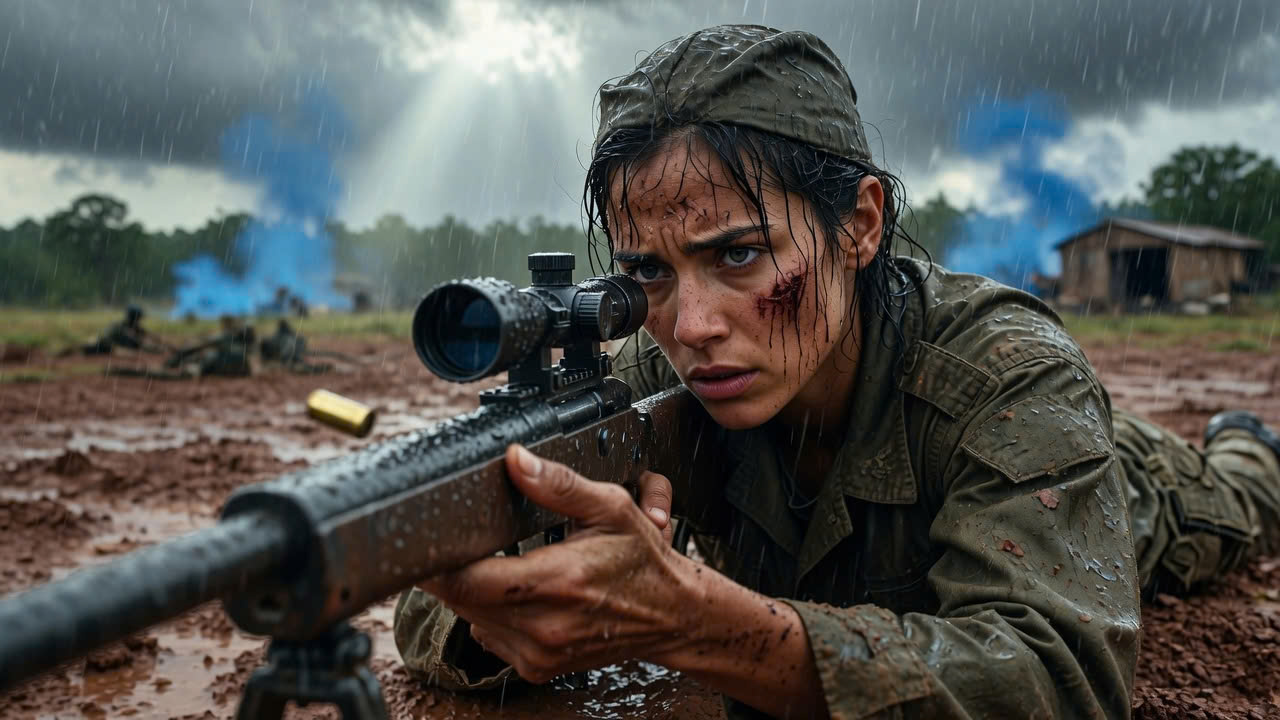
A crow landed on the fence post beyond the berm.
The morning warmed.
Evelyn Cross walked back to the bench, picked up the old training rifle, and began to clean it.
Not because it was dirty.
Because care was a language.
Because silence was not emptiness.
Because the field had spoken, and this time, everyone had listened.
By the next cycle, the story had already changed.
Stories always did.
Some said she had hit every target blindfolded. Some said she had crawled through live fire. Some said she was Special Forces, CIA, dead, resurrected, classified, cursed.
The candidates whispered before dawn as they waited on the line.
Then the range door opened.
Evelyn Cross stepped out with a rifle case in one hand and no expression on her face.
Voss stood beside her.
“This is Instructor Cross,” he said. “She will not raise her voice. She will not repeat herself. And if you are smart, you will learn to fear what she notices before you do.”
A young candidate near the back smirked.
Evelyn saw him.
She set the rifle case on the bench, opened it, and placed one brass casing beside the scope.
The casing from the final shot.
The one that had crossed eleven hundred yards of wind, memory, and pain.
Then she looked at the field.
“First lesson,” she said.
Her voice was quiet.
Every soldier leaned in.
“Tell me what you see.”
No one laughed.