When they cuffed me at the Veterans Tribute Gala, my father raised his glass and smiled for the cameras.
“I’m the one who reported her,” Admiral Grant Vey said, loud enough for the entire ballroom to hear.
The music died.
A violinist froze with her bow still hovering above the strings. Forks paused above plates. Conversations broke off in sharp little gasps beneath the chandeliers.
I stood in my dress uniform, wrists behind my back, medals catching the light like evidence.
Two federal agents flanked me.
My father took a slow sip of whiskey.
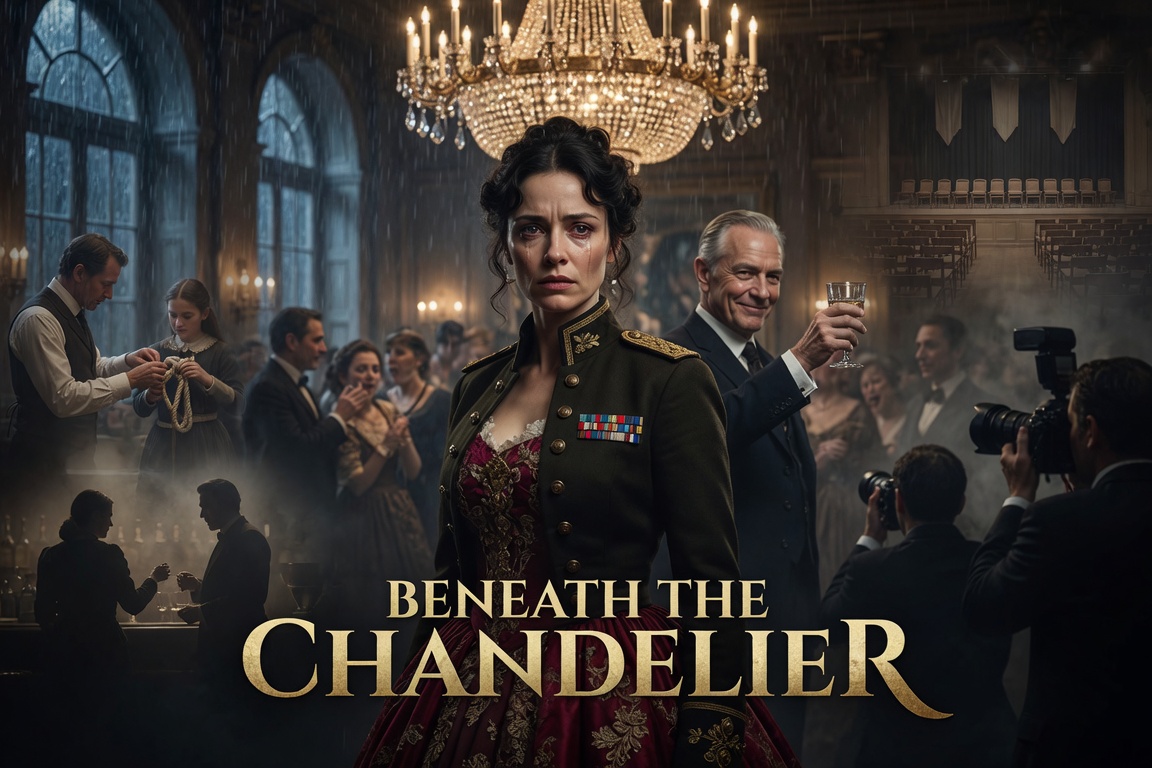
He had taught me, when I was nine, that duty meant choosing country over comfort. When I was seventeen, he taught me that tears were a private weakness. When I joined the Navy, he taught me that the Vey name came with weight.
That night, he taught me that blood could testify against you and still believe itself righteous.
“Admiral,” one agent said, “please step back.”
My father did not step back.
He looked at me the way he used to look at failed cadets.
Cold.
Disappointed.
Almost pleased.
“You should have come to me first, Elara.”
I said nothing.
If I opened my mouth, the room would hear the daughter before the officer. And he had already dragged enough of me into public.
My heels clicked against the marble as the agents led me toward the side corridor.
One.
Two.
Three.
A countdown.
Behind me, my father’s laughter followed softly through the ballroom.
Then another sound answered it.
Boots.
Not dress shoes.
Not hotel security.
Boots moving in perfect rhythm down the corridor ahead.
A sound I had not heard in three years, except in dreams I woke from with my hand reaching for a radio that was no longer there.
The agents slowed.
The double doors at the far end opened.
Six men entered first.
Dark suits. Military bearing. Eyes forward.
Behind them came Captain Owen Vale, former SEAL Team commander, silver scar across his jaw, left hand curled from an injury he never let anyone mention.
He looked past the agents.
Past the cuffs.
Straight at me.
Then he said the words my father had spent years making impossible.
“Admiral, we’re here.”
The ballroom behind us went silent all over again.
My father’s smile vanished.
Three years earlier, everyone thought SEAL Team Blackwater had died because I betrayed them.
The truth was worse.
They lived because I did.
My name is Commander Elara Vey.
For most of my life, people heard the surname before they heard me.
Vey meant Navy.
Vey meant legacy.
Vey meant my grandfather’s destroyer command, my father’s rise through intelligence, my mother’s careful silence at ceremonies where men thanked families for sacrifice while never asking what sacrifice had eaten at home.
I learned early that love in our house was conditional, but pride was inherited like furniture.
My older brother, Julian, carried the name beautifully.
He smiled easily, shook hands firmly, wore uniforms as if born inside them. My father looked at him and saw continuity.
He looked at me and saw risk.
I asked questions too young.
Not rebellious ones.
Worse.
Precise ones.
Why did a failed operation get called “unavoidable loss” before the investigation ended?
Why did certain contractors appear in every classified procurement chain?
Why did Dad lower his voice when Captain Mercer called from Stuttgart?
Why did Mom keep a locked box of letters from sailors’ widows in the laundry room?
At nineteen, I stopped asking him questions.
At twenty-two, I joined naval intelligence.
At thirty-four, I was attached to a joint special operations cell that did not exist on official guest lists.
That was where I met Blackwater.
They were not family.
That made them safer at first.
Men like Owen Vale did not ask who your father was after you proved you could get his team home. Petty Officer Cruz brought me burnt coffee without comment during twenty-hour operations. Mercer hummed old soul songs when decrypting field signals. Shaw cursed at every printer on three continents. Bennett taped cartoons to my secure monitor after I failed a psych review because “grim competence depresses everybody.”
They saw me tired, angry, brilliant, wrong, bleeding, silent.
They stayed.
Then came Operation Night Glass.
A hostage recovery in a coastal city where every street camera had been turned into a weapon. Blackwater went in under a communications blackout. I ran overwatch from a mobile command suite two kilometers away, tracking heat signatures, broken radio bursts, drone shadows, and one encrypted emergency beacon no one else could hear.
The extraction route failed.
Not from enemy action.
From internal compromise.
Someone had sold the secondary path.
Blackwater walked into a kill box.
Command ordered me to cut the feed and preserve larger intelligence channels.
My father’s voice came through the secure line.
“Elara, stand down.”
Not Commander Vey.
Elara.
He only used my first name when he wanted obedience to feel like love.
I refused.
I rerouted a surveillance satellite, broke two communication protocols, exposed a classified asset, and opened a dirty channel through a fishing fleet’s navigation net.
Blackwater got out.
Barely.
Nine men wounded.
Two dead.
One intelligence pipeline burned forever.
The official review said I exceeded authority.
Then classified evidence vanished.
Then my father testified in closed session that I had long displayed “unstable loyalty patterns due to personal attachment to field operators.”
Blackwater was redeployed and sealed under medical and operational restrictions.
I was removed from active operations.
Not court-martialed.
Not cleared.
Worse.
Suspended in suspicion.
A living cautionary tale.
My father called it mercy.
At the Veterans Tribute Gala, he called it treason.
The cuffs were cold against my wrists.
Captain Owen Vale stopped ten feet away.
The agents stiffened.
“Captain Vale,” one said. “This is a federal detention.”
Owen’s damaged hand twitched once.
“Yes,” he said. “We know.”
Behind him, the rest of Blackwater entered the corridor.
Cruz.
Shaw.
Bennett.
Mercer.
Doyle.
Men whose funerals had almost happened because I disobeyed my father.
Men my father had publicly mourned and privately silenced.
My father stepped into the corridor from the ballroom.
“What is this?” he asked.
Owen turned toward him.
“Sir.”
One word.
No warmth.
My father’s face hardened.
“You are interfering with an active counterintelligence arrest.”
“No, Admiral,” Owen said. “We are correcting one.”
The ballroom had emptied toward the corridor now. Donors, officers, spouses, reporters, hotel staff. All staring. All hungry for scandal and terrified of what rank might do next.
My father lowered his voice.
“Owen, you owe your lives to disciplined command.”
Owen stepped closer.
“No, sir. We owe our lives to your daughter ignoring it.”
The words struck the corridor like a weapon dropped on marble.
My father’s jaw tightened.
“You have no idea what she exposed.”
Owen’s eyes did not move.
“We know exactly what she exposed.”
Cruz lifted a sealed hard case.
“And we brought it.”
Agent Marlow, the senior federal agent holding my left arm, looked between them.
“What is in the case?”
Owen answered without looking away from my father.
“The evidence Admiral Vey reported destroyed.”
The first crack in my father’s composure was small.
A blink.
Nothing more.
But I saw it.
I had spent my childhood learning to survive his face.
Marlow looked at me.
“Commander Vey?”
I said my first words since the cuffs closed.
“If the case is authentic, your warrant is contaminated.”
My father snapped, “Do not advise federal agents while under arrest.”
I looked at him.
“Then stop giving them bad evidence.”
The corridor held its breath.
Agent Marlow released my arm.
Not the cuffs.
Just his grip.
That was enough.
We were taken to a private hotel conference room under federal control.
The gala continued nowhere.
Outside the glass walls, guests clustered in the hallway, whispering beneath portraits of naval battles and framed charity pledges. Inside, the air smelled of coffee, cut flowers, and the cold plastic of secure equipment cases.
My wrists were finally uncuffed.
Red marks circled my skin.
I rubbed them once, then stopped.
My father noticed.
Good.
Agent Marlow stood at the head of the table. Agent Priya Sen set up a recording device. Two hotel security guards waited near the door, useless but alert.
Blackwater stood behind Owen.
My father sat across from me, his uniform perfect, whiskey glass gone, eyes sharp again.
He had recovered fast.
Men like him always did when the room still respected rank.
Marlow opened the meeting.
“Captain Vale, you will explain why your team disrupted a lawful arrest.”
Owen placed the sealed case on the table.
“Because the warrant against Commander Vey relies on a falsified timeline, redacted communications, and a classified asset report altered by Admiral Vey’s office after Operation Night Glass.”
My father gave a dry laugh.
“You’re alleging conspiracy at a charity dinner?”
Shaw muttered, “You alleged treason at dessert.”
Owen did not look back.
Marlow cut in.
“Open the case.”
Cruz entered a code.
Then another.
The locks clicked.
Inside were three drives, one blood-stained field notebook, and a broken comms device wrapped in protective foam.
My throat tightened.
I knew that device.
It had been in Mercer’s kit the night Night Glass burned.
Mercer stepped forward.
His left cheek still carried a pale burn line from the blast.
“Ma’am,” he said to Agent Sen, “that device recorded the full dirty-channel exchange after command ordered Commander Vey to stand down.”
My father’s eyes turned to him.
“Petty Officer Mercer, you are aware unauthorized possession of classified equipment is a crime.”
Mercer looked at him.
“So is burying evidence from dead men.”
Silence.
Agent Sen lifted her head.
“Dead men?”
Owen’s voice changed.
Lower.
“Lieutenant Aaron Pike and Chief Nolan Webb. Killed during extraction. Their final transmissions were removed from the review.”
My father looked at Marlow.
“This material has no chain of custody.”
Bennett, who had not spoken yet, stepped forward and placed a smaller envelope on the table.
“It does now.”
Marlow opened it.
Inside was a notarized statement, chain logs, and a court order.
My father’s face went still.
Owen said, “We filed with the Inspector General before we came. Federal Judge Anika Cross authorized preservation review at 1800 hours. Your arrest warrant was issued at 1837 using evidence that should already have been frozen.”
Agent Marlow turned toward my father.
“Admiral?”
My father’s lips thinned.
“I was not informed of such an order.”
“No,” I said. “You moved too fast.”
His eyes cut to mine.
There it was.
The old hatred wrapped in disappointment.
“You always did mistake insubordination for intelligence.”
I leaned forward.
“And you always mistook control for service.”
For a moment, we were no longer in a conference room.
We were in his study when I was thirteen, and I had just asked why Julian’s failed math grade disappeared from the school portal.
We were in the hospital when my mother died, and he told me she wanted no visitors, only for me to learn later she had asked for me twice.
We were in a secure review room after Night Glass, and he would not look at the screen when I said men were alive because I refused him.
Agent Sen connected the first drive.
The conference room lights dimmed.
Audio filled the room.
Static.
Gunfire.
Breathing.
Then my voice, younger by three years and frayed by exhaustion.
“Blackwater, this is Overwatch. Primary extraction compromised. Do not enter south corridor.”
Owen’s voice answered through static.
“Already in it. Taking fire.”
Another voice.
Mercer.
“Command says push through.”
My voice cut back.
“Negative. South corridor is burned. Exit through east drainage. Repeat, east drainage.”
Then my father.
Calm.
“Commander Vey, you are ordered to maintain the approved route.”
I heard my own breath.
One second.
Two.
Then: “Approved route is compromised.”
“Elara,” he said. “Stand down.”
Owen looked at me across the table.
No one else moved.
On the recording, I said, “No, sir.”
The next minutes played like a wound reopened with surgical precision.
Me breaking protocol.
Me rerouting data.
Me exposing an asset.
Me guiding wounded men through a drainage line while command shouted over me.
Then Lieutenant Pike’s voice, weak and soaked in static.
“Tell Overwatch… she was right. Tell her…”
Gunfire swallowed the rest.
Chief Webb came next.
“Admiral Vey gave us the wrong exit.”
The room went colder than any battlefield.
My father did not move.
Marlow paused the audio.
“Replay that.”
Sen did.
Chief Webb again.
“Admiral Vey gave us the wrong exit.”
My father’s voice came sharp.
“That is battlefield confusion.”
Owen’s damaged hand flattened on the table.
“Webb died six minutes after saying it. He was not confused.”
My father looked at Marlow.
“You cannot possibly accept wounded-field audio as definitive.”
“No,” I said.
Everyone turned.
I looked at Agent Sen.
“Play the second drive.”
My father’s eyes narrowed.
He had not expected me to know.
Good.
Sen connected it.
Video appeared.
A command feed.
Grainy. Timestamped. Redacted header partially restored.
My father in the secure operations room on Night Glass.
Beside him stood a civilian contractor.
Graham Voss.
My father’s longtime adviser.
The man who built half of his post-retirement influence network.
On the video, Voss leaned toward my father and pointed to the extraction map.
“South corridor must remain primary,” Voss said. “The asset channel depends on it.”
My father stared at the screen.
“Elara flagged compromise.”
“Your daughter is attached to the team. Her judgment is contaminated.”
My father said nothing.
Voss continued.
“If Blackwater diverts east, the Vey Foundation pipeline is exposed. Years of work vanish.”
There.
The room heard it.
The Vey Foundation.
My father’s charity.
His redemption engine.
His empire built on veterans, donors, contracts, grief, and reputation.
My father’s hand tightened on the table.
In the video, he finally spoke.
“Maintain south corridor.”
The feed ended.
No one breathed for several seconds.
Then Agent Marlow turned slowly toward him.
“Admiral Vey, what pipeline?”
My father looked at me.
Not at Marlow.
At me.
For one strange second, I saw fear in his eyes.
Not fear of prison.
Fear that I finally understood him.
“The foundation saved lives,” he said.
I laughed.
It came out once, broken and sharp.
Everyone looked at me.
My father flinched as if I had slapped him.
“You sent men into a kill zone to protect a charity ledger?”
He stood.
“No. I protected an intelligence channel that funded extractions, medical treatment, relocation programs—things Congress delays while people die.”
Owen stepped forward.
“Two of my men died.”
My father turned on him.
“And how many lived because I kept channels open you never knew existed?”
The room saw him then.
Not the cartoon villain.
Not the simple traitor.
Something worse.
A man who had done terrible things and kept a ledger of good outcomes to survive himself.
Agent Sen’s voice was quiet.
“Through the Vey Foundation?”
My father looked toward the windows.
Beyond them, gala guests still watched, their reflections mixed with ours in the glass.
“The foundation moved money where official channels could not,” he said. “Hostage families. informants. medical evacuations. widows. You think clean systems save everyone? They don’t.”
I stood.
“You used veteran donations as cover.”
“I used donor vanity to fund operations they would have praised if they knew.”
“You sold extraction routes.”
His face hardened.
“I traded access.”
“Pike and Webb died.”
His mouth tightened.
His voice lowered.
“Yes.”
One word.
Finally.
The dead entered the room fully.
Owen looked away.
Mercer closed his eyes.
Cruz’s jaw worked.
My father straightened, trying one last time to become the admiral instead of the man beneath the uniform.
“They died in service of a larger mission.”
I stepped closer.
“No. They died because you loved being necessary more than you loved being honest.”
The sentence changed his face.
It found the father under the admiral and cut there.
Agent Marlow signaled to the guards.
“Admiral Vey, I need you to surrender your sidearm and credentials.”
My father looked at him with disbelief.
“You cannot be serious.”
Marlow’s expression did not shift.
“I am.”
Then the ballroom doors burst open.
Not agents.
Julian.
My brother crossed the threshold in a tuxedo, face pale, bow tie undone. Behind him came Graham Voss with a gun pressed discreetly against his ribs.
No one saw the weapon at first.
I did.
Julian’s eyes met mine.
The little boy who used to hide failed grades behind my books was still in there somewhere, terrified and obedient.
“Elara,” he said carefully. “Voss says you need to stop.”
The room went very still.
Voss smiled over Julian’s shoulder.
“Family meetings are always so emotional.”
Agent Marlow’s hand moved toward his weapon.
Voss pressed the gun harder into Julian’s side.
“Slowly, Agent.”
My father stared.
“Graham, what are you doing?”
Voss laughed softly.
“Preventing your daughter from burning down everything we built because you decided to confess like an old Catholic.”
My father’s face drained.
So.
Even he had not known who held the final leash.
Voss moved Julian farther into the room.
He was fifty-eight, polished, composed, silver cufflinks, expensive suit, the kind of man donors trusted because he never seemed to need anything. That should have warned them.
Men without visible hunger often hide the worst appetites.
He looked at me.
“Commander Vey. Still breaking rooms.”
“Let Julian go.”
“Eventually.”
Owen shifted.
Voss noticed.
“Captain Vale, please don’t test me. Your team already proved hard to kill. I’d hate to ruin the statistic.”
Cruz’s eyes went black.
My father found his voice.
“Graham.”
Voss turned the smile toward him.
“Grant. You were magnificent until conscience made you sloppy.”
“I never authorized threats against my son.”
“No. You only built the machine that made him useful.”
Julian’s face tightened.
That hit him.
Good.
Truth should not spare favorites.
Voss looked at Agent Sen.
“Disconnect the drives.”
No one moved.
He cocked the gun slightly.
Julian inhaled sharply.
I raised my hand.
“Do it.”
Sen looked at me.
I nodded once.
She slowly unplugged the drive.
Voss’s smile widened.
“Thank you. Now the case.”
Owen said, “No.”
Voss pressed the gun harder.
Julian winced.
My father made a small sound.
Not command.
Panic.
I looked at Voss.
“You won’t shoot him.”
“Because?”
“Because Julian is your insurance. Not your target.”
Voss’s eyes warmed with interest.
“And you always were the bright one.”
Julian flinched.
My father heard it.
For the first time in my life, I saw him understand what favoritism had done to both his children.
Voss moved toward the side door.
“The case.”
Owen’s jaw tightened.
I picked it up before he could refuse.
“Elara,” my father said.
I did not look at him.
I walked toward Voss with the case in both hands.
The room watched my every step.
One.
Two.
Three.
My heels against marble again.
A countdown.
Voss held Julian close.
“Set it down.”
I placed the case on the carpet.
His eyes flicked down.
That was all I needed.
Julian drove his elbow back.
Not hard enough to win.
Hard enough to make space.
I kicked the case into Voss’s knee.
Owen moved like a door kicked open.
Marlow drew.
Cruz took Julian down and away.
Voss fired once.
The shot shattered the glass wall.
Guests screamed outside.
Owen hit Voss at the waist and drove him into the conference table. The gun skidded across polished wood. Mercer caught it before it fell.
In three seconds, Voss was on the floor with Owen’s knee between his shoulder blades and Agent Marlow’s cuffs on his wrists.
Julian sat against the wall, breathing hard, one hand pressed to his ribs.
My father rushed to him.
“Julian.”
My brother looked up.
Not at him.
At me.
“You knew I’d move?”
I shook my head.
“I hoped.”
He laughed once, shaking.
“Great plan.”
“Worked.”
He looked at me for a long moment.
“I’m sorry.”
My father froze.
Julian’s eyes did not leave mine.
“For all of it,” he said.
The room was too broken for that sentence, but it arrived anyway.
My father lowered his hand slowly.
He had not been the first person Julian apologized to.
That might have hurt him.
It should have.
Voss laughed from the floor, blood at the corner of his mouth.
“You think this ends it? The foundation records are mirrored. Donors, contractors, intelligence liaisons. Your precious truth will burn half the people in this room.”
Agent Marlow looked at him.
“Then we’ll need more rooms.”
By midnight, the gala had become a federal crime scene.
Reporters filled the sidewalk outside. Flashing lights painted the hotel facade red and blue. Guests gave statements wrapped in evening coats. The ballroom sat abandoned, candles still burning on tables where dessert had not been served.
My father sat in the conference room without his sidearm, credentials, or command.
Julian was being examined by medics.
Voss had been taken away under guard.
Blackwater waited near the doors.
Not celebrating.
Men like them knew truth did not resurrect the dead.
Agent Marlow approached me with the arrest warrant folded in his hand.
“Commander Vey,” he said, “you are no longer in custody.”
I looked at the paper.
“Am I cleared?”
“Not tonight.”
Honest.
I preferred that.
“But the treason allegation is suspended pending review of new evidence,” he said. “And Admiral Vey’s report is now part of an obstruction investigation.”
Across the room, my father heard.
His face did not change.
Good.
Let him practice stillness without power.
Marlow left.
Owen came to stand beside me.
For a while, neither of us spoke.
Through the broken glass panel, I could see the ballroom chandeliers still glowing.
“They cuffed you hard,” he said.
I looked at my wrists.
Red marks. Already fading.
“I’ve had worse.”
“Not from your father.”
That landed.
I said nothing.
Owen’s voice softened.
“We should have come sooner.”
“You were sealed under restrictions.”
“We were alive.”
I looked at him.
His scar pulled slightly when his jaw tightened.
“Pike and Webb weren’t,” he said.
“No.”
The names sat between us.
Finally spoken without classification swallowing them.
My father stood.
Both of us turned.
He walked toward me slowly. No admiral’s stride now. No room bending around him. Just an old officer in a uniform that suddenly looked heavy.
“Elara.”
I waited.
His eyes moved to my wrists.
For a second, pain crossed his face.
Then shame.
“I believed I could control the damage.”
The old language.
Control.
Damage.
Not grief.
Not guilt.
Not daughter.
I looked at him.
“You smiled.”
He flinched.
Good.
“At the gala,” I said. “When they cuffed me. You smiled.”
His mouth opened.
Closed.
No strategy fit the truth.
“I thought turning you in proved I was still clean,” he said.
The confession was quiet enough that only Owen and I heard it.
“And when the room looked at me, I felt…” His face twisted. “Vindicated.”
My throat tightened.
There it was.
Not the conspiracy.
Not the foundation.
The small, intimate crime beneath the national one.
He had enjoyed watching me fall because my fall helped him stand.
I nodded once.
Not forgiveness.
Recognition.
“You reported me for treason to redeem yourself.”
His eyes filled.
“Yes.”
The word almost broke him.
Almost.
I had spent my life waiting for my father to break open into love.
Instead, he broke open into truth.
Maybe that was all men like him could manage.
Julian approached, ribs wrapped under his shirt, bow tie gone.
He stood beside me.
Not behind Dad.
That changed the room more than he knew.
My father saw it.
His shoulders sank.
“Julian.”
My brother’s voice was hoarse.
“You used me too.”
My father closed his eyes.
“Yes.”
Julian swallowed.
“I let you.”
Silence.
Owen looked away, giving us privacy without leaving protection.
My father touched the table to steady himself.
“I don’t know how to repair this.”
I looked at him.
“You don’t repair treason with a family talk.”
He flinched at the word.
Treason.
The one he gave me.
Now returned.
“You cooperate,” I said. “Fully. No legacy statements. No foundation language. No larger mission. Names. Accounts. Orders. Every dirty channel Voss touched and every clean person you used as cover.”
His face tightened.
“That could destroy programs that help people.”
“Then we rebuild them without lies.”
“You make it sound simple.”
“No. I make it sound necessary.”
He stared at me.
For once, he had no command left to give.
Only a choice.
At last, he nodded.
“I’ll give a statement.”
“No,” I said. “You’ll give evidence.”
His eyes lowered.
“Yes.”
Blackwater escorted me out through the service entrance.
Not because I needed protection, though maybe I did.
Because men who survived together understand that walking out alone after public betrayal can feel worse than walking into fire.
Rain fell over the hotel alley.
Cold. Hard. Clean.
The city lights blurred on wet pavement. Sirens wailed somewhere beyond the block. A news helicopter beat the air overhead.
Cruz handed me my cover.
“You dropped this when they cuffed you.”
I took it.
“Thank you.”
Mercer looked at my wrists and said nothing.
Bennett, always the worst at solemn moments, cleared his throat.
“Good gala. Food was terrible. Treason subplot excessive.”
I laughed.
It surprised all of us.
The sound came out cracked but real.
Owen smiled faintly.
“There she is.”
I looked at them.
My team.
Not by blood.
By risk.
By return.
By truth carried too long.
“You shouldn’t have come in like that,” I said.
Owen shrugged.
“Admiral needed a reminder.”
“Of what?”
Cruz answered.
“That you were never alone in the report.”
The rain hit harder.
For a moment, the alley disappeared and I was back in Night Glass, hearing wounded men breathe through static, choosing whether to obey my father or save the team.
I had thought that choice cost me everything.
Maybe it had saved the only things worth keeping.
Three months later, the Vey Foundation collapsed.
Not all at once.
Things built from reputation rarely fall cleanly. First came suspended accounts. Then sealed indictments. Then congressional questions. Then donors explaining how they had no idea their money moved through intelligence cutouts. Then contractors discovering that silence does not love them back.
Graham Voss took a deal that made everyone angry and many people nervous.
My father testified for nine days.
On the seventh, he named himself.
Not as misled.
Not as manipulated.
As responsible.
That testimony did not redeem him.
But it stopped him from lying in uniform.
Julian resigned from the foundation board and began working with investigators to identify families owed restitution. He called me every Sunday for six weeks before I answered.
The first call I took lasted four minutes.
Progress.
Not forgiveness.
Maybe one day.
As for me, the review restored my operational record, cleared the treason allegation, and added a commendation I did not attend in person.
I did not want another ballroom.
Instead, I went to Arlington on a cold morning with Owen and Blackwater.
Pike and Webb were buried two rows apart.
The grass was wet. The sky low and gray. White stones lined the earth in disciplined silence. No cameras. No speeches. No chandeliers.
Owen stood at Pike’s grave.
Mercer at Webb’s.
I placed two small black stones on the headstones, each marked with the broken signal symbol from Night Glass.
“Your names are in the corrected report,” I said.
The wind moved across the cemetery.
It did not answer.
That was all right.
The dead had spent long enough being used by the living.
On my way back to the car, my phone buzzed.
A message from my father.
I am sorry.
I stood beneath a bare tree and stared at the words.
Four syllables after thirty-five years of command.
They looked small on the screen.
Not meaningless.
Small.
Owen waited near the car, giving me space.
I typed one sentence.
Tell the truth again tomorrow.
Then I sent it.
No hearts.
No forgiveness.
No daughter rushing back to make a ruined father comfortable.
Just the next order.
For him.
For me.
For whatever survived.
I put the phone away and walked toward my team.
Years ago, my father taught me that duty meant choosing country over comfort.
He forgot to teach me that sometimes duty means choosing truth over the people who taught you the word.
At the Veterans Tribute Gala, he reported me for treason and smiled while they cuffed me.
He thought that was my fall.
He was wrong.
It was the moment every buried signal found a voice.
The SEAL team stormed in, not to save me from justice, but to bring justice with them.
And when Owen said, “Admiral, we’re here,” he was not announcing a rescue.
He was announcing witnesses.
The kind my father could not command.
The kind Voss could not buy.
The kind that stand beside you when the room mistakes silence for guilt.
I walked out of that cemetery with rain on my uniform, my wrists healed, my name restored, and no illusion that truth fixes everything it touches.
It doesn’t.
Truth breaks first.
Then it clears ground.
And on that ground, if you are brave enough not to rebuild the lie, something stronger can finally stand.