The DARKEST Truth of the Nazi “Breeding Farms”
What if giving birth were no longer treated as the beginning of a human life—but as the production of a weapon?
What if a government examined your ancestry before deciding whether you deserved to become a mother?
And what if the child in your arms did not legally or morally belong to you, but to a racial empire that believed it had the right to decide where that child would live, what name they would carry, and even which nation they would remember as home?
This was the world created by Nazi Germany.
It did not begin with rows of cribs or maternity wards hidden behind country estates. It began with an idea: that human beings could be ranked by blood, measured by ancestry, and divided into those whose lives should multiply and those whose lives should disappear.
The Nazis called one side of that system “racial hygiene.”
The rest of the world would eventually understand it as organized dehumanization.
At the center of this story stood Heinrich Himmler, head of the SS and one of the principal architects of Nazi terror. In December 1935, the SS established an organization called Lebensborn, a German word often translated as “Fount of Life.” Its official purpose sounded almost charitable: provide medical care, financial assistance, maternity homes, adoption services, and privacy for pregnant women considered racially acceptable by the regime.
The buildings could look peaceful.
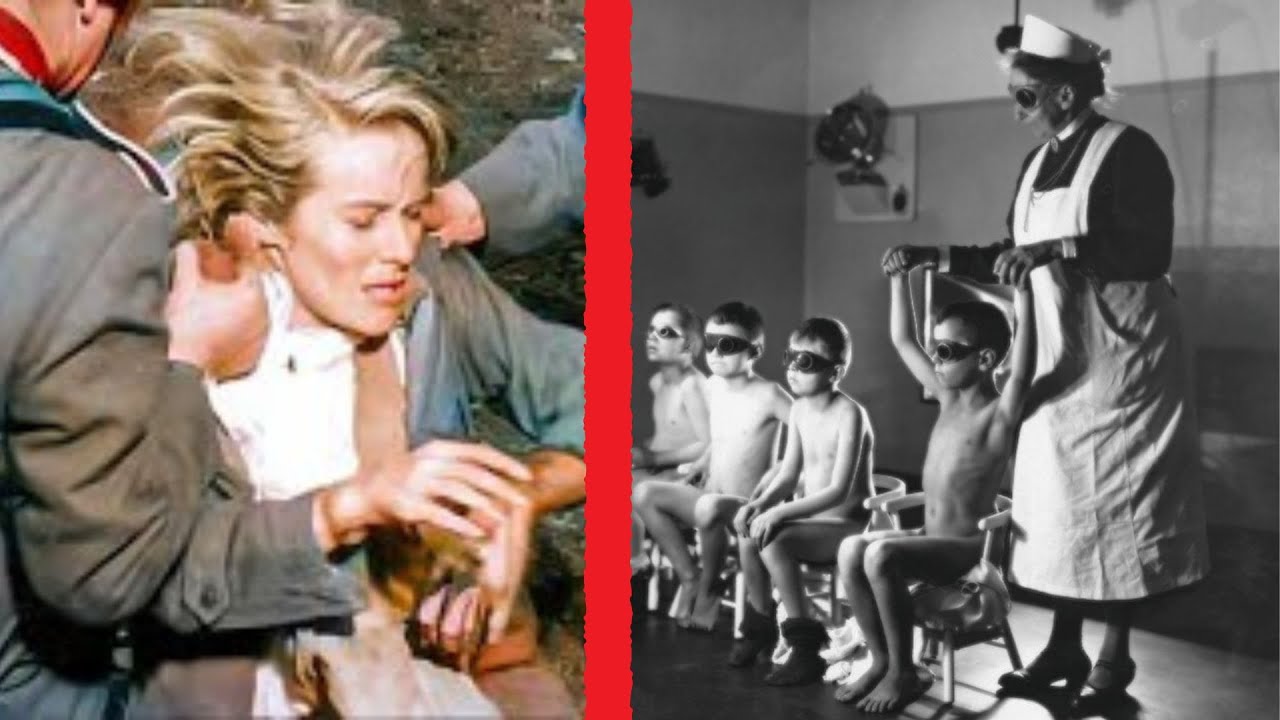
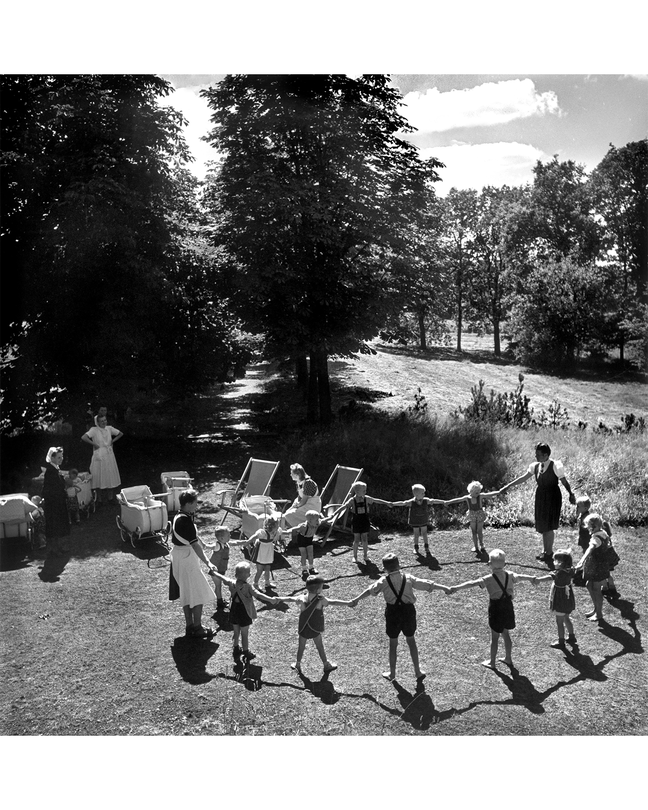
Some stood in quiet countryside settings, surrounded by trees and gardens. Inside were clean rooms, nurses in white uniforms, polished floors, and orderly lines of cribs. Pregnant women received food and medical attention. Babies were weighed, documented, examined, and cared for.
Nothing about the surface immediately revealed the moral catastrophe underneath.

Because Lebensborn was not created to protect motherhood.
It was created to control it.
The women admitted to its homes were not welcomed simply because they needed help. They first had to satisfy the racial demands of the SS. Their ancestry, health, and family history could be investigated. The identity and racial background of the father mattered. The unborn child was evaluated not merely as a baby, but as a potential biological contribution to the Nazi future.
A woman could be frightened, unmarried, abandoned, or desperate.
The regime did not primarily ask whether she was safe.
It asked whether her blood was useful.
That distinction reveals the darkest truth of Lebensborn.
The program is often described as a network of Nazi “breeding farms,” a phrase that produces images of SS officers being systematically paired with selected women inside secret compounds. The documented reality was more complicated. Lebensborn homes were not generally organized as literal human mating facilities. They functioned as maternity institutions, welfare centers, adoption networks, and instruments of racial selection.
But correcting the myth does not make the truth less disturbing.
It makes it more disturbing.
The system did not need chains in every room or forced pairings behind every door. It operated through benefits, paperwork, secrecy, social pressure, legal authority, and racial privilege. It made surrendering control appear respectable. It wrapped coercion in medical language and transformed ideology into administrative procedure.
A doctor could perform an examination.
A clerk could inspect a family tree.
An SS official could approve a file.
A nurse could carry a newborn into another room.
And with each calm, professional act, the boundary between family and state became thinner.
Nazi propaganda insisted that so-called “racially valuable” Germans had a duty to produce more children. The regime encouraged large families among those it considered acceptable, while sterilizing, persecuting, imprisoning, or murdering those it classified as biologically or racially undesirable. In that system, reproduction was never a private matter. It was a battlefield on which the government tried to engineer the population of the future.
The ideal Nazi mother was praised publicly, but only under strict conditions.
She was honored not because motherhood itself was sacred, but because the regime believed her body could create the right kind of Germans.
That meant the celebration of one mother depended on the rejection of another.
While some women received medals for producing large “Aryan” families, others were told that their illnesses, disabilities, ancestry, relationships, or social circumstances made them unworthy of reproduction. The state that praised birth in one household could enforce sterilization in another. The government that presented itself as the defender of children could simultaneously classify entire groups of children as enemies.
This contradiction was not a flaw in Nazi policy.
It was the policy.
Lebensborn offered particular advantages to unmarried pregnant women who passed its racial tests. In a conservative society where pregnancy outside marriage could bring humiliation, loss of employment, or rejection by family, the promise of confidential care was powerful.
A woman could disappear into a private maternity home.
She could give birth away from neighbors.
Documents could be handled discreetly.
The child might be placed for adoption.
To a frightened young woman, this could look like rescue.
But the rescue came with a silent transfer of authority.
According to surviving records and historical research, Lebensborn officials could determine whether a child born to an unmarried woman would be released into her custody or placed with an adoptive family. Roughly 7,000 children were born in Lebensborn maternity homes between 1936 and 1945, although the organization’s influence extended beyond those births.
Imagine the moment.
A mother has just survived labor. She is exhausted, vulnerable, and surrounded by people wearing uniforms of care. Her baby is nearby, sleeping under a white blanket.
Then the conversation changes.
There are forms to sign.
Questions about the father.
Questions about employment.
Questions about whether she can provide a proper home.
Officials who claim to know what is best.
The room remains clean. No one needs to shout. No weapon needs to be placed on the table.
Power is already present.
The Nazi state had inserted itself into the most intimate human relationship and given itself permission to decide whether that relationship should continue.
To Himmler and the SS, children were not merely members of families. They were demographic assets. SS men were encouraged to father large numbers of children, and during the war the organization reassured them that children born outside marriage—and their mothers—could receive Lebensborn support if they met racial requirements.
The language was always about life.
The logic was always about ownership.
A newborn could be recorded as evidence that the “master race” was expanding. A mother could be treated as a biological contributor. A father’s duty could be reduced to producing descendants for the Reich.
Love, commitment, and family responsibility became secondary to heredity.
But the program’s most horrifying transformation came after Nazi Germany expanded across Europe.
As German forces occupied foreign countries, Nazi racial experts encountered children they believed possessed desirable physical characteristics. Some had blond hair, blue or light-colored eyes, or features that fit the regime’s fantasies about Germanic ancestry.
To ordinary people, they were Polish, Slovenian, Czech, Ukrainian, Norwegian, or members of other communities.
To the SS, some of them were “recoverable German blood.”
That belief opened the door to kidnapping.
Children were taken from parents, orphanages, schools, and occupied communities. They could be subjected to racial examinations, renamed, forced to learn German, and placed with German foster or adoptive families. Various Nazi organizations participated in this wider system of child abduction and Germanization; Lebensborn became part of the machinery that processed or placed some of them.
The language used to justify this crime was deliberately upside down.
The Nazis did not describe themselves as stealing children.
They claimed they were reclaiming them.
A Polish child who cried for her mother was told that her previous identity was a mistake.
A boy who spoke no German could be punished or pressured until his first language began to disappear.
Birth certificates and names could be changed.
Family histories could be erased.
The child might then be presented to a German couple as an orphan suitable for adoption.
Some adoptive parents may not have known the full origin of the child placed in their home. Others accepted the system without asking questions that might have broken the comforting story they had been given.
Either way, somewhere beyond Germany, a family was still waiting.
A mother might continue searching through offices and refugee lists.
A father returning from forced labor might discover an empty home.
Grandparents might keep a child’s clothing folded in a drawer because admitting the truth would mean admitting that the child could be alive—and still unreachable.
This was not simply the theft of a body.
It was the theft of memory.
And here lies the part of the story that changes the meaning of those quiet maternity homes.
At first, Lebensborn can appear to have been a pronatalist welfare program corrupted by racist ideology: a place where selected German women gave birth and selected babies received care.
But the network belonged to a much larger project.
The same state that encouraged the birth of children it wanted also removed children from families it considered inferior. It did not merely seek to increase a population. It sought to redesign Europe by deciding which bloodlines would continue, which identities would be erased, and which families had no right to remain intact.
The cribs were not separate from the concentration camps.
The maternity benefits were not separate from forced sterilization.
The adoption files were not separate from occupation.
They were different expressions of one principle: the Nazi regime believed the individual existed for the racial state.
A mother’s consent mattered only when it aligned with that principle.
A child’s identity mattered only when the regime approved it.
A family remained a family only until an official decided otherwise.
After the war, the buildings could be opened, the uniforms removed, and the Nazi emblems taken down.
But the damage could not be reversed with a change of flags.
Some abducted children were located and returned. Others had become too young to remember their original names. Some no longer spoke the language of their birth families. Some rejected the people who came to reclaim them because those relatives appeared to be strangers.
For others, the truth surfaced years or even decades later.
A document did not match.
A parent refused to discuss the past.
A surviving file revealed a different surname, a foreign birthplace, or an adoption arranged through Nazi authorities.
A person who had spent a lifetime believing they were German suddenly discovered that their identity had been constructed by the people who destroyed their first family. The surviving records of Lebensborn and other Nazi child programs remain important because descendants and researchers are still trying to reconstruct origins that the regime deliberately obscured.
There was rarely one dramatic moment of justice.
No single courtroom could restore a stolen childhood.
No verdict could return the years in which a mother had searched for a child who was living under another name.
The consequences moved silently through generations: shame, confusion, broken ancestry, uncertain nationality, and the unbearable knowledge that the first facts of a person’s life had been chosen by a racial bureaucracy.
That is why the familiar phrase “Nazi breeding farms” can both attract attention and conceal the deepest horror.
It suggests that the evil was confined to bizarre secret facilities run by obvious monsters.
The reality was broader.
The system involved doctors, nurses, clerks, welfare officers, racial examiners, adoption officials, foster parents, administrators, and SS leaders. Some believed passionately in the ideology. Some obeyed because it benefited them. Some chose not to examine what was happening beyond the clean corridors and official seals.
The machinery worked because cruelty learned to look ordinary.
A woman entered a respectable building.
A baby received a file number.
A child was given a new name.
A clerk stamped the paper.
And an entire human life was redirected.
The Nazis understood that controlling death gave them enormous power.
Lebensborn reveals that they also understood the power of controlling birth.
They tried to reach backward into ancestry and forward into generations not yet born. They transformed pregnancy into public policy, motherhood into racial service, adoption into political engineering, and childhood into territory that could be conquered.
But the moment a government decides that some babies are national treasures while others are biological threats, it has already abandoned the idea that human life possesses equal worth.
That is the warning left behind by those silent nurseries.
The greatest danger does not always announce itself with violence. Sometimes it arrives offering medical care, financial support, social respectability, and protection—then quietly asks who should be allowed to belong.
A regime does not have to call mothers prisoners to take away their freedom.
It does not have to call children property to claim ownership of their future.
And it does not have to call a maternity ward a battlefield to turn birth into an act of war.