THE PUBLIC EXECUTION OF STUTTHOF GUARD JENNY-WANDA BARKMANN — THE “BEAUTIFUL SPECTRE” WHO SENT PRISONERS TO THEIR DEATHS

On July 4, 1946, a young woman stood beneath a wooden gallows on Biskupia Górka Hill outside Gdańsk, Poland.
She was in her early twenties.
Her clothes were plain. Her face was youthful. In photographs taken during her imprisonment and trial, she looked less like a notorious war criminal than someone posing for an ordinary portrait.
But the thousands of people gathered around the hill had not come to admire her appearance.
They had come to watch Jenny-Wanda Barkmann die.
Only a short time earlier, Barkmann had worn the uniform of an SS camp guard at Stutthof, a Nazi concentration camp where prisoners were starved, beaten, worked to exhaustion and murdered. Survivors remembered her not merely as someone who followed orders, but as a guard capable of extraordinary cruelty.
They reportedly gave her a name that captured the contradiction they saw every time she approached:
The Beautiful Spectre.
A beautiful ghost.
A polished face carrying death behind it.
And on that summer day in 1946, the woman who had once stood above terrified prisoners was about to experience a complete reversal of power.
She was no longer giving orders.
She was waiting for one to be carried out.
Stutthof had been established by Nazi Germany in September 1939, near the town now known as Sztutowo, about 22 miles east of Danzig, today’s Gdańsk.
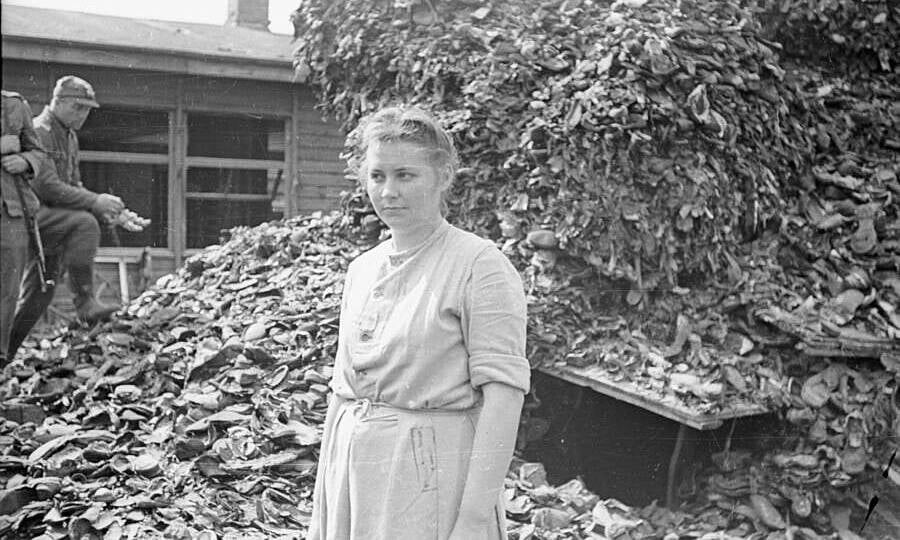
It began as an internment camp. It later became a forced-labor facility and, in January 1942, an official concentration camp.
Its isolated location served the Nazi system well.
The camp stood in wet, low-lying terrain between waterways and the Baltic coast. Barbed wire separated the prisoners from the outside world. After the camp was expanded, electrified fencing enclosed rows of barracks where hunger, disease and violence became part of daily existence.
Tens of thousands of people were deported to the Stutthof camp system. They included Polish civilians, Jews transported from occupied territories, Soviet prisoners and others classified by Nazi authorities as enemies or human beings whose lives had no value.
The prisoners were forced to work in SS enterprises, factories, workshops, agriculture and armaments production. Those who became too sick or too weak to work could be killed.
Gassing with Zyklon B began at Stutthof in 1944. Camp physicians also murdered prisoners through lethal injections. More than 60,000 people died in Stutthof and its network of subcamps.
It was into this machinery of imprisonment and death that Jenny-Wanda Barkmann entered.
Little reliable information survives about her childhood.
She was born in Hamburg in the early 1920s. Later accounts sometimes claimed that she had worked as a model, a detail repeated so often that it became part of the legend surrounding her. Yet the documentary record of her early life remains thin.
There is no complete childhood biography explaining how an apparently ordinary young woman became an SS overseer.
There is only the woman who eventually appeared at Stutthof in 1944.
That absence of explanation can be unsettling.
People often want monsters to arrive already marked—to look cruel, speak cruelly and carry some visible warning of what they are capable of doing.
Barkmann offered no such warning.
She was young. She was considered attractive. She could present herself neatly and speak calmly.
Nothing in her face announced what survivors would later describe.
By the time she became an Aufseherin, a female camp overseer, Nazi Germany had spent years teaching its citizens to divide humanity into categories of value.
Propaganda had normalized racial hatred.
Obedience had been praised as virtue.

Violence had become administrative work.
Murder could be recorded on forms, discussed in offices and carried out by people who returned to ordinary meals afterward.
Women were not excluded from that system.
Thousands served as guards in Nazi concentration camps. Some entered through recruitment or assignment. Others volunteered. Once inside the camps, many demonstrated that cruelty did not belong to one gender.
The uniform gave them authority.
The camp gave them victims who could not escape.
And the Nazi system gave them permission.
Barkmann arrived at Stutthof during the final year of the war, but she did not need long to make prisoners fear her.
According to later biographical accounts and testimony associated with her prosecution, she beat prisoners and participated in selections that sent women and children toward the gas chamber.
Her appearance intensified the terror.
A prisoner seeing Barkmann approach might first notice a young woman whose hair and clothing appeared carefully maintained. Then came the uniform, the authority and the knowledge that a gesture from her could lead to punishment—or death.
She did not need to shout constantly.
Power was already built into the scene.
The prisoners stood exhausted, hungry and vulnerable. Barkmann stood fed, armed and protected by the SS system.
A small infraction could result in a beating.
Moving too slowly could attract attention.
Falling ill could mean being declared useless.
And being declared useless inside Stutthof could become a death sentence.
Accounts of Barkmann’s conduct describe her brutality as personal, not merely bureaucratic. She was accused of attacking prisoners directly and showing no hesitation when selecting vulnerable inmates for death.

The victims most easily discarded by the camp were often the people least able to defend themselves: the sick, the elderly and children.
For Barkmann, a selection could take only moments.
For the prisoner standing before her, it separated continued suffering from immediate death.
That was the horror of the camp system.
Mass murder did not always arrive with theatrical rage.
Sometimes it arrived through a glance.
A hand movement.
A name marked on a list.
A guard deciding that a human being would not return to the barracks.
The nickname “Beautiful Spectre” survived because it expressed something survivors struggled to reconcile.
Barkmann’s face belonged to the familiar world.
Her actions belonged to a place where ordinary morality had been inverted.
Beauty, usually associated with warmth or admiration, became a disguise for danger.
Youth, usually associated with innocence, offered no protection against corruption.
Femininity, often treated by society as proof of gentleness, concealed nothing.
Inside Stutthof, the prisoners learned to fear the polished surface.
They knew what stood behind it.
By early 1945, the world that had empowered Barkmann was collapsing.
Soviet forces were advancing from the east. Nazi officials began evacuating the Stutthof camp system in January.
Nearly 50,000 prisoners remained across the system when the evacuations began, most of them Jewish. Many were forced onto death marches in severe winter conditions. Thousands died from exposure, starvation, shootings and abuse.
Some prisoners were driven toward the Baltic coast. Others were transported by boat. Many never survived the final months.
Soviet troops liberated Stutthof on May 9, 1945. They found only about 100 prisoners who had managed to remain behind or hide during the evacuation.
Barkmann had already disappeared.
Like many people connected to the Nazi camp system, she attempted to blend into the chaos surrounding Germany’s defeat.
Uniforms could be removed.
Documents could be destroyed.
Names could be changed.
Millions of displaced people crowded roads, rail stations and damaged cities. Refugees, soldiers, former prisoners and civilians moved through a landscape where governments had collapsed and borders were changing.
For a brief period, Barkmann may have believed she could vanish among them.
But survivors remembered her face.
In May 1945, she was recognized and arrested in Gdańsk.
The same appearance that had made her distinctive at Stutthof now made hiding more difficult.
The prisoners she had once treated as powerless had survived long enough to speak.
Their memories became evidence.
In 1946, Barkmann was placed on trial with other former personnel connected to Stutthof, including SS guards and prisoner functionaries known as kapos.
The first Stutthof trial was held before a Special Criminal Court in Gdańsk from April 25 to May 31, 1946.
Thirteen defendants were tried.
The courtroom became a place where the hierarchy of the camp was turned upside down.
Former prisoners were no longer required to stand silently while guards judged them.
Now the survivors spoke.
The accused sat and listened.
Witnesses described conditions inside the camp, the beatings, the selections and the treatment of prisoners who had been stripped of every legal protection.
Barkmann was accused of crimes against humanity and of direct brutality toward inmates.
The case did not portray her as a frightened bystander caught inside a system she could not control.
It portrayed her as a participant who had used the system’s power.
Reports of her behavior during imprisonment and trial only deepened public disgust.
Later accounts claimed that she remained highly conscious of her appearance, changed her hairstyle and behaved with a disturbing detachment. Some stories even described her flirting with guards.
Not every dramatic detail repeated about Barkmann can be verified with equal confidence.
But the images from the proceedings preserve something undeniable.
She appeared composed.
While witnesses spoke about humiliation, violence and death, the young former guard often seemed strangely separated from the human consequences of the accusations.
There was no public collapse.
No visible transformation.
No moment in which the person described by survivors appeared to confront the scale of what had happened at Stutthof.
That composure may once have impressed or intimidated people around her.
In the courtroom, it worked differently.
It made the distance between the accused and the suffering described by witnesses appear even greater.
The verdict was guilty.
Barkmann was sentenced to death by hanging.
Several of her co-defendants received the same punishment.
The trial had lasted weeks.
The sentence would be carried out in public.
On July 4, 1946, crowds moved toward Biskupia Górka Hill.
Estimates of the number present vary widely, but contemporary and historical accounts agree that tens of thousands witnessed the event. The execution was not treated simply as the punishment of eleven convicted criminals.
It became a public ritual of postwar justice.
Gdańsk and the surrounding region had endured occupation, persecution, mass displacement and death. Many people in the crowd had lost relatives. Some had survived prisons or camps. Others had spent years watching Nazi authorities act as if they would never answer to anyone.
Now wooden gallows stood in the open air.
The condemned included five women and six men.
Among them were camp guards and kapos convicted during the first Stutthof trial.
The physical arrangement itself carried a brutal symbolism.
Prisoners had once been transported to Stutthof under guard.
Now former camp personnel were transported under guard.
Prisoners had once been forced to stand while SS personnel decided their fate.
Now former prisoners and witnesses stood among the crowd while a court sentence was imposed on the people who had helped terrorize them.
Accounts state that former Stutthof prisoners volunteered to assist in carrying out the executions.
That fact transformed the scene into an unmistakable reversal.
The powerless were no longer powerless.
The uniform no longer protected its wearer.
Barkmann was led toward the gallows.
She was still strikingly young.
Anyone who knew nothing about her crimes might have looked at her face and wondered how someone so young had reached that place.
But the survivors did know.
They knew the sound of boots in the barracks.
They knew the fear of being inspected.
They knew what it meant when a guard selected someone who was sick, elderly or unable to continue working.
They knew that youth had not stopped Barkmann from using violence.
They knew that beauty had not produced mercy.
As the final preparations were made, Barkmann could see the crowd.
She could see the gallows.
She could see the former prisoners standing on the other side of the power she had once possessed.
This was the moment no uniform could conceal.
The authority was gone.
The war was over.
The camp had been liberated.
The people she and others had expected to disappear without witnesses had returned to name them.
Whatever composure she maintained, the structure around her made the truth visible.
She was no longer the figure prisoners feared approaching through the barracks.
She was a convicted war criminal standing before the consequences of her actions.
A line widely attributed to Barkmann after her sentencing declared that life was a pleasure and pleasures were usually short.
Whether spoken with bravado, indifference or an attempt at theatrical defiance, the words could not change what happened next.
The sentence was carried out.
Jenny-Wanda Barkmann died on July 4, 1946, alongside ten others convicted in the first Stutthof trial. The proceedings had ended on May 31; the public execution followed just over a month later.
The photographs taken that day remain disturbing.
Not because they show a supernatural monster.
Because they show ordinary human faces.
That may be the most frightening part of Barkmann’s story.
She was not born wearing an SS uniform.
She did not enter history with the word “murderer” written across her face.
She became part of a system that rewarded obedience, dehumanization and cruelty. Then, according to the accusations proven against her, she went beyond passive participation and inflicted suffering herself.
Her appearance became famous because people expected evil to look different.
They expected it to be ugly.
They expected it to be obvious.
They expected to recognize it before it came close.
But Stutthof taught its prisoners a more terrible lesson.
Evil can smile.
It can adjust its hair.
It can speak calmly.
It can perform violence as though completing an ordinary task.
The public execution on Biskupia Górka Hill offered survivors a form of legal closure, but it could not restore the dead.
It could not return children to their parents.
It could not undo the selections.
It could not erase the barracks, the gas chamber, the forced labor or the death marches.
Justice arrived only after tens of thousands had been killed.
And even then, it reached only a fraction of the people who had helped the system function.
That is why the story of Jenny-Wanda Barkmann should not be remembered merely as the sensational downfall of a beautiful Nazi guard.
Her face is not the lesson.
Her execution is not the lesson.
The lesson is how easily a normal-looking person can accept power over dehumanized people—and how quickly that power can reveal what appearance was able to hide.
On July 4, 1946, Barkmann finally stood where her victims had always stood: unable to command, unable to select and unable to walk away.
The “Beautiful Spectre” disappeared beneath the gallows.
But the question left behind is far more unsettling than the manner of her death: