“DON’T DO THAT TO MY MOTHER!”
The little girl’s voice cut through Bella Napoli so sharply that every fork in the pizzeria seemed to stop at once.
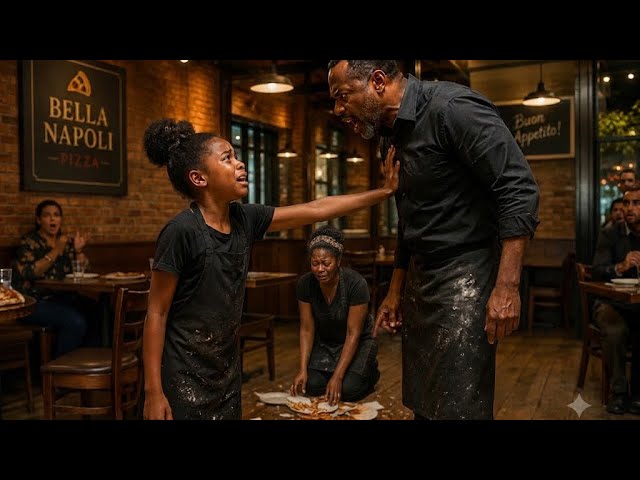
A man near the window froze with a slice of pepperoni halfway to his mouth. Two servers stopped beside the drink station. Even the cooks behind the open kitchen turned toward the dining room.
At the center of it all stood ten-year-old Zuri Bennett.
Her backpack was still hanging from one shoulder. Her school sweater was tied around her waist. One of her hands was clenched around a damp cleaning cloth.
The other was wrapped around her mother’s wrist.
Amina Bennett stood beside her in a tomato-stained uniform, breathing hard. Broken plates lay scattered across the floor near her shoes. Red sauce streaked the tiles like paint.
Victor Russo, the owner of Bella Napoli, towered over her.
His face was red.
His finger was inches from Amina’s face.
“I asked you a question,” he snapped. “Are you too stupid to carry three plates now?”
Amina lowered her eyes.
“I’m sorry, Mr. Russo. A customer moved his chair, and I—”
“I don’t care what happened.”
Victor kicked a broken piece of ceramic aside.
“You break it, you pay for it. I’ll take it out of your wages.”
Amina’s lips parted, but no words came out.
Zuri stepped in front of her.
“My mother didn’t do it on purpose.”
Victor looked down at the child as if he had just noticed an insect on the floor.
“This is a workplace,” he said. “Children should be quiet.”
Zuri’s chin trembled.
But she did not move.
“My mother works harder than everybody here.”
The silence inside Bella Napoli deepened.
Amina reached for her daughter’s shoulder.
“Zuri, please.”
“No, Mama.”
The words came out small, but firm.
“He always talks to you like this. He makes you stay late. He makes you clean things that aren’t your job. And then he says he won’t pay you if you complain.”
Victor’s expression changed.
Not much.
Just enough.
The anger remained, but something colder moved underneath it.
Fear.
At a corner table, a well-dressed man in a charcoal suit slowly placed his glass of water down.
His name was Malik Carter.
No one in the restaurant knew that yet.
To Victor, he was simply another customer with expensive shoes and a quiet manner. To the staff, he was the stranger who had been sitting alone for nearly an hour, watching more than he ate.
But Malik had noticed Zuri the moment she entered the restaurant after school.
She had not gone to a booth to do homework.
She had tied on a faded apron.
Then she had wiped tables, stacked menus, gathered dirty glasses, and moved chairs back into place.
At first, Malik assumed she was the owner’s daughter.
Then he watched her carry an overflowing bus tub toward the kitchen while Victor walked past without helping.
A few minutes later, he had gently asked, “Do you work here?”
Zuri had glanced toward her mother before answering.
“I just help.”
“Every day?”
She nodded.
“My mom gets tired.”
Malik studied the dark circles beneath her eyes.
“You should be doing homework.”
“I do it when we get home.”
“What time is that?”
Zuri looked down at the cloth in her hand.
“Sometimes eleven.”
Malik’s expression tightened.
“Why does your mother need you to help this much?”
The child hesitated, then whispered, “Because if she loses this job, we lose everything.”
Before Malik could ask another question, the crash of the plates had shaken the room.
Now he rose from his table.
“It was clearly an accident,” he said.
Victor turned toward him.
“This doesn’t concern you.”
“You are humiliating an employee in front of customers.”
Victor gave a dry laugh.
“You eat your pizza. I’ll manage my staff.”
Malik remained calm.
“That doesn’t look like management.”
A few customers lowered their eyes to hide their reactions.
Victor took one step closer.
“You don’t know what you’re talking about.”
“No,” Malik said. “But I’m beginning to understand.”
Victor’s jaw tightened.
Amina quickly crouched to gather the broken plates.
“I’ll clean it up,” she said. “Please, Mr. Russo. It won’t happen again.”
Zuri knelt beside her.
Her eyes were wet now.
“My mom has worked here for six months,” she said. “She never missed one day. Not even when she was sick.”
Victor’s face lost color.
“Zuri,” Amina whispered.
But the girl had already crossed the line Victor had spent months guarding.
“She worked when you said you couldn’t put her on the schedule. She worked after the restaurant closed. She worked on Sundays, even though you told people she didn’t.”
One of the servers near the kitchen muttered, “He’s scared they’ll find out.”
Victor spun around.
“What did you say?”
The server looked at the floor.
Nothing moved in the room except the ceiling fans.
Then Victor pointed at Amina.
“Take your daughter and get back to work. One more scene like this and you’re finished.”
Amina flinched.
Zuri gripped her hand tighter.
Malik watched Victor’s face carefully.
He had seen arrogance before.
He had seen cruel managers, dishonest owners, and men who confused fear with loyalty.
But this was different.
Victor was not merely protecting his pride.
He was protecting a secret.
Malik returned to Bella Napoli the next morning.
Amina had barely slept.
Victor’s threat had followed her home and sat beside her through the night.
One more scene and you’re finished.
For Amina, losing the job did not mean searching calmly for another one. It meant a late rent payment. It meant a possible eviction notice. It meant deciding whether groceries or electricity came first.
She had already hidden two past-due envelopes from Zuri.
That morning, Zuri walked beside her in silence.
The child tried to look brave, but she kept glancing up at her mother as if checking that she was still there.
When they entered the restaurant, Victor stood near the register.
He smiled.
It was the first time Amina had seen him smile at her in weeks.
“You’re early,” he said.
The friendliness in his voice felt more dangerous than shouting.
Then Malik entered behind them.
Victor’s smile widened.
“Sir. Back again?”
“The food was memorable.”
Victor laughed as if it were a compliment.
Malik chose a table near the kitchen.
During the next three hours, he spoke casually with almost everyone.
He asked a delivery driver how often Victor delayed payments.
He asked a cook why the kitchen was short-staffed on weekends.
He asked a server how shift schedules were recorded.
He asked a supplier whether Bella Napoli’s accounts were current.
No conversation lasted long.
No question sounded aggressive.
But Victor noticed every one.
Finally, he approached Malik’s table.
“You seem very interested in my business.”
Malik folded his napkin beside his plate.
“I am.”
Victor pulled out the opposite chair without being invited.
“What kind of work do you do?”
“I evaluate restaurants.”
Victor’s posture changed.
“For reviews?”
“For investment.”
The word transformed him.
Within seconds, the suspicious owner disappeared. In his place sat a charming businessman with polished gestures and rehearsed confidence.
“Well,” Victor said, lowering his voice, “Bella Napoli has enormous potential.”
“I can see that.”
“We’re one of the oldest family restaurants in the neighborhood.”
“How long has it been in your family?”
Victor hesitated.
“Almost thirty years.”
Malik already knew the truth.
Victor had bought the business four years earlier.
But he simply nodded.
Victor leaned forward.
“With the right capital, I could open three more locations. Maybe five.”
“And your staff?”
“The best in the city.”
Amina passed carrying a tray loaded with drinks.
Victor smiled at her.
“Amina, take your time. Safety first.”
Amina nearly stopped walking.
It was the first polite sentence he had spoken to her all morning.
Malik noticed.
So did every employee in the room.
For the rest of the day, Victor performed kindness like an actor who had forgotten his lines.
He thanked customers too loudly.
He asked employees whether they needed breaks.
He carried one plate to a table, then glanced at Malik to make sure he had seen it.
But beneath the performance, panic was spreading.
By late afternoon, Malik had enough.
More than enough.
He had photographs of handwritten schedules showing employees working hours that never appeared on payroll records.
He had copies of wage statements with unexplained deductions.
He had messages in which Victor threatened to report workers to immigration authorities if they complained, even when those workers had legal status.
He had testimony from a former cook who had been fired after asking for overtime pay.
And he had one document Victor did not know existed.
At seven-thirty that evening, Bella Napoli was full.
Victor moved confidently through the dining room, convinced he was about to receive the investment that would make him rich.
Malik stood near the center of the restaurant.
He tapped a spoon gently against his glass.
“May I have everyone’s attention?”
Conversations faded.
Victor stepped beside him, smiling broadly.
“My friend here has an announcement,” he said. “A very exciting one.”
Malik looked around the room.
He saw Amina near the kitchen entrance.
Zuri sat at an empty back table with a math workbook open in front of her.
The same cloth from the previous night was beside her.
“My name is Malik Carter,” he began. “I am the managing director of Carter Hospitality Group.”
A murmur moved through the room.
Carter Hospitality owned and operated dozens of restaurants across several states. Its newest properties had been featured in business magazines and local news reports.
Victor’s smile became almost radiant.
Malik continued.
“Mr. Russo believes I came here to consider investing in Bella Napoli.”
Victor spread his hands as if welcoming applause.
“He is partly correct.”
Malik paused.
“I came here because my company has been trying to understand why this restaurant has failed three separate labor compliance reviews in the past eighteen months.”
Victor’s smile vanished.
No one spoke.
Malik opened a folder.
“Our preliminary review found unpaid wages, unrecorded overtime, illegal payroll deductions, manipulated time sheets, and repeated intimidation of employees.”
Victor’s face hardened.
“That is ridiculous.”
Malik lifted one document.
“This is a work schedule from last month. It shows Amina working sixty-two hours in one week.”
He lifted another.
“This is her wage statement for the same period. She was paid for thirty-eight.”
Amina stared at him.
Victor looked toward her.
“You gave him records?”
“No,” Malik said. “Your employees did not need to give me anything.”
He placed the pages on a nearby table.
“Your own bookkeeping service did.”
The color drained from Victor’s face.
Malik turned toward the room.
“Mr. Russo has also been deducting the cost of broken dishes, customer complaints, uniforms, and alleged food waste from employee paychecks.”
A cook near the kitchen raised his hand.
“He charged me for a refrigerator repair.”
A waitress spoke next.
“He took two hundred dollars from my pay because a table left without paying.”
Another employee stepped forward.
“He made us clock out before cleaning.”
The accusations came slowly at first.
Then all at once.
“He changed my hours.”
“He threatened my brother.”
“He refused to give me my final paycheck.”
“He said nobody would believe us.”
Victor raised both hands.
“They’re lying. Every one of them. They’re angry employees trying to destroy me.”
But the room no longer belonged to him.
The fear that had kept the staff quiet was gone.
Customers turned in their seats to face him.
A man near the window began recording on his phone.
Victor saw the camera.
Then he saw Amina.
Then he saw Zuri.
For a moment, his eyes moved toward the child who had shouted at him the night before.
And something shifted in his face.
His mouth opened, but no words came.
His shoulders dropped.
The confidence he had worn like armor seemed to collapse all at once.
He finally understood.
The little girl had not ruined him.
His own records had.
Malik closed the folder.
“Carter Hospitality Group will not invest in Bella Napoli.”
Victor swallowed.
“You can’t come into my restaurant and do this.”
Malik looked at him steadily.
“This is not your restaurant.”
The sentence landed harder than any accusation before it.
Victor blinked.
Malik reached into his jacket and removed another document.
“Three months ago, your landlord began foreclosure proceedings after you failed to make payments on the commercial loan tied to this property.”
Victor’s eyes widened.
“You don’t know anything about that.”
“I know the building was sold this morning.”
Malik placed the document on the table.
“To Carter Hospitality Group.”
A gasp moved across the dining room.
Victor stared at the paper.
His hands remained at his sides, but his fingers curled inward.
Malik had not come to Bella Napoli by accident.
His company had been evaluating the property for weeks. The financial records had already raised concerns. What he witnessed between Victor, Amina, and Zuri had only revealed how deep the abuse went.
“You…” Victor whispered.
Malik’s voice remained quiet.
“Your lease is terminated for fraud, nonpayment, and violations that place this property at legal risk. You are no longer authorized to operate here.”
Victor’s knees seemed to weaken.
For the first time since Amina had known him, he had nothing to threaten anyone with.
No schedule.
No paycheck.
No job to take away.
Two representatives from Carter Hospitality entered from the front lobby. Behind them stood an attorney and a labor investigator who had been waiting outside.
Victor looked around for support.
Not one employee met his eyes.
Not one customer defended him.
The only sound in the room was the low hum of the pizza ovens.
Then Malik turned to Amina.
She stiffened.
After six months of being called careless, slow, replaceable, and ungrateful, she expected another judgment.
Instead, Malik placed a small set of keys in her hand.
Amina stared at them.
“What is this?”
“The keys to this building.”
Victor looked up sharply.
Malik continued.
“Carter Hospitality is reopening this location under new management.”
Amina shook her head.
“I don’t understand.”
“I watched you last night,” Malik said. “And again today. You were serving tables, solving kitchen problems, calming customers, training new staff, and protecting your coworkers.”
Amina glanced around the room.
Several employees were crying.
“You have already been managing this restaurant,” Malik said. “You were simply never given the title, the pay, or the respect.”
Amina’s hand trembled around the keys.
“I don’t have money to invest.”
“You do not need to.”
Malik nodded toward the staff.
“You need a team you trust, the courage to lead it, and the willingness to run this place differently.”
He held out a contract.
“Carter Hospitality will fund the renovation and retain ownership of the property. You will receive a salary, profit participation, and full authority over hiring and operations. After three years, you will have the option to acquire an ownership stake.”
Amina covered her mouth.
Victor stared at her as if he no longer recognized the woman he had ordered around for months.
That was the moment the truth finally reached him.
The employee he had treated as disposable was about to replace him.
The child he had told to remain quiet was standing beside the next owner of his restaurant.
Zuri ran across the room and wrapped both arms around her mother.
Amina bent down and held her.
For several seconds, neither of them spoke.
Then the applause began.
One table.
Then another.
Within moments, the entire pizzeria was on its feet.
Three months later, the old Bella Napoli sign was gone.
In its place hung a new one:
AMINA’S PIZZA HOUSE.
On opening weekend, the line reached the end of the block.
The same cooks returned. So did most of the servers. Their schedules were posted clearly. Overtime was paid. Breaks were mandatory. Every employee received written wage statements that made sense.
Amina no longer rushed through the dining room with fear in her eyes.
She moved with purpose.
She listened.
She delegated.
She thanked people.
And when a young server dropped a tray on the second night, the entire room went quiet out of habit.
Amina walked over, helped her pick up the broken dishes, and said, “Are you hurt?”
The server shook her head.
“Then we’re fine. Plates can be replaced.”
From a booth near the window, Malik watched without saying a word.
At the back table, Zuri was no longer wiping tables or collecting glasses.
She was doing her homework.
Her backpack sat beside her. A slice of pizza rested on a plate. Amina passed by, kissed the top of her head, and returned to the kitchen.
Zuri smiled and kept writing.
The greatest gift Malik gave them was not a restaurant.
It was the moment a frightened child realized her mother could no longer be controlled by someone else’s cruelty.
Because sometimes justice does not arrive with shouting or revenge.
Sometimes it arrives quietly, carrying a folder of evidence and a set of keys—and hands the future to the person who was told she deserved nothing.