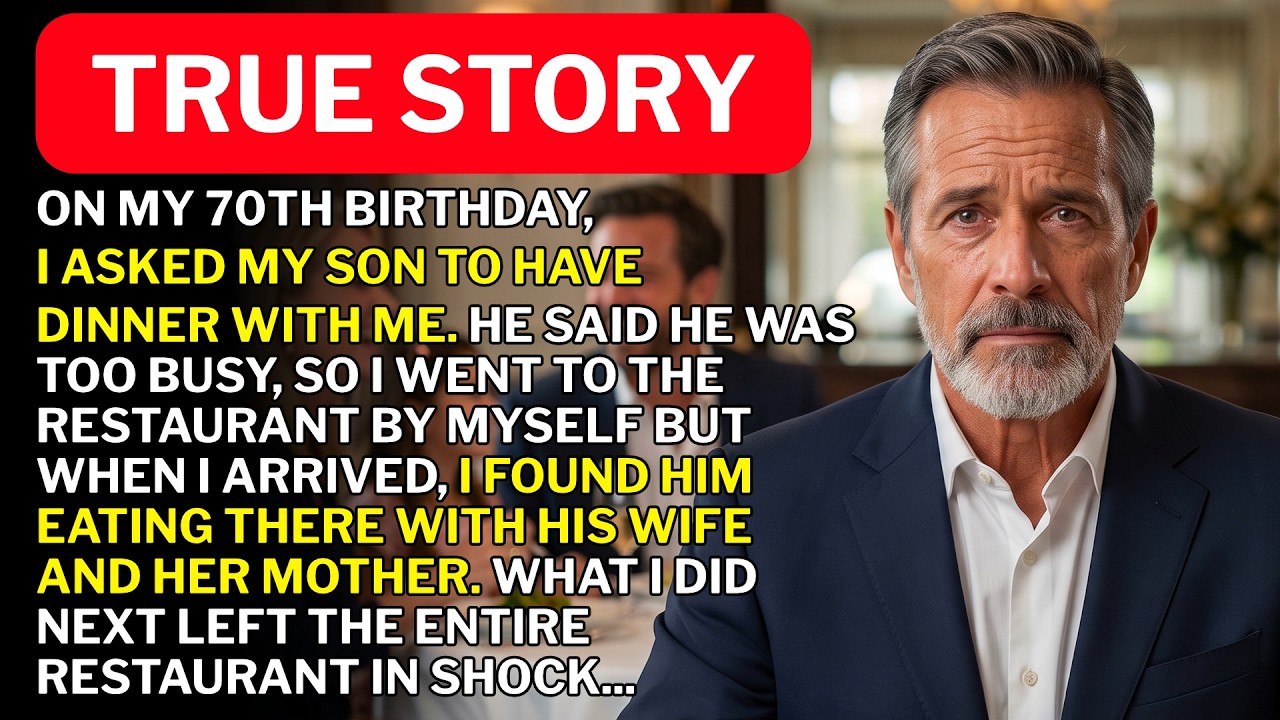
On my 62nd birthday, my son told me he was too exhausted to have dinner with me.
“Mom, I’m really sorry,” Daniel said over the phone. His voice sounded flat, rehearsed. “Work has been brutal. Maybe this weekend?”
I was standing in my kitchen with two candles already stuck into a small lemon cake I had baked that morning. Not a big cake. Not the kind you buy for a party. Just the kind a woman makes when she knows no one else is planning one, but still wants the house to smell like something warm.
I looked at the two plates on the dining table.
One for me.
One for him.
“That’s okay, sweetheart,” I said. “Rest.”
There was a small pause. In that pause, I heard him breathing, and behind him, faintly, the sound of a woman laughing.
Then he said, “Thanks for understanding, Mom,” and hung up.
I stood there for a while with the phone in my hand.
Daniel was my only child. His father died when he was sixteen, and from that day on, it was just the two of us. I worked double shifts at the hospital laundry so he could stay in his private school. I sold my wedding necklace to help with his college deposit. When he got his first job, I ironed his shirts at 5 a.m. before my own shift because he had said, half-asleep, “Mom, I need to look sharp today.”
He did look sharp.
He became a senior project manager at a construction firm downtown. Married well, too. His wife, Vanessa, came from a family that knew which fork to use at dinners where the bread cost more than my weekly groceries. Her mother, Gloria Whitman, introduced herself to me at their engagement party by looking around my small rented hall and saying, “How charming. Very… modest.”
I smiled because it was my son’s night.
That became my habit.
Smiling.
When Vanessa corrected the way I pronounced “quinoa,” I smiled. When Gloria told Daniel that “some mothers don’t know when to let their sons become men,” I smiled. When my invitations to Sunday lunch slowly turned into excuses, and excuses turned into silence, I smiled.
Because mothers learn to survive on crumbs, as long as those crumbs come from their children.
That evening, after Daniel canceled, I blew out the candles without lighting them. It felt less embarrassing that way.
I wrapped half the lemon cake in foil, put it in the fridge, and changed out of the blue dress I had bought from the clearance rack the week before. It still had the tiny plastic tag string near the collar because my hands had been shaking too much to cut it properly.
At 7:40 p.m., my neighbor Mrs. Alvarez knocked on my door.
“Birthday girl,” she said, holding up a little gift bag. “Don’t tell me you’re staying in.”
I tried to laugh. “Daniel had to work late.”
She looked at my face, then at the untouched table behind me.
Mrs. Alvarez had known me for fourteen years. She had watched Daniel grow from a skinny teenager carrying too many textbooks into a man who drove a black SUV and no longer parked in front of my building.
She didn’t say what she was thinking.
Instead, she said, “Put your shoes on. We’re getting soup.”
I almost refused. Pride is strange. It shows up even when you are alone, even when no one has done anything kind for you all day. But she had already taken my coat from the hook.
Ten minutes later, we were in her old Toyota, driving through the soft rain toward a small Vietnamese restaurant she liked.
Then we passed The Marlowe.
It was the most expensive restaurant in our part of the city. Glass walls. Valet parking. Men in dark suits opening doors for women who stepped out of cars like they had never carried their own groceries.
I wouldn’t have looked twice.
But Mrs. Alvarez slowed at the red light.
And there, through the bright restaurant window, I saw my son.
Daniel was sitting at a round table near the center of the room, wearing the navy blazer I had bought him three Christmases ago. Vanessa sat beside him in a cream dress. Gloria Whitman sat across from him, lifting a champagne glass as if she were giving a toast.
There were flowers on the table.
A cake, too.
Not lemon.
Chocolate, with gold flakes on top.
I felt something inside me go very quiet.
Mrs. Alvarez turned her head slowly toward me. “Is that—”
“Yes,” I said.
The light turned green, but she didn’t move right away. A horn sounded behind us.
Inside the restaurant, Daniel smiled at something Gloria said. Vanessa touched his arm. Then a waiter placed a small wrapped box in front of him, and everyone clapped softly.
My birthday dinner.
He had refused dinner with me on my birthday because he was “too exhausted.”
But there he was.
Dining with his wife and mother-in-law.
Laughing.
Celebrating.
The horn behind us blared again, and Mrs. Alvarez drove forward. She didn’t speak for nearly a block.
Finally, she said, “Do you want to go home?”
I looked down at my hands. They were folded neatly in my lap, the way I used to fold them in church when I was trying not to cry.
“No,” I said.
My voice surprised me. It was calm.
“Take me there.”
Mrs. Alvarez glanced at me. “To The Marlowe?”
“Yes.”
“Are you sure?”
I looked out the windshield at the rain sliding across the glass, bending every streetlight into a blur.
For years, I had told myself that being quiet was the same as being kind. That swallowing disrespect was part of keeping peace. That if I made no demands, Daniel would eventually remember me on his own.
But that night, watching him through that window, I understood something with a clarity that almost hurt.
He had not forgotten me.
He had chosen.
Mrs. Alvarez pulled up near the valet stand. The young man in the black coat opened my door and gave me the practiced smile reserved for people he assumed belonged there.
I stepped out in my old brown shoes, my clearance-rack dress under a faded coat, and walked toward the glowing entrance.
Through the glass, Gloria Whitman raised her champagne glass again.
And this time, Daniel saw me.
His smile disappeared before I even reached the door.
[Confirm to continue Part 2]